
Python
W kategorii Python zostały zebrane podręczniki poruszające tematykę programowania z zastosowaniem praktycznie niezależnego sprzętowo, dostępnego na licencji Open Source języka. Książki przedstawią Wam wszechstronności i elastyczności Pythona a także różne typy tworzenia kodu poprzez programowanie strukturalne, obiektowe czy funkcjonalne.
Nauczycie się tworzyć aplikacje sieciowe o dowolnym przeznaczeniu, komunikujące się z systemami operacyjnymi, lub korzystające z baz danych. Techniki analizy składni, przetwarzanie tekstu czy rozłożenie obciążenia programu na wiele wątków i procesów przestanie być problematyczne.
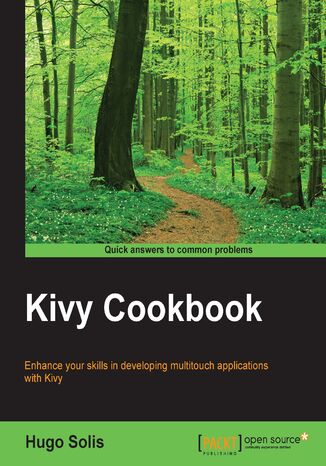
Kivy Cookbook. Enhance your skills in developing multi-touch applications with Kivy
Hugo Solis
Kivy is an open-source Python library for rapid development of applications that make use of innovative user interfaces, such as multi-touch apps. It is a promising Python framework to develop UI and UX apps in a cross-platform environment, under the Python philosophy.Kivy Cookbook is a practical book that will guide you through the Kivy framework to develop apps and get your apps ready for distribution in App Store and Android devices.You will start off with installing Kivy and building your interfaces. You will learn how to work the accelerometer and create custom events. Then, you will understand how to use the basics, buttons, labels and text inputs and manipulate the widget tree. Next, you will be able to work with manipulating instructions, create an atlas and layouts. Moving on, you will learn packing for Windows and packing for iOS, and use TestDrive.By the end of the book, you will have learnt in detail the relevant features and tools in Kivy and how to create portable packages to distribute your apps in the most used platforms.
LangChain in your Pocket. LangChain Essentials: From Basic Concepts to Advanced Applications
Mehul Gupta
LangChain in your Pocket offers a detailed exploration into the LangChain framework, designed to enhance your skills in developing sophisticated language understanding models and applications. This book begins with the basics, introducing you to the fundamental concepts of LangChain through a simple Hello World example. As you progress, you'll delve into various LangChain modules, learning how to create agents, manage memory, and utilize output parsers effectively.The journey continues as you explore the RAG Framework, vector databases, and their applications in natural language processing, providing you with the tools to tackle common NLP problems efficiently. The book also addresses critical aspects of working with large language models (LLMs), such as prompt engineering, handling hallucinations, and evaluating model outputs. Advanced topics like autonomous AI agents and the integration of LangSmith and LangServe are covered, giving you a holistic view of what you can achieve with LangChain.By the end of this book, you will not only understand the technical aspects of LangChain but also how to apply these principles in real-world scenarios, making it an essential resource for anyone looking to advance their capabilities in AI and language processing.
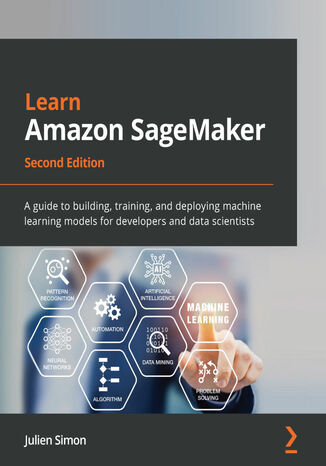
Julien Simon
Amazon SageMaker enables you to quickly build, train, and deploy machine learning models at scale without managing any infrastructure. It helps you focus on the machine learning problem at hand and deploy high-quality models by eliminating the heavy lifting typically involved in each step of the ML process. This second edition will help data scientists and ML developers to explore new features such as SageMaker Data Wrangler, Pipelines, Clarify, Feature Store, and much more.You'll start by learning how to use various capabilities of SageMaker as a single toolset to solve ML challenges and progress to cover features such as AutoML, built-in algorithms and frameworks, and writing your own code and algorithms to build ML models. The book will then show you how to integrate Amazon SageMaker with popular deep learning libraries, such as TensorFlow and PyTorch, to extend the capabilities of existing models. You'll also see how automating your workflows can help you get to production faster with minimum effort and at a lower cost. Finally, you'll explore SageMaker Debugger and SageMaker Model Monitor to detect quality issues in training and production.By the end of this Amazon book, you'll be able to use Amazon SageMaker on the full spectrum of ML workflows, from experimentation, training, and monitoring to scaling, deployment, and automation.

Learn Apache Mesos. A beginner's guide to scalable cluster management and deployment
Manuj Aggarwal
Apache Mesos is an open source cluster manager that provides efficient resource isolation and sharing across distributed applications or frameworks. This book will help you build a strong foundation of Mesos' capabilities along with practical examples to support the concepts explained throughout the book.Learn Apache Mesos dives straight into how Mesos works. You will be introduced to the distributed system and its challenges and then learn how you can use Mesos and its framework to solve data problems. You will also gain a full understanding of Mesos' internal mechanisms and get equipped to use Mesos and develop applications. Furthermore, this book lets you explore all the steps required to create highly available clusters and build your own Mesos frameworks. You will also cover application deployment and monitoring.By the end of this book, you will have learned how to use Mesos to make full use of machines and how to simplify data center maintenance.
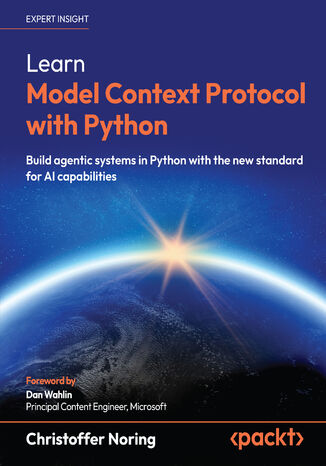
Christoffer Noring, Dan Wahlin
Learn Model Context Protocol with Python introduces developers, architects, and AI practitioners to the transformative capabilities of Model Context Protocol (MCP), an emerging protocol designed to standardize, distribute, and scale AI-driven applications. Through the lens of a practical project, the book tackles the modern challenges of resource management, client-server interaction, and deployment at scale.Drawing from Christoffer's expertise as a published author and tutor at the University of Oxford, you’ll explore the components of MCP and how they streamline server and client development. Next, you’ll progress from building robust backends and integrating LLMs into intelligent clients to interacting with servers via tools such as Claude for desktop and Visual Studio Code agents. The chapters help you understand how to describe the capabilities of hosts, clients, and servers, facilitating better interoperability, easier integration, and clearer communication between different components.The book also covers security best practices and building for the cloud, ensuring that you're ready to deploy your MCP-based apps. Each chapter enables you to develop hands-on skills for building and operating MCP-based agentic apps. The Python primer at the end rounds out the practical toolkit, making this book essential for any team building AI-native applications today.
Greg Moss
Odoo is management software that contains a set of open source enterprise management applications that help you modernize your business.Completely revised and updated, this comprehensive Odoo guide is a fourth edition of Working with Odoo. This book begins with an introduction to Odoo and helps you set up Odoo Online in your system. You'll learn how to start a new company database in Odoo and the basics of Odoo sales management. You will explore customer relationship management in Odoo and its importance in a modern business environment. Moving on, you'll learn how to install the purchasing application, set up suppliers, and begin purchasing and receiving products in Odoo. Next, you'll learn how to use the MRP module to create, process, and schedule the manufacturing and production order. Once you get to grips with the basic applications, you'll uncover how to customize Odoo to meet the specific needs of your business. You'll learn some advanced techniques for searching and finding information, and you'll be taken through business intelligence in Odoo. Towards the end of the book, you'll go in-depth into Odoo's architecture and learn to use Odoo's API to integrate with other applications. By the end of the book, you'll be ready to use Odoo to build enterprise applications and set up the functional requirements for your business.
Cody Jackson
Python is a cross-platform language used by organizations such as Google and NASA. It lets you work quickly and efficiently, allowing you to concentrate on your work rather than the language. Based on his personal experiences when learning to program, Learn Programming in Python with Cody Jackson provides a hands-on introduction to computer programming utilizing one of the most readable programming languages–Python. It aims to educate readers regarding software development as well as help experienced developers become familiar with the Python language, utilizing real-world lessons to help readers understand programming concepts quickly and easily. The book starts with the basics of programming, and describes Python syntax while developing the skills to make complete programs. In the first part of the book, readers will be going through all the concepts with short and easy-to-understand code samples that will prepare them for the comprehensive application built in parts 2 and 3. The second part of the book will explore topics such as application requirements, building the application, testing, and documentation. It is here that you will get a solid understanding of building an end-to-end application in Python. The next part will show you how to complete your applications by converting text-based simulation into an interactive, graphical user interface, using a desktop GUI framework. After reading the book, you will be confident in developing a complete application in Python, from program design to documentation to deployment.
Philipp Kats, David Katz
Python is the most widely used programming language for building data science applications. Complete with step-by-step instructions, this book contains easy-to-follow tutorials to help you learn Python and develop real-world data science projects. The “secret sauce” of the book is its curated list of topics and solutions, put together using a range of real-world projects, covering initial data collection, data analysis, and production.This Python book starts by taking you through the basics of programming, right from variables and data types to classes and functions. You’ll learn how to write idiomatic code and test and debug it, and discover how you can create packages or use the range of built-in ones. You’ll also be introduced to the extensive ecosystem of Python data science packages, including NumPy, Pandas, scikit-learn, Altair, and Datashader. Furthermore, you’ll be able to perform data analysis, train models, and interpret and communicate the results. Finally, you’ll get to grips with structuring and scheduling scripts using Luigi and sharing your machine learning models with the world as a microservice.By the end of the book, you’ll have learned not only how to implement Python in data science projects, but also how to maintain and design them to meet high programming standards.