
Python
W kategorii Python zostały zebrane podręczniki poruszające tematykę programowania z zastosowaniem praktycznie niezależnego sprzętowo, dostępnego na licencji Open Source języka. Książki przedstawią Wam wszechstronności i elastyczności Pythona a także różne typy tworzenia kodu poprzez programowanie strukturalne, obiektowe czy funkcjonalne.
Nauczycie się tworzyć aplikacje sieciowe o dowolnym przeznaczeniu, komunikujące się z systemami operacyjnymi, lub korzystające z baz danych. Techniki analizy składni, przetwarzanie tekstu czy rozłożenie obciążenia programu na wiele wątków i procesów przestanie być problematyczne.
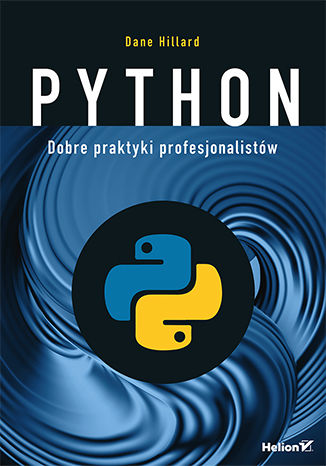
Python. Dobre praktyki profesjonalistów
Dane Hillard
Python wydaje się językiem idealnym: ma intuicyjną składnię, jest przyjemny w używaniu, umożliwia tworzenie wydajnego, elastycznego kodu. Przy tym jest wyjątkowo wszechstronny, a stosowanie go w przeróżnych celach ułatwiają liczne biblioteki tworzone przez pasjonatów. To jednak nie zmienia faktu, że aby stać się profesjonalnym programistą Pythona, trzeba nauczyć się tworzyć kod godny profesjonalisty: działający bez błędów, czysty, czytelny i łatwy w utrzymaniu. W tym celu trzeba korzystać z branżowych standardów, które określają styl kodowania, projektowania aplikacji i prowadzenie całego procesu programowania. Należy wiedzieć, kiedy i w jaki sposób modularyzować kod, jak poprawić jakość przez zmniejszenie złożoności i stosować kilka innych, koniecznych praktyk. Ta książka okaże się szczególnie cenna dla każdego, kto zamierza profesjonalnie tworzyć kod w Pythonie. Stanowi jasny i zrozumiały zbiór zasad wytwarzania oprogramowania o najwyższej jakości, praktyk stosowanych przez zawodowych wyjadaczy projektowania i kodowania. Poza teoretycznym omówieniem poszczególnych zagadnień znalazło się tu mnóstwo przykładów i przydatnych ćwiczeń, utrwalających prezentowany materiał. Nie zabrakło krótkiego wprowadzenia do Pythona, przedstawiono też sporo informacji o strukturach danych i różnych podejściach w kontekście osiągania dobrej wydajności kodu. Pokazano, w jaki sposób zapobiegać nadmiernemu przyrostowi kodu podczas rozwijania aplikacji i jak redukować niepożądane powiązania w aplikacji. Dodatkową wartością publikacji jest bogactwo informacji o ogólnej architekturze oprogramowania, przydatnych każdemu zawodowemu programiście. W książce między innymi: podstawy projektowania w Pythonie wysokopoziomowe koncepcje rozwoju oprogramowania abstrakcje i hermetyzacja kodu różne metody testowania kodu tworzenie dużych systemów a rozszerzalność i elastyczność aplikacji Pythona praktykuj profesjonalnie!
Steven F. Lott
This book is designed for Python 2 developers who want to get to grips with Python 3 in a short period of time. It covers the key features of Python, assuming you are familiar with the fundamentals of Python 2.
Fahad Ali Sarwar
Penetration testing enables you to evaluate the security or strength of a computer system, network, or web application that an attacker can exploit. With this book, you'll understand why Python is one of the fastest-growing programming languages for penetration testing. You'll find out how to harness the power of Python and pentesting to enhance your system security.Developers working with Python will be able to put their knowledge and experience to work with this practical guide. Complete with step-by-step explanations of essential concepts and practical examples, this book takes a hands-on approach to help you build your own pentesting tools for testing the security level of systems and networks. You'll learn how to develop your own ethical hacking tools using Python and explore hacking techniques to exploit vulnerabilities in networks and systems. Finally, you'll be able to get remote access to target systems and networks using the tools you develop and modify as per your own requirements.By the end of this ethical hacking book, you'll have developed the skills needed for building cybersecurity tools and learned how to secure your systems by thinking like a hacker.
Soledad Galli, Christoph Molnar
Streamline data preprocessing and feature engineering in your machine learning project with this third edition of the Python Feature Engineering Cookbook to make your data preparation more efficient.This guide addresses common challenges, such as imputing missing values and encoding categorical variables using practical solutions and open source Python libraries. You’ll learn advanced techniques for transforming numerical variables, discretizing variables, and dealing with outliers. Each chapter offers step-by-step instructions and real-world examples, helping you understand when and how to apply various transformations for well-prepared data.The book explores feature extraction from complex data types such as dates, times, and text. You’ll see how to create new features through mathematical operations and decision trees and use advanced tools like Featuretools and tsfresh to extract features from relational data and time series.By the end, you’ll be ready to build reproducible feature engineering pipelines that can be easily deployed into production, optimizing data preprocessing workflows and enhancing machine learning model performance.
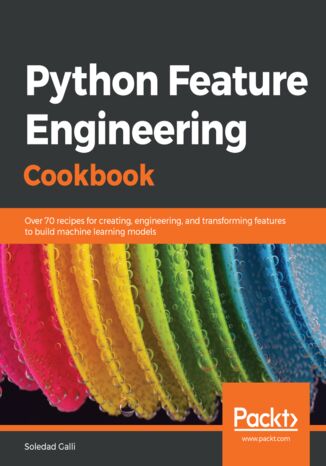
Soledad Galli
Feature engineering is invaluable for developing and enriching your machine learning models. In this cookbook, you will work with the best tools to streamline your feature engineering pipelines and techniques and simplify and improve the quality of your code.Using Python libraries such as pandas, scikit-learn, Featuretools, and Feature-engine, you’ll learn how to work with both continuous and discrete datasets and be able to transform features from unstructured datasets. You will develop the skills necessary to select the best features as well as the most suitable extraction techniques. This book will cover Python recipes that will help you automate feature engineering to simplify complex processes. You’ll also get to grips with different feature engineering strategies, such as the box-cox transform, power transform, and log transform across machine learning, reinforcement learning, and natural language processing (NLP) domains.By the end of this book, you’ll have discovered tips and practical solutions to all of your feature engineering problems.
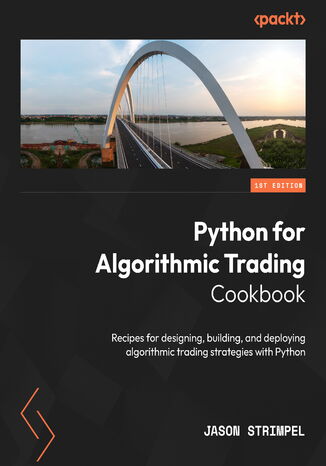
Jason Strimpel
Discover how Python has made algorithmic trading accessible to non-professionals with unparalleled expertise and practical insights from Jason Strimpel, founder of PyQuant News and a seasoned professional with global experience in trading and risk management. This book guides you through from the basics of quantitative finance and data acquisition to advanced stages of backtesting and live trading.Detailed recipes will help you leverage the cutting-edge OpenBB SDK to gather freely available data for stocks, options, and futures, and build your own research environment using lightning-fast storage techniques like SQLite, HDF5, and ArcticDB. This book shows you how to use SciPy and statsmodels to identify alpha factors and hedge risk, and construct momentum and mean-reversion factors. You’ll optimize strategy parameters with walk-forward optimization using VectorBT and construct a production-ready backtest using Zipline Reloaded. Implementing all that you’ve learned, you’ll set up and deploy your algorithmic trading strategies in a live trading environment using the Interactive Brokers API, allowing you to stream tick-level data, submit orders, and retrieve portfolio details.By the end of this algorithmic trading book, you'll not only have grasped the essential concepts but also the practical skills needed to implement and execute sophisticated trading strategies using Python.
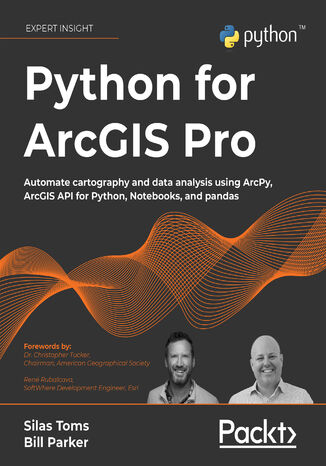
Silas Toms, William Parker
Integrating Python into your day-to-day ArcGIS work is highly recommended when dealing with large amounts of geospatial data. Python for ArcGIS Pro aims to help you get your work done faster, with greater repeatability and higher confidence in your results.Starting from programming basics and building in complexity, two experienced ArcGIS professionals-turned-Python programmers teach you how to incorporate scripting at each step: automating the production of maps for print, managing data between ArcGIS Pro and ArcGIS Online, creating custom script tools for sharing, and then running data analysis and visualization on top of the ArcGIS geospatial library, all using Python.You’ll use ArcGIS Pro Notebooks to explore and analyze geospatial data, and write data engineering scripts to manage ongoing data processing and data transfers. This exercise-based book also includes three rich real-world case studies, giving you an opportunity to apply and extend the concepts you studied earlier.Irrespective of your expertise level with Esri software or the Python language, you’ll benefit from this book’s hands-on approach, which takes you through the major uses of Python for ArcGIS Pro to boost your ArcGIS productivity.
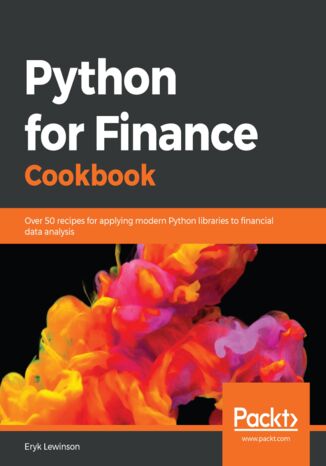
Eryk Lewinson
Python is one of the most popular programming languages used in the financial industry, with a huge set of accompanying libraries. In this book, you'll cover different ways of downloading financial data and preparing it for modeling. You'll calculate popular indicators used in technical analysis, such as Bollinger Bands, MACD, RSI, and backtest automatic trading strategies. Next, you'll cover time series analysis and models, such as exponential smoothing, ARIMA, and GARCH (including multivariate specifications), before exploring the popular CAPM and the Fama-French three-factor model. You'll then discover how to optimize asset allocation and use Monte Carlo simulations for tasks such as calculating the price of American options and estimating the Value at Risk (VaR). In later chapters, you'll work through an entire data science project in the financial domain. You'll also learn how to solve the credit card fraud and default problems using advanced classifiers such as random forest, XGBoost, LightGBM, and stacked models. You'll then be able to tune the hyperparameters of the models and handle class imbalance. Finally, you'll focus on learning how to use deep learning (PyTorch) for approaching financial tasks.By the end of this book, you’ll have learned how to effectively analyze financial data using a recipe-based approach.