
Matematyka

Analiza matematyczna dla ekonomicznych kierunków studiów
Dorota Pekasiewicz, Krystyna Pruska
Podręcznik akademicki zawiera rozważania teoretyczne, przykłady o charakterze matematycznym i ekonomicznym oraz zadania do samodzielnego rozwiązania. Przeznaczony jest dla studentów z różnych kierunków ekonomicznych i o różnym stopniu zaawansowania wymagań matematycznych. Zagadnienia wstępne zawierają elementy logiki, teorii mnogości i topologii. Przedstawione są tu także zbiory liczb rzeczywistych i zespolonych oraz relacje. W kolejnych rozdziałach zaprezentowane są ciągi liczb rzeczywistych i punktów z wielowymiarowych przestrzeni rzeczywistych, rzeczywiste funkcje jednej i wielu zmiennych oraz rachunek różniczkowy w tym zakresie, ciągi funkcji rzeczywistych, szeregi liczb rzeczywistych i funkcji rzeczywistych oraz rachunek całkowy rzeczywistych funkcji jednej i wielu zmiennych. W podręczniku zaprezentowane są również równania różniczkowe zwyczajne i metody ich rozwiązywania oraz elementy równań różnicowych.
Analytic and Algebraic Geometry 2
Tadeusz Krasiński, Stanisław Spodzieja
The volume is dedicated to three mathematicians celebrating in 2017 the jubilees of 70th and 60th birth anniversaries: Arkadiusz Ptoski, Kamil Rusek and Krzysztof Kurdyka. They all have contributed significantly to the success of the annual conferences Analytic and Algebraic Geometry since 1983 till now.
Annales Mathematicae Silesianae. T. 22 (2008)
Komitet Redakcyjny
Na treść niniejszego tomu składa się między innymi rozwiązanie równania funkcyjnego pochodzącego od reguły kwadraturowej Gaussa. Jest to najprostsza reguła kwadraturowa zawierająca niewymierne współczynniki węzłów. Równania z tego typu współczynnikami nie były dotąd rozważane, a są to istotne zagadnienia, pozwalają bowiem charakteryzować wielomiany wysokiego stopnia z użyciem małej liczby punktów pośrednich.
Annales Mathematicae Silesianae. T. 23 (2009)
Komitet Redakcyjny
Kolejny tom otwiera wspomnienie o zmarłym w grudniu 2006 r. matematyku Profesorze Andrzeju Lasocie, który był nie tylko wybitnym uczonym, ale także znakomitym wykładowcą, wychowawcą wielu pokoleń polskich matematyków. W tomie zamieszczono ponadto zarówno artykuły zawierające nowe wyniki z analizy matematycznej i algebry, jak i sprawozdania z konferencji i sympozjów naukowych.
David S. Jordan
Data scientists, when presented with a myriad of data, can often lose sight of how to present geospatial analyses in a meaningful way so that it makes sense to everyone. Using Python to visualize data helps stakeholders in less technical roles to understand the problem and seek solutions. The goal of this book is to help data scientists and GIS professionals learn and implement geospatial data science workflows using Python.Throughout this book, you’ll uncover numerous geospatial Python libraries with which you can develop end-to-end spatial data science workflows. You’ll learn how to read, process, and manipulate spatial data effectively. With data in hand, you’ll move on to crafting spatial data visualizations to better understand and tell the story of your data through static and dynamic mapping applications. As you progress through the book, you’ll find yourself developing geospatial AI and ML models focused on clustering, regression, and optimization. The use cases can be leveraged as building blocks for more advanced work in a variety of industries.By the end of the book, you’ll be able to tackle random data, find meaningful correlations, and make geospatial data models.
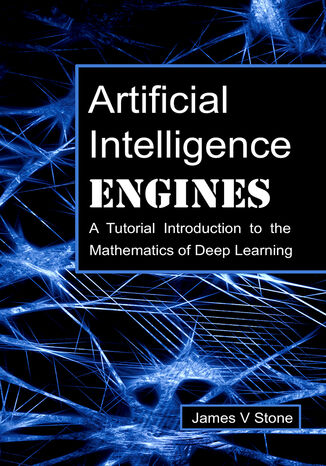
Artificial Intelligence Engines. A Tutorial Introduction to the Mathematics of Deep Learning
James V Stone
This book is a comprehensive guide to the mathematics behind artificial intelligence engines, taking readers from foundational concepts to advanced applications. It begins with an introduction to artificial neural networks, exploring topics like perceptrons, linear associative networks, and gradient descent. Practical examples accompany each chapter, making complex mathematical principles accessible, even for those with limited prior knowledge.The book's detailed structure covers key algorithms like backpropagation, Hopfield networks, and Boltzmann machines, advancing to deep restricted Boltzmann machines, variational autoencoders, and convolutional neural networks. Modern topics such as generative adversarial networks, reinforcement learning, and capsule networks are explored in depth. Each section connects theory to real-world AI applications, helping readers understand how these techniques are used in practice.Ideal for students, researchers, and AI enthusiasts, the book balances theoretical depth with practical insights. Basic mathematical knowledge or foundation is recommended, allowing readers to fully engage with the content. This book serves as an accessible yet thorough resource for anyone eager to dive deeper into artificial intelligence and machine learning.
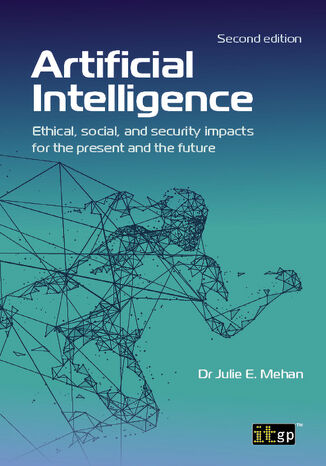
Artificial Intelligence. Ethical, social, and security impacts for the present and the future
IT Governance Publishing, Dr. Julie E. Mehan
This book offers an in-depth exploration of Artificial Intelligence (AI), from its origins to the ethical and societal challenges it presents today. It provides a comprehensive understanding of AI’s impact on human interaction, collaboration, privacy, and security. Through analyzing both opportunities and risks, the book emphasizes the ethical concerns surrounding AI, such as bias, privacy violations, and security threats.Chapters explore AI’s transformative role in cybersecurity, misinformation, and human-machine collaboration, highlighting its implications for job markets and human relationships. Real-world examples illustrate how AI can drive progress or cause harm. The ethical dilemmas around AI, including its use in surveillance and decision-making, are thoroughly examined, presenting challenges central to modern technology.Looking ahead, the book offers a forward-thinking perspective on AI’s future, discussing emerging trends and the need for responsible policy-making. It concludes by addressing how society can prepare for AI’s continued growth, offering strategies for navigating the evolving landscape. With practical insights and deep analysis, this book helps readers grasp AI’s profound implications for our future.
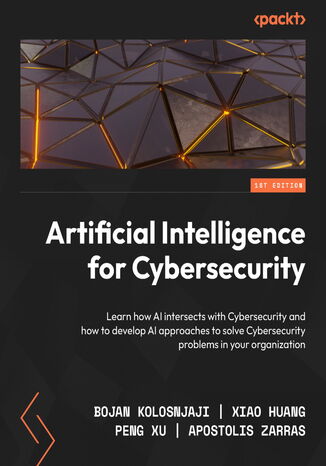
Bojan Kolosnjaji, Huang Xiao, Peng Xu, Apostolis...
Artificial intelligence offers data analytics methods that enable us to efficiently recognize patterns in large-scale data. These methods can be applied to various cybersecurity problems, from authentication and the detection of various types of cyberattacks in computer networks to the analysis of malicious executables.Written by a machine learning expert, this book introduces you to the data analytics environment in cybersecurity and shows you where AI methods will fit in your cybersecurity projects. The chapters share an in-depth explanation of the AI methods along with tools that can be used to apply these methods, as well as design and implement AI solutions. You’ll also examine various cybersecurity scenarios where AI methods are applicable, including exercises and code examples that’ll help you effectively apply AI to work on cybersecurity challenges. The book also discusses common pitfalls from real-world applications of AI in cybersecurity issues and teaches you how to tackle them.By the end of this book, you’ll be able to not only recognize where AI methods can be applied, but also design and execute efficient solutions using AI methods.*Email sign-up and proof of purchase required