
Big data
Mark Lewin, Eric Pimpler
The ArcGIS API for JavaScript enables you to quickly build web and mobile mapping applications that include sophisticated GIS capabilities, yet are easy and intuitive for the user.Aimed at both new and experienced web developers, this practical guide gives you everything you need to get started with the API. After a brief introduction to HTML/CSS/JavaScript, you'll embed maps in a web page, add the tiled, dynamic, and streaming data layers that your users will interact with, and mark up the map with graphics. You will learn how to quickly incorporate a broad range of useful user interface elements and GIS functionality to your application with minimal effort using prebuilt widgets. As the book progresses, you will discover and use the task framework to query layers with spatial and attribute criteria, search for and identify features on the map, geocode addresses, perform network analysis and routing, and add custom geoprocessing operations. Along the way, we cover exciting new features such as the client-side geometry engine, learn how to integrate content from ArcGIS.com, and use your new skills to build mobile web mapping applications.We conclude with a look at version 4 of the ArcGIS API for JavaScript (which is being developed in parallel with version 3.x) and what it means for you as a developer.
Davide Moraschi
Business intelligence is becoming more important by the day, with cloud offerings and mobile devices gaining wider acceptance and achieving better market penetration. MicroStrategy Reporting Suite is a complete business intelligence platform that covers all the data analysis needs of an enterprise. Scorecards, dashboards, and reports can be explored and delivered on desktop, the Web, mobile devices, and the Cloud. With the latest Visual Insight tool, MicroStrategy brings the power of BI to the business users, allowing them to discover information without the help of IT personnel.Business Intelligence with MicroStrategy Cookbook covers the full cycle of a BI project with the MicroStrategy platform, from setting up the software to using dashboards in the cloud and on mobile devices. This book uses step-by-step instructions to teach you everything from the very basics to the more advanced topics. We will start by downloading and installing the software and a well-known sample SQL Server database. Then, one brick at a time, we will construct a fully-featured BI solution with a web interface, mobile reporting, and agile analytics.The chapters are ordered by increasing difficulty, and each one builds on top of the preceding chapter so that the learning process is progressive. The examples given in this book are practical, and you will be able to see the immediate result of your efforts. We will first cover setting up the platform, including the creation of the metadata and the different objects that are part of a BI project: tables, attributes, and metrics. Then, we take a look at how to create and analyze reports, charts, documents, and dashboards, as well as how to manipulate data with the desktop application, the web Interface, and an iPad device.The last part of the book is dedicated to advanced topics like the new agile analytics technology from MicroStrategy, where we cover both Visual Insight and MicroStrategy Cloud Express. Whether you are a database developer, data analyst, or a business user, Business Intelligence with MicroStrategy Cookbook will get you up to speed with one of the most powerful BI platforms on the market with the smallest possible investment of time and money.
Cacti Beginner's Guide. Leverage Cacti to design a robust network operations center - Second Edition
Thomas Urban
Cacti is a performance measurement tool that provides easy methods and functions for gathering and graphing system data. You can use Cacti to develop a robust event management system that can alert on just about anything you would like it to. But to do that, you need to gain a solid understanding of the basics of Cacti, its plugin architecture, and automation concepts.Cacti Beginner's Guide will introduce you to the wide variety of features of Cacti and will guide you on how to use them for maximum effectiveness. Advanced topics such as the plugin architecture and Cacti automation using the command-line interface will help you build a professional performance measurement system. Designed as a beginner's guide, the book starts off with the basics of installing and using Cacti, and also covers the advanced topics that will show you how to customize and extend the core Cacti functionalities. The book offers essential tutorials for creating advanced graphs and using plugins to create enterprise-class reports to show your customers and colleagues. From data templates to input methods and plugin installation to creating your own customized plugins, this book provides you with a rich selection of step-by-step instructions to reach your goals. It covers all you need to know to implement professional performance measurement techniques with Cacti and ways to fully customize Cacti to fit your needs. You will also learn how to migrate Cacti to new servers. Lastly you will also be introduced to the latest feature of building a scalable remote poller environment. By the end of the book, you will be able to implement and extend Cacti to monitor, display, and report the performance of your network exactly the way you want.
David Mertz
Data cleaning is the all-important first step to successful data science, data analysis, and machine learning. If you work with any kind of data, this book is your go-to resource, arming you with the insights and heuristics experienced data scientists had to learn the hard way.In a light-hearted and engaging exploration of different tools, techniques, and datasets real and fictitious, Python veteran David Mertz teaches you the ins and outs of data preparation and the essential questions you should be asking of every piece of data you work with.Using a mixture of Python, R, and common command-line tools, Cleaning Data for Effective Data Science follows the data cleaning pipeline from start to end, focusing on helping you understand the principles underlying each step of the process. You'll look at data ingestion of a vast range of tabular, hierarchical, and other data formats, impute missing values, detect unreliable data and statistical anomalies, and generate synthetic features. The long-form exercises at the end of each chapter let you get hands-on with the skills you've acquired along the way, also providing a valuable resource for academic courses.
MrExcel's Holy Macro! Books, Oz du Soleil
This book provides a step-by-step guide to using Power Query in Excel for efficient data cleaning and transformation. Starting with an introduction to its capabilities, it explains how to import data, handle missing values, and parse text fields with ease.Advanced techniques such as merging datasets, appending data, and performing joins are explored in detail. The book also covers grouping data, creating conditional and custom columns, and reshaping data through unpivoting for analysis. Each concept is illustrated with practical examples for clarity.By the end of the book, readers will be equipped with the skills to automate repetitive tasks and streamline workflows. Whether dealing with messy data or preparing datasets for analysis, this guide ensures you can confidently tackle any Excel data transformation challenge.
Eric Richard Rochester
This book is for those with a basic knowledge of Clojure, who are looking to push the language to excel with data analysis.
Clojure for Data Science. Statistics, big data, and machine learning for Clojure programmers
Henry Garner
The term “data science” has been widely used to define this new profession that is expected to interpret vast datasets and translate them to improved decision-making and performance. Clojure is a powerful language that combines the interactivity of a scripting language with the speed of a compiled language. Together with its rich ecosystem of native libraries and an extremely simple and consistent functional approach to data manipulation, which maps closely to mathematical formula, it is an ideal, practical, and flexible language to meet a data scientist’s diverse needs.Taking you on a journey from simple summary statistics to sophisticated machine learning algorithms, this book shows how the Clojure programming language can be used to derive insights from data. Data scientists often forge a novel path, and you’ll see how to make use of Clojure’s Java interoperability capabilities to access libraries such as Mahout and Mllib for which Clojure wrappers don’t yet exist. Even seasoned Clojure developers will develop a deeper appreciation for their language’s flexibility!You’ll learn how to apply statistical thinking to your own data and use Clojure to explore, analyze, and visualize it in a technically and statistically robust way. You can also use Incanter for local data processing and ClojureScript to present interactive visualisations and understand how distributed platforms such as Hadoop sand Spark’s MapReduce and GraphX’s BSP solve the challenges of data analysis at scale, and how to explain algorithms using those programming models.Above all, by following the explanations in this book, you’ll learn not just how to be effective using the current state-of-the-art methods in data science, but why such methods work so that you can continue to be productive as the field evolves into the future.
Sanket Thodge
With the ongoing data explosion, more and more organizations all over the world are slowly migrating their infrastructure to the cloud. These cloud platforms also provide their distinct analytics services to help you get faster insights from your data. This book will give you an introduction to the concept of analytics on the cloud, and the different cloud services popularly used for processing and analyzing data. If you’re planning to adopt the cloud analytics model for your business, this book will help you understand the design and business considerations to be kept in mind, and choose the best tools and alternatives for analytics, based on your requirements. The chapters in this book will take you through the 70+ services available in Google Cloud Platform and their implementation for practical purposes. From ingestion to processing your data, this book contains best practices on building an end-to-end analytics pipeline on the cloud by leveraging popular concepts such as machine learning and deep learning.By the end of this book, you will have a better understanding of cloud analytics as a concept as well as a practical know-how of its implementation
Kathrin Melcher, Rosaria Silipo
KNIME Analytics Platform is an open source software used to create and design data science workflows. This book is a comprehensive guide to the KNIME GUI and KNIME deep learning integration, helping you build neural network models without writing any code. It’ll guide you in building simple and complex neural networks through practical and creative solutions for solving real-world data problems.Starting with an introduction to KNIME Analytics Platform, you’ll get an overview of simple feed-forward networks for solving simple classification problems on relatively small datasets. You’ll then move on to build, train, test, and deploy more complex networks, such as autoencoders, recurrent neural networks (RNNs), long short-term memory (LSTM), and convolutional neural networks (CNNs). In each chapter, depending on the network and use case, you’ll learn how to prepare data, encode incoming data, and apply best practices.By the end of this book, you’ll have learned how to design a variety of different neural architectures and will be able to train, test, and deploy the final network.
Cameron Dodd
The CompTIA Data+ certification exam not only helps validate a skill set required to enter one of the fastest-growing fields in the world, but also is starting to standardize the language and concepts within the field. However, there’s a lot of conflicting information and a lack of existing resources about the topics covered in this exam, and even professionals working in data analytics may need a study guide to help them pass on their first attempt.The CompTIA Data + (DAO-001) Certification Guide will give you a solid understanding of how to prepare, analyze, and report data for better insights.You’ll get an introduction to Data+ certification exam format to begin with, and then quickly dive into preparing data. You'll learn about collecting, cleaning, and processing data along with data wrangling and manipulation. As you progress, you’ll cover data analysis topics such as types of analysis, common techniques, hypothesis techniques, and statistical analysis, before tackling data reporting, common visualizations, and data governance. All the knowledge you've gained throughout the book will be tested with the mock tests that appear in the final chapters.By the end of this book, you’ll be ready to pass the Data+ exam with confidence and take the next step in your career.
J. Ashley Hunt
The CompTIA Project+ exam is designed for IT professionals who want to improve their career trajectory by gaining certification in project management specific to their industry. This guide covers everything necessary to pass the current iteration of the Project+ PK0-004 exam.The CompTIA Project+ Certification Guide starts by covering project initiation best practices, including an understanding of organizational structures, team roles, and responsibilities. You’ll then study best practices for developing a project charter and the scope of work to produce deliverables necessary to obtain formal approval of the end result. The ability to monitor your project work and make changes as necessary to bring performance back in line with the plan is the difference between a successful and unsuccessful project. The concluding chapters of the book provide best practices to help keep an eye on your projects and close them out successfully. The guide also includes practice questions created to mirror the exam experience and help solidify your understanding of core project management concepts.By the end of this book, you will be able to develop creative solutions for complex issues faced in project management.
Ian Neil
CompTIA Security+ is a worldwide certification that establishes the fundamental knowledge required to perform core security functions and pursue an IT security career. CompTIA Security+ Certification Guide is a best-in-class exam study guide that covers all of CompTIA Security+ 501 exam objectives. It is authored by Ian Neil, who is a world-class trainer of CompTIA Security+ 501. Packed with self-assessment scenarios and realistic exam questions, this guide will help you master the core concepts to succeed in the exam the first time you take it. Using relevant examples, you will learn all the important security fundamentals from Certificates and Encryption to Identity and Access Management concepts. You will then dive into the important domains of the exam; namely, threats, attacks and vulnerabilities, technologies and tools, architecture and design, risk management, and cryptography and Public Key Infrastructure (PKI). This book comes with over 600 practice questions with detailed explanation that is at the exam level and also includes two mock exams to help you with your study plan. This guide will ensure that encryption and certificates are made easy for you.
Ian Neil
CompTIA Security+ is a core security certification that will validate your baseline skills for a career in cybersecurity. Passing this exam will not only help you identify security incidents but will also equip you to resolve them efficiently. This book builds on the popular CompTIA Security+ Certification Guide, which mirrors the SY0-501 exam pattern.This practice test-based guide covers all six domains of the Security+ SY0-501 exam: threats, attacks, and vulnerabilities; technologies and tools; architecture and design; identity and access management; cryptography and PKI; and risk management. You’ll take six mock tests designed as per the official Security+ certification exam pattern, each covering significant aspects from an examination point of view. For each domain, the book provides a dedicated cheat sheet that includes important concepts covered in the test. You can even time your tests to simulate the actual exam. These tests will help you identify gaps in your knowledge and discover answers to tricky exam questions.By the end of this book, you’ll have developed and enhanced the skills necessary to pass the official CompTIA Security+ exam.
Computational Physics. A Comprehensive Guide to Numerical Methods in Physics
Mercury Learning and Information, Darren Walker
This updated edition introduces computational physics for performing experiments on the computer. It provides a grounding in scientific programming with examples in the context of physics problems. Using C++ as the primary language, it covers interpolation, integration, and solving differential equations, from simple concepts to advanced topics. The book includes a chapter on high-performance computing and parallel programming.Understanding computational physics is crucial for data manipulation and real-world simulations. The book starts with introductory topics and progresses to advanced material, including a C++ library and sample programs. Readers will learn problem-solving methods and constructing models.This journey equips readers with skills for scientific tasks, demonstrating efficient problem-solving and model construction. The practical approach ensures users can apply these concepts in real-world scenarios, making it an essential resource for those interested in computational physics.
Lauren Mullennex, Nate Bachmeier, Jay Rao
Computer vision (CV) is a field of artificial intelligence that helps transform visual data into actionable insights to solve a wide range of business challenges. This book provides prescriptive guidance to anyone looking to learn how to approach CV problems for quickly building and deploying production-ready models.You’ll begin by exploring the applications of CV and the features of Amazon Rekognition and Amazon Lookout for Vision. The book will then walk you through real-world use cases such as identity verification, real-time video analysis, content moderation, and detecting manufacturing defects that’ll enable you to understand how to implement AWS AI/ML services. As you make progress, you'll also use Amazon SageMaker for data annotation, training, and deploying CV models. In the concluding chapters, you'll work with practical code examples, and discover best practices and design principles for scaling, reducing cost, improving the security posture, and mitigating bias of CV workloads.By the end of this AWS book, you'll be able to accelerate your business outcomes by building and implementing CV into your production environments with the help of AWS AI/ML services.
Matthew Rever
Python is the ideal programming language for rapidly prototyping and developing production-grade codes for image processing and Computer Vision with its robust syntax and wealth of powerful libraries. This book will help you design and develop production-grade Computer Vision projects tackling real-world problems.With the help of this book, you will learn how to set up Anaconda and Python for the major OSes with cutting-edge third-party libraries for Computer Vision. You'll learn state-of-the-art techniques for classifying images, finding and identifying human postures, and detecting faces within videos. You will use powerful machine learning tools such as OpenCV, Dlib, and TensorFlow to build exciting projects such as classifying handwritten digits, detecting facial features,and much more. The book also covers some advanced projects, such as reading text from license plates from real-world images using Google’s Tesseract software, and tracking human body poses using DeeperCut within TensorFlow.By the end of this book, you will have the expertise required to build your own Computer Vision projects using Python and its associated libraries.
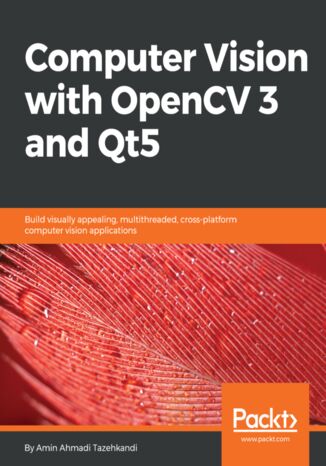
Amin Ahmadi Tazehkandi
Developers have been using OpenCV library to develop computer vision applications for a long time. However, they now need a more effective tool to get the job done and in a much better and modern way. Qt is one of the major frameworks available for this task at the moment. This book will teach you to develop applications with the combination of OpenCV 3 and Qt5, and how to create cross-platform computer vision applications. We’ll begin by introducing Qt, its IDE, and its SDK. Next you’ll learn how to use the OpenCV API to integrate both tools, and see how to configure Qt to use OpenCV. You’ll go on to build a full-fledged computer vision application throughout the book. Later, you’ll create a stunning UI application using the Qt widgets technology, where you’ll display the images after they are processed in an efficient way. At the end of the book, you’ll learn how to convert OpenCV Mat to Qt QImage. You’ll also see how to efficiently process images to filter them, transform them, detect or track objects as well as analyze video. You’ll become better at developing OpenCV applications.
Continuing Financial Modelling. Advanced Techniques and Insights for Modern Financial Modelling
MrExcel's Holy Macro! Books, Liam Bastick
This book provides a thorough exploration of advanced financial modeling techniques, designed to elevate the skills of finance professionals. Starting with a recap of essential concepts, it progresses into dynamic 'What-If?' analysis, advanced forecasting methods, and inventory modeling. The focus is on practical applications, ensuring readers can implement the techniques immediately.Topics such as capital expenditure, debt calculations, and valuation are covered in detail, including DCF and MIRR analysis. The book emphasizes accuracy and efficiency in financial models, offering insights into refining forecasts and linking complex models. With a focus on sensitivity analysis and scenario planning, readers gain tools to handle real-world financial challenges.The final chapters delve into advanced Excel functions like XLOOKUP, dynamic arrays, and scenario-building tools. Best practices for maintaining model accuracy, reducing file sizes, and creating professional models are thoroughly discussed. This guide equips readers with the expertise to manage complex financial modeling tasks confidently.
Xiaoquan Kong, Guan Wang, Alan Nichol
The Rasa framework enables developers to create industrial-strength chatbots using state-of-the-art natural language processing (NLP) and machine learning technologies quickly, all in open source.Conversational AI with Rasa starts by showing you how the two main components at the heart of Rasa work – Rasa NLU (natural language understanding) and Rasa Core. You'll then learn how to build, configure, train, and serve different types of chatbots from scratch by using the Rasa ecosystem. As you advance, you'll use form-based dialogue management, work with the response selector for chitchat and FAQ-like dialogs, make use of knowledge base actions to answer questions for dynamic queries, and much more. Furthermore, you'll understand how to customize the Rasa framework, use conversation-driven development patterns and tools to develop chatbots, explore what your bot can do, and easily fix any mistakes it makes by using interactive learning. Finally, you'll get to grips with deploying the Rasa system to a production environment with high performance and high scalability and cover best practices for building an efficient and robust chat system.By the end of this book, you'll be able to build and deploy your own chatbots using Rasa, addressing the common pain points encountered in the chatbot life cycle.
Alex Büchner
Moodle Workplace is a comprehensive extension to Standard Moodle, the world's most used learning management system (LMS) platform, empowering millions of learners worldwide. Moodle Workplace is suitable for businesses and organizations, from small enterprises to global corporations.Corporate Learning with Moodle Workplace is a comprehensive introduction to this latest product from Moodle, which facilitates collaborative learning in enterprises and larger teams. Complete with detailed descriptions, a variety of diagrams, and real working examples, this easy-to-follow guide will teach you everything you need to know to manage a Moodle Workplace system. You’ll learn how to manage your users along reporting lines and organize them in to tenants, organizations, positions, job assignments, and teams, before setting up typical HR processes such as induction, compliance, and reporting. Filled with real-world examples, the book covers blended and offline scenarios, including appointments and the Moodle Workplace mobile app.By the end of this Moodle book, you’ll have learned how to fully manage a Moodle Workplace instance.
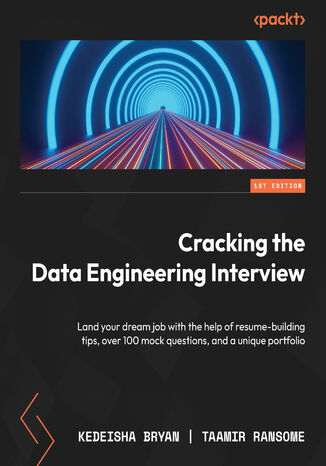
Kedeisha Bryan, Taamir Ransome
Preparing for a data engineering interview can often get overwhelming due to the abundance of tools and technologies, leaving you struggling to prioritize which ones to focus on. This hands-on guide provides you with the essential foundational and advanced knowledge needed to simplify your learning journey.The book begins by helping you gain a clear understanding of the nature of data engineering and how it differs from organization to organization. As you progress through the chapters, you’ll receive expert advice, practical tips, and real-world insights on everything from creating a resume and cover letter to networking and negotiating your salary. The chapters also offer refresher training on data engineering essentials, including data modeling, database architecture, ETL processes, data warehousing, cloud computing, big data, and machine learning. As you advance, you’ll gain a holistic view by exploring continuous integration/continuous development (CI/CD), data security, and privacy. Finally, the book will help you practice case studies, mock interviews, as well as behavioral questions.By the end of this book, you will have a clear understanding of what is required to succeed in an interview for a data engineering role.
Julian Villafuerte
QlikView is one of the most powerful analytical tools in the market. Based on an in-memory associative model, it lets users freely navigate through the data, spot trends and make better decisions. This platform is capable of integrating a wide range of data sources like ERP systems, data warehouses or spreadsheets into a single application in order display dashboards with state-of-the-art visualizations.Creating Stunning Dashboards with QlikView is an easy to follow handbook that guides you through the process of creating an effective and engaging dashboard that delivers tangible value to the business. It starts with the identification of the business needs and the definition of the main KPIs, and takes you all the way to the application rollout.Throughout the book, you will learn how to apply some of the best practices in the field of data visualization, create a robust navigation schema, chose the best chart types for each scenario and many other things that will help you create effective dashboards that uncover all the stories behind the data.
MrExcel's Holy Macro! Books, Mike Girvin
Excel users often encounter limitations with standard formulas, but the Ctrl+Shift+Enter technique changes everything. This book is your gateway to mastering Excel array formulas, revealing their potential to solve complex problems effortlessly. You'll start with the basics, understand the fundamental concepts of array formulas, and gradually progress to advanced applications, including mathematical operations, comparative calculations, and dynamic ranges.Each chapter is crafted to build your confidence and expertise. From performing array operations that manipulate large datasets efficiently to utilizing advanced functions like SUMPRODUCT and AGGREGATE, you will learn how to apply these tools to real-world scenarios. The guide also covers the creation of dynamic ranges with INDEX and OFFSET, ensuring your formulas remain flexible and powerful even as your data changes.By the end of the book, you'll not only understand the theoretical aspects of array formulas but also possess the practical skills to implement them effectively. Whether you're creating complex financial models, conducting detailed data analysis, or automating routine tasks, this guide equips you with the knowledge to transform your Excel capabilities and achieve more with less effort.
D3.js 4.x Data Visualization. Learn to visualize your data with JavaScript - Third Edition
Aendrew Rininsland , Swizec Teller
Want to get started with impressive interactive visualizations and implement them in your daily tasks? This book offers the perfect solution-D3.js. It has emerged as the most popular tool for data visualization. This book will teach you how to implement the features of the latest version of D3 while writing JavaScript using the newest tools and techniqueYou will start by setting up the D3 environment and making your first basic bar chart. You will then build stunning SVG and Canvas-based data visualizations while writing testable, extensible code,as accurate and informative as it is visually stimulating. Step-by-step examples walk you through creating, integrating, and debugging different types of visualization and will have you building basic visualizations (such as bar, line, and scatter graphs) in no time.By the end of this book, you will have mastered the techniques necessary to successfully visualize data and will be ready to use D3 to transform any data into an engaging and sophisticated visualization.