
Big data
Chanchal Singh, Manisha Sethi, Manish Kumar, Anshul...
Apache Kafka is a popular distributed streaming platform that acts as a messaging queue or an enterprise messaging system. It lets you publish and subscribe to a stream of records, and process them in a fault-tolerant way as they occur.This book is a comprehensive guide to designing and architecting enterprise-grade streaming applications using Apache Kafka and other big data tools. It includes best practices for building such applications, and tackles some common challenges such as how to use Kafka efficiently and handle high data volumes with ease. This book first takes you through understanding the type messaging system and then provides a thorough introduction to Apache Kafka and its internal details. The second part of the book takes you through designing streaming application using various frameworks and tools such as Apache Spark, Apache Storm, and more. Once you grasp the basics, we will take you through more advanced concepts in Apache Kafka such as capacity planning and security.By the end of this book, you will have all the information you need to be comfortable with using Apache Kafka, and to design efficient streaming data applications with it.
Rising Odegua, Stephen Oni
Most data analysts use Python and pandas for data processing for the convenience and performance these libraries provide. However, JavaScript developers have always wanted to use machine learning in the browser as well. This book focuses on how Danfo.js brings data processing, analysis, and ML tools to JavaScript developers and how to make the most of this library to build data-driven applications.Starting with an overview of modern JavaScript, you’ll cover data analysis and transformation with Danfo.js and Dnotebook. The book then shows you how to load different datasets, combine and analyze them by performing operations such as handling missing values and string manipulations. You’ll also get to grips with data plotting, visualization, aggregation, and group operations by combining Danfo.js with Plotly. As you advance, you’ll create a no-code data analysis and handling system and create-react-app, react-table, react-chart, Draggable.js, and tailwindcss, and understand how to use TensorFlow.js and Danfo.js to build a recommendation system. Finally, you’ll build a Twitter analytics dashboard powered by Danfo.js, Next.js, node-nlp, and Twit.js.By the end of this app development book, you’ll be able to build and embed data analytics, visualization, and ML capabilities into any JavaScript app in server-side Node.js or the browser.
Brij Kishore Pandey, Emily Ro Schoof
Modern extract, transform, and load (ETL) pipelines for data engineering have favored the Python language for its broad range of uses and a large assortment of tools, applications, and open source components. With its simplicity and extensive library support, Python has emerged as the undisputed choice for data processing.In this book, you’ll walk through the end-to-end process of ETL data pipeline development, starting with an introduction to the fundamentals of data pipelines and establishing a Python development environment to create pipelines. Once you've explored the ETL pipeline design principles and ET development process, you'll be equipped to design custom ETL pipelines. Next, you'll get to grips with the steps in the ETL process, which involves extracting valuable data; performing transformations, through cleaning, manipulation, and ensuring data integrity; and ultimately loading the processed data into storage systems. You’ll also review several ETL modules in Python, comparing their pros and cons when building data pipelines and leveraging cloud tools, such as AWS, to create scalable data pipelines. Lastly, you’ll learn about the concept of test-driven development for ETL pipelines to ensure safe deployments.By the end of this book, you’ll have worked on several hands-on examples to create high-performance ETL pipelines to develop robust, scalable, and resilient environments using Python.
Michael Olafusi, Olanrewaju Oyinbooke
M365 Excel is a modern Excel version that is constantly updated with features that make creating and automating analyses, reports, and dashboards very easy compared with older Excel versions. This book will help you leverage its full capabilities, beginning with a quick overview of what dashboards are and how they are different from other types of reports. Then, you’ll familiarize yourself with the different standard dashboards currently available and what they are meant to accomplish for organizations. As you progress, you’ll get to grips with the use of new powerful tools such as Power Query and dynamic array formulae in the automation of analysis, gaining insights into the right approach to take in building effective dashboards. You’ll equip yourself with not only all the essential formulae, charts, and non-chart visuals but also learn how to set up your dashboard perfectly. Along the way, you’ll build a couple of awesome dashboards from scratch to utilize your newfound knowledge.By the end of this book, you will be able to carry out an impressive and robust level of analysis on business data that may come from multiple sources or files, using better processes, formulae, and best practices in M365 to create insightful dashboards faster.
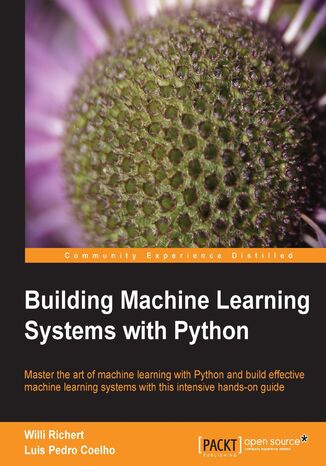
Willi Richert , Luis Pedro Coelho
Machine learning, the field of building systems that learn from data, is exploding on the Web and elsewhere. Python is a wonderful language in which to develop machine learning applications. As a dynamic language, it allows for fast exploration and experimentation and an increasing number of machine learning libraries are developed for Python.Building Machine Learning system with Python shows you exactly how to find patterns through raw data. The book starts by brushing up on your Python ML knowledge and introducing libraries, and then moves on to more serious projects on datasets, Modelling, Recommendations, improving recommendations through examples and sailing through sound and image processing in detail. Using open-source tools and libraries, readers will learn how to apply methods to text, images, and sounds. You will also learn how to evaluate, compare, and choose machine learning techniques. Written for Python programmers, Building Machine Learning Systems with Python teaches you how to use open-source libraries to solve real problems with machine learning. The book is based on real-world examples that the user can build on.Readers will learn how to write programs that classify the quality of StackOverflow answers or whether a music file is Jazz or Metal. They will learn regression, which is demonstrated on how to recommend movies to users. Advanced topics such as topic modeling (finding a text's most important topics), basket analysis, and cloud computing are covered as well as many other interesting aspects.Building Machine Learning Systems with Python will give you the tools and understanding required to build your own systems, which are tailored to solve your problems.
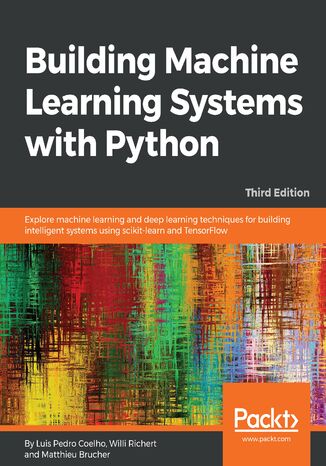
Luis Pedro Coelho, Willi Richert , Matthieu...
Machine learning enables systems to make predictions based on historical data. Python is one of the most popular languages used to develop machine learning applications, thanks to its extensive library support. This updated third edition of Building Machine Learning Systems with Python helps you get up to speed with the latest trends in artificial intelligence (AI).With this guide’s hands-on approach, you’ll learn to build state-of-the-art machine learning models from scratch. Complete with ready-to-implement code and real-world examples, the book starts by introducing the Python ecosystem for machine learning. You’ll then learn best practices for preparing data for analysis and later gain insights into implementing supervised and unsupervised machine learning techniques such as classification, regression and clustering. As you progress, you’ll understand how to use Python’s scikit-learn and TensorFlow libraries to build production-ready and end-to-end machine learning system models, and then fine-tune them for high performance.By the end of this book, you’ll have the skills you need to confidently train and deploy enterprise-grade machine learning models in Python.
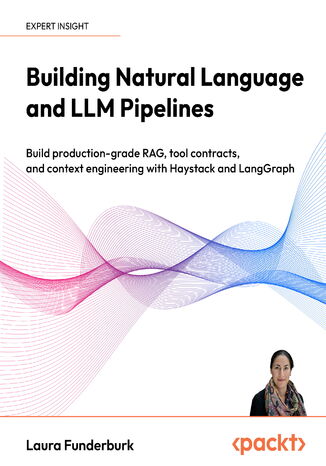
Laura Funderburk
Modern LLM applications often break in production due to brittle pipelines, loose tool definitions, and noisy context. This book shows you how to build production-ready, context-aware systems using Haystack and LangGraph. You’ll learn to design deterministic pipelines with strict tool contracts and deploy them as microservices. Through structured context engineering, you’ll orchestrate reliable agent workflows and move beyond simple prompt-based interactions. You'll start by understanding LLM behavior—tokens, embeddings, and transformer models—and see how prompt engineering has evolved into a full context engineering discipline. Then, you'll build retrieval-augmented generation (RAG) pipelines with retrievers, rankers, and custom components using Haystack’s graph-based architecture. You’ll also create knowledge graphs, synthesize unstructured data, and evaluate system behavior using Ragas and Weights & Biases. In LangGraph, you’ll orchestrate agents with supervisor-worker patterns, typed state machines, retries, fallbacks, and safety guardrails. By the end of the book, you’ll have the skills to design scalable, testable LLM pipelines and multi-agent systems that remain robust as the AI ecosystem evolves.*Email sign-up and proof of purchase required
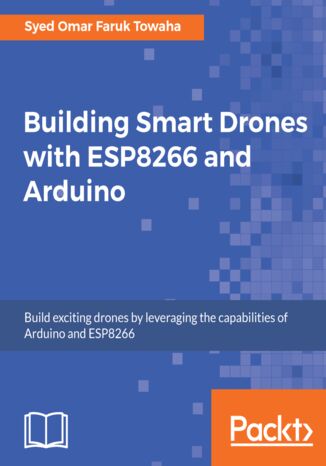
Syed Omar Faruk Towaha
With the use of drones, DIY projects have taken off. Programmers are rapidly moving from traditional application programming to developing exciting multi-utility projects.This book will teach you to build industry-level drones with Arduino and ESP8266 and their modified versions of hardware.With this book, you will explore techniques for leveraging the tiny WiFi chip to enhance your drone and control it over a mobile phone. This book will start with teaching you how to solve problems while building your own WiFi controlled Arduino based drone. You will also learn how to build a Quadcopter and a mission critical drone. Moving on you will learn how to build a prototype drone that will be given a mission to complete which it will do it itself. You will also learn to build various exciting projects such as gliding and racing drones. By the end of this book you will learn how to maintain and troubleshoot your drone.By the end of this book, you will have learned to build drones using ESP8266 and Arduino and leverage their functionalities to the fullest.