
Systemy operacyjne
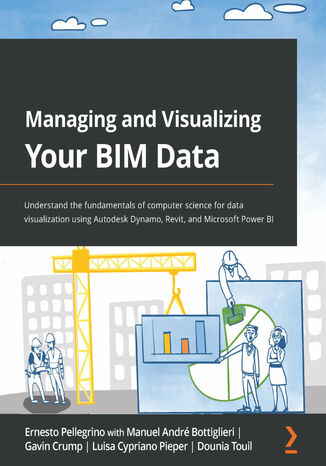
Ernesto Pellegrino, Manuel André Bottiglieri, Gavin Crump,...
Business intelligence software has rapidly spread its roots in the AEC industry during the last few years. This has happened due to the presence of rich digital data in BIM models whose datasets can be gathered, organized, and visualized through software such as Autodesk Dynamo BIM and Power BI.Managing and Visualizing Your BIM Data helps you understand and implement computer science fundamentals to better absorb the process of creating Dynamo scripts and visualizing the collected data on powerful dashboards. This book provides a hands-on approach and associated methodologies that will have you productive and up and running in no time. After understanding the theoretical aspects of computer science and related topics, you will focus on Autodesk Dynamo to develop scripts to manage data. Later, the book demonstrates four case studies from AEC experts across the world. In this section, you’ll learn how to get started with Autodesk Dynamo to gather data from a Revit model and create a simple C# plugin for Revit to stream data on Power BI directly. As you progress, you’ll explore how to create dynamic Power BI dashboards using Revit floor plans and make a Power BI dashboard to track model issues.By the end of this book, you’ll have learned how to develop a script to gather a model’s data and visualize datasets in Power BI easily.
Atanas Georgiev Rusev
For the beginner or intermediate user, this Linux book has it all. The book presents Linux through Manjaro, an Arch-based efficient Linux distribution. Atanas G. Rusev, a dedicated Manjaro enthusiast and seasoned writer with thousands of pages of technical documentation under his belt, has crafted this comprehensive guide by compiling information scattered across countless articles, manuals, and posts. The book provides an overview of the different desktop editions and detailed installation instructions and offers insights into the GUI modules and features of Manjaro’s official editions. You’ll explore the regular software, Terminal, and all basic Linux commands and cover topics such as package management, filesystems, automounts, storage, backups, and encryption. The book’s modular structure allows you to navigate to the specific information you need, whether it’s data sharing, security and networking, firewalls, VPNs, or SSH. You’ll build skills in service and user management, troubleshooting, scripting, automation, and kernel switching. By the end of the book, you’ll have mastered Linux basics, intermediate topics, and essential advanced Linux features and have gained an appreciation of what makes Linux the powerhouse driving everything from home PCs and Android devices to the servers of Google, Facebook, and Amazon, as well as all supercomputers worldwide.
James Freeman, Jesse Keating
Automation is essential for success in the modern world of DevOps. Ansible provides a simple, yet powerful, automation engine for tackling complex automation challenges.This book will take you on a journey that will help you exploit the latest version's advanced features to help you increase efficiency and accomplish complex orchestrations. This book will help you understand how Ansible 2.7 works at a fundamental level and will also teach you to leverage its advanced capabilities. Throughout this book, you will learn how to encrypt Ansible content at rest and decrypt data at runtime. Next, this book will act as an ideal resource to help you master the advanced features and capabilities required to tackle complex automation challenges. Later, it will walk you through workflows, use cases, orchestrations, troubleshooting, and Ansible extensions. Lastly, you will examine and debug Ansible operations, helping you to understand and resolve issues.By the end of the book, you will be able to unlock the true power of the Ansible automation engine and tackle complex, real- world actions with ease.
Prabath Siriwardena
If you are working with Java or Java EE projects and you want to take full advantage of Maven in designing, executing, and maintaining your build system for optimal developer productivity, then this book is ideal for you. You should be well versed with Maven and its basic functionality if you wish to get the most out of the book.
Mastering Assembly Programming. From instruction set to kernel module with Intel processor
Alexey Lyashko
The Assembly language is the lowest level human readable programming language on any platform. Knowing the way things are on the Assembly level will help developers design their code in a much more elegant and efficient way. It may be produced by compiling source code from a high-level programming language (such as C/C++) but can also be written from scratch. Assembly code can be converted to machine code using an assembler.The first section of the book starts with setting up the development environment on Windows and Linux, mentioning most common toolchains. The reader is led through the basic structure of CPU and memory, and is presented the most important Assembly instructions through examples for both Windows and Linux, 32 and 64 bits. Then the reader would understand how high level languages are translated into Assembly and then compiled into object code. Finally we will cover patching existing code, either legacy code without sources or a running code in same or remote process.
Ryan Mangan, Jim Moyle
Azure Virtual Desktop is a cloud desktop virtualization platform that securely delivers virtual desktops and remote apps. Mastering Azure Virtual Desktop will guide you through designing, implementing, configuring, and maintaining an Azure Virtual Desktop environment effectively. This book can also be used as an exam preparation guide to help you sit the Microsoft AZ-140 exam.You’ll start with an introduction to the essentials of Azure Virtual Desktop. Next, you’ll get to grips with planning an Azure Virtual Desktop architecture before learning how to implement an Azure Virtual Desktop environment. Moving ahead, you’ll learn how to manage and control access as well as configure security controls on your Azure Virtual Desktop environment. As you progress, you’ll understand how to manage user environments and configure MSIX app attach and other Azure Virtual Desktop features to enhance the user experience. You’ll also learn about the Azure Active Directory (AD) join and getting started feature. Finally, you’ll discover how to monitor and maintain an Azure Virtual Desktop environment to help you support your users and diagnose issues when they occur.By the end of this Microsoft Azure book, you’ll have covered all the essential topics you need to know to design and manage Azure Virtual Desktop and prepare for the AZ-140 exam.
Mastering Bash. A Step-by-Step Guide to working with Bash Programming and Shell Scripting
Giorgio Zarrelli
System administration is an everyday effort that involves a lot of tedious tasks, and devious pits. Knowing your environment is the key to unleashing the most powerful solution that will make your life easy as an administrator, and show you the path to new heights. Bash is your Swiss army knife to set up your working or home environment as you want, when you want.This book will enable you to customize your system step by step, making your own real, virtual, home out of it. The journey will take you swiftly through the basis of the shell programming in Bash to more interesting and challenging tasks. You will be introduced to one of the most famous open source monitoring systems—Nagios, and write complex programs with it in any languages. You’ll see how to perform checks on your sites and applications.Moving on, you’ll discover how to write your own daemons so you can create your services and take advantage of inter-process communication to let your scripts talk to each other. So, despite these being everyday tasks, you’ll have a lot of fun on the way. By the end of the book, you will have gained advanced knowledge of Bash that will help you automate routine tasks and manage your systems.
Cesar Bravo
Every organization has its own data and digital assets that need to be protected against an ever-growing threat landscape that compromises the availability, integrity, and confidentiality of crucial data. Therefore, it is important to train professionals in the latest defensive security skills and tools to secure them. Mastering Defensive Security provides you with in-depth knowledge of the latest cybersecurity threats along with the best tools and techniques needed to keep your infrastructure secure.The book begins by establishing a strong foundation of cybersecurity concepts and advances to explore the latest security technologies such as Wireshark, Damn Vulnerable Web App (DVWA), Burp Suite, OpenVAS, and Nmap, hardware threats such as a weaponized Raspberry Pi, and hardening techniques for Unix, Windows, web applications, and cloud infrastructures. As you make progress through the chapters, you'll get to grips with several advanced techniques such as malware analysis, security automation, computer forensics, and vulnerability assessment, which will help you to leverage pentesting for security.By the end of this book, you'll have become familiar with creating your own defensive security tools using IoT devices and developed advanced defensive security skills.