
Biznes IT
Czy myśleliście kiedyś, w jaki sposób rozpocząć swój biznes w branży IT? Może już prowadzicie własną firmę i Chcecie, aby zaistniała ona w sieci? W tej kategorii znajdziecie książki, w których zawarty jest know-how związany z wieloma rodzajami działalności prowadzonych poprzez internet, czy w inny sposób związanych z nowoczesnymi technologiami w biznesie.
Znajdziecie informacje o systemach zarządzania informacjami o Klientach - popularnych CRM'ach, o zarządzaniu projektami IT, wykorzystaniu potencjału popularnych teraz portali społecznościowych do promocji swojej działalności, czy też poradniki, które pomogą Wam rozwinąć umiejętności pozatechniczne - równie ważne dla Waszych przedsięwzięć.

Benedikt Bergmann, Scott Durow
Managing Power Platform solutions manually can be challenging and time-consuming, as is application lifecycle management (ALM), which encompasses governance, development, and maintenance. This book provides comprehensive coverage of ALM, addressing planning, development, testing, deployment, and maintenance. Drawing on his extensive experience as a Power Platform consultant and Microsoft MVP, Benedikt Bergmann simplifies complex topics, making them accessible and easy to grasp.From planning and designing applications to deploying and maintaining them, this book provides step-by-step instructions, best practices, and real-world examples to effectively manage the entire application lifecycle. You’ll gain insights into optimizing Power Platform's toolbox, including Power Apps, Power Automate, Power Pages, and Power Virtual Agents, for seamless collaboration, agile development, and rapid application delivery. You’ll also implement best practices for version control, code management, and collaboration using the Microsoft Power Platform.By the end of this book, you’ll be equipped with the knowledge and skills to effectively manage the entire application lifecycle, accelerate development cycles, and deliver exceptional solutions with the Microsoft Power Platform.
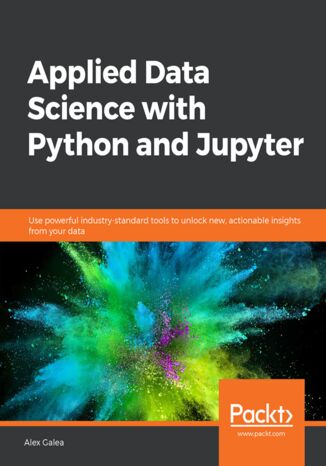
Alex Galea
Getting started with data science doesn't have to be an uphill battle. Applied Data Science with Python and Jupyter is a step-by-step guide ideal for beginners who know a little Python and are looking for a quick, fast-paced introduction to these concepts. In this book, you'll learn every aspect of the standard data workflow process, including collecting, cleaning, investigating, visualizing, and modeling data. You'll start with the basics of Jupyter, which will be the backbone of the book. After familiarizing ourselves with its standard features, you'll look at an example of it in practice with our first analysis. In the next lesson, you dive right into predictive analytics, where multiple classification algorithms are implemented. Finally, the book ends by looking at data collection techniques. You'll see how web data can be acquired with scraping techniques and via APIs, and then briefly explore interactive visualizations.
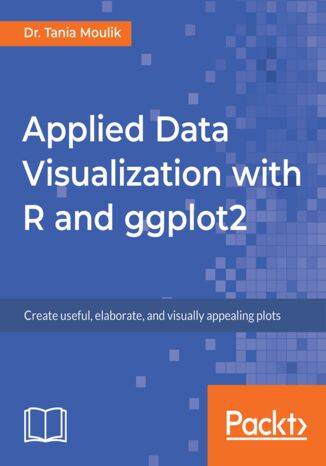
Dr. Tania Moulik
Applied Data Visualization with R and ggplot2 introduces you to the world of data visualization by taking you through the basic features of ggplot2. To start with, you’ll learn how to set up the R environment, followed by getting insights into the grammar of graphics and geometric objects before you explore the plotting techniques.You’ll discover what layers, scales, coordinates, and themes are, and study how you can use them to transform your data into aesthetical graphs. Once you’ve grasped the basics, you’ll move on to studying simple plots such as histograms and advanced plots such as superimposing and density plots. You’ll also get to grips with plotting trends, correlations, and statistical summaries.By the end of this book, you’ll have created data visualizations that will impress your clients.
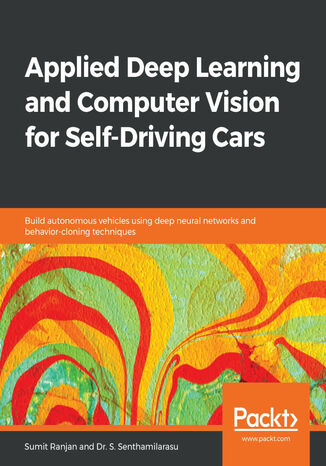
Balu Nair, Sumit Ranjan, Dr. S. Senthamilarasu
Thanks to a number of recent breakthroughs, self-driving car technology is now an emerging subject in the field of artificial intelligence and has shifted data scientists' focus to building autonomous cars that will transform the automotive industry. This book is a comprehensive guide to use deep learning and computer vision techniques to develop autonomous cars. Starting with the basics of self-driving cars (SDCs), this book will take you through the deep neural network techniques required to get up and running with building your autonomous vehicle. Once you are comfortable with the basics, you'll delve into advanced computer vision techniques and learn how to use deep learning methods to perform a variety of computer vision tasks such as finding lane lines, improving image classification, and so on. You will explore the basic structure and working of a semantic segmentation model and get to grips with detecting cars using semantic segmentation. The book also covers advanced applications such as behavior-cloning and vehicle detection using OpenCV, transfer learning, and deep learning methodologies to train SDCs to mimic human driving.By the end of this book, you'll have learned how to implement a variety of neural networks to develop your own autonomous vehicle using modern Python libraries.
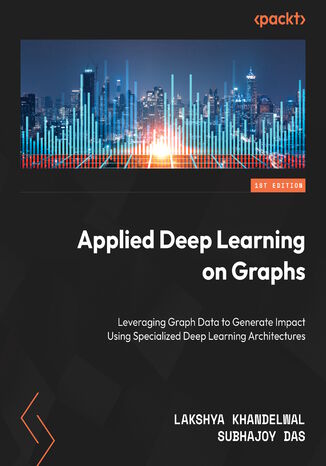
Lakshya Khandelwal, Subhajoy Das
With their combined expertise spanning cutting-edge AI product development at industry giants such as Walmart, Adobe, Samsung, and Arista Networks, Lakshya and Subhajoy provide real-world insights into the transformative world of graph neural networks (GNNs).This book demystifies GNNs, guiding you from foundational concepts to advanced techniques and real-world applications. You’ll see how graph data structures power today’s interconnected world, why specialized deep learning approaches are essential, and how to address challenges with existing methods. You’ll start by dissecting early graph representation techniques such as DeepWalk and node2vec. From there, the book takes you through popular GNN architectures, covering graph convolutional and attention networks, autoencoder models, LLMs, and technologies such as retrieval augmented generation on graph data. With a strong theoretical grounding, you’ll seamlessly navigate practical implementations, mastering the critical topics of scalability, interpretability, and application domains such as NLP, recommendations, and computer vision.By the end of this book, you’ll have mastered the underlying ideas and practical coding skills needed to innovate beyond current methods and gained strategic insights into the future of GNN technologies.
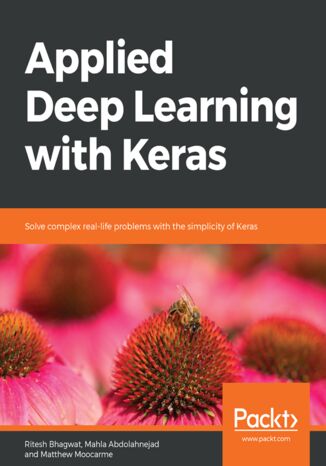
Applied Deep Learning with Keras. Solve complex real-life problems with the simplicity of Keras
Ritesh Bhagwat , Mahla Abdolahnejad , Matthew...
Though designing neural networks is a sought-after skill, it is not easy to master. With Keras, you can apply complex machine learning algorithms with minimum code.Applied Deep Learning with Keras starts by taking you through the basics of machine learning and Python all the way to gaining an in-depth understanding of applying Keras to develop efficient deep learning solutions. To help you grasp the difference between machine and deep learning, the book guides you on how to build a logistic regression model, first with scikit-learn and then with Keras. You will delve into Keras and its many models by creating prediction models for various real-world scenarios, such as disease prediction and customer churning. You’ll gain knowledge on how to evaluate, optimize, and improve your models to achieve maximum information. Next, you’ll learn to evaluate your model by cross-validating it using Keras Wrapper and scikit-learn. Following this, you’ll proceed to understand how to apply L1, L2, and dropout regularization techniques to improve the accuracy of your model. To help maintain accuracy, you’ll get to grips with applying techniques including null accuracy, precision, and AUC-ROC score techniques for fine tuning your model.By the end of this book, you will have the skills you need to use Keras when building high-level deep neural networks.
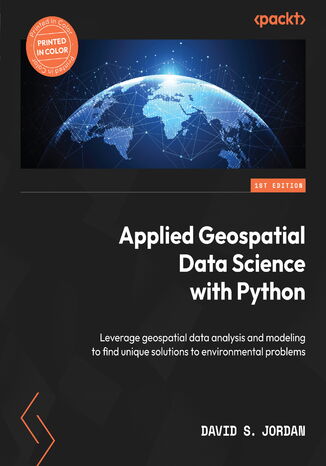
David S. Jordan
Data scientists, when presented with a myriad of data, can often lose sight of how to present geospatial analyses in a meaningful way so that it makes sense to everyone. Using Python to visualize data helps stakeholders in less technical roles to understand the problem and seek solutions. The goal of this book is to help data scientists and GIS professionals learn and implement geospatial data science workflows using Python.Throughout this book, you’ll uncover numerous geospatial Python libraries with which you can develop end-to-end spatial data science workflows. You’ll learn how to read, process, and manipulate spatial data effectively. With data in hand, you’ll move on to crafting spatial data visualizations to better understand and tell the story of your data through static and dynamic mapping applications. As you progress through the book, you’ll find yourself developing geospatial AI and ML models focused on clustering, regression, and optimization. The use cases can be leveraged as building blocks for more advanced work in a variety of industries.By the end of the book, you’ll be able to tackle random data, find meaningful correlations, and make geospatial data models.
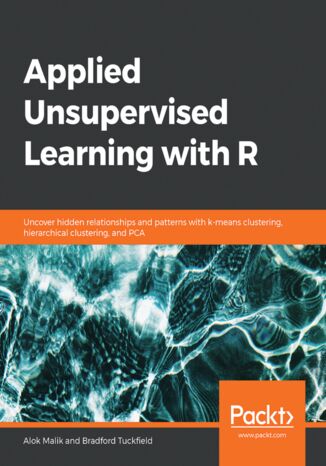
Alok Malik, Bradford Tuckfield
Starting with the basics, Applied Unsupervised Learning with R explains clustering methods, distribution analysis, data encoders, and features of R that enable you to understand your data better and get answers to your most pressing business questions. This book begins with the most important and commonly used method for unsupervised learning - clustering - and explains the three main clustering algorithms - k-means, divisive, and agglomerative. Following this, you'll study market basket analysis, kernel density estimation, principal component analysis, and anomaly detection. You'll be introduced to these methods using code written in R, with further instructions on how to work with, edit, and improve R code. To help you gain a practical understanding, the book also features useful tips on applying these methods to real business problems, including market segmentation and fraud detection. By working through interesting activities, you'll explore data encoders and latent variable models. By the end of this book, you will have a better understanding of different anomaly detection methods, such as outlier detection, Mahalanobis distances, and contextual and collective anomaly detection.