
Gry
John Horton
Android is one of the most popular mobile operating systems today. It uses the most popular programming language, Java, as one of the primary languages for building apps of all types. Unlike most other Android books, this book doesn’t assume that you have any prior knowledge of Java programming, instead helps you get started with building Android games as a beginner.This new, improved, and updated third edition of Learning Java by Building Android Games helps you to build Android games from scratch. Once you've got to grips with the fundamentals, the difficulty level increases steadily as you explore key Java topics, such as variables, loops, methods, object-oriented programming (OOP), and design patterns while working with up-to-date code and supporting examples. At each stage, you'll be able to test your understanding by implementing the concepts that you’ve learned to develop a game. Toward the end, you’ll build games such as Sub Hunter, Retro Pong, Bullet Hell, Classic Snake, and Scrolling Shooter.By the end of this Java book, you'll not only have a solid understanding of Java and Android basics but will also have developed five cool games for the Android platform.
Suryakumar B Nair, Andreas Oehlke
This book is aimed at indie and existing game developers as well as those who want to get started with game development using LibGDX. Basic knowledge of Java programming and game development is required.
Charles Bernardoff
Project teams rarely forget to work on the technology, but they often forget to work with the people, and no matter how amazing your new technology is, it’s useless unless people use it efficiently.
Learning Rust. A comprehensive guide to writing Rust applications
Paul Johnson, Vesa Kaihlavirta
Rust is a highly concurrent and high performance language that focuses on safety and speed, memory management, and writing clean code. It also guarantees thread safety, and its aim is to improve the performance of existing applications. Its potential is shown by the fact that it has been backed by Mozilla to solve the critical problem of concurrency.Learning Rust will teach you to build concurrent, fast, and robust applications. From learning the basic syntax to writing complex functions, this book will is your one stop guide to get up to speed with the fundamentals of Rust programming. We will cover the essentials of the language, including variables, procedures, output, compiling, installing, and memory handling. You will learn how to write object-oriented code, work with generics, conduct pattern matching, and build macros. You will get to know how to communicate with users and other services, as well as getting to grips with generics, scoping, and more advanced conditions. You will also discover how to extend the compilation unit in Rust. By the end of this book, you will be able to create a complex application in Rust to move forward with.
Learning RxJava. Reactive, Concurrent, and responsive applications
Thomas Nield
RxJava is a library for composing asynchronous and event-based programs using Observable sequences for the JVM, allowing developers to build robust applications in less time.Learning RxJava addresses all the fundamentals of reactive programming to help readers write reactive code, as well as teach them an effective approach to designing and implementing reactive libraries and applications. Starting with a brief introduction to reactive programming concepts, there is an overview of Observables and Observers, the core components of RxJava, and how to combine different streams of data and events together. You will also learn simpler ways to achieve concurrency and remain highly performant, with no need for synchronization. Later on, we will leverage backpressure and other strategies to cope with rapidly-producing sources to prevent bottlenecks in your application. After covering custom operators, testing, and debugging, the book dives into hands-on examples using RxJava on Android as well as Kotlin.
Kyle Langley
Over recent years, the market for mobile game development using Unity has grown multi-fold with an overwhelming 600 million gamers playing games developed using Unity engine. The newly launched Unity 5 offers a wide range of dedicated and powerful tools for iOS developers who intend to follow the basics and gradually elevate their skills to revolutionize the way they design and publish games for the App Store.From beginners, to those who are experienced making video games, this book goes through the steps of using Unity 5 to make a game from the ground up and setting the game up with iTunes Game Center features.The book begins with an introduction to setting up an iTunes Connect developer account, this will allow you to use Unity to its full potential with iOS. You will create a new app in iTunes Connect with the settings for Apple approval. You will learn, in detail, how to use Unity 5 and the programming language C# to make a fully interactive game that keeps track of player progress, Game Center Leaderboards, and Achievements, as well as displaying iAds and offering In-App purchases.Moving on, you’ll discover how to create development and release builds, enabling you to test the game on your device before finally submitting the game for Apple’s approval.By the end of the book, you will have a complete understanding of how iTunes and Unity can be used in combination to build and publish a fully interactive and reliable game to the App Store.
Muhammad A.Moniem
If you are a game developer, designer, artist, or a beginner in the gaming industry, and want to make iOS games efficiently at a low cost, this book is ideal for you.
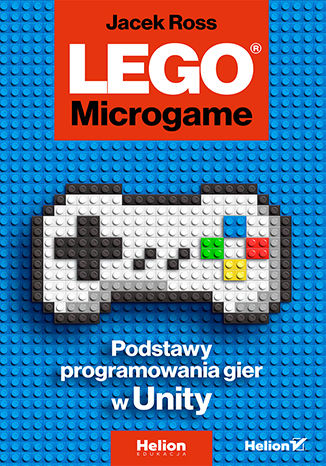
LEGO Microgame. Podstawy programowania gier w Unity
Jacek Ross
Lubisz klocki LEGO? Kochasz gry komputerowe? Chcesz połączyć te dwie pasje? Naucz się tworzyć porywające gry w środowisku LEGO(R) Microgame! Klocków LEGO chyba nikomu nie trzeba przedstawiać. Znane i lubiane, zawsze są gwarancją świetnej zabawy. Dzięki Unity i stworzonemu we współpracy z marką LEGO(R) projektowi LEGO(R) Microgame każdy może opracować własną minigrę komputerową, której akcja dzieje się w świecie znanym z kolekcji popularnych klocków. Jeśli lubisz dobrą zabawę i nie boisz się wyzwań, jeszcze dziś zainstaluj Unity i moduł LEGO(R) Microgame. Korzystając z nich - i z tej książki! - szybko opanujesz podstawy tworzenia gier, poznasz narzędzia programistyczne i rozwiniesz swoją kreatywność. Nie trać czasu - świat gier stoi przed Tobą otworem! Instalacja niezbędnego oprogramowania Podstawy obsługi Unity i LEGO(R) Microgame Tworzenie scen i zarządzanie obiektami Zastosowanie klocków specjalnych Publikacja gry w serwisie Unity Play Nieważne, ile masz lat - ważne, czy chcesz się dobrze bawić!