
.NET - Programowanie
W podręcznikach z działu .NET znajdziecie szereg informacji koniecznych do gruntownego poznania platformy .Net, jej elementów oraz technik wykorzystywanych w codziennej pracy programistów. Znajdziecie tu książki opisujące ASP.NET - popularną technologię tworzenia interaktywnych stron WWW i dynamicznych aplikacji internetowych.
Poznacie najważniejsze klasy platformy .Net oraz informacje na temat zasad programowania obiektowego oraz stosowania wyrażeń regularnych, metadanych i refleksji. Przeczytacie o zaawansowanych technikach diagnostycznych a także poznacie tajniki konstruowania dokumentów XML. Od teraz zwroty typu programowanie współbieżne przy użyciu domen, wątków i procesów staną się jasne i zrozumiałe.
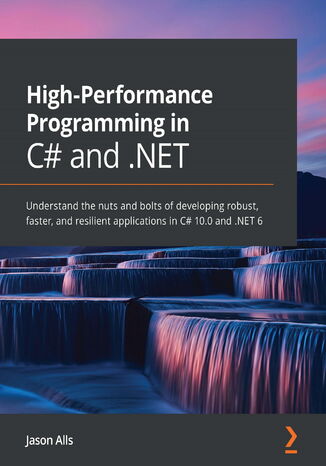
Jason Alls
Writing high-performance code while building an application is crucial, and over the years, Microsoft has focused on delivering various performance-related improvements within the .NET ecosystem. This book will help you understand the aspects involved in designing responsive, resilient, and high-performance applications with the new version of C# and .NET.You will start by understanding the foundation of high-performance code and the latest performance-related improvements in C# 10.0 and .NET 6. Next, you’ll learn how to use tracing and diagnostics to track down performance issues and the cause of memory leaks. The chapters that follow then show you how to enhance the performance of your networked applications and various ways to improve directory tasks, file tasks, and more. Later, you’ll go on to improve data querying performance and write responsive user interfaces. You’ll also discover how you can use cloud providers such as Microsoft Azure to build scalable distributed solutions. Finally, you’ll explore various ways to process code synchronously, asynchronously, and in parallel to reduce the time it takes to process a series of tasks.By the end of this C# programming book, you’ll have the confidence you need to build highly resilient, high-performance applications that meet your customer's demands.
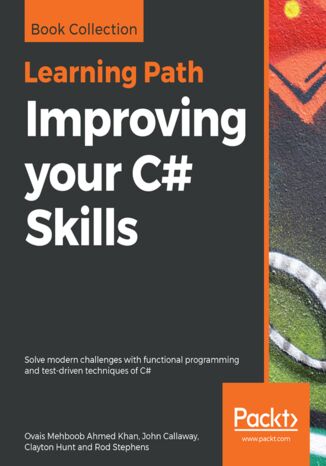
Ovais Mehboob Ahmed Khan, John Callaway, Clayton...
This Learning Path shows you how to create high performing applications and solve programming challenges using a wide range of C# features. You’ll begin by learning how to identify the bottlenecks in writing programs, highlight common performance pitfalls, and apply strategies to detect and resolve these issues early. You'll also study the importance of micro-services architecture for building fast applications and implementing resiliency and security in .NET Core. Then, you'll study the importance of defining and testing boundaries, abstracting away third-party code, and working with different types of test double, such as spies, mocks, and fakes. In addition to describing programming trade-offs, this Learning Path will also help you build a useful toolkit of techniques, including value caching, statistical analysis, and geometric algorithms. This Learning Path includes content from the following Packt products:• C# 7 and .NET Core 2.0 High Performance by Ovais Mehboob Ahmed Khan• Practical Test-Driven Development using C# 7 by John Callaway, Clayton Hunt• The Modern C# Challenge by Rod Stephens
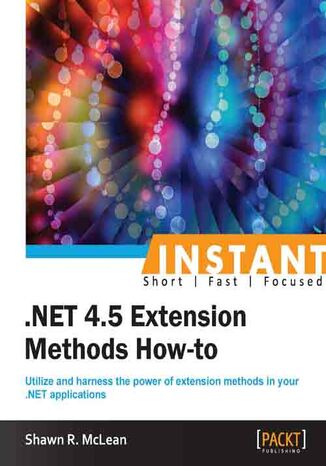
Shawn Ricardo Mclean
.NET extension methods is an essential feature to know and understand for all .NET developers. Usage of extension methods is found in applications ranging from small to large scale enterprise systems built using the .NET framework. Create and use extension methods the correct way to save your development time and maintainability costs.Instant .NET 4.5 Extension Methods How-to is a practical, hands-on guide that provides you with a number of clear, step-by-step exercises that will help you take advantage of the real power that is behind extension methods and gives you good knowledge of how to use them in your .NET applications.This book covers how to create, write, and use different types of extension methods. It will take you through a number of clear, practical recipes that will help you take advantage of the power of extension methods in the quickest possible way.You will also learn exactly how to create extension methods on strings, interfaces, classes such as IQueryable and IEnumerable, and so on. You will write them from scratch and then use them practically in your application. You will also learn the most suitable scenarios for using these extension methods.You will learn everything you need to know about creating your own extension methods and using them and other external extension methods.
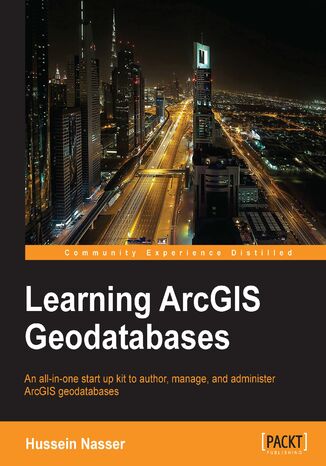
Hussein Nasser
This is a solution-based book, showcasing the real power of ArcGIS Geodatabase by following a real-world, example-based approach.This book is aimed at geospatial developers who want to work with ArcGIS geodatabases as well as manage them. Having knowledge of building a geodatabase from scratch isn't a must; Learning ArcGIS Geodatabases is ideal for those who want to use ArcGIS geodatabase for the first time, or for those who want to migrate from their existing legacy database to a geodatabase.
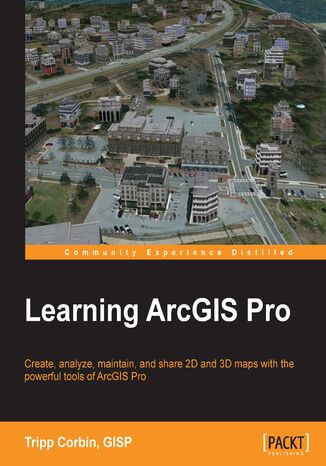
Tripp Corbin, GISP
ArcGIS Pro is Esri’s newest desktop GIS application with powerful tools for visualizing, maintaining, and analyzing data. ArcGIS Pro makes use of the modern ribbon interface and 64-bit processing to increase the speed and efficiency of using GIS. It allows users to create amazing maps in both 2D and 3D quickly and easily.This book will take you from software installation to performing geospatial analysis. It is packed with how-to’s for a host of commonly-performed tasks. You will start by learning how to download and install the software including hardware limitations and recommendations. Then you are exposed to the new Ribbon interface and how its smart design can make finding tools easier.After you are exposed to the new interface, you are walked through the steps to create a new GIS Project to provide quick access to project resources. With a project created, you will learn how to construct 2D and 3D maps including how to add layers, adjust symbology, and control labeling. Next you will learn how to access and use analysis tools to help you answer real-world questions.Lastly, you will learn how processes can be automated and standardized in ArcGIS Pro using Tasks, Models, and Python Scripts.This book will provide an invaluable resource for all those seeking to use ArcGIS Pro as their primary GIS application or for those looking to migrate from ArcMap and ArcCatalog.
Learning ASP.NET Core 2.0. Build modern web apps with ASP.NET Core 2.0, MVC, and EF Core 2
Michel Bruchet, Jason De Oliveira
The ability to develop web applications that are highly efficient but also easy to maintain has become imperative to many businesses. ASP.NET Core 2.0 is an open source framework from Microsoft, which makes it easy to build cross-platform web applications that are modern and dynamic. This book will take you through all of the essential concepts in ASP.NET Core 2.0, so you can learn how to build powerful web applications. The book starts with a brief introduction to the ASP.NET Core framework and the improvements made in the latest release, ASP.NET Core 2.0. You will then build, test, and debug your first web application very quickly. Once you understand the basic structure of ASP.NET Core 2.0 web applications, you'll dive deeper into more complex concepts and scenarios. Moving on, we'll explain how to take advantage of widely used frameworks such as Model View Controller and Entity Framework Core 2 and you'll learn how to secure your applications. Finally, we'll show you how to deploy and monitor your applications using Azure, AWS, and Docker. After reading the book, you'll be able to develop efficient and robust web applications in ASP.NET Core 2.0 that have high levels of customer satisfaction and adoption.
Eduardo Sojo
Unlock the full potential of AI with Microsoft Foundry, Microsoft’s unified platform for building, orchestrating, and operating AI solutions at scale. This hands-on guide walks you through the full AI application lifecycle, from data preparation and model selection to deployment, monitoring, and continuous evaluation.Written by Eduardo Sojo, a former Microsoft consultant and current solutions architect at Databricks with over 15 years of experience, the book focuses on practical implementation using the latest Microsoft Foundry portal. You’ll learn to design intelligent workflows, build agents, and apply guardrails to ensure safe, reliable AI behavior in real-world scenarios.Rather than focusing only on models, the book shows how to connect workflows, agents, evaluations, and observability so solutions are not just functional, but production-ready.You’ll explore real-world use cases such as building copilots, integrating external systems like Databricks, and creating multi-agent architectures that work with enterprise data. By the end, you’ll be able to design, build, and operate secure, scalable, intelligent AI solutions using Microsoft Foundry.
Mithun Pattankar, Malendra Hurbuns
Microsoft has unified their main web development platforms. This unification will help develop web applications using various pieces of the ASP.NET platform that can be deployed on both Windows and LINUX. With ASP.NET Core (Web API), it will become easier than ever to build secure HTTP services that can be used from any client.Mastering ASP.NET Web API starts with the building blocks of the ASP.NET Core, then gradually moves on to implementing various HTTP routing strategies in the Web API. We then focus on the key components of building applications that employ the Web API, such as Kestrel, Middleware, Filters, Logging, Security, and Entity Framework.Readers will be introduced to take the TDD approach to write test cases along with the new Visual Studio 2017 live unit testing feature. They will also be introduced to integrate with the database using ORMs. Finally, we explore how the Web API can be consumed in a browser as well as by mobile applications by utilizing Angular 4, Ionic and ReactJS.By the end of this book, you will be able to apply best practices to develop complex Web API, consume them in frontend applications and deploy these applications to a modern hosting infrastructure.
Prabhakaran Anbazhagan
Being able to create and maintain data-oriented applications has become crucial in modern programming. This is why Microsoft came up with Entity Framework so architects can optimize storage requirements while also writing efficient and maintainable application code. This book is a comprehensive guide that will show how to utilize the power of the Entity Framework to build efficient .NET Core applications. It not only teaches all the fundamentals of Entity Framework Core but also demonstrates how to use it practically so you can implement it in your software development. The book is divided into three modules. The first module focuses on building entities and relationships. Here you will also learn about different mapping techniques, which will help you choose the one best suited to your application design. Once you have understood the fundamentals of the Entity Framework, you will move on to learn about validation and querying in the second module. It will also teach you how to execute raw SQL queries and extend the Entity Framework to leverage Query Objects using the Query Object Pattern. The final module of the book focuses on performance optimization and managing the security of your application. You will learn to implement failsafe mechanisms using concurrency tokens. The book also explores row-level security and multitenant databases in detail. By the end of the book, you will be proficient in implementing Entity Framework on your .NET Core applications.
Daniel Baharestani
Dependency injection is an approach to creating loosely coupled applications. Maintainability, testability, and extensibility are just a few advantages of loose coupling. Ninject is a software library which automates almost everything that we need in order to implement a dependency injection pattern.Mastering Ninject for Dependency Injection will teach you everything you need to know in order to implement dependency injection using Ninject in a real-life project. Not only does it teach you about Ninject core framework features that are essential for implementing dependency injection, but it also explores the power of Ninject's most useful extensions and demonstrates how to apply them.Mastering Ninject for Dependency Injection starts by introducing you to dependency injection and what it's meant for with the help of sufficient examples.Eventually, you'll learn how to integrate Ninject into your practical project and how to use its basic features. Also, you will go through scenarios wherein advanced features of Ninject, such as Multi-binding, Contextual binding, providers, factories and so on, come into play. As you progress, Mastering Ninject for Dependency Injection will show you how to create a multilayer application that demonstrates the use of Ninject on different application types such as MVC, WPF, WCF, and so on. Finally, you will learn the benefits of using the powerful extensions of Ninject.
Kunal Chowdhury
Visual Studio 2017 is the all-new IDE released by Microsoft for developers, targeting Microsoft and other platforms to build stunning Windows and web apps. Learning how to effectively use this technology can enhance your productivity while simplifying your most common tasks, allowing you more time to focus on your project. With this book, you will learn not only what VS2017 offers, but also what it takes to put it to work for your projects.Visual Studio 2017 is packed with improvements that increase productivity, and this book will get you started with the new features introduced in Visual Studio 2017 IDE and C# 7.0. Next, you will learn to use XAML tools to build classic WPF apps, and UWP tools to build apps targeting Windows 10. Later, you will learn about .NET Core and then explore NuGet, the package manager for the Microsoft development platform. Then, you will familiarize yourself with the debugging and live unit testing techniques that comes with the IDE. Finally, you'll adapt Microsoft's implementation of cloud computing with Azure, and the Visual Studio integration with Source Control repositories.
Christiaan Brinkhoff, Sandeep Patnaik, Morten Pedholt, Scott...
Windows 365 Cloud PC continues to evolve, integrating AI-driven management, enhanced security, and expanded capabilities to provide a seamless cloud-based Windows experience. This second edition builds on the foundation of the first, incorporating new content on Intune Suite, Copilot+ AI PCs, Windows App, and advanced security with Security Copilot to help IT professionals deploy, manage, and optimize Windows 365 Cloud PCs effectively.This edition expands beyond the basics, covering Intune Suite’s role in optimizing and securing deployments, new methods for application management and delivery, and insights into Windows 365 Link for hybrid cloud environments. You’ll also explore AI-powered administration with Security Copilot, providing intelligent security management and automation.Written by experts from the Windows 365 product team and a Microsoft MVP, this book provides practical guidance, best practices, and real-world insights to help you master modern Windows cloud management. Whether you’re working with Windows 365, Intune Suite, or AI-powered administration, this guide equips you with the latest tools and strategies to stay ahead in cloud computing.
Chris Dent, Brenton J.W. Blawat
PowerShell scripts offer a handy way to automate various chores. Working with these scripts effectively can be a difficult task.This comprehensive guide starts from scratch and covers advanced-level topics to make you a PowerShell expert. The first module, PowerShell Fundamentals, begins with new features, installing PowerShell on Linux, working with parameters and objects, and also how you can work with .NET classes from within PowerShell. In the next module, you’ll see how to efficiently manage large amounts of data and interact with other services using PowerShell. You’ll be able to make the most of PowerShell’s powerful automation feature, where you will have different methods to parse and manipulate data, regular expressions, and WMI.After automation, you will enter the Extending PowerShell module, which covers topics such as asynchronous processing and, creating modules. The final step is to secure your PowerShell, so you will land in the last module, Securing and Debugging PowerShell, which covers PowerShell execution policies, error handling techniques, and testing. By the end of the book, you will be an expert in using the PowerShell language.
Ed Snider
Discover how to extend and build upon the components of the most recent version of Xamarin.Forms to develop an effective, robust mobile app architecture. This new edition features Xamarin.Forms 4 updates, including CollectionView and RefreshView, new coverage of client-side validation, and updates on how to implement user authentication.Mastering Xamarin.Forms, Third Edition is one of the few Xamarin books structured around the development of a simple app from start to finish, beginning with a basic Xamarin.Forms app and going step by step through several advanced topics to create a solution architecture rich with the benefits of good design patterns and best practices.This book introduces a core separation between the app's user interface and the app's business logic by applying the MVVM pattern and data binding, and then focuses on building a layer of plugin-like services that handle platform-specific utilities such as navigation and geo-location, as well as how to loosely use these services in the app with inversion of control and dependency injection. You’ll connect the app to a live web-based API and set up offline synchronization before testing the app logic through unit testing. Finally, you will learn how to add monitoring to your Xamarin.Forms projects to track crashes and analytics and gain a proactive edge on quality.
Trevoir Williams
Are you a developer seeking practical, up-to-date insights into designing scalable and resilient microservices? Microservices Design Patterns in .NET, Second Edition provides a comprehensive exploration of modern microservices using C# 14 and .NET 10.This edition expands on core patterns such as CQRS, event sourcing, and Saga, while introducing advanced concepts such as observability with OpenTelemetry, zero-trust security, and container-based workflows.You’ll explore both synchronous and asynchronous communication, apply domain-driven design to define service boundaries, and manage data consistency using proven persistence strategies. The book also guides you through container hosting, serverless functions, and production-ready deployment pipelines.By the end of this book, you’ll know how to design and deploy secure, maintainable, and resilient microservices that fit perfectly in modern cloud ecosystems.Free with your book: DRM-free PDF version + access to Packt's next-gen Reader*
Steve Miles
Microsoft 365 Copilot and AI agents are transforming how organizations collaborate, automate workflows, and manage productivity. This practical certification guide prepares you for the Microsoft AB-900 exam while building real-world administration skills for modern AI-powered workplaces. Aligned with the latest Microsoft Learn objectives, the book covers Microsoft 365 services, security principles, governance controls, and Copilot administration fundamentals.You’ll begin with Microsoft 365 essentials, including licensing, Exchange Online, SharePoint, Teams, identity management, authentication, Conditional Access, and Zero Trust. You’ll then explore Microsoft Purview capabilities, including data classification, sensitivity labels, retention, DLP, Insider Risk Management, Communication Compliance, and DSPM for AI.The book also explains how Copilot accesses organizational data through Microsoft Graph, how to identify oversharing risks in SharePoint, and how to use Purview tools to investigate compliance and governance issues. Finally, you’ll learn how to manage Copilot licensing, billing, prompts, usage analytics, and AI agent lifecycles using Microsoft 365 and Power Platform admin centers.By the end of this book, you’ll be ready to confidently take the AB-900 exam and support secure, compliant Microsoft 365 Copilot deployments.