
Hacking
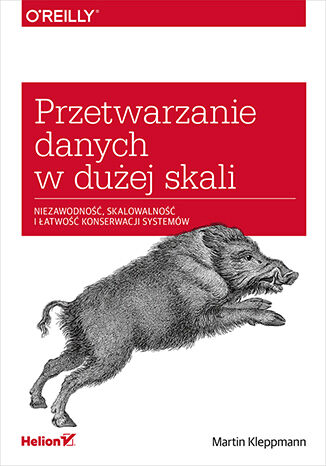
Przetwarzanie danych w dużej skali. Niezawodność, skalowalność i łatwość konserwacji systemów
Martin Kleppmann
Przetwarzanie i bezpieczne przechowywanie danych absorbuje uwagę inżynierów oprogramowania w coraz większym stopniu. W ostatnich latach pojawiło się wiele bardzo różnych rozwiązań w dziedzinie baz danych, systemów rozproszonych i metodyce budowania aplikacji. Sprzyjają temu zarówno rozwój technologii, rosnące potrzeby dotyczące dostępu do danych, jak i malejąca tolerancja na przestoje spowodowane awarią czy konserwacją systemu. To wszystko sprawia, że zespoły projektujące aplikacje muszą cały czas aktualizować swoją wiedzę i znakomicie orientować się w zakresie słabych i silnych stron poszczególnych rozwiązań oraz możliwości ich stosowania. I właśnie ta książka Ci to ułatwi. Dzięki niej zaczniesz orientować się w świecie szybko zmieniających się technologii przetwarzania i przechowywania danych. Znajdziesz tu przykłady skutecznych systemów spełniających wymogi skalowalności, wydajności i niezawodności. Zapoznasz się z wewnętrznymi mechanizmami tych systemów, analizami najważniejszych algorytmów, omówieniem zasad działania i koniecznymi kompromisami. Przy okazji przyswoisz sobie przydatne sposoby myślenia o systemach danych. W ten sposób rozwiniesz dobre intuicyjne zrozumienie tego, jak i dlaczego działają systemy, co pozwoli Ci analizować ich pracę, podejmować trafne decyzje projektowe i wyszukiwać źródła pojawiających się problemów. W tej książce między innymi: co to właściwie znaczy: niezawodność, skalowalność i łatwość konserwacji różne modele danych i obsługa zapytań replikacja, dzielenie danych, transakcje dane pochodne i ich przetwarzanie przetwarzanie strumieniowe Poznaj systemy, w których liczą się dane!

David Routin, Simon Thoores, Samuel Rossier
With small to large companies focusing on hardening their security systems, the term purple team has gained a lot of traction over the last couple of years. Purple teams represent a group of individuals responsible for securing an organization’s environment using both red team and blue team testing and integration – if you’re ready to join or advance their ranks, then this book is for you. Purple Team Strategies will get you up and running with the exact strategies and techniques used by purple teamers to implement and then maintain a robust environment. You’ll start with planning and prioritizing adversary emulation, and explore concepts around building a purple team infrastructure as well as simulating and defending against the most trendy ATT&CK tactics. You’ll also dive into performing assessments and continuous testing with breach and attack simulations. Once you’ve covered the fundamentals, you'll also learn tips and tricks to improve the overall maturity of your purple teaming capabilities along with measuring success with KPIs and reporting.With the help of real-world use cases and examples, by the end of this book, you'll be able to integrate the best of both sides: red team tactics and blue team security measures.
pytest Quick Start Guide. Write better Python code with simple and maintainable tests
Bruno Oliveira
Python's standard unittest module is based on the xUnit family of frameworks, which has its origins in Smalltalk and Java, and tends to be verbose to use and not easily extensible.The pytest framework on the other hand is very simple to get started, but powerful enough to cover complex testing integration scenarios, being considered by many the true Pythonic approach to testing in Python.In this book, you will learn how to get started right away and get the most out of pytest in your daily work?ow, exploring powerful mechanisms and plugins to facilitate many common testing tasks. You will also see how to use pytest in existing unittest-based test suites and will learn some tricks to make the jump to a pytest-style test suite quickly and easily.
Python Digital Forensics Cookbook. Effective Python recipes for digital investigations
Chapin Bryce, Preston Miller
Technology plays an increasingly large role in our daily lives and shows no sign of stopping. Now, more than ever, it is paramount that an investigator develops programming expertise to deal with increasingly large datasets. By leveraging the Python recipes explored throughout this book, we make the complex simple, quickly extracting relevant information from large datasets. You will explore, develop, and deploy Python code and libraries to provide meaningful results that can be immediately applied to your investigations. Throughout the Python Digital Forensics Cookbook, recipes include topics such as working with forensic evidence containers, parsing mobile and desktop operating system artifacts, extracting embedded metadatafrom documents and executables, and identifying indicators of compromise. Youwill also learn to integrate scripts with Application Program Interfaces (APIs) suchas VirusTotal and PassiveTotal, and tools such as Axiom, Cellebrite, and EnCase. By the end of the book, you will have a sound understanding of Python and how you can use it to process artifacts in your investigations.
Fahad Ali Sarwar
Penetration testing enables you to evaluate the security or strength of a computer system, network, or web application that an attacker can exploit. With this book, you'll understand why Python is one of the fastest-growing programming languages for penetration testing. You'll find out how to harness the power of Python and pentesting to enhance your system security.Developers working with Python will be able to put their knowledge and experience to work with this practical guide. Complete with step-by-step explanations of essential concepts and practical examples, this book takes a hands-on approach to help you build your own pentesting tools for testing the security level of systems and networks. You'll learn how to develop your own ethical hacking tools using Python and explore hacking techniques to exploit vulnerabilities in networks and systems. Finally, you'll be able to get remote access to target systems and networks using the tools you develop and modify as per your own requirements.By the end of this ethical hacking book, you'll have developed the skills needed for building cybersecurity tools and learned how to secure your systems by thinking like a hacker.
Hussam Khrais
Python is an easy-to-learn and cross-platform programming language that has unlimited third-party libraries. Plenty of open source hacking tools are written in Python, which can be easily integrated within your script.This book is packed with step-by-step instructions and working examples to make you a skilled penetration tester. It is divided into clear bite-sized chunks, so you can learn at your own pace and focus on the areas of most interest to you. This book will teach you how to code a reverse shell and build an anonymous shell. You will also learn how to hack passwords and perform a privilege escalation on Windows with practical examples. You will set up your own virtual hacking environment in VirtualBox, which will help you run multiple operating systems for your testing environment.By the end of this book, you will have learned how to code your own scripts and mastered ethical hacking from scratch.
José Manuel Ortega
Python’s latest updates add numerous libraries that can be used to perform critical security-related missions, including detecting vulnerabilities in web applications, taking care of attacks, and helping to build secure and robust networks that are resilient to them. This fully updated third edition will show you how to make the most of them and improve your security posture.The first part of this book will walk you through Python scripts and libraries that you’ll use throughout the book. Next, you’ll dive deep into the core networking tasks where you will learn how to check a network’s vulnerability using Python security scripting and understand how to check for vulnerabilities in your network – including tasks related to packet sniffing. You’ll also learn how to achieve endpoint protection by leveraging Python packages along with writing forensics scripts.The next part of the book will show you a variety of modern techniques, libraries, and frameworks from the Python ecosystem that will help you extract data from servers and analyze the security in web applications. You’ll take your first steps in extracting data from a domain using OSINT tools and using Python tools to perform forensics tasks.By the end of this book, you will be able to make the most of Python to test the security of your network and applications.
Python Network Programming. Conquer all your networking challenges with the powerful Python language
Abhishek Ratan, Eric Chou, Pradeeban Kathiravelu, Dr....
This Learning Path highlights major aspects of Python network programming such as writing simple networking clients, creating and deploying SDN and NFV systems, and extending your network with Mininet. You’ll also learn how to automate legacy and the latest network devices. As you progress through the chapters, you’ll use Python for DevOps and open source tools to test, secure, and analyze your network. Toward the end, you'll develop client-side applications, such as web API clients, email clients, SSH, and FTP, using socket programming.By the end of this Learning Path, you will have learned how to analyze a network's security vulnerabilities using advanced network packet capture and analysis techniques. This Learning Path includes content from the following Packt products:• Practical Network Automation by Abhishek Ratan • Mastering Python Networking by Eric Chou • Python Network Programming Cookbook, Second Edition by Pradeeban Kathiravelu, Dr. M. O. Faruque Sarker