
Informatyka
Zajrzyj do kategorii Informatyka w księgarni internetowej Ebookpoint. Znajdziesz tutaj bestsellerowe książki, ebooki i kursy video z branży IT. Sięgnij po najlepszą literaturę dla specjalistów i rozwijaj doświadczenie, które już posiadasz, lub rozpocznij swoją przygodę z programowaniem, cyberbezpieczeństwem lub grafiką komputerową. Pogłębiaj swoją wiedzę tak, jak Ci wygodnie - z tradycyjną książką, wygodnym ebookiem lub nowoczesnym videokursem. Sprawdź, jakie tytuły znajdziesz w kategorii Informatyka!
Docker Deep Dive. Zero to Docker in a Single Book - Second Edition
Nigel Poulton
Most applications, even the funky cloud-native microservices ones, need high-performance, production-grade infrastructure to run on. Having impeccable knowledge of Docker will help you thrive in the modern cloud-first world. With this book, you will gain the skills you need in order to work with Docker and its containers.The book begins with an introduction to containers and explains their functionality and application in the real world. You will then get an overview of VMware, Kubernetes, and Docker and learn to install Docker on Windows, Mac, and Linux. Once you have understood the Ops and Dev perspective of Docker, you will be able to see the big picture and understand what Docker exactly does. The book then turns its attention to the more technical aspects, guiding you through practical exercises covering Docker engine, Docker images, and Docker containers. You will learn techniques for containerizing an app, deploying apps with Docker Compose, and managing cloud-native applications with Swarm. You will also build Docker networks and Docker overlay networks and handle applications that write persistent data. Finally, you will deploy apps with Docker stacks and secure your Docker environment.By the end of this book, you will be well-versed in Docker and containers and have developed the skills to create, deploy, and run applications on the cloud.
Docker Deep Dive. Zero to Docker in a single book - Third Edition
Nigel Poulton
Embark on a transformative journey into the world of Docker and containers with this expertly crafted course. Starting with a high-level overview, you'll gain a solid understanding of containers and the significance of Docker in modern software development. Delve into Docker's core components, exploring essential standards, projects, and the intricacies of the Docker Engine, ensuring a robust foundation.As you progress, practical hands-on modules will guide you through working with images and containers, containerizing applications, and managing multi-container setups using Docker Compose. You'll learn to deploy applications efficiently with Docker Swarm and Docker Stacks, enhancing your ability to manage and scale containerized applications. The course also introduces Docker's integration with WebAssembly, offering a glimpse into cutting-edge container technologies.Concluding with advanced topics, you'll master Docker networking, including overlay networks and persistent data management with volumes. Emphasis on Docker security ensures you can safeguard your applications and data effectively. By the end of this course, you'll possess the skills and knowledge to leverage Docker's full capabilities, from development to deployment, ensuring you remain at the forefront of container technology.
Chanwit Kaewkasi
Serverless applications have gained a lot of popularity among developers and are currently the buzzwords in the tech market. Docker and serverless are two terms that go hand-in-hand.This book will start by explaining serverless and Function-as-a-Service (FaaS) concepts, and why they are important. Then, it will introduce the concepts of containerization and how Docker fits into the Serverless ideology. It will explore the architectures and components of three major Docker-based FaaS platforms, how to deploy and how to use their CLI. Then, this book will discuss how to set up and operate a production-grade Docker cluster. We will cover all concepts of FaaS frameworks with practical use cases, followed by deploying and orchestrating these serverless systems using Docker. Finally, we will also explore advanced topics and prototypes for FaaS architectures in the last chapter.By the end of this book, you will be in a position to build and deploy your own FaaS platform using Docker.
Docker on Amazon Web Services. Build, deploy, and manage your container applications at scale
Justin Menga
Over the last few years, Docker has been the gold standard for building and distributing container applications. Amazon Web Services (AWS) is a leader in public cloud computing, and was the first to offer a managed container platform in the form of the Elastic Container Service (ECS).Docker on Amazon Web Services starts with the basics of containers, Docker, and AWS, before teaching you how to install Docker on your local machine and establish access to your AWS account. You'll then dig deeper into the ECS, a native container management platform provided by AWS that simplifies management and operation of your Docker clusters and applications for no additional cost. Once you have got to grips with the basics, you'll solve key operational challenges, including secrets management and auto-scaling your infrastructure and applications. You'll explore alternative strategies for deploying and running your Docker applications on AWS, including Fargate and ECS Service Discovery, Elastic Beanstalk, Docker Swarm and Elastic Kubernetes Service (EKS). In addition to this, there will be a strong focus on adopting an Infrastructure as Code (IaC) approach using AWS CloudFormation.By the end of this book, you'll not only understand how to run Docker on AWS, but also be able to build real-world, secure, and scalable container platforms in the cloud.
Docker on Windows. From 101 to production with Docker on Windows
Elton Stoneman
Docker is a platform for running server applications in lightweight units called containers. You can run Docker on Windows Server 2016 and Windows 10, and run your existing apps in containers to get significant improvements in efficiency, security, and portability. This book teaches you all you need to know about Docker on Windows, from 101 to deploying highly-available workloads in production. This book takes you on a Docker journey, starting with the key concepts and simple examples of how to run .NET Framework and .NET Core apps in Windows Docker containers. Then it moves on to more complex examples—using Docker to modernize the architecture and development of traditional ASP.NET and SQL Server apps.The examples show you how to break up monoliths into distributed apps and deploy them to a clustered environment in the cloud, using the exact same artifacts you use to run them locally. To help you move confidently to production, it then explains Docker security, and the management and support options. The book finishes with guidance on getting started with Docker in your own projects, together with some real-world case studies for Docker implementations, from small-scale on-premises apps to very large-scale apps running on Azure.
Docker on Windows. From 101 to production with Docker on Windows - Second Edition
Elton Stoneman
Docker on Windows, Second Edition teaches you all you need to know about Docker on Windows, from the 101 to running highly-available workloads in production. You’ll be guided through a Docker journey, starting with the key concepts and simple examples of .NET Framework and .NET Core apps in Docker containers on Windows. Then you’ll learn how to use Docker to modernize the architecture and development of traditional ASP.NET and SQL Server apps.The examples show you how to break up legacy monolithic applications into distributed apps and deploy them to a clustered environment in the cloud, using the exact same artifacts you use to run them locally. You’ll see how to build a CI/CD pipeline which uses Docker to compile, package, test and deploy your applications. To help you move confidently to production, you’ll learn about Docker security, and the management and support options.The book finishes with guidance on getting started with Docker in your own projects. You’ll walk through some real-world case studies for Docker implementations, from small-scale on-premises apps to very large-scale apps running on Azure.
Randall Smith
Docker orchestration is what you need when transitioning from deploying containers individually on a single host to deploying complex multi-container apps on many machines.This book covers the new orchestration features of Docker 1.12 and helps you efficiently build, test, and deploy your application using Docker. You will be shown how to build multi-container applications using Docker Compose. You will also be introduced to the building blocks for multi-host Docker clusters such as registry, overlay networks, and shared storage using practical examples. This book gives an overview of core tools such as Docker Machine, Swarm, and Compose which will enhance your orchestration skills. You’ll learn how to set up a swarm using the decentralized building block. Next, you’ll be shown how to make the most out of the in-built orchestration feature of Docker engine and you’ll use third-party tools such as Kubernetes, Mesosphere, and CoreOS to orchestrate your existing process. Finally, you will learn to deploy cluster hosts on cloud services and automate your infrastructure.
Docker Quick Start Guide. Learn Docker like a boss, and finally own your applications
Earl Waud
Docker is an open source software platform that helps you with creating, deploying, and running your applications using containers. This book is your ideal introduction to Docker and containerization.You will learn how to set up a Docker development environment on a Linux, Mac, or Windows workstation, and learn your way around all the commands to run and manage your Docker images and containers.You will explore the Dockerfile and learn how to build your own enterprise-grade Docker images. Then you will learn about Docker networks, Docker swarm, and Docker volumes, and how to use these features with Docker stacks in order to define, deploy, and maintain highly-scalable, fault-tolerant multi-container applications.Finally, you will learn how to leverage Docker with Jenkins to automate the building of Docker images and the deployment of Docker containers. By the end of this book, you will be well prepared when it comes to using Docker for your next project.
Pawan Kumar
This is a complete study guide including study material and practice questions to prepare for the EMC Proven Professional certification Exam E20-120. It can also serve Documentum beginners and practitioners as a handy guide and quick reference to the technical fundamentals that is fully up to date for Documentum 5.3. Beginners are introduced to concepts in a logical manner while practitioners can use it as a reference to jump to relevant concepts directly.EMC Documentum is a leading enterprise content management technology platform that helps enterprises to streamline the capture, processing, and distribution of business information including documents, records, e-mails, web content, images, reports, and digital assets. It can also automate entire business processes in accordance with business rules. EMC Proven Professional is an exam-based certification program, which introduced a new EMC Proven Content Management Application Developer (EMCAD) track in early 2007. The first exam in this track is Content Management Foundations (CMF) Associate-level Exam, with exam code E20-120, which tests knowledge about technical fundamentals of Documentum. This book is a study guide to help you prepare for this exam with hundreds of practice questions and an efficient exam-preparation strategy.
Doktryna jakości. Rzecz o skutecznym zarządzaniu
Andrzej Jacek Blikle
"Doktryna jakości" na podium My Company Polska Choice! Książka prof. Andrzeja Bliklego "Doktryna jakości. Rzecz o skutecznym zarządzaniu" zdobyła II miejsce w kategorii "Vademecum przedsiębiorcy" w konkursie My Company Polska Choice. Wyróżnienie dla "Doktryna jakości. Rzecz o skutecznym zarządzaniu" podczas 19. Poznańskich Dni Książki nie tylko Naukowej. ECONOMICUS 2015 - I miejsce w kategorii "Najlepszy poradnik ekonomiczny" Książka dostępna również w twardej oprawie » Nowa filozofia zarządzania Moja książka jest efektem doświadczeń, jakie nabywałem w latach 1990 – 2010, wdrażając zarządzanie jakością (TQM) w mojej rodzinnej firmie, a także ucząc tej metody w innych firmach i na uczelniach wyższych, co zresztą czynię do dziś. Pierwsze wykłady z TQM prowadziłem dla pracowników firmy A.Blikle, a notatki do tych wykładów stanowiły zaczątki Doktryny jakości. Początki oczywiście nie były łatwe. Wiedza konieczna do zarządzania zgodnie z TQM nie jest technicznie trudna, ale jej zaakceptowanie bywa trudne emocjonalnie. Bywa trudne, bo zaraz na samym początku trzeba porzucić wiele przekonań, do których jesteśmy przyzwyczajani niemal od dziecka: że nagrody motywują, że współzawodnictwo jest twórcze, że struktura zarządcza firmy musi być hierarchiczna… Nie było więc łatwo, ale było nadzwyczaj ciekawie, bo czasy pionierskie z zasady charakteryzują się wysokim poziomem zaangażowania. Pamiętam, jak nasz pierwszy nauczyciel TQM, Jim Murray, wyraził zdumienie, że moi pracownicy zgodzili się poświęcić na szkolenie dni wolne od pracy. „W Anglii to by nie było możliwe” - powiedział. Oczywiście na naukach Jima się nie skończyło. Dzięki niemu zacząłem jeździć do Anglii na coroczne konferencje Brytyjskiego Towarzystwa im. Deminga (twórcy TQM), a zdobywaną tam (również za pośrednictwem wielu znakomitych książek) wiedzę niezwłocznie przekazywałem moim pracownikom prowadząc dla nich wykłady. Materiały do książki rosły, a na wykłady zaczęli przychodzić słuchacze spoza firmy. I tak narodziło się moje konwersatorium z TQM, które prowadzę od roku 1997 raz w miesiącu od października do czerwca. Wstęp wolny, a informacje o programie można znaleźć na mojej witrynie www.moznainaczej.com.pl. To taka moja prywatna misja, gdyż uważam, że TQM może być wielką szansą dla polskiej gospodarki. Patroni wydania:
Doktryna jakości. Rzecz o turkusowej samoorganizacji. Wydanie III
Andrzej Jacek Blikle
Doktryna jakości Andrzeja J. Bliklego to projekt rozpisany na lata. Autor, profesor matematyki i dyplomowany mistrz cukierniczy, przez dwie dekady kierował firmą, której nazwę zna chyba każdy Polak. Równocześnie pracował nad swoim opus magnum. Wciąż nad nim pracuje. Książka ta bowiem zmienia się zgodnie z tym, jaką ścieżką podąża myślenie o zarządzaniu jakością nie tylko w naszym kraju, ale przede wszystkim na świecie. Andrzej J. Blikle wychodzi z założenia, że nie może być mowy o skutecznym zarządzaniu bez położenia nacisku na jakość produktu i usługi, jakie się proponuje klientowi. Co więcej, nie ma mowy o wysokiej jakości bez dobrych, równorzędnych relacji w pracy. Stąd w kolejnym wydaniu swojej książki tak silny nacisk kładzie na zarządzanie turkusowe, czyli swego rodzaju partnerską demokrację - wolność, zaufanie, partnerstwo i współpracę wewnątrz organizacji. Połączenie doświadczeń praktycznych z wiedzą teoretyczną dało rezultat, który może satysfakcjonować zarówno praktyków, jak i teoretyków, a także wszystkich, którzy chcą poznać tajniki skutecznego, efektywnego zarządzania przedsiębiorstwem czy też pogłębiać wiedzę na ten temat. Autor w atrakcyjnej, przystępnej formie narracyjnej kompleksowo przedstawia zawiłości zarządzania przedsiębiorstwem, wskazując na źródła sukcesu, ale i na przyczyny, podłoże porażek. Przedstawia przy tym te kwestie w ujęciu interdyscyplinarnym, co sprzyja wnikliwości wywodów i pogłębionym refleksjom. Elżbieta Mączyńska, Szkoła Główna Handlowa w Warszawie, fragment recenzji Gospodarka nadmiaru versus doktryna jakości
Matthew Boyle
Domain-driven design (DDD) is one of the most sought-after skills in the industry. This book provides you with step-by-step explanations of essential concepts and practical examples that will see you introducing DDD in your Go projects in no time. Domain-Driven Design with Golang starts by helping you gain a basic understanding of DDD, and then covers all the important patterns, such as bounded context, ubiquitous language, and aggregates. The latter half of the book deals with the real-world implementation of DDD patterns and teaches you how to build two systems while applying DDD principles, which will be a valuable addition to your portfolio. Finally, you’ll find out how to build a microservice, along with learning how DDD-based microservices can be part of a greater distributed system. Although the focus of this book is Golang, by the end of this book you’ll be able to confidently use DDD patterns outside of Go and apply them to other languages and even distributed systems.
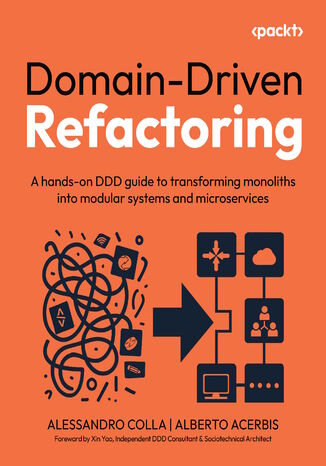
Alessandro Colla, Alberto Acerbis, Xin Yao
As software development continues to grow, mastering domain-driven design (DDD) will help transform your approach to complex systems. Filled with actionable insights and practical examples, this book is your essential guide to implementing DDD principles, covering its key concepts and practical applications in modern architecture.Alessandro, an eCommerce specialist and DDD expert with 30 years of experience, and Alberto, a dedicated backend developer, tap into their extensive expertise to help you refactor your monolith into a modular structure, whether it be evolving into microservices or enhancing a maintainable monolith, resulting in a system that adapts to changing business needs and non-functional requirements.You’ll explore vital DDD patterns like strategic design with bounded contexts and ubiquitous language, improving communication between technical and domain experts. The chapters take you through modeling techniques to manage complexity and increase flexibility, while also addressing microservices integration, including inter-service communication, transaction management, and data strategies.By the end of this book, you’ll be able to decompose a monolith and refine its architecture for adaptability, all while ensuring business logic remains central to your software design and development.
Dick McCarrick, Stephen Cooke, Timothy Speed, Raphael...
Written by Lotus insiders, the book provides a practical guide to developing applications making use of the important features and enhancements introduced in Notes/Domino 7. These experienced experts use their own experiences to map out the benefits you could gain, and the dangers you may face, as you develop Domino applications in your business. Written by specific experts, edited and overseen by Lotus content generator Dick McCarrick, this book is the definitive guide to developing Domino 7 applications. TECHNOLOGYDomino is an application server that can be used as a standalone web server or as the server component of IBM's Lotus Domino product which provides a powerful collaborative platform for development of customized business applications. It also provides enterprise-grade email, messaging, and scheduling capabilities.
Domowe laboratorium naukowe. Zrób to sam
Windell Oskay (Author), Raymond Barrett (Contributor)
Doświadczenia w laboratorium są świetnym pomysłem na urozmaicenie zajęć z wielu przedmiotów nauk przyrodniczych. Tam zainteresowanie fizyką, biologią czy chemią w niezwykle łatwo przeobraża się w pasję, która odpowiednio rozwijana może zaprowadzić do prawdziwego naukowego odkrycia! Dzięki zajęciom w laboratorium nawet najtrudniejsze zagadnienia stają się zrozumiałe i przystępne. Dla wielu młodych pasjonatów nauki własne laboratorium to wymarzone miejsce na eksperymenty. Książka, którą trzymasz w rękach, pozwoli Ci spełnić to marzenie! Dzięki niej zbudujesz własne laboratorium badawcze, podobnie jak zrobili to Newton, Faraday czy Pasteur. Dowiesz się, jak zaprojektować i zbudować przyrządy pomiarowe i sprzęt laboratoryjny, aby za ich pomocą poznawać fascynujące prawa przyrody. Poradzisz sobie nawet z dość złożonymi urządzeniami (jak łukowy piec węglowy lub generator wodoru) i przygotujesz wszystko, co jest potrzebne naukowcowi. W tej książce znajdziesz wskazówki i porady: jak zorganizować i gdzie zlokalizować laboratorium jak samodzielnie wykonać sprzęt i przyrządy laboratoryjne jak przygotować się do przeprowadzenia eksperymentu jak przeprowadzać eksperyment jak zdobyć trudno dostępne materiały i substancje oraz jak je można zastąpić jak uniknąć niebezpiecznych sytuacji i jakie przedsięwziąć środki zapobiegawcze Przekonaj się, czy potrafisz pracować jak naukowiec! Raymond E. Barrett (1926 – 2011) przez wiele lat był dyrektorem edukacyjnym w muzeum OMSI (Oregon Museum of Science and Industry). Jego pasją było wzbudzanie u najmłodszych fascynacji nauką przez pokazywanie im eksperymentów naukowych. Windell Oskay jest doktorem fizyki. Był inżynierem projektowym sprzętu w Stanford Research Systems. Był też współzałożycielem Evil Mad Scientist Laboratories, firmy z Doliny Krzemowej, zajmującej się od 2007 roku projektowaniem i produkcją wyspecjalizowanych elementów elektronicznych oraz zestawów do budowy robotów.
Domowe lekcje matematyki. Klasy 4-6
Danuta Zaremba
Twoje dziecko wreszcie zrozumie matematykę! Matematyka nie jest łatwa, wielu uczniów uważa ją za najtrudniejszy przedmiot w szkole. Nierzadko sprawia problemy także tym, którzy jej uczą - nie jest łatwo przygotować lekcje tak, aby uczynić zrozumiałym to, co zrozumieć trudno. Autorka tej książki sama się o tym przekonała, gdy pracowała jako nauczycielka. Teraz dzieli się swoimi pomysłami, jak efektywnie uczyć matematyki w szkole podstawowej. Zawarty w proponowanych scenariuszach lekcji materiał nauczania jest określony podstawą programową nauczania matematyki w szkole podstawowej. Domowe lekcje matematyki to propozycja dla opiekunów, którzy chcą pomóc dzieciom w zrozumieniu matematyki. Każdej lekcji towarzyszą starannie dobrane do tematu ćwiczenia, za pomocą których autorka pokazuje, w jaki sposób rozmawiać z podopiecznym i jakie pytania mu zadawać, aby dostrzegł istotę omawianego zagadnienia. A w efekcie - zrozumiał matematykę, bo, jak twierdzi francuski filozof Alain Badiou, "bez matematyki jesteśmy ślepi". Arytmetyka liczb naturalnych Długość i kąty Ułamki zwykłe i dziesiętne Trójkąty, czworokąty i wielokąty Bryły Liczby ujemne i dodatnie Elementy algebry Odpowiedzi do zadań dostepne są pod tym linkiem.