
Wydawca: Packt Publishing
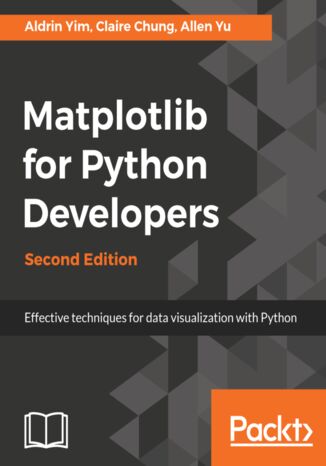
Aldrin Yim, Claire Chung, Allen Yu
Python is a general-purpose programming language increasingly being used for data analysis and visualization. Matplotlib is a popular data visualization package in Python used to design effective plots and graphs. This is a practical, hands-on resource to help you visualize data with Python using the Matplotlib library. Matplotlib for Python Developers, Second Edition shows you how to create attractive graphs, charts, and plots using Matplotlib. You will also get a quick introduction to third-party packages, Seaborn, Pandas, Basemap, and Geopandas, and learn how to use them with Matplotlib. After that, you’ll embed and customize your plots in third-party tools such as GTK+3, Qt 5, and wxWidgets. You’ll also be able to tweak the look and feel of your visualization with the help of practical examples provided in this book. Further on, you’ll explore Matplotlib 2.1.x on the web, from a cloud-based platform using third-party packages such as Django. Finally, you will integrate interactive, real-time visualization techniques into your current workflow with the help of practical real-world examples.By the end of this book, you’ll be thoroughly comfortable with using the popular Python data visualization library Matplotlib 2.1.x and leveraging its power to build attractive, insightful, and powerful visualizations.
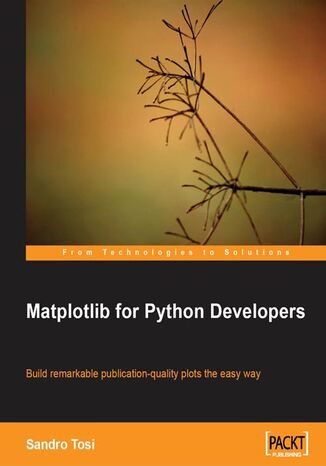
Sandro Tosi
Providing appealing plots and graphs is an essential part of various fields such as scientific research, data analysis, and so on. Matplotlib, the Python 2D plotting library, is used to produce publication-quality figures in a variety of hardcopy formats and interactive environments across platforms. This book explains creating various plots, histograms, power spectra, bar charts, error charts, scatter-plots and much more using the powerful Matplotlib library to get impressive out-of-the-box results.This book gives you a comprehensive tour of the key features of the Matplotlib Python 2D plotting library, right from the simplest concepts to the most advanced topics. You will discover how easy it is to produce professional-quality plots when you have this book to hand.The book introduces the library in steps. First come the basics: introducing what the library is, its important prerequisites (and terminology), installing and configuring Matplotlib, and going through simple plots such as lines, grids, axes, and charts. Then we start with some introductory examples, and move ahead by discussing the various programming styles that Matplotlib allows, and several key features.Further, the book presents an important section on embedding applications. You will be introduced to three of the best known GUI libraries 'GTK+, Qt, and wxWidgets' and presented with the steps to implement to include Matplotlib in an application written using each of them. You will learn through an incremental approach: from a simple example that presents the peculiarities of the GUI library, to more complex ones, using GUI designer tools.Because the Web permeates all of our activities, a part of the book is dedicated to showing how Matplotlib can be used in a web environment, and another section focuses on using Matplotlib with common Python web frameworks, namely, Pylons and Django. Last, but not least, you will go through real-world examples, where you will see some real situations in which you can use Matplotlib.
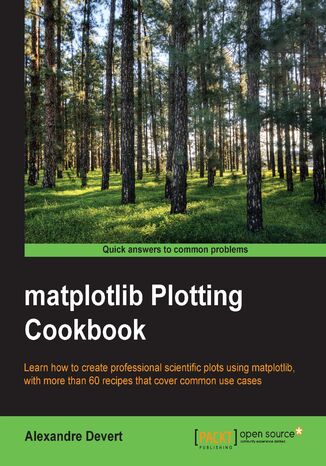
Alexandre Devert
This book follows a cookbook style approach that puts orthogonal and non-redundant recipes in your hands. Rather than rehashing the user manual, the explanations expose the underlying logic behind Matplotlib. If you are an engineer or scientist who wants to create great visualizations with Python, rather than yet another specialized language, this is the book for you. While there are several very competent plotting packages, Matplotlib is “just” a Python module. Thus, if you know some Python already, you will feel at home from the first steps on. In case you are an application writer, you won't be left out since the integration of Matplolib is covered.
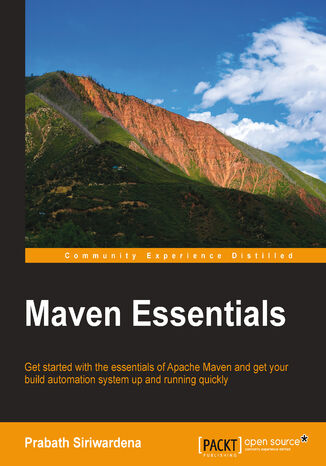
Prabath Siriwardena
Maven is the #1 build tool used by developers and it has been around for more than a decade. Maven stands out among other build tools due to its extremely extensible architecture, which is built on of the concept of convention over configuration. It’s widely used by many open source Java projects under Apache Software Foundation, Sourceforge, Google Code, and more.Maven Essentials is a fast-paced guide to show you the key concepts in Maven and build automation. We get started by introducing you to Maven and exploring its core concepts and architecture. Next, you will learn about and write a Project Object Model (POM) while creating your own Maven project. You will also find out how to create custom archetypes and plugins to establish the most common goals in build automation. After this, you’ll get to know how to design the build to prevent any maintenance nightmares, with proper dependency management. We then explore Maven build lifecycles and Maven assemblies. Finally, you will discover how to apply the best practices when designing a build system to improve developer productivity.
Grady Brett Beaubouef
Using packaged software for Customer Relationship Management or Enterprise Resource Planning is often seen as a sure-fire way to reduce costs, refocus scarce resources, and increase returns on investment. However, research shows that the majority of packaged or Commercial Off-The-Shelf (COTS) implementations fail to provide this value due to the implementation approach taken.Authored by Grady Brett Beaubouef, who has over fifteen years of packaged software implementation experience, this book will help you define an effective implementation strategy for your packaged software investment.The book focuses on Commercial Off-The-Shelf (COTS) implementations, and helps you to successfully implement packaged software. Using a step-by-step approach, it begins with an assessment of the limitations of current implementation methods for packaged software. It then helps you to analyze your requirements and offers 10 must-know principles gleaned from real-world packaged software implementations. These 10 principles cover how to maximize enhancements and minimize customizations, focus on business results, and negotiate for success, and so on. You will learn how to best leverage these principles as part of your implementation. As you progress through the book, you will learn how to put packaged software into action with forethought, planning, and proper execution. Doing so will lead to reductions in implementation costs, customizations, and development time.
Patrick Sarsfield, Brandi Locker
Tableau Server is a business intelligence application that provides a centralized location to store, edit, share, and collaborate on content, such as dashboards and curated data sources. This book gets you up and running with Tableau Server to help you increase end-user engagement for your published work as well as reduce or eliminate redundant tasks.You’ll explore Tableau Server's structure and how to get started by connecting, publishing content, and navigating the software interface. Next, you’ll learn when and how to update the settings of your content at various levels to best utilize Tableau Server’s features. You’ll understand how to interact with the Tableau Server interface to locate, sort, filter, manage and customize content. Later, the book shows you how to leverage other valuable features that enable you and your audience to share, download, and interact with content on Tableau Server. As you progress, you’ll cover principles to increase the performance of your published content. All along, the book shows you how to navigate, interact with, and use Tableau Server with the help of engaging examples and best practices shared by recognized Tableau professionals.By the end of this Tableau book, you’ll have a solid understanding of how to use Tableau Server to manage content, automate tasks, and increase end-user engagement.
Adrian Herbez
Maya is a 3D graphics and animation software, used to develop interactive 3D applications and games with stupendous visual effects. The Maya Programming with Python Cookbook is all about creating fast, powerful automation systems with minimum coding using Maya Python. With the help of insightful and essential recipes, this book will help you improve your modelling skills. Expand your development options and overcome scripting problems encountered whilst developing code in Maya. Right from the beginning, get solutions to complex development concerns faced when implementing as parts of build.
Sasha Kranjac, Vladimir Stefanovic
MCSA: Windows Server 2016 is one of the most sought-after certifications for IT professionals which include working with Windows Server and performing administrative tasks around it. It targets Exam 70-740, Exam 70-741, Exam 70-742 and Exam 70-743 certifications and the demand for these certifications is increasingly high.This book will start with installation, upgrade and migration to Windows Server 2016, cover imaging and deployment and proceed with High Availability and Clustering. Then we will deep dive into fundamental concepts like Core networking, DNS, DHCP, Storage and proceed to Hyper-V, Network Access and Distributed File System. It will also explain Advanced Networking topics such as Software Defined Networking and High-Performance Networking. Furthermore, it will also cover advanced Identity topics in Windows Server 2016 such as Active Directory installation and configuration, Group Policy, Active Directory Certificate Services, and Active Directory Federation Services and Rights Management. Towards the end of this book, test questions and mock preparation items will help in preparing for the certifications with more ease.By the end of this book, you will be able to complete MCSA: Windows Server 2016 certification with more confidence.