
Wydawca: Packt Publishing
Jon Hoffman
Swift has become the number one language used in iOS and macOS development. The Swift standard library is developed using protocol-oriented programming techniques, generics, and first-class value semantics; therefore, every Swift developer should understand these powerful concepts and how to take advantage of them in their application design.This book will help you understand the differences between object-oriented programming and protocol-oriented programming. It will demonstrate how to work with protocol-oriented programming using real-world use cases. You will gain a solid knowledge of the various types that can be used in Swift and the differences between value and reference types. You will be taught how protocol-oriented programming techniques can be used to develop very flexible and easy-to-maintain code.By the end of the book, you will have a thorough understanding of protocol-oriented programming and how to utilize it to build powerful and practical applications.
Giordano Scalzo
This book is intended for those who want to learn to develop apps in Swift the right way. Whether you are an expert Objective-C programmer or new to this platform, you'll learn quickly, grasping the code of real-world apps to use Swift effectively. Prior experience in development for Apple devices would be helpful, but is not mandatory.
Cecil Costa
If you are an experienced Objective-C programmer and are looking for quick solutions to many different coding tasks in Swift, then this book is for you. You are expected to have development experience, though not necessarily with Swift.
Keith Moon, Chris Barker
Swift is an exciting, multi-platform, general-purpose programming language, and with this book, you'll explore the features of its latest version, Swift 5.3.The book begins with an introduction to the basic building blocks of Swift 5.3, its syntax, and the functionalities of Swift constructs. You’ll then discover how Swift Playgrounds provide an ideal platform to write, execute, and debug your Swift code. As you advance through the chapters, the book will show you how to bundle variables into tuples or sets, order your data with an array, store key-value pairs with dictionaries, and use property observers. You’ll also get to grips with the decision-making and control structures in Swift, examine advanced features such as generics and operators, and explore functionalities outside of the standard library. Once you’ve learned how to build iOS applications using UIKit, you'll find out how to use Swift for server-side programming, run Swift on Linux, and investigate Vapor. Finally, you'll discover some of the newest features of Swift 5.3 using SwiftUI and Combine to build adaptive and reactive applications, and find out how to use Swift to build and integrate machine learning models along with Apple’s Vision Framework.By the end of this Swift book, you'll have discovered solutions to boost your productivity while developing code using Swift 5.3.
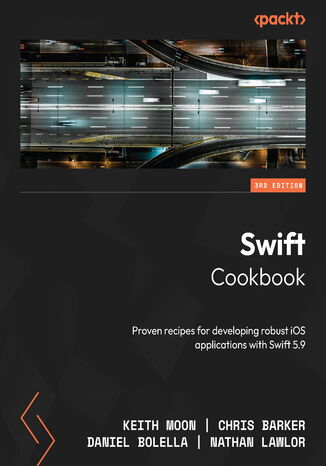
Swift Cookbook. Proven recipes for developing robust iOS applications with Swift 5.9 - Third Edition
Keith Moon, Chris Barker, Daniel Bolella, Nathan...
Unlock the full potential of Swift and elevate your iOS development skills with this new edition of Swift Cookbook, highlighting the latest features in Swift 5.9.This cookbook will take your Swift programming skills to the next level, boosting your productivity and efficiency step by step through a plethora of practical recipes. Although this book is primarily for experienced iOS developers, it provides an introductory overview of Swift 5.9, including its basic building blocks, syntax, and the functionalities of Swift constructs, to get you warmed up. Once you’ve mastered the fundamentals, you’ll get down to business.Unless you’re completely new to Swift, this recipe-based guide doesn’t need to be read in order; you can jump to whichever topic takes your fancy, from UIKit and SwiftUI to advanced UI techniques, from Swift’s control flow and generics to machine learning with Vision, CoreML, and augmented reality with ARKit.By the end of this book, you’ll be fully up to speed with Swift’s capabilities and be able to develop amazing applications across a wide variety of domains.
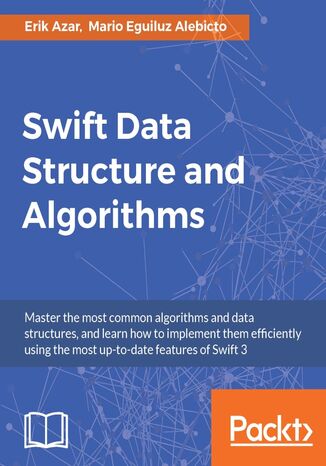
Swift Data Structure and Algorithms. Implement Swift structures and algorithms natively
Erik Azar, Mario Eguiluz Alebicto
Apple’s Swift language has expressive features that are familiar to those working with modern functional languages, but also provides backward support for Objective-C and Apple’s legacy frameworks. These features are attracting many new developers to start creating applications for OS X and iOS using Swift. Designing an application to scale while processing large amounts of data or provide fast and efficient searching can be complex, especially running on mobile devices with limited memory and bandwidth. Learning about best practices and knowing how to select the best data structure and algorithm in Swift is crucial to the success of your application and will help ensure your application is a success. That’s what this book will teach you.Starting at the beginning, this book will cover the basic data structures and Swift types, and introduce asymptotic analysis. You’ll learn about the standard library collections and bridging between Swift and Objective-C collections. You will see how to implement advanced data structures, sort algorithms, work with trees, advanced searching methods, use graphs, and performance and algorithm efficiency. You’ll also see how to choose the perfect algorithm for your problem.
Swift: Developing iOS Applications. Developing iOS Applications
Jon Hoffman, Andrew J Wagner, Giordano Scalzo
The Swift––Developing iOS Applications course will take you on a journey to become an efficient iOS and OS X developer, with the latest trending topic in town. Right from the basics to the advanced level topics, this course would cover everything in detail. We’ll embark our journey by dividing the learning path into four modules. Each of these modules are a mini course in their own right; and as you complete each one, you’ll gain key skills and be ready for the material in the next module.The first module is like a step-by-step guide to programming in Swift 2. Each topic is separated into compressible sections that are full of practical examples and easy-to-understand explanations. Each section builds on the previous topics, so you can develop a proficient and comprehensive understanding of app development in Swift 2. By the end of this module, you’ll have a basic understanding of Swift 2 and its functionalities.The second module will be the an easy-to-follow guide filled with tutorials to show you how to build real-world apps. The difficulty and complexity level increases chapter by chapter. Each chapter is dedicated to build a new app, beginning from a basic and unstyled app through to a full 3D game. The last two chapters show you how to build a complete client-server e-commerce app right from scratch. By the end of these modules, you’ll be able to build well-designed apps, effectively use AutoLayout, develop videogames, and build server apps.The third and the last module of our course will take an example-based approach where each concept covered is supported by example code to not only give you a good understanding of the concept, but also to demonstrate how to properly implement it.
Alex Blewitt
Whether you are a seasoned Objective-C developer or new to the Xcode platform, Swift Essentials will provide you with all you need to know to get started with the language. Prior experience with iOS development is not necessary, but will be helpful to get the most out of the book.