
Verleger: Packt Publishing
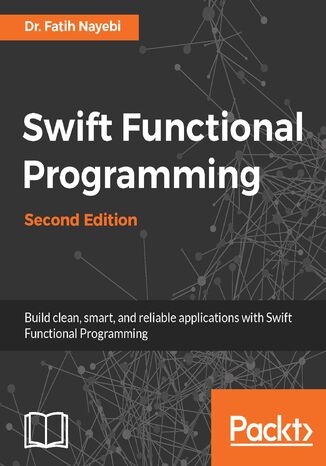
Dr. Fatih Nayebi
Swift is a multi-paradigm programming language enabling you to tackle different problems in various ways. Understanding each paradigm and knowing when and how to utilize and combine them can lead to a better code base. Functional programming (FP) is an important paradigm that empowers us with declarative development and makes applications more suitable for testing, as well as performant and elegant. This book aims to simplify the FP paradigms, making them easily understandable and usable, by showing you how to solve many of your day-to-day development problems using Swift FP.It starts with the basics of FP, and you will go through all the core concepts of Swift and the building blocks of FP. You will also go through important aspects, such as function composition and currying, custom operator definition, monads, functors, applicative functors,memoization, lenses, algebraic data types, type erasure, functional data structures, functional reactive programming (FRP), and protocol-oriented programming(POP). You will then learn to combine those techniques to develop a fully functional iOS application from scratch
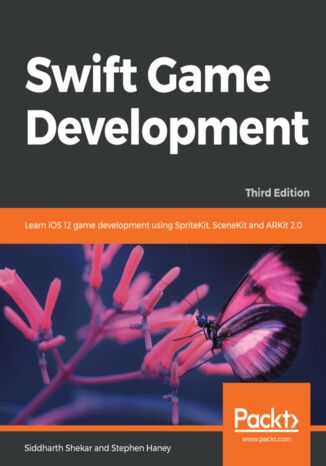
Siddharth Shekar, Stephen Haney
Swift is the perfect choice for game development. Developers are intrigued by Swift and want to make use of new features to develop their best games yet. Packed with best practices and easy-to-use examples, this book leads you step by step through the development of your first Swift game.The book starts by introducing Swift's best features – including its new ones for game development. Using SpriteKit, you will learn how to animate sprites and textures. Along the way, you will master physics, animations, and collision effects and how to build the UI aspects of a game. You will then work on creating a 3D game using the SceneKit framework. Further, we will look at how to add monetization and integrate Game Center. With iOS 12, we see the introduction of ARKit 2.0. This new version allows us to integrate shared experiences such as multiplayer augmented reality and persistent AR that is tied to a specific location so that the same information can be replicated on all connected devices. In the next section, we will dive into creating Augmented Reality games using SpriteKit and SceneKit. Then, finally, we will see how to create a Multipeer AR project to connect two devices, and send and receive data back and forth between those devices in real time.By the end of this book, you will be able to create your own iOS games using Swift and publish them on the iOS App Store.
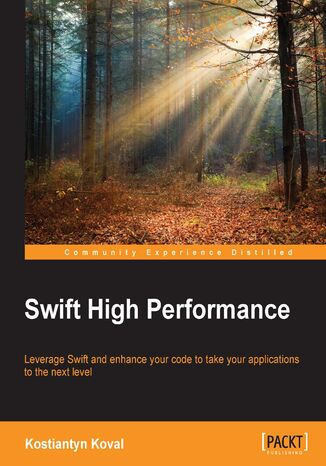
Kostiantyn Koval
Swift is one of the most popular and powerful programming languages for building iOS and Mac OS applications, and continues to evolve with new features and capabilities. Swift is considered a replacement to Objective-C and has performance advantages over Objective-C and Python. Swift adopts safe programming patterns and adds modern features to make programming easier, more flexible, and more fun.Develop Swift and discover best practices that allow you to build solid applications and optimize their performance.First, a few of performance characteristics of Swift will be explained. You will implement new tools available in Swift, including Playgrounds and REPL. These will improve your code efficiency, enable you to analyse Swift code, and enhance performance. Next, the importance of building solid applications using multithreading concurrency and multi-core device architecture is covered, before moving on to best practices and techniques that you should utilize when building high performance applications, such as concurrency and lazy-loading. Finally, you will explore the underlying structure of Swift further, and learn how to disassemble and compile Swift code.
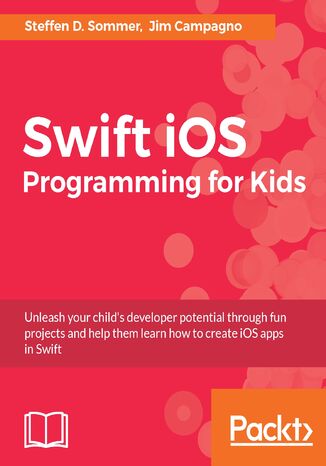
Swift iOS Programming for Kids. Help your kids build simple and engaging applications with Swift 3.0
Steffen D. Sommer, Jim Campagno
This book starts at the beginning by introducing programming through easy to use examples with the Swift Playgrounds app. Kids are regularly encouraged to explore and play with new concepts to support knowledge acquisition and retention – these newly learned skills can then be used to express their own unique ideas. Children will be shown how to create their first iOS application and build their very own movie night application.
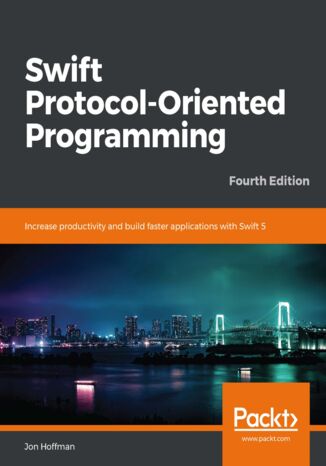
Jon Hoffman
Protocol-oriented programming is an incredibly powerful concept at the heart of Swift's design. Swift's standard library was developed using POP techniques, generics, and first-class value semantics; therefore, it is important for every Swift developer to understand these core concepts and take advantage of them. The fourth edition of this book is improved and updated to the latest version of the Swift programming language.This book will help you understand what protocol-oriented programming is all about and how it is different from other programming paradigms such as object-oriented programming. This book covers topics such as generics, Copy-On-Write, extensions, and of course protocols. It also demonstrates how to use protocol-oriented programming techniques via real-world use cases. By the end of this book, you will know how to use protocol-oriented programming techniques to build powerful and practical applications.
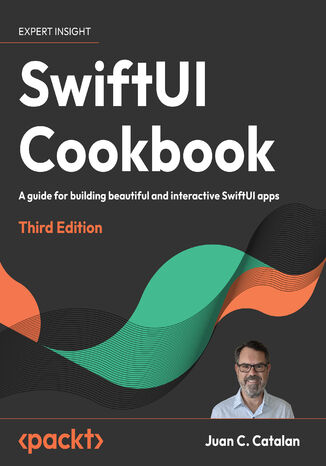
SwiftUI Cookbook. A guide for building beautiful and interactive SwiftUI apps - Third Edition
Juan C. Catalan
SwiftUI is the modern way to build user interfaces for iOS, macOS, and watchOS. It provides a declarative and intuitive way to create beautiful and interactive user interfaces. The new edition of this comprehensive cookbook includes a fully updated repository for SwiftUI 5, iOS 17, Xcode 15, and Swift 5.9. With this arsenal, it teaches you everything you need to know to build beautiful and interactive user interfaces with SwiftUI 5, from the basics to advanced topics like custom modifiers, animations, and state management.In this new edition, you will dive into the world of creating powerful data visualizations with a new chapter on Swift Charts and how to seamlessly integrate charts into your SwiftUI apps. Further, you will be able to unleash your creativity with advanced controls, including multi-column tables and two-dimensional layouts. You can explore new modifiers for text, images, and shapes that give you more control over the appearance of your views.You will learn how to develop apps for multiple platforms, including iOS, macOS, watchOS, and more.With expert insights, real-world examples, and a recipe-based approach, you’ll be equipped to build remarkable SwiftUI apps that stand out in today’s competitive market.
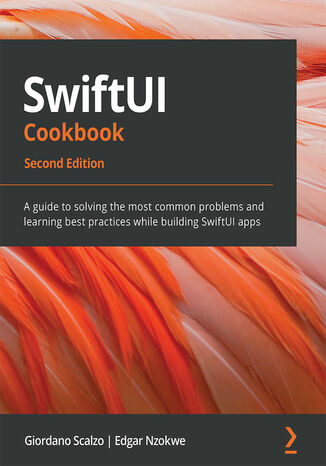
Giordano Scalzo, Edgar Nzokwe
SwiftUI provides an innovative and simple way to build beautiful user interfaces (UIs) for all Apple platforms, from iOS and macOS through to watchOS and tvOS, using the Swift programming language. In this recipe-based cookbook, you’ll cover the foundations of SwiftUI as well as the new SwiftUI 3 features introduced in iOS 15 and explore a range of essential techniques and concepts that will help you through the development process.The cookbook begins by explaining how to use basic SwiftUI components. Once you’ve learned the core concepts of UI development, such as Views, Controls, Lists, and ScrollViews, using practical implementations in Swift, you'll advance to adding useful features to SwiftUI using drawings, built-in shapes, animations, and transitions. You’ll understand how to integrate SwiftUI with exciting new components in the Apple development ecosystem, such as Combine for managing events and Core Data for managing app data. Finally, you’ll write iOS, macOS, and watchOS apps by sharing the same SwiftUI codebase.By the end of this SwiftUI book, you'll have discovered a range of simple, direct solutions to common problems encountered when building SwiftUI apps.
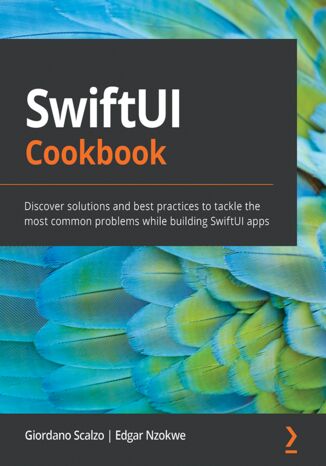
Giordano Scalzo, Edgar Nzokwe
SwiftUI is an innovative and simple way to build beautiful user interfaces (UIs) for all Apple platforms, right from iOS and macOS through to watchOS and tvOS, using the Swift programming language. In this recipe-based book, you’ll work with SwiftUI and explore a range of essential techniques and concepts that will help you through the development process. The recipes cover the foundations of SwiftUI as well as the new SwiftUI 2.0 features introduced in iOS 14. Other recipes will help you to make some of the new SwiftUI 2.0 components backward-compatible with iOS 13, such as the Map View or the Sign in with Apple View.The cookbook begins by explaining how to use basic SwiftUI components. Then, you’ll learn the core concepts of UI development such as Views, Controls, Lists, and ScrollViews using practical implementation in Swift. By learning drawings, built-in shapes, and adding animations and transitions, you’ll discover how to add useful features to the SwiftUI. When you’re ready, you’ll understand how to integrate SwiftUI with exciting new components in the Apple development ecosystem, such as Combine for managing events and Core Data for managing app data. Finally, you’ll write iOS, macOS, and watchOS apps while sharing the same SwiftUI codebase.By the end of this SwiftUI book, you'll have discovered a range of simple, direct solutions to common problems found in building SwiftUI apps.