
Analiza danych
Nagaraj Venkatesan
Business Intelligence (BI) tools like Power BI are used by a wide range of professionals, creating diverse and complex scenarios, and finding the right solution can be daunting, especially when multiple approaches exist for a single use case. The author distills his 17 years of experience on various data platform technologies in this book to walk you through various Power BI usage scenarios.The book is structured around Power BI usage scenarios, such as developing solutions for corporate BI reporting, self-service BI reporting, and Power BI for data scientists and independent software vendors (ISVs). Each part highlights common data issues encountered in the usage scenario, the correct approach to solve the problems, and supporting technical guidance. The chapters also introduce you to some of the latest enhancements in Power BI, such as Microsoft Fabric integration with Power BI, AI features like Copilot, Power BI Git integration, and Power BI Governance features.By the end of this book, you’ll have learned how to design optimal solutions using Power BI components and pick the right tool for the job, while adhering to security and performance best practices.*Email sign-up and proof of purchase required
Anand Deshpande, Manish Kumar, Albenzo Coletta, Giancarlo...
In this age of big data, companies have larger amount of consumer data than ever before, far more than what the current technologies can ever hope to keep up with. However, Artificial Intelligence closes the gap by moving past human limitations in order to analyze data.With the help of Artificial Intelligence for big data, you will learn to use Machine Learning algorithms such as k-means, SVM, RBF, and regression to perform advanced data analysis. You will understand the current status of Machine and Deep Learning techniques to work on Genetic and Neuro-Fuzzy algorithms. In addition, you will explore how to develop Artificial Intelligence algorithms to learn from data, why they are necessary, and how they can help solve real-world problems.By the end of this book, you'll have learned how to implement various Artificial Intelligence algorithms for your big data systems and integrate them into your product offerings such as reinforcement learning, natural language processing, image recognition, genetic algorithms, and fuzzy logic systems.
Luis Sobrecueva
AutoKeras is an AutoML open-source software library that provides easy access to deep learning models. If you are looking to build deep learning model architectures and perform parameter tuning automatically using AutoKeras, then this book is for you.This book teaches you how to develop and use state-of-the-art AI algorithms in your projects. It begins with a high-level introduction to automated machine learning, explaining all the concepts required to get started with this machine learning approach. You will then learn how to use AutoKeras for image and text classification and regression. As you make progress, you'll discover how to use AutoKeras to perform sentiment analysis on documents. This book will also show you how to implement a custom model for topic classification with AutoKeras. Toward the end, you will explore advanced concepts of AutoKeras such as working with multi-modal data and multi-task, customizing the model with AutoModel, and visualizing experiment results using AutoKeras Extensions.By the end of this machine learning book, you will be able to confidently use AutoKeras to design your own custom machine learning models in your company.
Dmitry Foshin, Tonya Chernyshova, Dmitry Anoshin, Xenia...
This new edition of the Azure Data Factory book, fully updated to reflect ADS V2, will help you get up and running by showing you how to create and execute your first job in ADF. There are updated and new recipes throughout the book based on developments happening in Azure Synapse, Deployment with Azure DevOps, and Azure Purview. The current edition also runs you through Fabric Data Factory, Data Explorer, and some industry-grade best practices with specific chapters on each.You’ll learn how to branch and chain activities, create custom activities, and schedule pipelines, as well as discover the benefits of cloud data warehousing, Azure Synapse Analytics, and Azure Data Lake Gen2 Storage. With practical recipes, you’ll learn how to actively engage with analytical tools from Azure Data Services and leverage your on-premises infrastructure with cloud-native tools to get relevant business insights. You'll familiarize yourself with the common errors that you may encounter while working with ADF and find out the solutions to them. You’ll also understand error messages and resolve problems in connectors and data flows with the debugging capabilities of ADF.By the end of this book, you’ll be able to use ADF with its latest advancements as the main ETL and orchestration tool for your data warehouse projects.
Badanie danych. Raport z pierwszej linii działań
Rachel Schutt, Cathy O'Neil
Unikalne wprowadzenie do nauki o danych! W dzisiejszych czasach najcenniejszym dobrem jest informacja. Ogromne ilości danych są przechowywane w przepastnych bazach danych, a kluczem do sukcesu jest ich umiejętna analiza i wyciąganie wniosków. To dynamicznie rozwijająca się dziedzina wiedzy, w której do tej pory brakowało solidnych podręczników, pozwalających na dogłębne poznanie tego obszaru. Na szczęście to się zmieniło! To unikalna książka, w której badacze z największych firm branży IT dzielą się skutecznymi technikami analizy danych. Z kolejnych rozdziałów dowiesz się, czym jest nauka o danych, model danych oraz test A/B. Ponadto zdobędziesz wiedzę na temat wnioskowania statystycznego, algorytmów, języka R oraz wizualizacji danych. Sięgnij po tę książkę, jeżeli chcesz się dowiedzieć, jak wykrywać oszustwa, korzystać z MapReduce oraz badać przyczynowość. To obowiązkowa pozycja na półce czytelników zainteresowanych badaniem danych. Wśród tematów poruszonych w książce odnajdziesz: Wnioskowanie statystyczne, eksploracyjną analizę danych i proces (metodologię) nauki o danych Algorytmy Filtry spamu, naiwny algorytm Bayesa i wstępną obróbkę danych Regresję logistyczną Modelowanie finansowe Mechanizmy rekomendacji i przyczynowość Wizualizowanie danych Sieci społecznościowe i dziennikarstwo danych Inżynierię danych, systemy MapReduce, Pregel i Hadoop Wyciągnij wartościowe wnioski z posiadanych informacji!
Osvaldo Martin, Eric Ma, Austin Rochford
The second edition of Bayesian Analysis with Python is an introduction to the main concepts of applied Bayesian inference and its practical implementation in Python using PyMC3, a state-of-the-art probabilistic programming library, and ArviZ, a new library for exploratory analysis of Bayesian models.The main concepts of Bayesian statistics are covered using a practical and computational approach. Synthetic and real data sets are used to introduce several types of models, such as generalized linear models for regression and classification, mixture models, hierarchical models, and Gaussian processes, among others. By the end of the book, you will have a working knowledge of probabilistic modeling and you will be able to design and implement Bayesian models for your own data science problems. After reading the book you will be better prepared to delve into more advanced material or specialized statistical modeling if you need to.
Bayesian Analysis with Python. Unleash the power and flexibility of the Bayesian framework
Osvaldo Martin
The purpose of this book is to teach the main concepts of Bayesian data analysis. We will learn how to effectively use PyMC3, a Python library for probabilistic programming, to perform Bayesian parameter estimation, to check models and validate them. This book begins presenting the key concepts of the Bayesian framework and the main advantages of this approach from a practical point of view. Moving on, we will explore the power and flexibility of generalized linear models and how to adapt them to a wide array of problems, including regression and classification. We will also look into mixture models and clustering data, and we will finish with advanced topics like non-parametrics models and Gaussian processes. With the help of Python and PyMC3 you will learn to implement, check and expand Bayesian models to solve data analysis problems.
Alvaro Fuentes
Python is one of the most common and popular languages preferred by leading data analysts and statisticians for working with massive datasets and complex data visualizations.Become a Python Data Analyst introduces Python’s most essential tools and libraries necessary to work with the data analysis process, right from preparing data to performing simple statistical analyses and creating meaningful data visualizations.In this book, we will cover Python libraries such as NumPy, pandas, matplotlib, seaborn, SciPy, and scikit-learn, and apply them in practical data analysis and statistics examples. As you make your way through the chapters, you will learn to efficiently use the Jupyter Notebook to operate and manipulate data using NumPy and the pandas library. In the concluding chapters, you will gain experience in building simple predictive models and carrying out statistical computation and analysis using rich Python tools and proven data analysis techniques.By the end of this book, you will have hands-on experience performing data analysis with Python.
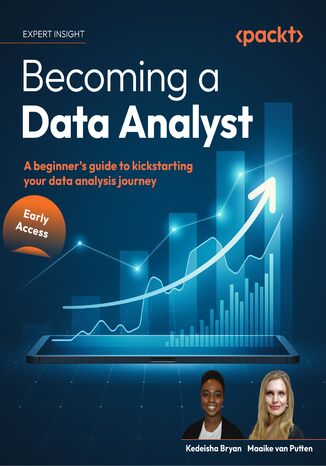
Becoming a Data Analyst. A Beginner's Guide to Kickstarting Your Data Analysis Career
Remsey Mailjard, Maaike van Putten
This guide is designed to take you from novice to confident data analyst. Starting with the fundamentals of data analytics, you will explore what data analysis entails and why it's crucial in today's data-driven industries. You'll develop a data analyst mindset, honing your problem-solving and critical-thinking skills through practical exercises. You'll be introduced to different types of data, data sources and key concepts like KPIs and data warehouses. Hands-on chapters will guide you through Excel for basic data analysis, teaching you vital functions, pivot tables, and visualization techniques. You'll dive into SQL to query and manipulate data as well as data cleaning and exploration to prepare datasets for meaningful analysis. More advanced chapters will introduce you to Power BI, so you can build interactive dashboards and use DAX for advanced calculations. You'll work on major projects that will form a professional portfolio showcasing your skills in sales analysis, HR analytics, and customer insights. Finally, the book will teach you the art of communicating your findings through data storytelling to different audiences. You'll also find guidance on continuing education and career growth, ensuring you're well-prepared to launch a successful career in data analytics.
Alex Galea
Get to grips with the skills you need for entry-level data science in this hands-on Python and Jupyter course. You'll learn about some of the most commonly used libraries that are part of the Anaconda distribution, and then explore machine learning models with real datasets to give you the skills and exposure you need for the real world. We'll finish up by showing you how easy it can be to scrape and gather your own data from the open web, so that you can apply your new skills in an actionable context.
Sridhar Alla
Apache Hadoop is the most popular platform for big data processing, and can be combined with a host of other big data tools to build powerful analytics solutions. Big Data Analytics with Hadoop 3 shows you how to do just that, by providing insights into the software as well as its benefits with the help of practical examples.Once you have taken a tour of Hadoop 3’s latest features, you will get an overview of HDFS, MapReduce, and YARN, and how they enable faster, more efficient big data processing. You will then move on to learning how to integrate Hadoop with the open source tools, such as Python and R, to analyze and visualize data and perform statistical computing on big data. As you get acquainted with all this, you will explore how to use Hadoop 3 with Apache Spark and Apache Flink for real-time data analytics and stream processing. In addition to this, you will understand how to use Hadoop to build analytics solutions on the cloud and an end-to-end pipeline to perform big data analysis using practical use cases.By the end of this book, you will be well-versed with the analytical capabilities of the Hadoop ecosystem. You will be able to build powerful solutions to perform big data analytics and get insight effortlessly.
Big Data Analytics with Java. Data analysis, visualization & machine learning techniques
RAJAT MEHTA
This book covers case studies such as sentiment analysis on a tweet dataset, recommendations on a movielens dataset, customer segmentation on an ecommerce dataset, and graph analysis on actual flights dataset.This book is an end-to-end guide to implement analytics on big data withJava. Java is the de facto language for major big data environments, including Hadoop. This book will teach you how to perform analytics on big data with production-friendly Java. This book basically divided into twosections. The first part is an introduction that will help the readers get acquainted with big data environments, whereas the second part will contain a hardcore discussion on all the concepts in analyticson big data. It will take you from data analysis and data visualization to the core concepts and advantages of machine learning, real-life usage of regression and classification using Naïve Bayes, a deep discussion on the concepts of clustering,and a review of simple neural networkson big data using deepLearning4j or plain Java Spark code. This book is a must-have book for Java developers who want to start learning big data analytics and want to use it in the real world.
Big Data Analytics with R. Leverage R Programming to uncover hidden patterns in your Big Data
Simon Walkowiak
Big Data analytics is the process of examining large and complex data sets that often exceed the computational capabilities. R is a leading programming language of data science, consisting of powerful functions to tackle all problems related to Big Data processing.The book will begin with a brief introduction to the Big Data world and its current industry standards. With introduction to the R language and presenting its development, structure, applications in real world, and its shortcomings. Book will progress towards revision of major R functions for data management and transformations. Readers will be introduce to Cloud based Big Data solutions (e.g. Amazon EC2 instances and Amazon RDS, Microsoft Azure and its HDInsight clusters) and also provide guidance on R connectivity with relational and non-relational databases such as MongoDB and HBase etc. It will further expand to include Big Data tools such as Apache Hadoop ecosystem, HDFS and MapReduce frameworks. Also other R compatible tools such as Apache Spark, its machine learning library Spark MLlib, as well as H2O.
Big Data Analytics with SAS. Get actionable insights from your Big Data using the power of SAS
David Pope, Subhashini S Tripathi
SAS has been recognized by Money Magazine and Payscale as one of the top business skills to learn in order to advance one’s career. Through innovative data management, analytics, and business intelligence software and services, SAS helps customers solve their business problems by allowing them to make better decisions faster. This book introduces the reader to the SAS and how they can use SAS to perform efficient analysis on any size data, including Big Data.The reader will learn how to prepare data for analysis, perform predictive, forecasting, and optimization analysis and then deploy or report on the results of these analyses. While performing the coding examples within this book the reader will learn how to use the web browser based SAS Studio and iPython Jupyter Notebook interfaces for working with SAS. Finally, the reader will learn how SAS’s architecture is engineered and designed to scale up and/or out and be combined with the open source offerings such as Hadoop, Python, and R. By the end of this book, you will be able to clearly understand how you can efficiently analyze Big Data using SAS.
Syed Muhammad Fahad Akhtar
The big data architects are the “masters” of data, and hold high value in today’s market. Handling big data, be it of good or bad quality, is not an easy task. The prime job for any big data architect is to build an end-to-end big data solution that integrates data from different sources and analyzes it to find useful, hidden insights.Big Data Architect’s Handbook takes you through developing a complete, end-to-end big data pipeline, which will lay the foundation for you and provide the necessary knowledge required to be an architect in big data. Right from understanding the design considerations to implementing a solid, efficient, and scalable data pipeline, this book walks you through all the essential aspects of big data. It also gives you an overview of how you can leverage the power of various big data tools such as Apache Hadoop and ElasticSearch in order to bring them together and build an efficient big data solution.By the end of this book, you will be able to build your own design system which integrates, maintains, visualizes, and monitors your data. In addition, you will have a smooth design flow in each process, putting insights in action.
Big Data. Najlepsze praktyki budowy skalowalnych systemów obsługi danych w czasie rzeczywistym
Nathan Marz, James Warren
Obsługa aplikacji, które operują na ogromnych zbiorach danych, czyli na przykład portali społecznościowych, przekracza możliwości zwykłych relacyjnych baz. Praca ze złożonymi zbiorami danych wymaga architektury obejmującej wielomaszynowe klastry, dzięki którym możliwe jest przechowywanie i przesyłanie informacji praktycznie dowolnej wielkości. Architektura taka powinna dodatkowo być prosta w użyciu, niezawodna i skalowalna. Dzięki tej książce nauczysz się budować tego rodzaju architekturę. Zapoznasz się z technologią wykorzystywania klastrów maszyn. Dowiesz się, jak działają narzędzia przeznaczone specjalnie do przechwytywania i analizy danych na wielką skalę. W książce zaprezentowano łatwe do zrozumienia podejście do obsługi systemów wielkich zbiorów danych, które mogą być budowane i uruchamiane przez niewielki zespół. Nie zabrakło też wyczerpującego opisu praktycznej implementacji systemu Big Data z wykorzystaniem rzeczywistego przykładu. W tej książce znajdziesz: teoretyczne podstawy koncepcji systemów Big Data wskazówki umożliwiające optymalne wykorzystanie zasobów do obsługi danych wybór technik przetwarzania i obsługi wielkich ilości danych w czasie rzeczywistym zagadnienia dotyczące baz danych NoSQL, przetwarzania strumieniowego i zarządzania złożonością obliczeń przyrostowych informacje o praktycznym stosowaniu takich narzędzi jak Hadoop, Cassandra i Storm wskazówki umożliwiające poszerzenie wiedzy o zwykłych bazach danych Big Data — to skalowalność i prostota obsługi wielkich ilości danych!