
Analiza danych
Analiza danych jest ekscytującą dyscypliną, która umożliwia zrozumienie pewnych zjawisk, uzyskanie wglądu i wiedzy na podstawie surowych danych. Pojęcie to oznacza dokładnie przetwarzanie danych za pomocą technik matematycznych i statystycznych w celu uzyskania cennych wniosków, podjęcia ważnych decyzji i opracowania przydatnych produktów. Termin ten wywodzi się od angielskiego data science, często traktowanego jako synonim takich terminów, jak analityka biznesowa, badania operacyjne, business intelligence, wywiad konkurencyjny, analiza i modelowanie danych, a także pozyskiwanie wiedzy. Dzięki takim technologiom, jak języki Python czy R, platformy Hadoop i Spark masz szansę wyciągnąć maksimum wniosków, dostrzec szanse na rozwój swojej organizacji albo przewidzieć i zapobiec zagrożeniom.
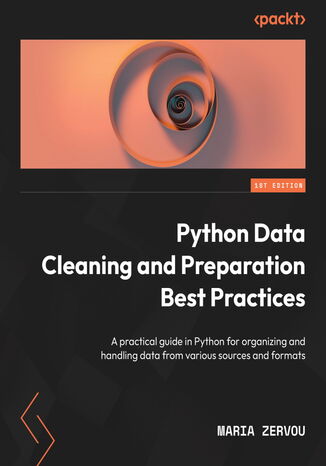
Maria Zervou
Professionals face several challenges in effectively leveraging data in today's data-driven world. One of the main challenges is the low quality of data products, often caused by inaccurate, incomplete, or inconsistent data. Another significant challenge is the lack of skills among data professionals to analyze unstructured data, leading to valuable insights being missed that are difficult or impossible to obtain from structured data alone.To help you tackle these challenges, this book will take you on a journey through the upstream data pipeline, which includes the ingestion of data from various sources, the validation and profiling of data for high-quality end tables, and writing data to different sinks. You’ll focus on structured data by performing essential tasks, such as cleaning and encoding datasets and handling missing values and outliers, before learning how to manipulate unstructured data with simple techniques. You’ll also be introduced to a variety of natural language processing techniques, from tokenization to vector models, as well as techniques to structure images, videos, and audio.By the end of this book, you’ll be proficient in data cleaning and preparation techniques for both structured and unstructured data.
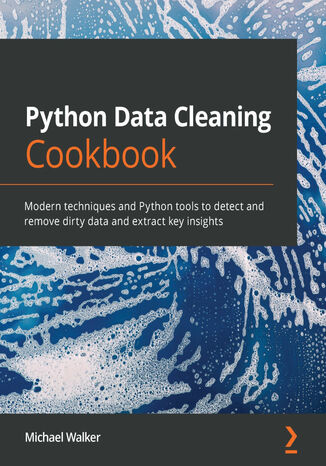
Michael Walker
Getting clean data to reveal insights is essential, as directly jumping into data analysis without proper data cleaning may lead to incorrect results. This book shows you tools and techniques that you can apply to clean and handle data with Python. You'll begin by getting familiar with the shape of data by using practices that can be deployed routinely with most data sources. Then, the book teaches you how to manipulate data to get it into a useful form. You'll also learn how to filter and summarize data to gain insights and better understand what makes sense and what does not, along with discovering how to operate on data to address the issues you've identified. Moving on, you'll perform key tasks, such as handling missing values, validating errors, removing duplicate data, monitoring high volumes of data, and handling outliers and invalid dates. Next, you'll cover recipes on using supervised learning and Naive Bayes analysis to identify unexpected values and classification errors, and generate visualizations for exploratory data analysis (EDA) to visualize unexpected values. Finally, you'll build functions and classes that you can reuse without modification when you have new data. By the end of this Python book, you'll be equipped with all the key skills that you need to clean data and diagnose problems within it.
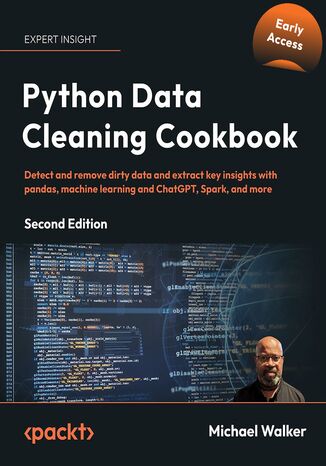
Michael Walker
Jumping into data analysis without proper data cleaning will certainly lead to incorrect results. The Python Data Cleaning Cookbook - Second Edition will show you tools and techniques for cleaning and handling data with Python for better outcomes.Fully updated to the latest version of Python and all relevant tools, this book will teach you how to manipulate and clean data to get it into a useful form. he current edition focuses on advanced techniques like machine learning and AI-specific approaches and tools for data cleaning along with the conventional ones. The book also delves into tips and techniques to process and clean data for ML, AI, and NLP models. You will learn how to filter and summarize data to gain insights and better understand what makes sense and what does not, along with discovering how to operate on data to address the issues you've identified. Next, you’ll cover recipes for using supervised learning and Naive Bayes analysis to identify unexpected values and classification errors and generate visualizations for exploratory data analysis (EDA) to identify unexpected values. Finally, you’ll build functions and classes that you can reuse without modification when you have new data.By the end of this Data Cleaning book, you'll know how to clean data and diagnose problems within it.
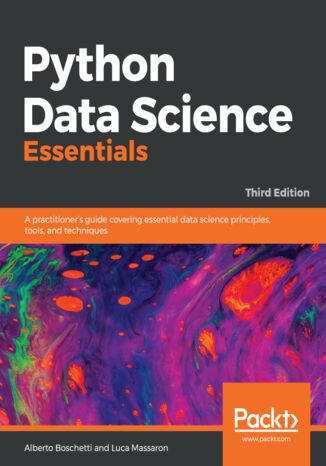
Alberto Boschetti, Luca Massaron
Fully expanded and upgraded, the latest edition of Python Data Science Essentials will help you succeed in data science operations using the most common Python libraries. This book offers up-to-date insight into the core of Python, including the latest versions of the Jupyter Notebook, NumPy, pandas, and scikit-learn.The book covers detailed examples and large hybrid datasets to help you grasp essential statistical techniques for data collection, data munging and analysis, visualization, and reporting activities. You will also gain an understanding of advanced data science topics such as machine learning algorithms, distributed computing, tuning predictive models, and natural language processing. Furthermore, You’ll also be introduced to deep learning and gradient boosting solutions such as XGBoost, LightGBM, and CatBoost.By the end of the book, you will have gained a complete overview of the principal machine learning algorithms, graph analysis techniques, and all the visualization and deployment instruments that make it easier to present your results to an audience of both data science experts and business users
Python Data Science Essentials. Learn the fundamentals of Data Science with Python - Second Edition
Luca Massaron, Alberto Boschetti
Fully expanded and upgraded, the second edition of Python Data Science Essentials takes you through all you need to know to suceed in data science using Python. Get modern insight into the core of Python data, including the latest versions of Jupyter notebooks, NumPy, pandas and scikit-learn. Look beyond the fundamentals with beautiful data visualizations with Seaborn and ggplot, web development with Bottle, and even the new frontiers of deep learning with Theano and TensorFlow. Dive into building your essential Python 3.5 data science toolbox, using a single-source approach that will allow to to work with Python 2.7 as well. Get to grips fast with data munging and preprocessing, and all the techniques you need to load, analyse, and process your data. Finally, get a complete overview of principal machine learning algorithms, graph analysis techniques, and all the visualization and deployment instruments that make it easier to present your results to an audience of both data science experts and business users.
Igor Milovanovic, Dimitry Foures, Giuseppe Vettigli
Python Data Visualization Cookbook will progress the reader from the point of installing and setting up a Python environment for data manipulation and visualization all the way to 3D animations using Python libraries. Readers will benefit from over 60 precise and reproducible recipes that will guide the reader towards a better understanding of data concepts and the building blocks for subsequent and sometimes more advanced concepts.Python Data Visualization Cookbook starts by showing how to set up matplotlib and the related libraries that are required for most parts of the book, before moving on to discuss some of the lesser-used diagrams and charts such as Gantt Charts or Sankey diagrams. Initially it uses simple plots and charts to more advanced ones, to make it easy to understand for readers. As the readers will go through the book, they will get to know about the 3D diagrams and animations. Maps are irreplaceable for displaying geo-spatial data, so this book will also show how to build them. In the last chapter, it includes explanation on how to incorporate matplotlib into different environments, such as a writing system, LaTeX, or how to create Gantt charts using Python.
Ivan Vasilev, Daniel Slater, Gianmario Spacagna, Peter...
With the surge in artificial intelligence in applications catering to both business and consumer needs, deep learning is more important than ever for meeting current and future market demands. With this book, you’ll explore deep learning, and learn how to put machine learning to use in your projects.This second edition of Python Deep Learning will get you up to speed with deep learning, deep neural networks, and how to train them with high-performance algorithms and popular Python frameworks. You’ll uncover different neural network architectures, such as convolutional networks, recurrent neural networks, long short-term memory (LSTM) networks, and capsule networks. You’ll also learn how to solve problems in the fields of computer vision, natural language processing (NLP), and speech recognition. You'll study generative model approaches such as variational autoencoders and Generative Adversarial Networks (GANs) to generate images. As you delve into newly evolved areas of reinforcement learning, you’ll gain an understanding of state-of-the-art algorithms that are the main components behind popular games Go, Atari, and Dota.By the end of the book, you will be well-versed with the theory of deep learning along with its real-world applications.
Ivan Idris, Magnus Vilhelm Persson, Luiz Felipe...
Data analysis is the process of applying logical and analytical reasoning to study each component of data present in the system. Python is a multi-domain, high-level, programming language that offers a range of tools and libraries suitable for all purposes, it has slowly evolved as one of the primary languages for data science. Have you ever imagined becoming an expert at effectively approaching data analysis problems, solving them, and extracting all of the available information from your data? If yes, look no further, this is the course you need!In this course, we will get you started with Python data analysis by introducing the basics of data analysis and supported Python libraries such as matplotlib, NumPy, and pandas. Create visualizations by choosing color maps, different shapes, sizes, and palettes then delve into statistical data analysis using distribution algorithms and correlations. You’ll then find your way around different data and numerical problems, get to grips with Spark and HDFS, and set up migration scripts for web mining. You’ll be able to quickly and accurately perform hands-on sorting, reduction, and subsequent analysis, and fully appreciate how data analysis methods can support business decision-making. Finally, you will delve into advanced techniques such as performing regression, quantifying cause and effect using Bayesian methods, and discovering how to use Python’s tools for supervised machine learning.The course provides you with highly practical content explaining data analysis with Python, from the following Packt books:1. Getting Started with Python Data Analysis.2. Python Data Analysis Cookbook.3. Mastering Python Data Analysis.By the end of this course, you will have all the knowledge you need to analyze your data with varying complexity levels, and turn it into actionable insights.
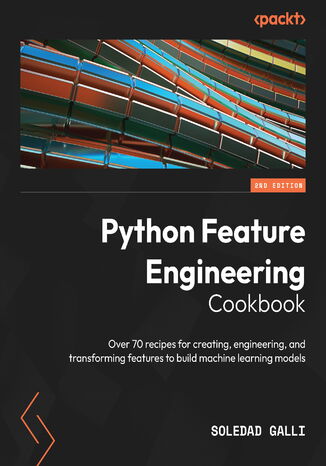
Soledad Galli
Feature engineering, the process of transforming variables and creating features, albeit time-consuming, ensures that your machine learning models perform seamlessly. This second edition of Python Feature Engineering Cookbook will take the struggle out of feature engineering by showing you how to use open source Python libraries to accelerate the process via a plethora of practical, hands-on recipes.This updated edition begins by addressing fundamental data challenges such as missing data and categorical values, before moving on to strategies for dealing with skewed distributions and outliers. The concluding chapters show you how to develop new features from various types of data, including text, time series, and relational databases. With the help of numerous open source Python libraries, you'll learn how to implement each feature engineering method in a performant, reproducible, and elegant manner.By the end of this Python book, you will have the tools and expertise needed to confidently build end-to-end and reproducible feature engineering pipelines that can be deployed into production.
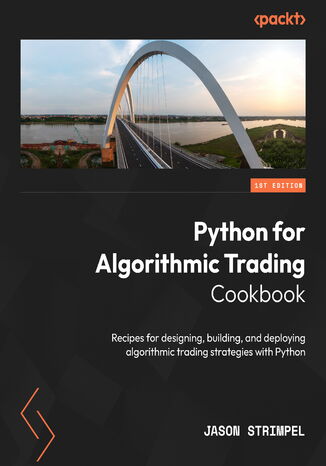
Jason Strimpel
Discover how Python has made algorithmic trading accessible to non-professionals with unparalleled expertise and practical insights from Jason Strimpel, founder of PyQuant News and a seasoned professional with global experience in trading and risk management. This book guides you through from the basics of quantitative finance and data acquisition to advanced stages of backtesting and live trading.Detailed recipes will help you leverage the cutting-edge OpenBB SDK to gather freely available data for stocks, options, and futures, and build your own research environment using lightning-fast storage techniques like SQLite, HDF5, and ArcticDB. This book shows you how to use SciPy and statsmodels to identify alpha factors and hedge risk, and construct momentum and mean-reversion factors. You’ll optimize strategy parameters with walk-forward optimization using VectorBT and construct a production-ready backtest using Zipline Reloaded. Implementing all that you’ve learned, you’ll set up and deploy your algorithmic trading strategies in a live trading environment using the Interactive Brokers API, allowing you to stream tick-level data, submit orders, and retrieve portfolio details.By the end of this algorithmic trading book, you'll not only have grasped the essential concepts but also the practical skills needed to implement and execute sophisticated trading strategies using Python.
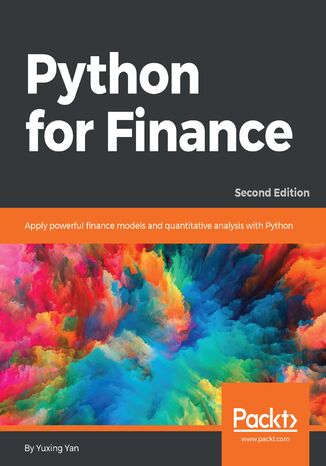
Yuxing Yan
This book uses Python as its computational tool. Since Python is free, any school ororganization can download and use it. This book is organized according to various finance subjects. In other words, the first edition focuses more on Python, while the second edition is truly trying to apply Python to finance.The book starts by explaining topics exclusively related to Python. Then we deal with critical parts of Python, explaining concepts such as time value of money stock and bond evaluations, capital asset pricing model, multi-factor models, time series analysis, portfolio theory,options and futures.This book will help us to learn or review the basics of quantitative finance and apply Python to solve various problems, such as estimating IBM’s market risk,running a Fama-French 3-factor, 5-factor, or Fama-French-Carhart 4 factor model, estimating the VaR of a 5-stock portfolio, estimating the optimal portfolio, and constructing the efficient frontier for a 20-stock portfolio with real-world stock, and with Monte Carlo Simulation. Later, we will also learn how to replicate the famous Black-Scholes-Merton option model and how to price exotic options such as the average price call option.
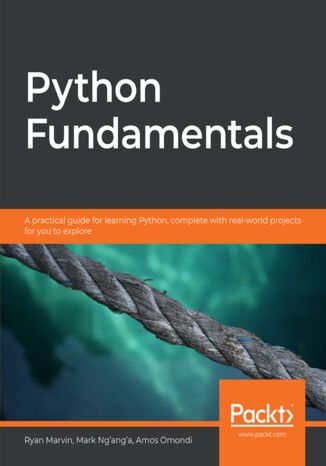
Ryan Marvin, Mark Nganga, Amos Omondi
After a brief history of Python and key differences between Python 2 and Python 3, you'll understand how Python has been used in applications such as YouTube and Google App Engine. As you work with the language, you'll learn about control statements, delve into controlling program flow and gradually work on more structured programs via functions.As you settle into the Python ecosystem, you'll learn about data structures and study ways to correctly store and represent information. By working through specific examples, you'll learn how Python implements object-oriented programming (OOP) concepts of abstraction, encapsulation of data, inheritance, and polymorphism. You'll be given an overview of how imports, modules, and packages work in Python, how you can handle errors to prevent apps from crashing, as well as file manipulation.By the end of this book, you'll have built up an impressive portfolio of projects and armed yourself with the skills you need to tackle Python projects in the real world.
Python Machine Learning By Example. The easiest way to get into machine learning
Yuxi (Hayden) Liu, Ivan Idris
Data science and machine learning are some of the top buzzwords in the technical world today. A resurging interest in machine learning is due to the same factors that have made data mining and Bayesian analysis more popular than ever. This book is your entry point to machine learning. This book starts with an introduction to machine learning and the Python language and shows you how to complete the setup. Moving ahead, you will learn all the important concepts such as, exploratory data analysis, data preprocessing, feature extraction, data visualization and clustering, classification, regression and model performance evaluation. With the help of various projects included, you will find it intriguing to acquire the mechanics of several important machine learning algorithms – they are no more obscure as they thought. Also, you will be guided step by step to build your own models from scratch. Toward the end, you will gather a broad picture of the machine learning ecosystem and best practices of applying machine learning techniques. Through this book, you will learn to tackle data-driven problems and implement your solutions with the powerful yet simple language, Python. Interesting and easy-to-follow examples, to name some, news topic classification, spam email detection, online ad click-through prediction, stock prices forecast, will keep you glued till you reach your goal.
Prateek Joshi, Vahid Mirjalili
Machine learning is becoming increasingly pervasive in the modern data-driven world. It is used extensively across many fields such as search engines, robotics, self-driving cars, and more. With this book, you will learn how to perform various machine learning tasks in different environments. We’ll start by exploring a range of real-life scenarios where machine learning can be used, and look at various building blocks. Throughout the book, you’ll use a wide variety of machine learning algorithms to solve real-world problems and use Python to implement these algorithms. You’ll discover how to deal with various types of data and explore the differences between machine learning paradigms such as supervised and unsupervised learning. We also cover a range of regression techniques, classification algorithms, predictive modeling, data visualization techniques, recommendation engines, and more with the help of real-world examples.
Sebastian Raschka
Machine learning and predictive analytics are transforming the way businesses and other organizations operate. Being able to understand trends and patterns in complex data is critical to success, becoming one of the key strategies for unlocking growth in a challenging contemporary marketplace. Python can help you deliver key insights into your data – its unique capabilities as a language let you build sophisticated algorithms and statistical models that can reveal new perspectives and answer key questions that are vital for success.Python Machine Learning gives you access to the world of predictive analytics and demonstrates why Python is one of the world’s leading data science languages. If you want to ask better questions of data, or need to improve and extend the capabilities of your machine learning systems, this practical data science book is invaluable. Covering a wide range of powerful Python libraries, including scikit-learn, Theano, and Keras, and featuring guidance and tips on everything from sentiment analysis to neural networks, you’ll soon be able to answer some of the most important questions facing you and your organization.
Jalaj Thanaki
This book starts off by laying the foundation for Natural Language Processing and why Python is one of the best options to build an NLP-based expert system with advantages such as Community support, availability of frameworks and so on. Later it gives you a better understanding of available free forms of corpus and different types of dataset. After this, you will know how to choose a dataset for natural language processing applications and find the right NLP techniques to process sentences in datasets and understand their structure. You will also learn how to tokenize different parts of sentences and ways to analyze them. During the course of the book, you will explore the semantic as well as syntactic analysis of text. You will understand how to solve various ambiguities in processing human language and will come across various scenarios while performing text analysis. You will learn the very basics of getting the environment ready for natural language processing, move on to the initial setup, and then quickly understand sentences and language parts. You will learn the power of Machine Learning and Deep Learning to extract information from text data.By the end of the book, you will have a clear understanding of natural language processing and will have worked on multiple examples that implement NLP in the real world.
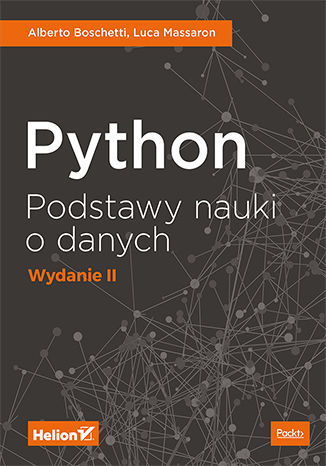
Python. Podstawy nauki o danych. Wydanie II
Alberto Boschetti, Luca Massaron
Nauka o danych jest nową, interdyscyplinarną dziedziną, funkcjonującą na pograniczu algebry liniowej, modelowania statystycznego, lingwistyki komputerowej, uczenia maszynowego oraz metod akumulacji danych. Jest przydatna między innymi dla analityków biznesowych, statystyków, architektów oprogramowania i osób zajmujących się sztuczną inteligencją. Szczególnie praktycznym narzędziem dla tych specjalistów jest język Python, który zapewnia doskonałe środowisko do analizy danych, uczenia maszynowego i algorytmicznego rozwiązywania problemów. Niniejsza książka jest doskonałym wprowadzeniem do nauki o danych. Jej autorzy wskażą Ci prostą i szybką drogę do rozwiązywania różnych problemów z tego obszaru za pomocą Pythona oraz powiązanych z nim pakietów do analizy danych i uczenia maszynowego. Dzięki lekturze przejdziesz przez kolejne etapy modyfikowania i wstępnego przetwarzania danych, poznając przy tym podstawowe operacje związane z wczytywaniem danych, przekształcaniem ich, poprawianiem na potrzeby analiz, eksplorowaniem i przetwarzaniem. Poza podstawami opanujesz też zagadnienia uczenia maszynowego, w tym uczenia głębokiego, techniki analizy grafów oraz wizualizacji danych. Najważniejsze zagadnienia przedstawione w książce: konfiguracja środowiska Jupyter Notebook najważniejsze operacje stosowane w nauce o danych potoki danych i uczenie maszynowe wprowadzenie do grafów i wizualizacje biblioteki i pakiety Pythona służące do badań danych Nauka o danych — fascynujące algorytmy i potężne grafy! Alberto Boschetti specjalizuje się w przetwarzaniu sygnałów i statystyce. Jest doktorem inżynierii telekomunikacyjnej. Zajmuje się przetwarzaniem języków naturalnych, analityką behawioralną, uczeniem maszynowym i przetwarzaniem rozproszonym. Luca Massaron specjalizuje się w statystycznych analizach wieloczynnikowych, uczeniu maszynowym, statystyce, eksploracji danych i algorytmice. Pasjonuje się potencjałem, jaki drzemie w nauce o danych.
Python: Real World Machine Learning. Take your Python Machine learning skills to the next level
Prateek Joshi, Bastiaan Sjardin, Luca Massaron, Alberto...
Machine learning is increasingly spreading in the modern data-driven world. It is used extensively across many fields such as search engines, robotics, self-driving cars, and more. Machine learning is transforming the way we understand and interact with the world around us.In the first module, Python Machine Learning Cookbook, you will learn how to perform various machine learning tasks using a wide variety of machine learning algorithms to solve real-world problems and use Python to implement these algorithms.The second module, Advanced Machine Learning with Python, is designed to take you on a guided tour of the most relevant and powerful machine learning techniques and you’ll acquire a broad set of powerful skills in the area of feature selection and feature engineering.The third module in this learning path, Large Scale Machine Learning with Python, dives into scalable machine learning and the three forms of scalability. It covers the most effective machine learning techniques on a map reduce framework in Hadoop and Spark in Python.This Learning Path will teach you Python machine learning for the real world. The machine learning techniques covered in this Learning Path are at the forefront of commercial practice.This Learning Path combines some of the best that Packt has to offer in one complete, curated package. It includes content from the following Packt products:? Python Machine Learning Cookbook by Prateek Joshi? Advanced Machine Learning with Python by John Hearty? Large Scale Machine Learning with Python by Bastiaan Sjardin, Alberto Boschetti, Luca Massaron
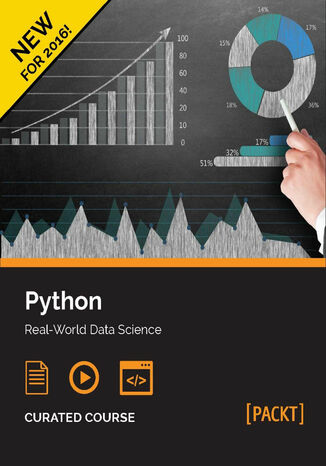
Python: Real-World Data Science. Real-World Data Science
Fabrizio Romano, Phuong Vo.T.H, Martin Czygan, Robert...
The Python: Real-World Data Science course will take you on a journey to become an efficient data science practitioner by thoroughly understanding the key concepts of Python. This learning path is divided into four modules and each module are a mini course in their own right, and as you complete each one, you’ll have gained key skills and be ready for the material in the next module. The course begins with getting your Python fundamentals nailed down. After getting familiar with Python core concepts, it’s time that you dive into the field of data science. In the second module, you'll learn how to perform data analysis using Python in a practical and example-driven way. The third module will teach you how to design and develop data mining applications using a variety of datasets, starting with basic classification and affinity analysis to more complex data types including text, images, and graphs. Machine learning and predictive analytics have become the most important approaches to uncover data gold mines. In the final module, we'll discuss the necessary details regarding machine learning concepts, offering intuitive yet informative explanations on how machine learning algorithms work, how to use them, and most importantly, how to avoid the common pitfalls.
Python Social Media Analytics. Analyze and visualize data from Twitter, YouTube, GitHub, and more
Siddhartha Chatterjee, Michal Krystyanczuk
Social Media platforms such as Facebook, Twitter, Forums, Pinterest, and YouTube have become part of everyday life in a big way. However, these complex and noisy data streams pose a potent challenge to everyone when it comes to harnessing them properly and benefiting from them. This book will introduce you to the concept of social media analytics, and how you can leverage its capabilities to empower your business.Right from acquiring data from various social networking sources such as Twitter, Facebook, YouTube, Pinterest, and social forums, you will see how to clean data and make it ready for analytical operations using various Python APIs. This book explains how to structure the clean data obtained and store in MongoDB using PyMongo. You will also perform web scraping and visualize data using Scrappy and Beautifulsoup. Finally, you will be introduced to different techniques to perform analytics at scale for your social data on the cloud, using Python and Spark. By the end of this book, you will be able to utilize the power of Python to gain valuable insights from social media data and use them to enhance your business processes.
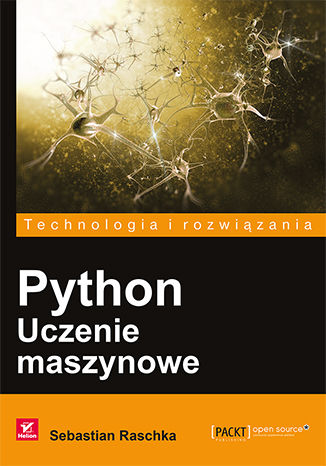
Sebastian Raschka
Sprawdź drugie wydanie tej książki >> --- Uczenie maszynowe, zajmujące się algorytmami analizującymi dane, stanowi chyba najciekawszą dziedzinę informatyki. W czasach, w których generuje się olbrzymie ilości danych, samouczące się algorytmy maszynowe stanowią wyjątkową metodę przekształcania tych danych w wiedzę. W ten sposób powstało wiele innowacyjnych technologii, a możliwości uczenia maszynowego są coraz większe. Nieocenioną pomoc w rozwijaniu tej dziedziny stanowią liczne nowe biblioteki open source, które pozwalają na budowanie algorytmów w języku Python, będącym ulubionym, potężnym i przystępnym narzędziem naukowców i analityków danych. Niniejsza książka jest lekturą obowiązkową dla każdego, kto chce rozwinąć swoją wiedzę o danych naukowych i zamierza w tym celu wykorzystać język Python. Przystępnie opisano tu teoretyczne podstawy dziedziny i przedstawiono wyczerpujące informacje o działaniu algorytmów uczenia maszynowego, sposobach ich wykorzystania oraz metodach unikania poważnych błędów. Zaprezentowano również biblioteki Theano i Keras, sposoby przewidywania wyników docelowych za pomocą analizy regresywnej oraz techniki wykrywania ukrytych wzorców metodą analizy skupień. Nie zabrakło opisu technik przetwarzania wstępnego i zasad oceny modeli uczenia maszynowego. W tej książce: podstawowe rodzaje uczenia maszynowego i ich zastosowanie, biblioteka scikit-learn i klasyfikatory uczenia maszynowego, wydajne łączenie różnych algorytmów uczących, analiza sentymentów — przewidywanie opinii osób na podstawie sposobu pisania, praca z nieoznakowanymi danymi — uczenie nienadzorowane, tworzenie i trenowanie sieci neuronowych. Uczenie maszynowe — odkryj wiedzę, którą niosą dane!
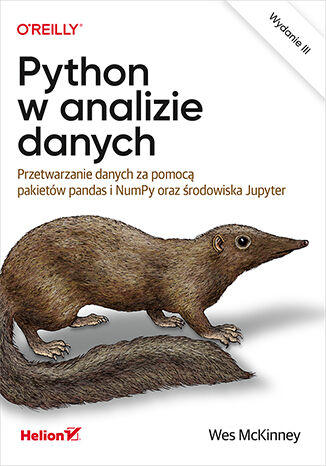
Wes McKinney
Wprawny analityk danych potrafi z nich uzyskać wiedzę ułatwiającą podejmowanie trafnych decyzji. Od kilku lat można do tego używać nowoczesnych narzędzi Pythona, które zbudowano specjalnie do tego celu. Praca z nimi nie wymaga głębokiej znajomości statystyki czy algebry. Aby cieszyć się uzyskanymi rezultatami, wystarczy się wprawić w stosowaniu kilku pakietów i środowisk Pythona. Ta książka jest trzecim, starannie zaktualizowanym wydaniem wyczerpującego przewodnika po narzędziach analitycznych Pythona. Uwzględnia Pythona 3.0 i bibliotekę pandas 1.4. Została napisana w przystępny sposób, a poszczególne zagadnienia bogato zilustrowano przykładami, studiami rzeczywistych przypadków i fragmentami kodu. W trakcie lektury nauczysz się korzystać z możliwości oferowanych przez pakiety pandas i NumPy, a także środowiska IPython i Jupyter. Nie zabrakło wskazówek dotyczących używania uniwersalnych narzędzi przeznaczonych do ładowania, czyszczenia, przekształcania i łączenia zbiorów danych. Pozycję docenią analitycy zamierzający zacząć pracę w Pythonie, jak również programiści Pythona, którzy chcą się zająć analizą danych i obliczeniami naukowymi. Dzięki książce nauczysz się: eksplorować dane za pomocą powłoki IPython i środowiska Jupyter korzystać z funkcji pakietów NumPy i pandas używać pakietu matplotlib do tworzenia czytelnych wizualizacji analizować i przetwarzać dane regularnych i nieregularne szeregi czasowe rozwiązywać rzeczywiste problemy analityczne Wes McKinney zaktualizował swoją książkę, aby była podstawowym źródłem informacji o wszystkich zagadnieniach związanych z analizą danych przy użyciu języka Python i biblioteki pandas. Gorąco polecam tę pozycję! Paul Barry, wykładowca i autor książek
Lazar Telebak, Michael Heydt, Mei Lu
Python Web Scraping Cookbook is a solution-focused book that will teach you techniques to develop high-performance scrapers and deal with crawlers, sitemaps, forms automation, Ajax-based sites, caches, and more. You'll explore a number of real-world scenarios where every part of the development/product life cycle will be fully covered. You will not only develop the skills needed to design and develop reliable performance data flows, but also deploy your codebase to AWS. If you are involved in software engineering, product development, or data mining (or are interested in building data-driven products), you will find this book useful as each recipe has a clear purpose and objective. Right from extracting data from the websites to writing a sophisticated web crawler, the book's independent recipes will be a godsend. This book covers Python libraries, requests, and BeautifulSoup. You will learn about crawling, web spidering, working with Ajax websites, paginated items, and more. You will also learn to tackle problems such as 403 errors, working with proxy, scraping images, and LXML.By the end of this book, you will be able to scrape websites more efficiently and able todeploy and operate your scraper in the cloud.
Katharine Jarmul
The Internet contains the most useful set of data ever assembled, most of which is publicly accessible for free. However, this data is not easily usable. It is embedded within the structure and style of websites and needs to be carefully extracted. Web scraping is becoming increasingly useful as a means to gather and make sense of the wealth of information available online.This book is the ultimate guide to using the latest features of Python 3.x to scrape data from websites. In the early chapters, you'll see how to extract data from static web pages. You'll learn to use caching with databases and files to save time and manage the load on servers. Aftercovering the basics, you'll get hands-on practice building a more sophisticated crawler using browsers, crawlers, and concurrent scrapers.You'll determine when and how to scrape data from a JavaScript-dependent website using PyQt and Selenium. You'll get a better understanding of how to submit forms on complex websites protected by CAPTCHA. You'll find out how to automate these actions with Python packages such as mechanize. You'll also learn how to create class-based scrapers with Scrapy libraries and implement your learning on real websites.By the end of the book, you will have explored testing websites with scrapers, remote scraping, best practices, working with images, and many other relevant topics.