
Analiza danych
Analiza danych jest ekscytującą dyscypliną, która umożliwia zrozumienie pewnych zjawisk, uzyskanie wglądu i wiedzy na podstawie surowych danych. Pojęcie to oznacza dokładnie przetwarzanie danych za pomocą technik matematycznych i statystycznych w celu uzyskania cennych wniosków, podjęcia ważnych decyzji i opracowania przydatnych produktów. Termin ten wywodzi się od angielskiego data science, często traktowanego jako synonim takich terminów, jak analityka biznesowa, badania operacyjne, business intelligence, wywiad konkurencyjny, analiza i modelowanie danych, a także pozyskiwanie wiedzy. Dzięki takim technologiom, jak języki Python czy R, platformy Hadoop i Spark masz szansę wyciągnąć maksimum wniosków, dostrzec szanse na rozwój swojej organizacji albo przewidzieć i zapobiec zagrożeniom.
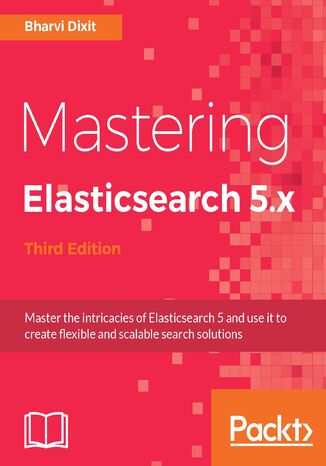
Bharvi Dixit
Elasticsearch is a modern, fast, distributed, scalable, fault tolerant, and open source search and analytics engine. Elasticsearch leverages the capabilities of Apache Lucene, and provides a new level of control over how you can index and search even huge sets of data.This book will give you a brief recap of the basics and also introduce you to the new features of Elasticsearch 5. We will guide you through the intermediate and advanced functionalities of Elasticsearch, such as querying, indexing, searching, and modifying data. We’ll also explore advanced concepts, including aggregation, index control, sharding, replication, and clustering. We’ll show you the modules of monitoring and administration available in Elasticsearch, and will also cover backup and recovery. You will get an understanding of how you can scale your Elasticsearch cluster to contextualize it and improve its performance. We’ll also show you how you can create your own analysis plugin in Elasticsearch. By the end of the book, you will have all the knowledge necessary to master Elasticsearch and put it to efficient use.
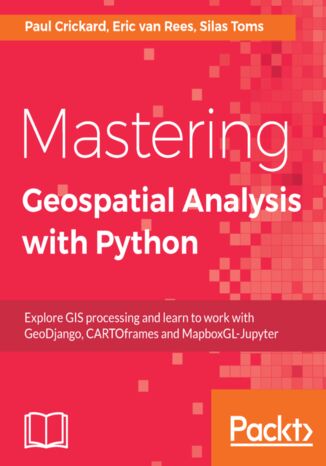
Silas Toms, Paul Crickard, Eric van Rees
Python comes with a host of open source libraries and tools that help you work on professional geoprocessing tasks without investing in expensive tools. This book will introduce Python developers, both new and experienced, to a variety of new code libraries that have been developed to perform geospatial analysis, statistical analysis, and data management. This book will use examples and code snippets that will help explain how Python 3 differs from Python 2, and how these new code libraries can be used to solve age-old problems in geospatial analysis.You will begin by understanding what geoprocessing is and explore the tools and libraries that Python 3 offers. You will then learn to use Python code libraries to read and write geospatial data. You will then learn to perform geospatial queries within databases and learn PyQGIS to automate analysis within the QGIS mapping suite. Moving forward, you will explore the newly released ArcGIS API for Python and ArcGIS Online to perform geospatial analysis and create ArcGIS Online web maps. Further, you will deep dive into Python Geospatial web frameworks and learn to create a geospatial REST API.
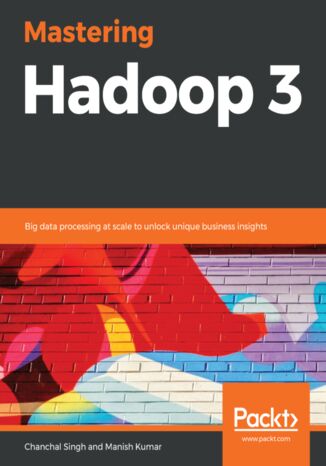
Mastering Hadoop 3. Big data processing at scale to unlock unique business insights
Timothy Wong, Chanchal Singh, Manish Kumar
Apache Hadoop is one of the most popular big data solutions for distributed storage and for processing large chunks of data. With Hadoop 3, Apache promises to provide a high-performance, more fault-tolerant, and highly efficient big data processing platform, with a focus on improved scalability and increased efficiency.With this guide, you’ll understand advanced concepts of the Hadoop ecosystem tool. You’ll learn how Hadoop works internally, study advanced concepts of different ecosystem tools, discover solutions to real-world use cases, and understand how to secure your cluster. It will then walk you through HDFS, YARN, MapReduce, and Hadoop 3 concepts. You’ll be able to address common challenges like using Kafka efficiently, designing low latency, reliable message delivery Kafka systems, and handling high data volumes. As you advance, you’ll discover how to address major challenges when building an enterprise-grade messaging system, and how to use different stream processing systems along with Kafka to fulfil your enterprise goals.By the end of this book, you’ll have a complete understanding of how components in the Hadoop ecosystem are effectively integrated to implement a fast and reliable data pipeline, and you’ll be equipped to tackle a range of real-world problems in data pipelines.
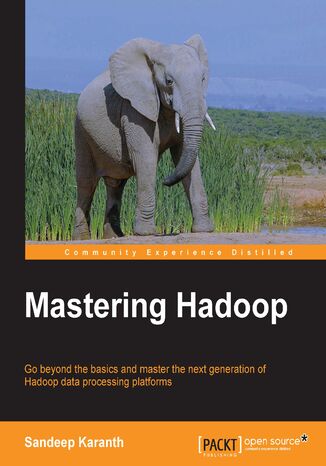
Sandeep Karanth
Do you want to broaden your Hadoop skill set and take your knowledge to the next level? Do you wish to enhance your knowledge of Hadoop to solve challenging data processing problems? Are your Hadoop jobs, Pig scripts, or Hive queries not working as fast as you intend? Are you looking to understand the benefits of upgrading Hadoop? If the answer is yes to any of these, this book is for you. It assumes novice-level familiarity with Hadoop.
Mastering Java for Data Science. Analytics and more for production-ready applications
Alexey Grigorev
Java is the most popular programming language, according to the TIOBE index, and it is a typical choice for running production systems in many companies, both in the startup world and among large enterprises.Not surprisingly, it is also a common choice for creating data science applications: it is fast and has a great set of data processing tools, both built-in and external. What is more, choosing Java for data science allows you to easily integrate solutions with existing software, and bring data science into production with less effort.This book will teach you how to create data science applications with Java. First, we will revise the most important things when starting a data science application, and then brush up the basics of Java and machine learning before diving into more advanced topics. We start by going over the existing libraries for data processing and libraries with machine learning algorithms. After that, we cover topics such as classification and regression, dimensionality reduction and clustering, information retrieval and natural language processing, and deep learning and big data.Finally, we finish the book by talking about the ways to deploy the model and evaluate it in production settings.
Uday Kamath, Krishna Choppella
Java is one of the main languages used by practicing data scientists; much of the Hadoop ecosystem is Java-based, and it is certainly the language that most production systems in Data Science are written in. If you know Java, Mastering Machine Learning with Java is your next step on the path to becoming an advanced practitioner in Data Science.This book aims to introduce you to an array of advanced techniques in machine learning, including classification, clustering, anomaly detection, stream learning, active learning, semi-supervised learning, probabilistic graph modeling, text mining, deep learning, and big data batch and stream machine learning. Accompanying each chapter are illustrative examples and real-world case studies that show how to apply the newly learned techniques using sound methodologies and the best Java-based tools available today.On completing this book, you will have an understanding of the tools and techniques for building powerful machine learning models to solve data science problems in just about any domain.
Mastering Kibana 6.x. Visualize your Elastic Stack data with histograms, maps, charts, and graphs
Anurag Srivastava
Kibana is one of the popular tools among data enthusiasts for slicing and dicing large datasets and uncovering Business Intelligence (BI) with the help of its rich and powerful visualizations.To begin with, Mastering Kibana 6.x quickly introduces you to the features of Kibana 6.x, before teaching you how to create smart dashboards in no time. You will explore metric analytics and graph exploration, followed by understanding how to quickly customize Kibana dashboards. In addition to this, you will learn advanced analytics such as maps, hits, and list analytics. All this will help you enhance your skills in running and comparing multiple queries and filters, influencing your data visualization skills at scale.With Kibana’s Timelion feature, you can analyze time series data with histograms and stats analytics. By the end of this book, you will have created a speedy machine learning job using X-Pack capabilities.
Cory Lesmeister
Given the growing popularity of the R-zerocost statistical programming environment, there has never been a better time to start applying ML to your data. This book will teach you advanced techniques in ML ,using? the latest code in R 3.5. You will delve into various complex features of supervised learning, unsupervised learning, and reinforcement learning algorithms to design efficient and powerful ML models. This newly updated edition is packed with fresh examples covering a range of tasks from different domains. Mastering Machine Learning with R starts by showing you how to quickly manipulate data and prepare it for analysis. You will explore simple and complex models and understand how to compare them. You’ll also learn to use the latest library support, such as TensorFlow and Keras-R, for performing advanced computations. Additionally, you’ll explore complex topics, such as natural language processing (NLP), time series analysis, and clustering, which will further refine your skills in developing applications. Each chapter will help you implement advanced ML algorithms using real-world examples. You’ll even be introduced to reinforcement learning, along with its various use cases and models. In the concluding chapters, you’ll get a glimpse into how some of these blackbox models can be diagnosed and understood. By the end of this book, you’ll be equipped with the skills to deploy ML techniques in your own projects or at work.