Uczenie maszynowe
Antonio Gulli, Dr. Amita Kapoor, Sujit Pal
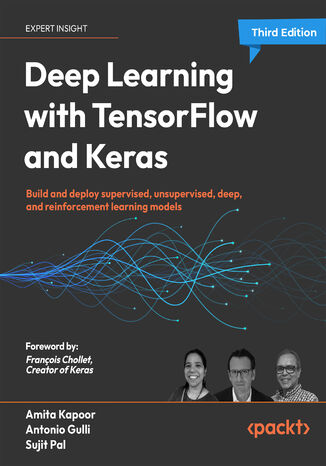
Deep Learning with TensorFlow 2 and Keras, Second Edition teaches neural networks and deep learning techniques alongside TensorFlow (TF) and Keras. You’ll learn how to write deep learning applications in the most powerful, popular, and scalable machine learning stack available.TensorFlow is the machine learning library of choice for professional applications, while Keras offers a simple and powerful Python API for accessing TensorFlow. TensorFlow 2 provides full Keras integration, making advanced machine learning easier and more convenient than ever before.This book also introduces neural networks with TensorFlow, runs through the main applications (regression, ConvNets (CNNs), GANs, RNNs, NLP), covers two working example apps, and then dives into TF in production, TF mobile, and using TensorFlow with AutoML.
Dr. Amita Kapoor, Antonio Gulli, Sujit Pal
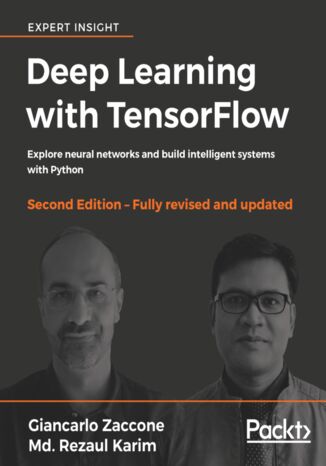
Deep Learning with TensorFlow and Keras teaches you neural networks and deep learning techniques using TensorFlow (TF) and Keras. You'll learn how to write deep learning applications in the most powerful, popular, and scalable machine learning stack available.TensorFlow 2.x focuses on simplicity and ease of use, with updates like eager execution, intuitive higher-level APIs based on Keras, and flexible model building on any platform. This book uses the latest TF 2.0 features and libraries to present an overview of supervised and unsupervised machine learning models and provides a comprehensive analysis of deep learning and reinforcement learning models using practical examples for the cloud, mobile, and large production environments.This book also shows you how to create neural networks with TensorFlow, runs through popular algorithms (regression, convolutional neural networks (CNNs), transformers, generative adversarial networks (GANs), recurrent neural networks (RNNs), natural language processing (NLP), and graph neural networks (GNNs)), covers working example apps, and then dives into TF in production, TF mobile, and TensorFlow with AutoML.
Giancarlo Zaccone, Vihan Jain, Md. Rezaul Karim,...
Deep learning is a branch of machine learning algorithms based on learning multiple levels of abstraction. Neural networks, which are at the core of deep learning, are being used in predictive analytics, computer vision, natural language processing, time series forecasting, and to perform a myriad of other complex tasks.This book is conceived for developers, data analysts, machine learning practitioners and deep learning enthusiasts who want to build powerful, robust, and accurate predictive models with the power of TensorFlow, combined with other open source Python libraries. Throughout the book, you’ll learn how to develop deep learning applications for machine learning systems using Feedforward Neural Networks, Convolutional Neural Networks, Recurrent Neural Networks, Autoencoders, and Factorization Machines. Discover how to attain deep learning programming on GPU in a distributed way.You'll come away with an in-depth knowledge of machine learning techniques and the skills to apply them to real-world projects.
Deep Learning with TensorFlow. Explore neural networks with Python
Giancarlo Zaccone, Md. Rezaul Karim, Ahmed Menshawy
Deep learning is the step that comes after machine learning, and has more advancedimplementations. Machine learning is not just for academics anymore, but is becoming a mainstream practice through wide adoption, and deep learning has taken the front seat. As a data scientist, if you want to explore data abstraction layers, this book will be your guide. This book shows how this can be exploited in the real world with complex raw data using TensorFlow 1.x.Throughout the book, you’ll learn how to implement deep learning algorithms for machine learning systems and integrate them into your product offerings, includingsearch, image recognition, and language processing. Additionally, you’ll learn howto analyze and improve the performance of deep learning models. This can be done bycomparing algorithms against benchmarks, along with machine intelligence, to learnfrom the information and determine ideal behaviors within a specific context.After finishing the book, you will be familiar with machine learning techniques, in particular the use of TensorFlow for deep learning, and will be ready to apply your knowledge to research or commercial projects.
Deep Learning with Theano. Perform large-scale numerical and scientific computations efficiently
Christopher Bourez
This book offers a complete overview of Deep Learning with Theano, a Python-based library that makes optimizing numerical expressions and deep learning models easy on CPU or GPU.The book provides some practical code examples that help the beginner understand how easy it is to build complex neural networks, while more experimented data scientists will appreciate the reach of the book, addressing supervised and unsupervised learning, generative models, reinforcement learning in the fields of image recognition, natural language processing, or game strategy.The book also discusses image recognition tasks that range from simple digit recognition, image classification, object localization, image segmentation, to image captioning. Natural language processing examples include text generation, chatbots, machine translation, and question answering. The last example deals with generating random data that looks real and solving games such as in the Open-AI gym. At the end, this book sums up the best -performing nets for each task. While early research results were based on deep stacks of neural layers, in particular, convolutional layers, the book presents the principles that improved the efficiency of these architectures, in order to help the reader build new custom nets.
Rowel Atienza
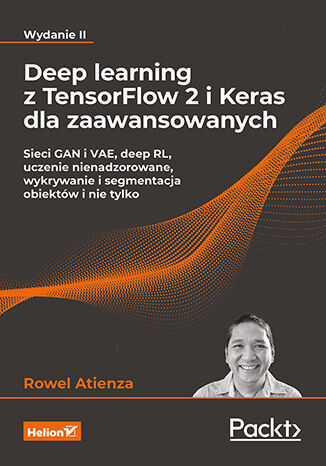
Oto propozycja dla specjalistów zajmujących się programowaniem sztucznej inteligencji i studentów kształcących się w tej dziedzinie. Autor przybliża tajniki tworzenia sieci neuronowych stosowanych w uczeniu głębokim i pokazuje, w jaki sposób używać w tym celu bibliotek Keras i TensorFlow. Objaśnia zagadnienia dotyczące programowania AI zarówno w teorii, jak i praktyce. Liczne przykłady, czytelna oprawa graficzna i logiczne wywody sprawiają, że to skuteczne narzędzie dla każdego, kto chce się nauczyć budowania sieci neuronowych typu MLP, CNN i RNN. Książka wprowadza w teoretyczne fundamenty uczenia głębokiego - znalazły się w niej wyjaśnienia podstawowych pojęć związanych z tą dziedziną i różnice pomiędzy poszczególnymi typami sieci neuronowych. Opisano tutaj również metody programowania algorytmów używanych w uczeniu głębokim i sposoby ich wdrażania. Dzięki lekturze lepiej zrozumiesz sieci neuronowe, nauczysz się ich tworzenia i zastosowania w różnych projektach z zakresu AI. Polecamy tę książkę każdemu, kto: chce zrozumieć, jak działają sieci neuronowe i w jaki sposób się je tworzy specjalizuje się w uczeniu głębokim lub zamierza lepiej poznać tę dziedzinę posługuje się sieciami neuronowymi w programowaniu chce się nauczyć stosować biblioteki Keras i TensorFlow w uczeniu głębokim
Reinier van Altena
This practical guide on no-code development with Betty Blocks will take you through the different features, no-code functionalities, and capabilities of the Betty Blocks platform using real-world use cases. The book will equip you with the tools to develop business apps based on various data models, business processes, and more.You’ll begin with an introduction to the basic concepts of the Betty Blocks no-code platform, such as developing IT solutions on various use cases including reporting apps, data tracking apps, workflows, and business processes. After getting to grips with the basics, you’ll explore advanced concepts such as building powerful applications that impact the business straight away with no-code application development and quickly creating prototypes. The concluding chapters will help you get a solid understanding of rapid application development, building customer portals, building dynamic web apps, drag-and-drop front ends, visual modelling capabilities, and complex data models.By the end of this book, you’ll have gained a comprehensive understanding of building your own applications as a citizen developer using the Betty Blocks no-code platform.
Fanny Ip, Jeremiah Crowley
Artificial intelligence (AI) enables enterprises to optimize business processes that are probabilistic, highly variable, and require cognitive abilities with unstructured data. Many believe there is a steep learning curve with AI, however, the goal of our book is to lower the barrier to using AI. This practical guide to AI with UiPath will help RPA developers and tech-savvy business users learn how to incorporate cognitive abilities into business process optimization. With the hands-on approach of this book, you'll quickly be on your way to implementing cognitive automation to solve everyday business problems.Complete with step-by-step explanations of essential concepts, practical examples, and self-assessment questions, this book will help you understand the power of AI and give you an overview of the relevant out-of-the-box models. You’ll learn about cognitive AI in the context of RPA, the basics of machine learning, and how to apply cognitive automation within the development lifecycle. You’ll then put your skills to test by building three use cases with UiPath Document Understanding, UiPath AI Center, and Druid.By the end of this AI book, you'll be able to build UiPath automations with the cognitive capabilities of intelligent document processing, machine learning, and chatbots, while understanding the development lifecycle.