
Uczenie maszynowe
Sztuczna inteligencja od podstaw
Feliks Kurp
Nie ma wątpliwości, że sztuczna inteligencja (AI) zrewolucjonizuje w najbliższych dekadach nasze życie. Wśród największych autorytetów świata nauki panuje przekonanie, że stoimy w obliczu przełomu porównywalnego z wynalezieniem i zastosowaniami elektryczności. Sztuczna inteligencja od podstaw to pozycja, która począwszy od opisu klasycznych metod SI, takich jak algorytm genetyczny, algorytm mrówkowy, systemy ekspertowe czy sztuczne życie, zapoznaje Czytelnika z najbardziej zaawansowanymi modelami opartymi na sztucznych sieciach neuronowych. Autor skrupulatnie objaśnia złożone zagadnienia dotyczące zarówno podstaw teoretycznych, jak i budowy i zastosowań takich systemów, nie unika przy tym odwołania do historii ich rozwoju. Książka stanowi kompendium wiedzy na temat tej niesłychanie szybko rozwijającej się i dynamicznie wkraczającej w nasze życie dziedziny. Została napisana tak, aby była przystępna dla osób posiadających podstawowe umiejętności matematyczne. Może stanowić podręcznik dla studentów takich kierunków jak informatyka, mechatronika, a także automatyka i robotyka. Dzięki książce: poznasz historię rozwoju sztucznej inteligencji zdobędziesz wiedzę na temat aktualnych metod AI, takich jak uczenie maszynowe (ML), głębokie uczenie maszynowe (DL) czy przetwarzanie języka naturalnego (NLP) na podstawie udostępnionych kodów źródłowych kilku autorskich aplikacji nabędziesz umiejętności w zakresie tworzenia i optymalizacji systemów sztucznej inteligencji
Sztuczna inteligencja w finansach. Używaj języka Python do projektowania i wdrażania algorytmów AI
Yves Hilpisch
W świecie finansów sztuczna inteligencja okazała się przełomową technologią - w połączeniu z odpowiednim zastosowaniem algorytmów i dużych zbiorów danych bowiem pozwala na poprawę jakości usług finansowych. Autor tej książki zdaje sobie z tego sprawę - ma wieloletnie doświadczenie i kompleksową wiedzę na temat projektowania i wdrażania zaawansowanych mechanizmów AI w największych podmiotach z branży. Swoją wiedzą dzieli się z czytelnikami. Dr Yves Hilpisch szczegółowo opisuje zarówno podstawy teoretyczne, jak i praktyczne aspekty używania algorytmów sztucznej inteligencji w ramach usług i produktów finansowych. Opierając się na przykładach z języka Python, pokazuje metodyki, modele, założenia i techniki wdrażania AI, a także analizuje problemy mogące utrudniać to zadanie i przybliża ich rozwiązania. Znajdziemy tutaj skomplikowane zagadnienia wytłumaczone w logiczny i zrozumiały sposób. Autor z powodzeniem łączy teorię z praktyką, a jego podejście do tematu i prezentowane przypadki bazujące na doświadczeniu są cennym źródłem wiedzy dla każdego, kto chce poznać tajniki dotyczące zastosowania sztucznej inteligencji, uczenia maszynowego, algorytmów i zbiorów danych w szeroko pojętym świecie finansów. Dzięki książce dowiesz się: na czym polega zastosowanie AI w usługach i produktach finansowych dlaczego i w jaki sposób użycie sztucznej inteligencji fundamentalnie zmienia sektor finansowy i jakie ma to skutki dla niego i konsumentów jak w języku Python konstruować i wdrażać algorytmy bazujące na rozbudowanych zbiorach danych jak dzięki AI i uczeniu maszynowemu usprawniać usługi i produkty finansowe
TensorFlow. 13 praktycznych projektów wykorzystujących uczenie maszynowe
Ankit Jain, Armando Fandango, Amita Kapoor
TensorFlow służy do projektowania i wdrażania zaawansowanych architektur głębokiego uczenia. Jego zaletami są prostota, wydajność i elastyczność. Umożliwia budowanie złożonych rozwiązań na bazie różnorodnych zbiorów danych. Co więcej, pozwala na stosowanie różnych technik uczenia nadzorowanego, nienadzorowanego oraz uczenia przez wzmacnianie. TensorFlow zmienił sposób postrzegania uczenia maszynowego. Dzięki temu środowisku każdy, kto chce uczynić z dużych zbiorów danych wiarygodne źródło wiedzy, może ten cel osiągnąć - niezależnie od tego, czy jest analitykiem danych, naukowcem, projektantem, czy pasjonatem metod sztucznej inteligencji. To książka przeznaczona dla osób, które chcą nauczyć się tworzyć całościowe rozwiązania z wykorzystaniem uczenia maszynowego. Poszczególne zagadnienia zilustrowano trzynastoma praktycznymi projektami, w których wykorzystano między innymi analizy sentymentów, przetwarzanie języka naturalnego, systemy rekomendacyjne, generatywne sieci kontradyktoryjne czy sieci kapsułowe. Pokazano, w jaki sposób używać TensorFlow z interfejsem APO Spark i wspomagać obliczenia układami GPU. Przedstawiono zastosowanie rozkładu macierzy (SVD++), modeli rankingowych i odmian splotowej sieci neuronowej. Nie zabrakło prezentacji nowych rozwiązań o dużym potencjale, takich jak sieci DiscoGAN. Dołączony do książki kod źródłowy, liczne wskazówki i porady pozwolą na płynne rozpoczęcie pracy z TensorFlow oraz innymi narzędziami do budowy sieci neuronowych. W tej książce między innymi: podstawy pracy z TensorFlow wykorzystanie TensorFlow do wizualizacji sieci neuronowych zastosowanie procesu gaussowskiego do prognozowania cen akcji wykrywanie oszukańczych transakcji za pomocą TensorFlow i Keras implementacja sieci kapsułowych w TensorFlow techniki uczenia przez wzmacnianie TensorFlow: prostota, wydajność i imponujący potencjał!
Antonio Gulli, Amita Kapoor
Deep neural networks (DNNs) have achieved a lot of success in the field of computer vision, speech recognition, and natural language processing. This exciting recipe-based guide will take you from the realm of DNN theory to implementing them practically to solve real-life problems in the artificial intelligence domain.In this book, you will learn how to efficiently use TensorFlow, Google’s open source framework for deep learning. You will implement different deep learning networks, such as Convolutional Neural Networks (CNNs), Recurrent Neural Networks (RNNs), Deep Q-learning Networks (DQNs), and Generative Adversarial Networks (GANs), with easy-to-follow standalone recipes. You will learn how to use TensorFlow with Keras as the backend. You will learn how different DNNs perform onsome popularly used datasets, such as MNIST, CIFAR-10, and Youtube8m. You will not only learn about the different mobile and embedded platforms supported by TensorFlow, but also how to set up cloud platforms for deep learning applications. You will also get a sneak peek at TPU architecture and how it will affect the future of DNNs.By using crisp, no-nonsense recipes, you will become an expert in implementing deep learning techniques in growing real-world applications and research areas such as reinforcement learning,GANs, and autoencoders.
TensorFlow 2 Pocket Primer. A Quick Reference Guide for TensorFlow 2 Developers
Mercury Learning and Information, Oswald Campesato
As part of the best-selling *Pocket Primer* series, this book introduces beginners to basic machine learning algorithms using TensorFlow 2. It provides a fast-paced introduction to TensorFlow, covering core features and machine learning basics with Python code samples. An appendix includes Keras-based code samples and explores MLPs, CNNs, RNNs, and LSTMs. The chapters illustrate how to solve various tasks, encouraging further reading to deepen your knowledge.The journey begins with an introduction to TensorFlow 2, followed by essential APIs and datasets. You'll explore linear regression and classifiers, learning to apply TensorFlow to practical problems. The comprehensive appendix covers advanced topics like NLPs and deep learning architectures, enhancing your understanding of machine learning.Understanding these concepts is crucial for modern AI applications. This book transitions readers from basic TensorFlow use to advanced machine learning techniques, blending theory with practical examples. Companion files with source code and figures enhance learning, making this an essential resource for mastering TensorFlow and machine learning.
Tony Holdroyd
TensorFlow is one of the most popular machine learning frameworks in Python. With this book, you will improve your knowledge of some of the latest TensorFlow features and will be able to perform supervised and unsupervised machine learning and also train neural networks.After giving you an overview of what's new in TensorFlow 2.0 Alpha, the book moves on to setting up your machine learning environment using the TensorFlow library. You will perform popular supervised machine learning tasks using techniques such as linear regression, logistic regression, and clustering. You will get familiar with unsupervised learning for autoencoder applications. The book will also show you how to train effective neural networks using straightforward examples in a variety of different domains.By the end of the book, you will have been exposed to a large variety of machine learning and neural network TensorFlow techniques.
Alexey Grigorev, Srinivas Kulkarni, Rajalingappaa Shanmugamani
TensorFlow is one of the most popular frameworks used for machine learning and, more recently, deep learning. It provides a fast and efficient framework for training different kinds of deep learning models, with very high accuracy. This book is your guide to master deep learning with TensorFlow with the help of 10 real-world projects.TensorFlow Deep Learning Projects starts with setting up the right TensorFlow environment for deep learning. You'll learn how to train different types of deep learning models using TensorFlow, including Convolutional Neural Networks, Recurrent Neural Networks, LSTMs, and Generative Adversarial Networks. While doing this, you will build end-to-end deep learning solutions to tackle different real-world problems in image processing, recommendation systems, stock prediction, and building chatbots, to name a few. You will also develop systems that perform machine translation and use reinforcement learning techniques to play games.By the end of this book, you will have mastered all the concepts of deep learning and their implementation with TensorFlow, and will be able to build and train your own deep learning models with TensorFlow confidently.
Oluwole Fagbohun
The TensorFlow Developer Certificate Guide is an indispensable resource for machine learning enthusiasts and data professionals seeking to master TensorFlow and validate their skills by earning the certification. This practical guide equips you with the skills and knowledge necessary to build robust deep learning models that effectively tackle real-world challenges across diverse industries.You’ll embark on a journey of skill acquisition through easy-to-follow, step-by-step explanations and practical examples, mastering the craft of building sophisticated models using TensorFlow 2.x and overcoming common hurdles such as overfitting and data augmentation. With this book, you’ll discover a wide range of practical applications, including computer vision, natural language processing, and time series prediction.To prepare you for the TensorFlow Developer Certificate exam, it offers comprehensive coverage of exam topics, including image classification, natural language processing (NLP), and time series analysis. With the TensorFlow certification, you’ll be primed to tackle a broad spectrum of business problems and advance your career in the exciting field of machine learning. Whether you are a novice or an experienced developer, this guide will propel you to achieve your aspirations and become a highly skilled TensorFlow professional.
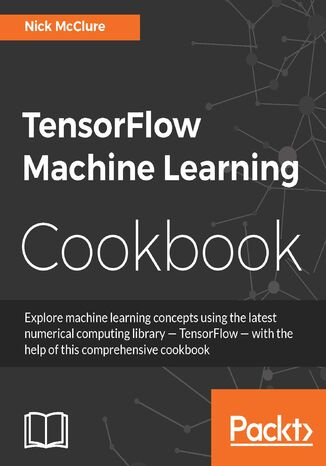
Nick McClure
TensorFlow is an open source software library for Machine Intelligence. The independent recipes in this book will teach you how to use TensorFlow for complex data computations and will let you dig deeper and gain more insights into your data than ever before. You’ll work through recipes on training models, model evaluation, sentiment analysis, regression analysis, clustering analysis, artificial neural networks, and deep learning – each using Google’s machine learning library TensorFlow.This guide starts with the fundamentals of the TensorFlow library which includes variables, matrices, and various data sources. Moving ahead, you will get hands-on experience with Linear Regression techniques with TensorFlow. The next chapters cover important high-level concepts such as neural networks, CNN, RNN, and NLP. Once you are familiar and comfortable with the TensorFlow ecosystem, the last chapter will show you how to take it to production.
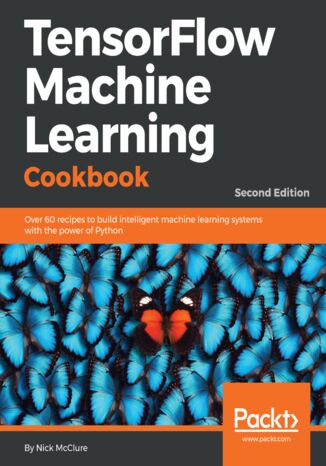
Nick McClure
TensorFlow is an open source software library for Machine Intelligence. The independent recipes in this book will teach you how to use TensorFlow for complex data computations and allow you to dig deeper and gain more insights into your data than ever before. With the help of this book, you will work with recipes for training models, model evaluation, sentiment analysis, regression analysis, clustering analysis, artificial neural networks, and more. You will explore RNNs, CNNs, GANs, reinforcement learning, and capsule networks, each using Google's machine learning library, TensorFlow. Through real-world examples, you will get hands-on experience with linear regression techniques with TensorFlow. Once you are familiar and comfortable with the TensorFlow ecosystem, you will be shown how to take it to production.By the end of the book, you will be proficient in the field of machine intelligence using TensorFlow. You will also have good insight into deep learning and be capable of implementing machine learning algorithms in real-world scenarios.
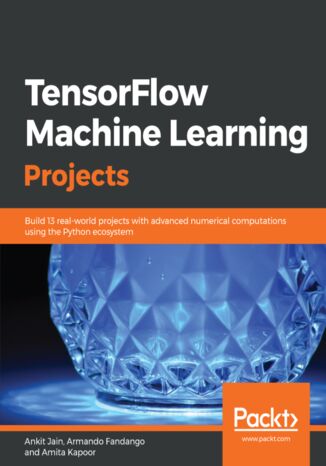
Ankit Jain, Dr. Amita Kapoor
TensorFlow has transformed the way machine learning is perceived. TensorFlow Machine Learning Projects teaches you how to exploit the benefits—simplicity, efficiency, and flexibility—of using TensorFlow in various real-world projects. With the help of this book, you’ll not only learn how to build advanced projects using different datasets but also be able to tackle common challenges using a range of libraries from the TensorFlow ecosystem.To start with, you’ll get to grips with using TensorFlow for machine learning projects; you’ll explore a wide range of projects using TensorForest and TensorBoard for detecting exoplanets, TensorFlow.js for sentiment analysis, and TensorFlow Lite for digit classification.As you make your way through the book, you’ll build projects in various real-world domains, incorporating natural language processing (NLP), the Gaussian process, autoencoders, recommender systems, and Bayesian neural networks, along with trending areas such as Generative Adversarial Networks (GANs), capsule networks, and reinforcement learning. You’ll learn how to use the TensorFlow on Spark API and GPU-accelerated computing with TensorFlow to detect objects, followed by how to train and develop a recurrent neural network (RNN) model to generate book scripts.By the end of this book, you’ll have gained the required expertise to build full-fledged machine learning projects at work.
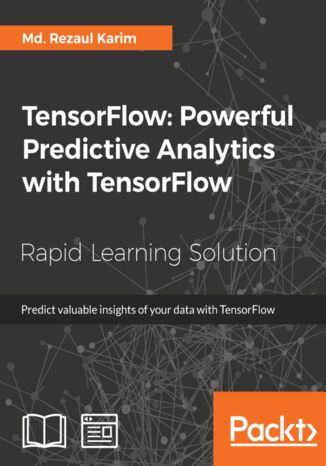
Md. Rezaul Karim
Predictive analytics discovers hidden patterns from structured and unstructured data for automated decision making in business intelligence. Predictive decisions are becoming a huge trend worldwide, catering to wide industry sectors by predicting which decisions are more likely to give maximum results. TensorFlow, Google’s brainchild, is immensely popular and extensively used for predictive analysis.This book is a quick learning guide on all the three types of machine learning, that is, supervised, unsupervised, and reinforcement learning with TensorFlow. This book will teach you predictive analytics for high-dimensional and sequence data. In particular, you will learn the linear regression model for regression analysis. You will also learn how to use regression for predicting continuous values. You will learn supervised learning algorithms for predictive analytics. You will explore unsupervised learning and clustering using K-meansYou will then learn how to predict neighborhoods using K-means, and then, see another example of clustering audio clips based on their audio features. This book is ideal for developers, data analysts, machine learning practitioners, and deep learning enthusiasts who want to build powerful, robust, and accurate predictive models with the power of TensorFlow. This book is embedded with useful assessments that will help you revise the concepts you have learned in this book. This book is repurposed for this specific learning experience from material from Packt's Predictive Analytics with TensorFlow by Md. Rezaul Karim.
Kaushik Balakrishnan
Advances in reinforcement learning algorithms have made it possible to use them for optimal control in several different industrial applications. With this book, you will apply Reinforcement Learning to a range of problems, from computer games to autonomous driving.The book starts by introducing you to essential Reinforcement Learning concepts such as agents, environments, rewards, and advantage functions. You will also master the distinctions between on-policy and off-policy algorithms, as well as model-free and model-based algorithms. You will also learn about several Reinforcement Learning algorithms, such as SARSA, Deep Q-Networks (DQN), Deep Deterministic Policy Gradients (DDPG), Asynchronous Advantage Actor-Critic (A3C), Trust Region Policy Optimization (TRPO), and Proximal Policy Optimization (PPO). The book will also show you how to code these algorithms in TensorFlow and Python and apply them to solve computer games from OpenAI Gym. Finally, you will also learn how to train a car to drive autonomously in the Torcs racing car simulator.By the end of the book, you will be able to design, build, train, and evaluate feed-forward neural networks and convolutional neural networks. You will also have mastered coding state-of-the-art algorithms and also training agents for various control problems.
Justin Bozonier
Machine learning is the process of teaching machines to remember data patterns, using them to predict future outcomes, and offering choices that would appeal to individuals based on their past preferences.Machine learning is applicable to a lot of what you do every day. As a result, you can’t take forever to deliver your first iteration of software. Learning to build machine learning algorithms within a controlled test framework will speed up your time to deliver, quantify quality expectations with your clients, and enable rapid iteration and collaboration.This book will show you how to quantifiably test machine learning algorithms. The very different, foundational approach of this book starts every example algorithm with the simplest thing that could possibly work. With this approach, seasoned veterans will find simpler approaches to beginning a machine learning algorithm. You will learn how to iterate on these algorithms to enable rapid delivery and improve performance expectations.The book begins with an introduction to test driving machine learning and quantifying model quality. From there, you will test a neural network, predict values with regression, and build upon regression techniques with logistic regression. You will discover how to test different approaches to naïve bayes and compare them quantitatively, along with how to apply OOP (Object-Oriented Programming) and OOP patterns to test-driven code, leveraging SciKit-Learn.Finally, you will walk through the development of an algorithm which maximizes the expected value of profit for a marketing campaign by combining one of the classifiers covered with the multiple regression example in the book.
Matthew Moocarme, Mahla Abdolahnejad , Ritesh Bhagwat
New experiences can be intimidating, but not this one! This beginner’s guide to deep learning is here to help you explore deep learning from scratch with Keras, and be on your way to training your first ever neural networks.What sets Keras apart from other deep learning frameworks is its simplicity. With over two hundred thousand users, Keras has a stronger adoption in industry and the research community than any other deep learning framework.The Deep Learning with Keras Workshop starts by introducing you to the fundamental concepts of machine learning using the scikit-learn package. After learning how to perform the linear transformations that are necessary for building neural networks, you'll build your first neural network with the Keras library. As you advance, you'll learn how to build multi-layer neural networks and recognize when your model is underfitting or overfitting to the training data. With the help of practical exercises, you’ll learn to use cross-validation techniques to evaluate your models and then choose the optimal hyperparameters to fine-tune their performance. Finally, you’ll explore recurrent neural networks and learn how to train them to predict values in sequential data.By the end of this book, you'll have developed the skills you need to confidently train your own neural network models.
Hyatt Saleh , Tim Hoolihan, Learnkart Technology...
Want to get to grips with one of the most popular machine learning libraries for deep learning? The Deep Learning with PyTorch Workshop will help you do just that, jumpstarting your knowledge of using PyTorch for deep learning even if you’re starting from scratch.It’s no surprise that deep learning’s popularity has risen steeply in the past few years, thanks to intelligent applications such as self-driving vehicles, chatbots, and voice-activated assistants that are making our lives easier. This book will take you inside the world of deep learning, where you’ll use PyTorch to understand the complexity of neural network architectures.The Deep Learning with PyTorch Workshop starts with an introduction to deep learning and its applications. You’ll explore the syntax of PyTorch and learn how to define a network architecture and train a model. Next, you’ll learn about three main neural network architectures - convolutional, artificial, and recurrent - and even solve real-world data problems using these networks. Later chapters will show you how to create a style transfer model to develop a new image from two images, before finally taking you through how RNNs store memory to solve key data issues.By the end of this book, you’ll have mastered the essential concepts, tools, and libraries of PyTorch to develop your own deep neural networks and intelligent apps.