
Uczenie maszynowe
Uczenie maszynowe (ang. machine learning) zajmuje się teorią i praktycznym zastosowaniem algorytmów analizujących dane — stanowi najciekawszą dziedzinę informatyki. Żyjemy w czasach przetwarzania olbrzymiej ilości informacji; za pomocą samouczących się algorytmów będących częścią uczenia maszynowego informacje te są przekształcane w rzeczywistą wiedzę. Dzięki licznym i potężnym bibliotekom o jawnym kodzie źródłowym, które powstały w ostatnich latach, prawdopodobnie teraz jest najlepszy czas, aby zainteresować się uczeniem maszynowym i nauczyć się wykorzystywać potężne algorytmy do wykrywania wzorców w przetwarzanych danych oraz prognozować przyszłe zdarzenia. Przykładami zastosowania Machine Learning są np. mechanizmy wyszukiwarek internetowych, GPS, autokorekta w edytorze tekstu czy boty w komunikatorach. Jedną z dziedzin uczenia maszynowego jest deep learning, podczas którego komputer uczy się procesów naturalnych dla ludzkiego mózgu (tworzy sieci neuronowe). Technologia ta jest wykorzystywana np. przy identyfikacji głosu i obrazów.
Syed Omar Faruk Towaha
With the use of drones, DIY projects have taken off. Programmers are rapidly moving from traditional application programming to developing exciting multi-utility projects.This book will teach you to build industry-level drones with Arduino and ESP8266 and their modified versions of hardware.With this book, you will explore techniques for leveraging the tiny WiFi chip to enhance your drone and control it over a mobile phone. This book will start with teaching you how to solve problems while building your own WiFi controlled Arduino based drone. You will also learn how to build a Quadcopter and a mission critical drone. Moving on you will learn how to build a prototype drone that will be given a mission to complete which it will do it itself. You will also learn to build various exciting projects such as gliding and racing drones. By the end of this book you will learn how to maintain and troubleshoot your drone.By the end of this book, you will have learned to build drones using ESP8266 and Arduino and leverage their functionalities to the fullest.
Cacti Beginner's Guide. Leverage Cacti to design a robust network operations center - Second Edition
Thomas Urban
Cacti is a performance measurement tool that provides easy methods and functions for gathering and graphing system data. You can use Cacti to develop a robust event management system that can alert on just about anything you would like it to. But to do that, you need to gain a solid understanding of the basics of Cacti, its plugin architecture, and automation concepts.Cacti Beginner's Guide will introduce you to the wide variety of features of Cacti and will guide you on how to use them for maximum effectiveness. Advanced topics such as the plugin architecture and Cacti automation using the command-line interface will help you build a professional performance measurement system. Designed as a beginner's guide, the book starts off with the basics of installing and using Cacti, and also covers the advanced topics that will show you how to customize and extend the core Cacti functionalities. The book offers essential tutorials for creating advanced graphs and using plugins to create enterprise-class reports to show your customers and colleagues. From data templates to input methods and plugin installation to creating your own customized plugins, this book provides you with a rich selection of step-by-step instructions to reach your goals. It covers all you need to know to implement professional performance measurement techniques with Cacti and ways to fully customize Cacti to fit your needs. You will also learn how to migrate Cacti to new servers. Lastly you will also be introduced to the latest feature of building a scalable remote poller environment. By the end of the book, you will be able to implement and extend Cacti to monitor, display, and report the performance of your network exactly the way you want.
Kathrin Melcher, Rosaria Silipo
KNIME Analytics Platform is an open source software used to create and design data science workflows. This book is a comprehensive guide to the KNIME GUI and KNIME deep learning integration, helping you build neural network models without writing any code. It’ll guide you in building simple and complex neural networks through practical and creative solutions for solving real-world data problems.Starting with an introduction to KNIME Analytics Platform, you’ll get an overview of simple feed-forward networks for solving simple classification problems on relatively small datasets. You’ll then move on to build, train, test, and deploy more complex networks, such as autoencoders, recurrent neural networks (RNNs), long short-term memory (LSTM), and convolutional neural networks (CNNs). In each chapter, depending on the network and use case, you’ll learn how to prepare data, encode incoming data, and apply best practices.By the end of this book, you’ll have learned how to design a variety of different neural architectures and will be able to train, test, and deploy the final network.
J. Ashley Hunt
The CompTIA Project+ exam is designed for IT professionals who want to improve their career trajectory by gaining certification in project management specific to their industry. This guide covers everything necessary to pass the current iteration of the Project+ PK0-004 exam.The CompTIA Project+ Certification Guide starts by covering project initiation best practices, including an understanding of organizational structures, team roles, and responsibilities. You’ll then study best practices for developing a project charter and the scope of work to produce deliverables necessary to obtain formal approval of the end result. The ability to monitor your project work and make changes as necessary to bring performance back in line with the plan is the difference between a successful and unsuccessful project. The concluding chapters of the book provide best practices to help keep an eye on your projects and close them out successfully. The guide also includes practice questions created to mirror the exam experience and help solidify your understanding of core project management concepts.By the end of this book, you will be able to develop creative solutions for complex issues faced in project management.
Ian Neil
CompTIA Security+ is a worldwide certification that establishes the fundamental knowledge required to perform core security functions and pursue an IT security career. CompTIA Security+ Certification Guide is a best-in-class exam study guide that covers all of CompTIA Security+ 501 exam objectives. It is authored by Ian Neil, who is a world-class trainer of CompTIA Security+ 501. Packed with self-assessment scenarios and realistic exam questions, this guide will help you master the core concepts to succeed in the exam the first time you take it. Using relevant examples, you will learn all the important security fundamentals from Certificates and Encryption to Identity and Access Management concepts. You will then dive into the important domains of the exam; namely, threats, attacks and vulnerabilities, technologies and tools, architecture and design, risk management, and cryptography and Public Key Infrastructure (PKI). This book comes with over 600 practice questions with detailed explanation that is at the exam level and also includes two mock exams to help you with your study plan. This guide will ensure that encryption and certificates are made easy for you.
Computational Physics. A Comprehensive Guide to Numerical Methods in Physics
Mercury Learning and Information, Darren Walker
This updated edition introduces computational physics for performing experiments on the computer. It provides a grounding in scientific programming with examples in the context of physics problems. Using C++ as the primary language, it covers interpolation, integration, and solving differential equations, from simple concepts to advanced topics. The book includes a chapter on high-performance computing and parallel programming.Understanding computational physics is crucial for data manipulation and real-world simulations. The book starts with introductory topics and progresses to advanced material, including a C++ library and sample programs. Readers will learn problem-solving methods and constructing models.This journey equips readers with skills for scientific tasks, demonstrating efficient problem-solving and model construction. The practical approach ensures users can apply these concepts in real-world scenarios, making it an essential resource for those interested in computational physics.
Lauren Mullennex, Nate Bachmeier, Jay Rao
Computer vision (CV) is a field of artificial intelligence that helps transform visual data into actionable insights to solve a wide range of business challenges. This book provides prescriptive guidance to anyone looking to learn how to approach CV problems for quickly building and deploying production-ready models.You’ll begin by exploring the applications of CV and the features of Amazon Rekognition and Amazon Lookout for Vision. The book will then walk you through real-world use cases such as identity verification, real-time video analysis, content moderation, and detecting manufacturing defects that’ll enable you to understand how to implement AWS AI/ML services. As you make progress, you'll also use Amazon SageMaker for data annotation, training, and deploying CV models. In the concluding chapters, you'll work with practical code examples, and discover best practices and design principles for scaling, reducing cost, improving the security posture, and mitigating bias of CV workloads.By the end of this AWS book, you'll be able to accelerate your business outcomes by building and implementing CV into your production environments with the help of AWS AI/ML services.
Matthew Rever
Python is the ideal programming language for rapidly prototyping and developing production-grade codes for image processing and Computer Vision with its robust syntax and wealth of powerful libraries. This book will help you design and develop production-grade Computer Vision projects tackling real-world problems.With the help of this book, you will learn how to set up Anaconda and Python for the major OSes with cutting-edge third-party libraries for Computer Vision. You'll learn state-of-the-art techniques for classifying images, finding and identifying human postures, and detecting faces within videos. You will use powerful machine learning tools such as OpenCV, Dlib, and TensorFlow to build exciting projects such as classifying handwritten digits, detecting facial features,and much more. The book also covers some advanced projects, such as reading text from license plates from real-world images using Google’s Tesseract software, and tracking human body poses using DeeperCut within TensorFlow.By the end of this book, you will have the expertise required to build your own Computer Vision projects using Python and its associated libraries.
Amin Ahmadi Tazehkandi
Developers have been using OpenCV library to develop computer vision applications for a long time. However, they now need a more effective tool to get the job done and in a much better and modern way. Qt is one of the major frameworks available for this task at the moment. This book will teach you to develop applications with the combination of OpenCV 3 and Qt5, and how to create cross-platform computer vision applications. We’ll begin by introducing Qt, its IDE, and its SDK. Next you’ll learn how to use the OpenCV API to integrate both tools, and see how to configure Qt to use OpenCV. You’ll go on to build a full-fledged computer vision application throughout the book. Later, you’ll create a stunning UI application using the Qt widgets technology, where you’ll display the images after they are processed in an efficient way. At the end of the book, you’ll learn how to convert OpenCV Mat to Qt QImage. You’ll also see how to efficiently process images to filter them, transform them, detect or track objects as well as analyze video. You’ll become better at developing OpenCV applications.
Xiaoquan Kong, Guan Wang, Alan Nichol
The Rasa framework enables developers to create industrial-strength chatbots using state-of-the-art natural language processing (NLP) and machine learning technologies quickly, all in open source.Conversational AI with Rasa starts by showing you how the two main components at the heart of Rasa work – Rasa NLU (natural language understanding) and Rasa Core. You'll then learn how to build, configure, train, and serve different types of chatbots from scratch by using the Rasa ecosystem. As you advance, you'll use form-based dialogue management, work with the response selector for chitchat and FAQ-like dialogs, make use of knowledge base actions to answer questions for dynamic queries, and much more. Furthermore, you'll understand how to customize the Rasa framework, use conversation-driven development patterns and tools to develop chatbots, explore what your bot can do, and easily fix any mistakes it makes by using interactive learning. Finally, you'll get to grips with deploying the Rasa system to a production environment with high performance and high scalability and cover best practices for building an efficient and robust chat system.By the end of this book, you'll be able to build and deploy your own chatbots using Rasa, addressing the common pain points encountered in the chatbot life cycle.
Dancing with Qubits. How quantum computing works and how it can change the world
Robert S. Sutor
Quantum computing is making us change the way we think about computers. Quantum bits, a.k.a. qubits, can make it possible to solve problems that would otherwise be intractable with current computing technology. Dancing with Qubits is a quantum computing textbook that starts with an overview of why quantum computing is so different from classical computing and describes several industry use cases where it can have a major impact. From there it moves on to a fuller description of classical computing and the mathematical underpinnings necessary to understand such concepts as superposition, entanglement, and interference. Next up is circuits and algorithms, both basic and more sophisticated. It then nicely moves on to provide a survey of the physics and engineering ideas behind how quantum computing hardware is built. Finally, the book looks to the future and gives you guidance on understanding how further developments will affect you.Really understanding quantum computing requires a lot of math, and this book doesn't shy away from the necessary math concepts you'll need. Each topic is introduced and explained thoroughly, in clear English with helpful examples.
Cuantum Technologies LLC
Embark on a comprehensive journey through data analysis with Python. Begin with an introduction to data analysis and Python, setting a strong foundation before delving into Python programming basics. Learn to set up your data analysis environment, ensuring you have the necessary tools and libraries at your fingertips. As you progress, gain proficiency in NumPy for numerical operations and Pandas for data manipulation, mastering the skills to handle and transform data efficiently.Proceed to data visualization with Matplotlib and Seaborn, where you'll create insightful visualizations to uncover patterns and trends. Understand the core principles of exploratory data analysis (EDA) and data preprocessing, preparing your data for robust analysis. Explore probability theory and hypothesis testing to make data-driven conclusions and get introduced to the fundamentals of machine learning. Delve into supervised and unsupervised learning techniques, laying the groundwork for predictive modeling.To solidify your knowledge, engage with two practical case studies: sales data analysis and social media sentiment analysis. These real-world applications will demonstrate best practices and provide valuable tips for your data analysis projects.
Duc Haba
Data is paramount in AI projects, especially for deep learning and generative AI, as forecasting accuracy relies on input datasets being robust. Acquiring additional data through traditional methods can be challenging, expensive, and impractical, and data augmentation offers an economical option to extend the dataset.The book teaches you over 20 geometric, photometric, and random erasing augmentation methods using seven real-world datasets for image classification and segmentation. You’ll also review eight image augmentation open source libraries, write object-oriented programming (OOP) wrapper functions in Python Notebooks, view color image augmentation effects, analyze safe levels and biases, as well as explore fun facts and take on fun challenges. As you advance, you’ll discover over 20 character and word techniques for text augmentation using two real-world datasets and excerpts from four classic books. The chapter on advanced text augmentation uses machine learning to extend the text dataset, such as Transformer, Word2vec, BERT, GPT-2, and others. While chapters on audio and tabular data have real-world data, open source libraries, amazing custom plots, and Python Notebook, along with fun facts and challenges.By the end of this book, you will be proficient in image, text, audio, and tabular data augmentation techniques.
Vijaya Kumar Suda
Data labeling is the invisible hand that guides the power of artificial intelligence and machine learning. In today’s data-driven world, mastering data labeling is not just an advantage, it’s a necessity. Data Labeling in Machine Learning with Python empowers you to unearth value from raw data, create intelligent systems, and influence the course of technological evolution.With this book, you'll discover the art of employing summary statistics, weak supervision, programmatic rules, and heuristics to assign labels to unlabeled training data programmatically. As you progress, you'll be able to enhance your datasets by mastering the intricacies of semi-supervised learning and data augmentation. Venturing further into the data landscape, you'll immerse yourself in the annotation of image, video, and audio data, harnessing the power of Python libraries such as seaborn, matplotlib, cv2, librosa, openai, and langchain. With hands-on guidance and practical examples, you'll gain proficiency in annotating diverse data types effectively.By the end of this book, you’ll have the practical expertise to programmatically label diverse data types and enhance datasets, unlocking the full potential of your data.
David Natingga
Machine learning applications are highly automated and self-modifying, and continue to improve over time with minimal human intervention, as they learn from the trained data. To address the complex nature of various real-world data problems, specialized machine learning algorithms have been developed. Through algorithmic and statistical analysis, these models can be leveraged to gain new knowledge from existing data as well.Data Science Algorithms in a Week addresses all problems related to accurate and efficient data classification and prediction. Over the course of seven days, you will be introduced to seven algorithms, along with exercises that will help you understand different aspects of machine learning. You will see how to pre-cluster your data to optimize and classify it for large datasets. This book also guides you in predicting data based on existing trends in your dataset. This book covers algorithms such as k-nearest neighbors, Naive Bayes, decision trees, random forest, k-means, regression, and time-series analysis.By the end of this book, you will understand how to choose machine learning algorithms for clustering, classification, and regression and know which is best suited for your problem
Mercury Learning and Information, P. G. Madhavan
This book introduces data science to professionals in engineering, physics, mathematics, and related fields. It serves as a workbook with MATLAB code, linking subject knowledge to data science, machine learning, and analytics, with applications in IoT. Part One integrates machine learning, systems theory, linear algebra, digital signal processing, and probability theory. Part Two develops a nonlinear, time-varying machine learning solution for modeling real-life business problems.Understanding data science is crucial for modern applications, particularly in IoT. This book presents a dynamic machine learning solution to handle these complexities. Topics include machine learning, systems theory, linear algebra, digital signal processing, probability theory, state-space formulation, Bayesian estimation, Kalman filter, causality, and digital twins.The journey begins with data science and machine learning, covering systems theory and linear algebra. Advanced concepts like the Kalman filter and Bayesian estimation lead to developing a dynamic machine learning model. The book ends with practical applications using digital twins.
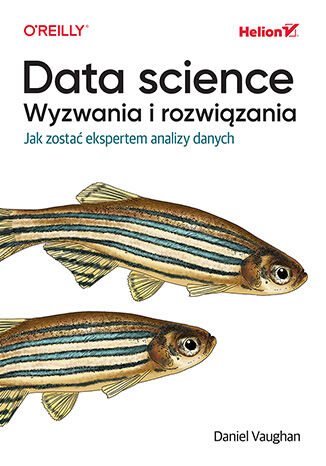
Data science, wyzwania i rozwiązania. Jak zostać ekspertem analizy danych
Daniel Vaughan
Uczenie się i praktykowanie danologii nie należy do najłatwiejszych zadań. Edukacja w tej dziedzinie zazwyczaj dotyczy programowania i uczenia maszynowego, a przecież świetny analityk danych musi się znać na wielu innych zagadnieniach. Może się ich nauczyć w pracy, ale w tym celu konieczne jest znalezienie mentora. A to niestety nie zawsze jest możliwe. Ten podręcznik zaczyna się tam, gdzie większość książek się kończy - od rzeczywistych procesów decyzyjnych opartych na wnioskach wynikających z danych. Brett Holleman, niezależny danolog Dzięki tej książce przyswoisz różne techniki, które pomogą Ci stać się bardziej produktywnym analitykiem danych. Najpierw zapoznasz się z tematami związanymi z rozumieniem danych i umiejętnościami miękkimi, które okazują się konieczne w pracy dobrego danologa. Dopiero potem skupisz się na kluczowych aspektach uczenia maszynowego. W ten sposób stopniowo przejdziesz ścieżkę od przeciętnego kandydata do wyjątkowego specjalisty data science. Umiejętności opisane w tym przewodniku przez wiele lat były rozpoznawane, katalogowane, analizowane i stosowane do generowania wartości i szkolenia danologów w różnych firmach i branżach. Z książki dowiesz się: jak sprawić, by procesy oparte na analizie danych generowały wartość jak zaprojektować przydatne wskaźniki jak zdobywać poparcie interesariuszy jak się upewnić, że algorytm uczenia maszynowego nadaje się do rozwiązania danego zadania jak zapanować nad wyciekami danych Oto brakujący podręcznik pozwalający odnieść sukces komercyjny dzięki data science! Adri Purkayastha, dyrektor do spraw zagrożeń związanych z AI, BNP Paribas
Stephanie Rivera, Anastasia Prokaieva, Amanda Baker, Hayley...
Discover what makes the Databricks Data Intelligence Platform the go-to choice for top-tier machine learning solutions. Written by a team of industry experts at Databricks with decades of combined experience in big data, machine learning, and data science, Databricks ML in Action presents cloud-agnostic, end-to-end examples with hands-on illustrations of executing data science, machine learning, and generative AI projects on the Databricks Platform.You’ll develop expertise in Databricks' managed MLflow, Vector Search, AutoML, Unity Catalog, and Model Serving as you learn to apply them practically in everyday workflows. This Databricks book not only offers detailed code explanations but also facilitates seamless code importation for practical use. You’ll discover how to leverage the open-source Databricks platform to enhance learning, boost skills, and elevate productivity with supplemental resources.By the end of this book, you'll have mastered the use of Databricks for data science, machine learning, and generative AI, enabling you to deliver outstanding data products.
Ali Madani
Debugging Machine Learning Models with Python is a comprehensive guide that navigates you through the entire spectrum of mastering machine learning, from foundational concepts to advanced techniques. It goes beyond the basics to arm you with the expertise essential for building reliable, high-performance models for industrial applications. Whether you're a data scientist, analyst, machine learning engineer, or Python developer, this book will empower you to design modular systems for data preparation, accurately train and test models, and seamlessly integrate them into larger technologies.By bridging the gap between theory and practice, you'll learn how to evaluate model performance, identify and address issues, and harness recent advancements in deep learning and generative modeling using PyTorch and scikit-learn. Your journey to developing high quality models in practice will also encompass causal and human-in-the-loop modeling and machine learning explainability. With hands-on examples and clear explanations, you'll develop the skills to deliver impactful solutions across domains such as healthcare, finance, and e-commerce.
Ahmed Menshawy
Deep learning is a popular subset of machine learning, and it allows you to build complex models that are faster and give more accurate predictions. This book is your companion to take your first steps into the world of deep learning, with hands-on examples to boost your understanding of the topic.This book starts with a quick overview of the essential concepts of data science and machine learning which are required to get started with deep learning. It introduces you to Tensorflow, the most widely used machine learning library for training deep learning models. You will then work on your first deep learning problem by training a deep feed-forward neural network for digit classification, and move on to tackle other real-world problems in computer vision, language processing, sentiment analysis, and more. Advanced deep learning models such as generative adversarial networks and their applications are also covered in this book.By the end of this book, you will have a solid understanding of all the essential concepts in deep learning. With the help of the examples and code provided in this book, you will be equipped to train your own deep learning models with more confidence.
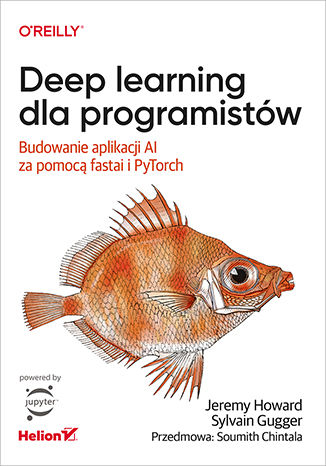
Deep learning dla programistów. Budowanie aplikacji AI za pomocą fastai i PyTorch
Jeremy Howard, Sylvain Gugger
Uczenie głębokie zmienia oblicze wielu branż. Ta rewolucja już się zaczęła, jednak potencjał AI i sieci neuronowych jest znacznie większy. Korzystamy więc dziś z osiągnięć komputerowej analizy obrazu i języka naturalnego, wspierania badań naukowych czy budowania skutecznych strategii biznesowych - wchodzimy do świata, który do niedawna był dostępny głównie dla naukowców. W konsekwencji trudno o źródła wiedzy, które równocześnie byłyby przystępne dla zwykłych programistów i miały wysoką wartość merytoryczną. Problem polega na tym, że bez dogłębnego zrozumienia działania algorytmów uczenia głębokiego trudno tworzyć dobre aplikacje. Oto praktyczny i przystępny przewodnik po koncepcjach uczenia głębokiego, napisany tak, aby ułatwić zrozumienie najnowszych technik w tej dziedzinie bez znajomości wyższej matematyki. Książka daje znakomite podstawy uczenia głębokiego, a następnie stopniowo wprowadza zagadnienia sposobu działania modeli, ich budowy i trenowania. Pokazano w niej również praktyczne techniki przekształcania modeli w działające aplikacje. Znalazło się tu mnóstwo wskazówek ułatwiających poprawianie dokładności, szybkości i niezawodności modeli. Nie zabrakło też informacji o najlepszych sposobach wdrażania od podstaw algorytmów uczenia głębokiego i stosowaniu ich w najnowocześniejszych rozwiązaniach. W książce między innymi: gruntownie i przystępnie omówione podstawy uczenia głębokiego najnowsze techniki uczenia głębokiego i ich praktyczne zastosowanie działanie modeli oraz zasady ich treningu praktyczne tworzenie aplikacji korzystających z uczenia głębokiego wdrażanie algorytmów uczenia głębokiego etyczne implikacje AI Uczenie głębokie? Dobrze zrozum, dobrze zastosuj!
Wei Di, Jianing Wei, Anurag Bhardwaj
Deep Learning a trending topic in the field of Artificial Intelligence today and can be considered to be an advanced form of machine learning. This book will help you take your first steps in training efficient deep learning models and applying them in various practical scenarios. You will model, train, and deploy different kinds of neural networks such as CNN, RNN, and will see some of their applications in real-world domains including computer vision, natural language processing, speech recognition, and so on. You will build practical projects such as chatbots, implement reinforcement learning to build smart games, and develop expert systems for image captioning and processing using Python library such as TensorFlow. This book also covers solutions for different problems you might come across while training models, such as noisy datasets, and small datasets.By the end of this book, you will have a firm understanding of the basics of deep learning and neural network modeling, along with their practical applications.
Dr. Pablo Rivas
With information on the web exponentially increasing, it has become more difficult than ever to navigate through everything to find reliable content that will help you get started with deep learning. This book is designed to help you if you're a beginner looking to work on deep learning and build deep learning models from scratch, and you already have the basic mathematical and programming knowledge required to get started.The book begins with a basic overview of machine learning, guiding you through setting up popular Python frameworks. You will also understand how to prepare data by cleaning and preprocessing it for deep learning, and gradually go on to explore neural networks. A dedicated section will give you insights into the working of neural networks by helping you get hands-on with training single and multiple layers of neurons. Later, you will cover popular neural network architectures such as CNNs, RNNs, AEs, VAEs, and GANs with the help of simple examples, and learn how to build models from scratch. At the end of each chapter, you will find a question and answer section to help you test what you've learned through the course of the book.By the end of this book, you'll be well-versed with deep learning concepts and have the knowledge you need to use specific algorithms with various tools for different tasks.
Rajalingappaa Shanmugamani
Deep learning has shown its power in several application areas of Artificial Intelligence, especially in Computer Vision. Computer Vision is the science of understanding and manipulating images, and finds enormous applications in the areas of robotics, automation, and so on. This book will also show you, with practical examples, how to develop Computer Vision applications by leveraging the power of deep learning. In this book, you will learn different techniques related to object classification, object detection, image segmentation, captioning, image generation, face analysis, and more. You will also explore their applications using popular Python libraries such as TensorFlow and Keras. This book will help you master state-of-the-art, deep learning algorithms and their implementation.