
Uczenie maszynowe
Uczenie maszynowe (ang. machine learning) zajmuje się teorią i praktycznym zastosowaniem algorytmów analizujących dane — stanowi najciekawszą dziedzinę informatyki. Żyjemy w czasach przetwarzania olbrzymiej ilości informacji; za pomocą samouczących się algorytmów będących częścią uczenia maszynowego informacje te są przekształcane w rzeczywistą wiedzę. Dzięki licznym i potężnym bibliotekom o jawnym kodzie źródłowym, które powstały w ostatnich latach, prawdopodobnie teraz jest najlepszy czas, aby zainteresować się uczeniem maszynowym i nauczyć się wykorzystywać potężne algorytmy do wykrywania wzorców w przetwarzanych danych oraz prognozować przyszłe zdarzenia. Przykładami zastosowania Machine Learning są np. mechanizmy wyszukiwarek internetowych, GPS, autokorekta w edytorze tekstu czy boty w komunikatorach. Jedną z dziedzin uczenia maszynowego jest deep learning, podczas którego komputer uczy się procesów naturalnych dla ludzkiego mózgu (tworzy sieci neuronowe). Technologia ta jest wykorzystywana np. przy identyfikacji głosu i obrazów.
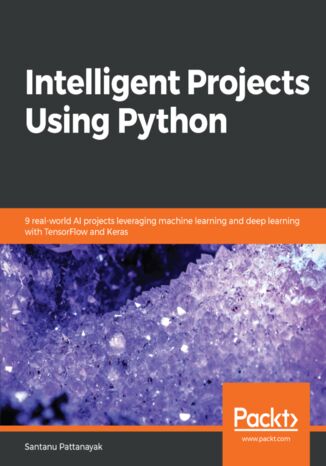
Santanu Pattanayak, Manohar Swamynathan
This book will be a perfect companion if you want to build insightful projects from leading AI domains using Python.The book covers detailed implementation of projects from all the core disciplines of AI. We start by covering the basics of how to create smart systems using machine learning and deep learning techniques. You will assimilate various neural network architectures such as CNN, RNN, LSTM, to solve critical new world challenges. You will learn to train a model to detect diabetic retinopathy conditions in the human eye and create an intelligent system for performing a video-to-text translation. You will use the transfer learning technique in the healthcare domain and implement style transfer using GANs. Later you will learn to build AI-based recommendation systems, a mobile app for sentiment analysis and a powerful chatbot for carrying customer services. You will implement AI techniques in the cybersecurity domain to generate Captchas. Later you will train and build autonomous vehicles to self-drive using reinforcement learning. You will be using libraries from the Python ecosystem such as TensorFlow, Keras and more to bring the core aspects of machine learning, deep learning, and AI.By the end of this book, you will be skilled to build your own smart models for tackling any kind of AI problems without any hassle.
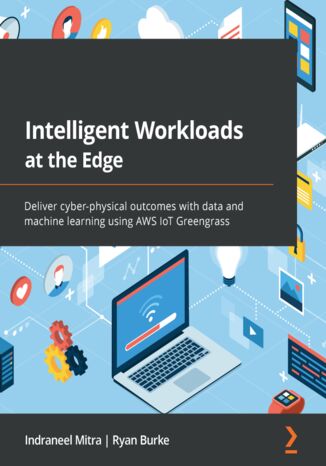
Indraneel (Neel) Mitra, Ryan Burke
The Internet of Things (IoT) has transformed how people think about and interact with the world. The ubiquitous deployment of sensors around us makes it possible to study the world at any level of accuracy and enable data-driven decision-making anywhere. Data analytics and machine learning (ML) powered by elastic cloud computing have accelerated our ability to understand and analyze the huge amount of data generated by IoT. Now, edge computing has brought information technologies closer to the data source to lower latency and reduce costs.This book will teach you how to combine the technologies of edge computing, data analytics, and ML to deliver next-generation cyber-physical outcomes. You’ll begin by discovering how to create software applications that run on edge devices with AWS IoT Greengrass. As you advance, you’ll learn how to process and stream IoT data from the edge to the cloud and use it to train ML models using Amazon SageMaker. The book also shows you how to train these models and run them at the edge for optimized performance, cost savings, and data compliance.By the end of this IoT book, you’ll be able to scope your own IoT workloads, bring the power of ML to the edge, and operate those workloads in a production setting.
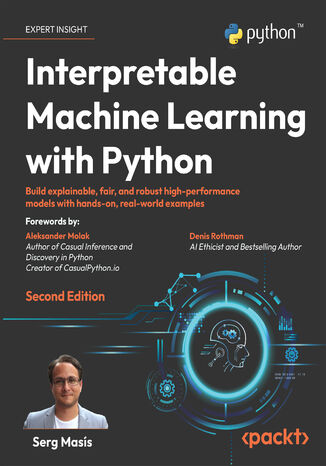
Serg Masís, Aleksander Molak, Denis Rothman
Interpretable Machine Learning with Python, Second Edition, brings to light the key concepts of interpreting machine learning models by analyzing real-world data, providing you with a wide range of skills and tools to decipher the results of even the most complex models.Build your interpretability toolkit with several use cases, from flight delay prediction to waste classification to COMPAS risk assessment scores. This book is full of useful techniques, introducing them to the right use case. Learn traditional methods, such as feature importance and partial dependence plots to integrated gradients for NLP interpretations and gradient-based attribution methods, such as saliency maps.In addition to the step-by-step code, you’ll get hands-on with tuning models and training data for interpretability by reducing complexity, mitigating bias, placing guardrails, and enhancing reliability.By the end of the book, you’ll be confident in tackling interpretability challenges with black-box models using tabular, language, image, and time series data.
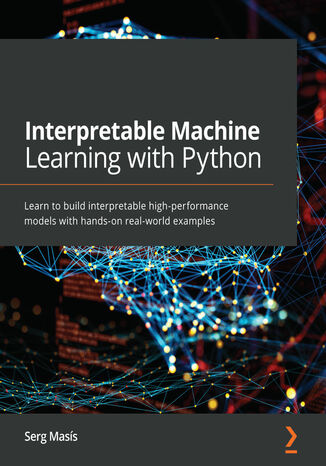
Serg Masís
Do you want to gain a deeper understanding of your models and better mitigate poor prediction risks associated with machine learning interpretation? If so, then Interpretable Machine Learning with Python deserves a place on your bookshelf.We’ll be starting off with the fundamentals of interpretability, its relevance in business, and exploring its key aspects and challenges. As you progress through the chapters, you'll then focus on how white-box models work, compare them to black-box and glass-box models, and examine their trade-off. You’ll also get you up to speed with a vast array of interpretation methods, also known as Explainable AI (XAI) methods, and how to apply them to different use cases, be it for classification or regression, for tabular, time-series, image or text. In addition to the step-by-step code, this book will also help you interpret model outcomes using examples. You’ll get hands-on with tuning models and training data for interpretability by reducing complexity, mitigating bias, placing guardrails, and enhancing reliability. The methods you’ll explore here range from state-of-the-art feature selection and dataset debiasing methods to monotonic constraints and adversarial retraining.By the end of this book, you'll be able to understand ML models better and enhance them through interpretability tuning.
Introduction to Algorithms. A Comprehensive Guide for Beginners: Unlocking Computational Thinking
Cuantum Technologies LLC
Begin your journey into the fascinating world of algorithms with this comprehensive course. Starting with an introduction to the basics, you will learn about pseudocode and flowcharts, the fundamental tools for representing algorithms. As you progress, you'll delve into the efficiency of algorithms, understanding how to evaluate and optimize them for better performance. The course will also cover various basic algorithm types, providing a solid foundation for further exploration.You will explore specific categories of algorithms, including search and sort algorithms, which are crucial for managing and retrieving data efficiently. You will also learn about graph algorithms, which are essential for solving problems related to networks and relationships. Additionally, the course will introduce you to the data structures commonly used in algorithms.Towards the end, the focus shifts to algorithm design techniques and their real-world applications. You will discover various strategies for creating efficient and effective algorithms and see how these techniques are applied in real-world scenarios. By the end of the course, you will have a thorough understanding of algorithmic principles and be equipped with the skills to apply them in your technical career.
Inżynieria danych na platformie AWS. Jak tworzyć kompletne potoki uczenia maszynowego
Chris Fregly, Antje Barth
Platforma Amazon Web Services jest uważana za największą i najbardziej dojrzałą chmurę obliczeniową. Zapewnia bogaty zestaw specjalistycznych narzędzi ułatwiających realizację projektów z zakresu inżynierii danych i uczenia maszynowego. W ten sposób inżynierowie danych, architekci i menedżerowie mogą szybko zacząć używać danych do podejmowania kluczowych decyzji biznesowych. Uzyskanie optymalnej efektywności pracy takich projektów wymaga jednak dobrego rozeznania w możliwościach poszczególnych narzędzi, usług i bibliotek. Dzięki temu praktycznemu przewodnikowi szybko nauczysz się tworzyć i uruchamiać procesy w chmurze, a następnie integrować wyniki z aplikacjami. Zapoznasz się ze scenariuszami stosowania technik sztucznej inteligencji: przetwarzania języka naturalnego, rozpoznawania obrazów, wykrywania oszustw, wyszukiwania kognitywnego czy wykrywania anomalii w czasie rzeczywistym. Ponadto dowiesz się, jak łączyć cykle rozwoju modeli z pobieraniem i analizą danych w powtarzalnych potokach MLOps. W książce znajdziesz też zbiór technik zabezpieczania projektów i procesów z obszaru inżynierii danych, takich jak stosowanie usługi IAM, uwierzytelnianie, autoryzacja, izolacja sieci, szyfrowanie danych w spoczynku czy postkwantowe szyfrowanie sieci dla danych w tranzycie. Najciekawsze zagadnienia: narzędzia AWS związane ze sztuczną inteligencją i z uczeniem maszynowym kompletny cykl rozwoju modelu przetwarzania języka naturalnego powtarzalne potoki MLOps uczenie maszynowe w czasie rzeczywistym wykrywanie anomalii i analiza strumieni danych zabezpieczanie projektów i procesów z obszaru inżynierii danych AWS i inżynieria danych: tak zwiększysz wydajność i obniżysz koszty! Implementowanie solidnego kompletnego procesu uczenia maszynowego to żmudne zadanie, dodatkowo komplikowane przez szeroki zakres dostępnych narzędzi i technologii. Autorzy wykonali świetną robotę, a jej efekty pomogą zarówno nowicjuszom, jak i doświadczonym praktykom realizować to zadanie z wykorzystaniem możliwości, jakie dają usługi AWS Brent Rabowsky, danolog w firmie Amazon Web Services
Jak projektować systemy uczenia maszynowego. Iteracyjne tworzenie aplikacji gotowych do pracy
Chip Huyen
Systemy uczenia maszynowego (ML) charakteryzują się złożonością i unikatowością. Zmiana w jednym z wielu komponentów może istotnie wpłynąć na całość. Zastosowane w modelach dane diametralnie różnią się od siebie w poszczególnych przypadkach użycia. To wszystko sprawia, że bardzo trudno jest stworzyć taki system, jeśli każdy komponent zostaje zaprojektowany oddzielnie. Aby zbudować aplikację korzystającą z ML i nadającą się do wdrożenia w środowisku produkcyjnym, konieczne jest podejmowanie decyzji projektowych z uwzględnieniem cech systemu jako całości. To książka przeznaczona dla inżynierów, którzy chcą stosować systemy uczenia maszynowego do rozwiązywania rzeczywistych problemów biznesowych. Zaprezentowano w niej systemy ML używane w szybko rozwijających się startupach, a także przedstawiono holistyczne podejście do ich projektowania ― z uwzględnieniem różnych komponentów systemu i celów osób zaangażowanych w proces. Dużo uwagi poświęcono analizie decyzji projektowych, dotyczących między innymi sposobu tworzenia i przetwarzania danych treningowych, wyboru wskaźników, częstotliwości ponownego treningu modelu czy techniki monitorowania pracy aplikacji. Zaprezentowana tu koncepcja iteracyjna natomiast pozwala na uzyskanie pewności, że podejmowane decyzje są optymalne z punktu widzenia pracy całości systemu. Co ważne, poszczególne zagadnienia zostały zilustrowane rzeczywistymi studiami przypadków. W książce między innymi: wybór wskaźników właściwych dla danego problemu biznesowego automatyzacja ciągłego rozwoju, ewaluacji, wdrażania i aktualizacji modeli szybkie wykrywanie i rozwiązywanie problemów podczas wdrożenia produkcyjnego tworzenie wszechstronnej platformy ML odpowiedzialne tworzenie systemów ML Wdrażaj i skaluj modele tak, aby uzyskiwać najlepsze wyniki!

Jak sztuczna inteligencja zmieni twoje życie
Marek Tłuczek
Poznaj podstawy i zastosowania sztucznej inteligencji Odkryj niesamowity świat AI Dowiedz się, jak powstała Zrozum, dokąd zmierza Sztuczna inteligencja staje się powoli nieodzownym składnikiem naszego życia. Przeszła długą drogę od modnego hasła pojawiającego się głównie w specjalistycznych publikacjach do technologii mającej realny wpływ na naszą codzienność. Z każdym dniem lepiej radzi sobie z coraz bardziej zaawansowanymi zadaniami, już nie tylko wygrywając mecze z arcymistrzami szachowymi, lecz również analizując ogromne zbiory danych, tłumacząc teksty, prowadząc samochody, rozpoznając ludzką mowę, przetwarzając obrazy, a nawet komponując muzykę i tworząc dzieła malarskie. Aby dogłębnie poznać szczegóły techniczne stojące za AI, trzeba dysponować pewną wiedzą informatyczną i sprawnie posługiwać się odpowiednim aparatem matematycznym. Na szczęście aby wkroczyć w świat sztucznej inteligencji i dowiedzieć się, co można dzięki niej zyskać, nie jest niezbędna żadna magia, wystarczy właściwy przewodnik! Jeśli chcesz to zrobić, dobrze trafiłeś! Ta publikacja pokaże Ci najciekawsze zastosowania AI i pomoże zrozumieć sposób działania tej technologii, a także spróbuje odpowiedzieć na pytanie, kiedy przekroczy ograniczenia swoich twórców. Być może zamierzasz zostać specjalistą od sztucznej inteligencji lub po prostu chcesz poznać podstawy tego zagadnienia. Jeśli tak, zrób pierwszy krok w tym kierunku! Historia sztucznej inteligencji Porównanie AI i ludzkiego mózgu Prawdopodobne scenariusze rozwoju AI Wykorzystanie AI w grach logicznych Rozpoznawanie mowy, języka pisanego i obrazu Medyczne zastosowania sztucznej inteligencji Wykorzystanie AI w autonomicznym transporcie Zagrożenia związane ze sztuczną inteligencją Nie czekaj! Już dziś poznaj technologię przyszłości! O książce i Autorze w mediach: Faktyczny Dom Kultury: Jak sztuczna inteligencja zmieni Twoje życie? Rozmowa Marka Tłuczka z Kamilem Bałukiem Radio Nowy Świat: Wywiad z autorem - prowadząca Katarzyna Kasia
Rahul Raj
Java is one of the most widely used programming languages in the world. With this book, you will see how to perform deep learning using Deeplearning4j (DL4J) – the most popular Java library for training neural networks efficiently.This book starts by showing you how to install and configure Java and DL4J on your system. You will then gain insights into deep learning basics and use your knowledge to create a deep neural network for binary classification from scratch. As you progress, you will discover how to build a convolutional neural network (CNN) in DL4J, and understand how to construct numeric vectors from text. This deep learning book will also guide you through performing anomaly detection on unsupervised data and help you set up neural networks in distributed systems effectively. In addition to this, you will learn how to import models from Keras and change the configuration in a pre-trained DL4J model. Finally, you will explore benchmarking in DL4J and optimize neural networks for optimal results.By the end of this book, you will have a clear understanding of how you can use DL4J to build robust deep learning applications in Java.
Md. Rezaul Karim
Java is one of the most widely used programming languages. With the rise of deep learning, it has become a popular choice of tool among data scientists and machine learning experts.Java Deep Learning Projects starts with an overview of deep learning concepts and then delves into advanced projects. You will see how to build several projects using different deep neural network architectures such as multilayer perceptrons, Deep Belief Networks, CNN, LSTM, and Factorization Machines.You will get acquainted with popular deep and machine learning libraries for Java such as Deeplearning4j, Spark ML, and RankSys and you’ll be able to use their features to build and deploy projects on distributed computing environments.You will then explore advanced domains such as transfer learning and deep reinforcement learning using the Java ecosystem, covering various real-world domains such as healthcare, NLP, image classification, and multimedia analytics with an easy-to-follow approach. Expert reviews and tips will follow every project to give you insights and hacks.By the end of this book, you will have stepped up your expertise when it comes to deep learning in Java, taking it beyond theory and be able to build your own advanced deep learning systems.
Giuseppe Ciaburro
Keras 2.x Projects explains how to leverage the power of Keras to build and train state-of-the-art deep learning models through a series of practical projects that look at a range of real-world application areas. To begin with, you will quickly set up a deep learning environment by installing the Keras library. Through each of the projects, you will explore and learn the advanced concepts of deep learning and will learn how to compute and run your deep learning models using the advanced offerings of Keras. You will train fully-connected multilayer networks, convolutional neural networks, recurrent neural networks, autoencoders and generative adversarial networks using real-world training datasets. The projects you will undertake are all based on real-world scenarios of all complexity levels, covering topics such as language recognition, stock volatility, energy consumption prediction, faster object classification for self-driving vehicles, and more. By the end of this book, you will be well versed with deep learning and its implementation with Keras. You will have all the knowledge you need to train your own deep learning models to solve different kinds of problems.
Keras Deep Learning Cookbook. Over 30 recipes for implementing deep neural networks in Python
Rajdeep Dua, Manpreet Singh Ghotra
Keras has quickly emerged as a popular deep learning library. Written in Python, it allows you to train convolutional as well as recurrent neural networks with speed and accuracy.The Keras Deep Learning Cookbook shows you how to tackle different problems encountered while training efficient deep learning models, with the help of the popular Keras library. Starting with installing and setting up Keras, the book demonstrates how you can perform deep learning with Keras in the TensorFlow. From loading data to fitting and evaluating your model for optimal performance, you will work through a step-by-step process to tackle every possible problem faced while training deep models. You will implement convolutional and recurrent neural networks, adversarial networks, and more with the help of this handy guide. In addition to this, you will learn how to train these models for real-world image and language processing tasks. By the end of this book, you will have a practical, hands-on understanding of how you can leverage the power of Python and Keras to perform effective deep learning
Giuseppe Ciaburro, Sudharsan Ravichandiran, Suriyadeepan Ramamoorthy
Reinforcement learning has evolved a lot in the last couple of years and proven to be a successful technique in building smart and intelligent AI networks. Keras Reinforcement Learning Projects installs human-level performance into your applications using algorithms and techniques of reinforcement learning, coupled with Keras, a faster experimental library.The book begins with getting you up and running with the concepts of reinforcement learning using Keras. You’ll learn how to simulate a random walk using Markov chains and select the best portfolio using dynamic programming (DP) and Python. You’ll also explore projects such as forecasting stock prices using Monte Carlo methods, delivering vehicle routing application using Temporal Distance (TD) learning algorithms, and balancing a Rotating Mechanical System using Markov decision processes.Once you’ve understood the basics, you’ll move on to Modeling of a Segway, running a robot control system using deep reinforcement learning, and building a handwritten digit recognition model in Python using an image dataset. Finally, you’ll excel in playing the board game Go with the help of Q-Learning and reinforcement learning algorithms.By the end of this book, you’ll not only have developed hands-on training on concepts, algorithms, and techniques of reinforcement learning but also be all set to explore the world of AI.
Luca Massaron, Alberto Boschetti, Bastiaan Sjardin
Large Python machine learning projects involve new problems associated with specialized machine learning architectures and designs that many data scientists have yet to tackle. But finding algorithms and designing and building platforms that deal with large sets of data is a growing need. Data scientists have to manage and maintain increasingly complex data projects, and with the rise of big data comes an increasing demand for computational and algorithmic efficiency. Large Scale Machine Learning with Python uncovers a new wave of machine learning algorithms that meet scalability demands together with a high predictive accuracy. Dive into scalable machine learning and the three forms of scalability. Speed up algorithms that can be used on a desktop computer with tips on parallelization and memory allocation. Get to grips with new algorithms that are specifically designed for large projects and can handle bigger files, and learn about machine learning in big data environments. We will also cover the most effective machine learning techniques on a map reduce framework in Hadoop and Spark in Python.
Julien Simon
Amazon SageMaker enables you to quickly build, train, and deploy machine learning models at scale without managing any infrastructure. It helps you focus on the machine learning problem at hand and deploy high-quality models by eliminating the heavy lifting typically involved in each step of the ML process. This second edition will help data scientists and ML developers to explore new features such as SageMaker Data Wrangler, Pipelines, Clarify, Feature Store, and much more.You'll start by learning how to use various capabilities of SageMaker as a single toolset to solve ML challenges and progress to cover features such as AutoML, built-in algorithms and frameworks, and writing your own code and algorithms to build ML models. The book will then show you how to integrate Amazon SageMaker with popular deep learning libraries, such as TensorFlow and PyTorch, to extend the capabilities of existing models. You'll also see how automating your workflows can help you get to production faster with minimum effort and at a lower cost. Finally, you'll explore SageMaker Debugger and SageMaker Model Monitor to detect quality issues in training and production.By the end of this Amazon book, you'll be able to use Amazon SageMaker on the full spectrum of ML workflows, from experimentation, training, and monitoring to scaling, deployment, and automation.
Chandramani Tiwary
If you are a Java developer and want to use Mahout and machine learning to solve Big Data Analytics use cases then this book is for you. Familiarity with shell scripts is assumed but no prior experience is required.
Hari Manassery Koduvely
Bayesian Inference provides a unified framework to deal with all sorts of uncertainties when learning patterns form data using machine learning models and use it for predicting future observations. However, learning and implementing Bayesian models is not easy for data science practitioners due to the level of mathematical treatment involved. Also, applying Bayesian methods to real-world problems requires high computational resources. With the recent advances in computation and several open sources packages available in R, Bayesian modeling has become more feasible to use for practical applications today. Therefore, it would be advantageous for all data scientists and engineers to understand Bayesian methods and apply them in their projects to achieve better results.Learning Bayesian Models with R starts by giving you a comprehensive coverage of the Bayesian Machine Learning models and the R packages that implement them. It begins with an introduction to the fundamentals of probability theory and R programming for those who are new to the subject. Then the book covers some of the important machine learning methods, both supervised and unsupervised learning, implemented using Bayesian Inference and R.Every chapter begins with a theoretical description of the method explained in a very simple manner. Then, relevant R packages are discussed and some illustrations using data sets from the UCI Machine Learning repository are given. Each chapter ends with some simple exercises for you to get hands-on experience of the concepts and R packages discussed in the chapter.The last chapters are devoted to the latest development in the field, specifically Deep Learning, which uses a class of Neural Network models that are currently at the frontier of Artificial Intelligence. The book concludes with the application of Bayesian methods on Big Data using the Hadoop and Spark frameworks.
Leif Larsen Henning Larsen
Take your app development to the next level with Learning Microsoft Cognitive Services. Using Leif's knowledge of each of the powerful APIs, you'll learn how to create smarter apps with more human-like capabilities. ? Discover what each API has to offer and learn how to add it to your app ? Study each AI using theory and practical examples ? Learn current API best practices
Leif Larsen Henning Larsen
Microsoft has revamped its Project Oxford to launch the all new Cognitive Services platform-a set of 30 APIs to add speech, vision, language, and knowledge capabilities to apps.This book will introduce you to 24 of the APIs released as part of Cognitive Services platform and show you how to leverage their capabilities. More importantly, you'll see how the power of these APIs can be combined to build real-world apps that have cognitive capabilities. The book is split into three sections: computer vision, speech recognition and language processing, and knowledge and search.You will be taken through the vision APIs at first as this is very visual, and not too complex. The next part revolves around speech and language, which are somewhat connected. The last part is about adding real-world intelligence to apps by connecting them to Knowledge and Search APIs.By the end of this book, you will be in a position to understand what Microsoft Cognitive Service can offer and how to use the different APIs.
Leif Larsen
Microsoft Cognitive Services is a set of APIs for integrating artificial intelligence in your applications to solve logical business problems. If you’re new to developing applications with AI, Learning Microsoft Cognitive Services will give you a comprehensive introduction to Microsoft’s AI stack and get you up-to-speed in no time.The book introduces you to 24 APIs, including Emotion, Language, Vision, Speech, Knowledge, and Search. Using Visual Studio, you can develop applications with enhanced capabilities for image processing, speech recognition, text processing, and much more. Moving forward, you will work with datasets that enable your applications to process various data in the form of image, video, or text.By the end of the book, you’ll be able to confidently explore Cognitive Services APIs for building intelligent applications that can be deployed for real-world business uses.
Giuseppe Bonaccorso
Machine learning has gained tremendous popularity for its powerful and fast predictions with large datasets. However, the true forces behind its powerful output are the complex algorithms involving substantial statistical analysis that churn large datasets and generate substantial insight.This second edition of Machine Learning Algorithms walks you through prominent development outcomes that have taken place relating to machine learning algorithms, which constitute major contributions to the machine learning process and help you to strengthen and master statistical interpretation across the areas of supervised, semi-supervised, and reinforcement learning. Once the core concepts of an algorithm have been covered, you’ll explore real-world examples based on the most diffused libraries, such as scikit-learn, NLTK, TensorFlow, and Keras. You will discover new topics such as principal component analysis (PCA), independent component analysis (ICA), Bayesian regression, discriminant analysis, advanced clustering, and gaussian mixture.By the end of this book, you will have studied machine learning algorithms and be able to put them into production to make your machine learning applications more innovative.
Gregory Keys, David Whiting
H2O is an open source, fast, and scalable machine learning framework that allows you to build models using big data and then easily productionalize them in diverse enterprise environments.Machine Learning at Scale with H2O begins with an overview of the challenges faced in building machine learning models on large enterprise systems, and then addresses how H2O helps you to overcome them. You’ll start by exploring H2O’s in-memory distributed architecture and find out how it enables you to build highly accurate and explainable models on massive datasets using your favorite ML algorithms, language, and IDE. You’ll also get to grips with the seamless integration of H2O model building and deployment with Spark using H2O Sparkling Water. You’ll then learn how to easily deploy models with H2O MOJO. Next, the book shows you how H2O Enterprise Steam handles admin configurations and user management, and then helps you to identify different stakeholder perspectives that a data scientist must understand in order to succeed in an enterprise setting. Finally, you’ll be introduced to the H2O AI Cloud platform and explore the entire machine learning life cycle using multiple advanced AI capabilities.By the end of this book, you’ll be able to build and deploy advanced, state-of-the-art machine learning models for your business needs.
Dario Radečić
The automation of machine learning tasks allows developers more time to focus on the usability and reactivity of the software powered by machine learning models. TPOT is a Python automated machine learning tool used for optimizing machine learning pipelines using genetic programming. Automating machine learning with TPOT enables individuals and companies to develop production-ready machine learning models cheaper and faster than with traditional methods.With this practical guide to AutoML, developers working with Python on machine learning tasks will be able to put their knowledge to work and become productive quickly. You'll adopt a hands-on approach to learning the implementation of AutoML and associated methodologies. Complete with step-by-step explanations of essential concepts, practical examples, and self-assessment questions, this book will show you how to build automated classification and regression models and compare their performance to custom-built models. As you advance, you'll also develop state-of-the-art models using only a couple of lines of code and see how those models outperform all of your previous models on the same datasets.By the end of this book, you'll have gained the confidence to implement AutoML techniques in your organization on a production level.
Andrew P. McMahon
The Second Edition of Machine Learning Engineering with Python is the practical guide that MLOps and ML engineers need to build solutions to real-world problems. It will provide you with the skills you need to stay ahead in this rapidly evolving field.The book takes an examples-based approach to help you develop your skills and covers the technical concepts, implementation patterns, and development methodologies you need. You'll explore the key steps of the ML development lifecycle and create your own standardized model factory for training and retraining of models. You'll learn to employ concepts like CI/CD and how to detect different types of drift.Get hands-on with the latest in deployment architectures and discover methods for scaling up your solutions. This edition goes deeper in all aspects of ML engineering and MLOps, with emphasis on the latest open-source and cloud-based technologies. This includes a completely revamped approach to advanced pipelining and orchestration techniques.With a new chapter on deep learning, generative AI, and LLMOps, you will learn to use tools like LangChain, PyTorch, and Hugging Face to leverage LLMs for supercharged analysis. You will explore AI assistants like GitHub Copilot to become more productive, then dive deep into the engineering considerations of working with deep learning.