
Uczenie maszynowe
Uczenie maszynowe (ang. machine learning) zajmuje się teorią i praktycznym zastosowaniem algorytmów analizujących dane — stanowi najciekawszą dziedzinę informatyki. Żyjemy w czasach przetwarzania olbrzymiej ilości informacji; za pomocą samouczących się algorytmów będących częścią uczenia maszynowego informacje te są przekształcane w rzeczywistą wiedzę. Dzięki licznym i potężnym bibliotekom o jawnym kodzie źródłowym, które powstały w ostatnich latach, prawdopodobnie teraz jest najlepszy czas, aby zainteresować się uczeniem maszynowym i nauczyć się wykorzystywać potężne algorytmy do wykrywania wzorców w przetwarzanych danych oraz prognozować przyszłe zdarzenia. Przykładami zastosowania Machine Learning są np. mechanizmy wyszukiwarek internetowych, GPS, autokorekta w edytorze tekstu czy boty w komunikatorach. Jedną z dziedzin uczenia maszynowego jest deep learning, podczas którego komputer uczy się procesów naturalnych dla ludzkiego mózgu (tworzy sieci neuronowe). Technologia ta jest wykorzystywana np. przy identyfikacji głosu i obrazów.
Giuseppe Bonaccorso
Machine learning is a subset of AI that aims to make modern-day computer systems smarter and more intelligent. The real power of machine learning resides in its algorithms, which make even the most difficult things capable of being handled by machines. However, with the advancement in the technology and requirements of data, machines will have to be smarter than they are today to meet the overwhelming data needs; mastering these algorithms and using them optimally is the need of the hour.Mastering Machine Learning Algorithms is your complete guide to quickly getting to grips with popular machine learning algorithms. You will be introduced to the most widely used algorithms in supervised, unsupervised, and semi-supervised machine learning, and will learn how to use them in the best possible manner. Ranging from Bayesian models to the MCMC algorithm to Hidden Markov models, this book will teach you how to extract features from your dataset and perform dimensionality reduction by making use of Python-based libraries such as scikit-learn v0.19.1. You will also learn how to use Keras and TensorFlow 1.x to train effective neural networks.If you are looking for a single resource to study, implement, and solve end-to-end machine learning problems and use-cases, this is the book you need.
Chiheb Chebbi
Cyber security is crucial for both businesses and individuals. As systems are getting smarter, we now see machine learning interrupting computer security. With the adoption of machine learning in upcoming security products, it’s important for pentesters and security researchers to understand how these systems work, and to breach them for testing purposes. This book begins with the basics of machine learning and the algorithms used to build robust systems. Once you’ve gained a fair understanding of how security products leverage machine learning, you'll dive into the core concepts of breaching such systems. Through practical use cases, you’ll see how to find loopholes and surpass a self-learning security system. As you make your way through the chapters, you’ll focus on topics such as network intrusion detection and AV and IDS evasion. We’ll also cover the best practices when identifying ambiguities, and extensive techniques to breach an intelligent system.By the end of this book, you will be well-versed with identifying loopholes in a self-learning security system and will be able to efficiently breach a machine learning system.
Dr. Saket S.R. Mengle , Maximo Gurmendez
Amazon Web Services (AWS) is constantly driving new innovations that empower data scientists to explore a variety of machine learning (ML) cloud services. This book is your comprehensive reference for learning and implementing advanced ML algorithms in AWS cloud.As you go through the chapters, you’ll gain insights into how these algorithms can be trained, tuned, and deployed in AWS using Apache Spark on Elastic Map Reduce (EMR), SageMaker, and TensorFlow. While you focus on algorithms such as XGBoost, linear models, factorization machines, and deep nets, the book will also provide you with an overview of AWS as well as detailed practical applications that will help you solve real-world problems. Every application includes a series of companion notebooks with all the necessary code to run on AWS. In the next few chapters, you will learn to use SageMaker and EMR Notebooks to perform a range of tasks, right from smart analytics and predictive modeling through to sentiment analysis. By the end of this book, you will be equipped with the skills you need to effectively handle machine learning projects and implement and evaluate algorithms on AWS.
Cory Lesmeister
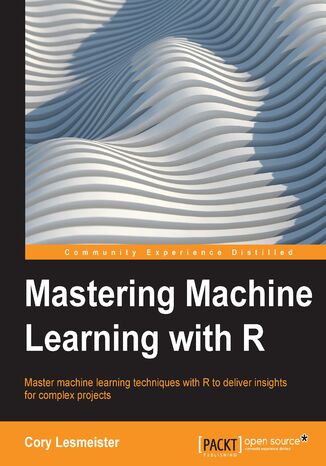
Given the growing popularity of the R-zerocost statistical programming environment, there has never been a better time to start applying ML to your data. This book will teach you advanced techniques in ML ,using? the latest code in R 3.5. You will delve into various complex features of supervised learning, unsupervised learning, and reinforcement learning algorithms to design efficient and powerful ML models. This newly updated edition is packed with fresh examples covering a range of tasks from different domains. Mastering Machine Learning with R starts by showing you how to quickly manipulate data and prepare it for analysis. You will explore simple and complex models and understand how to compare them. You’ll also learn to use the latest library support, such as TensorFlow and Keras-R, for performing advanced computations. Additionally, you’ll explore complex topics, such as natural language processing (NLP), time series analysis, and clustering, which will further refine your skills in developing applications. Each chapter will help you implement advanced ML algorithms using real-world examples. You’ll even be introduced to reinforcement learning, along with its various use cases and models. In the concluding chapters, you’ll get a glimpse into how some of these blackbox models can be diagnosed and understood. By the end of this book, you’ll be equipped with the skills to deploy ML techniques in your own projects or at work.
Cory Lesmeister
Machine learning is a field of Artificial Intelligence to build systems that learn from data. Given the growing prominence of R—a cross-platform, zero-cost statistical programming environment—there has never been a better time to start applying machine learning to your data.The book starts with introduction to Cross-Industry Standard Process for Data Mining. It takes you through Multivariate Regression in detail. Moving on, you will also address Classification and Regression trees. You will learn a couple of “Unsupervised techniques”. Finally, the book will walk you through text analysis and time series.The book will deliver practical and real-world solutions to problems and variety of tasks such as complex recommendation systems. By the end of this book, you will gain expertise in performing R machine learning and will be able to build complex ML projects using R and its packages.
Mastering OpenCV 3. Get hands-on with practical Computer Vision using OpenCV 3 - Second Edition
Jason Saragih
As we become more capable of handling data in every kind, we are becoming more reliant on visual input and what we can do with those self-driving cars, face recognition, and even augmented reality applications and games. This is all powered by Computer Vision.This book will put you straight to work in creating powerful and unique computer vision applications. Each chapter is structured around a central project and deep dives into an important aspect of OpenCV such as facial recognition, image target tracking, making augmented reality applications, the 3D visualization framework, and machine learning. You’ll learn how to make AI that can remember and use neural networks to help your applications learn.By the end of the book, you will have created various working prototypes with the projects in the book and will be well versed with the new features of OpenCV3.
Alberto Fernández Villán
OpenCV is considered to be one of the best open source computer vision and machine learning software libraries. It helps developers build complete projects in relation to image processing, motion detection, or image segmentation, among many others. OpenCV for Python enables you to run computer vision algorithms smoothly in real time, combining the best of the OpenCV C++ API and the Python language.In this book, you'll get started by setting up OpenCV and delving into the key concepts of computer vision. You'll then proceed to study more advanced concepts and discover the full potential of OpenCV. The book will also introduce you to the creation of advanced applications using Python and OpenCV, enabling you to develop applications that include facial recognition, target tracking, or augmented reality. Next, you'll learn machine learning techniques and concepts, understand how to apply them in real-world examples, and also explore their benefits, including real-time data production and faster data processing. You'll also discover how to translate the functionality provided by OpenCV into optimized application code projects using Python bindings. Toward the concluding chapters, you'll explore the application of artificial intelligence and deep learning techniques using the popular Python libraries TensorFlow, and Keras.By the end of this book, you'll be able to develop advanced computer vision applications to meet your customers' demands.
Ankur Ankan
Probabilistic Graphical Models is a technique in machine learning that uses the concepts of graph theory to compactly represent and optimally predict values in our data problems. In real world problems, it's often difficult to select the appropriate graphical model as well as the appropriate inference algorithm, which can make a huge difference in computation time and accuracy. Thus, it is crucial to know the working details of these algorithms.This book starts with the basics of probability theory and graph theory, then goes on to discuss various models and inference algorithms. All the different types of models are discussed along with code examples to create and modify them, and also to run different inference algorithms on them. There is a complete chapter devoted to the most widely used networks Naive Bayes Model and Hidden Markov Models (HMMs). These models have been thoroughly discussed using real-world examples.