
Uczenie maszynowe
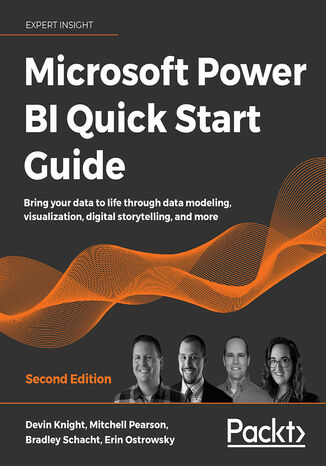
Devin Knight, Erin Ostrowsky, Mitchell Pearson, Bradley...
This revised edition has been fully updated to reflect the latest enhancements to Power BI. It includes a new chapter dedicated to dataflow, and covers all the essential concepts such as installation, designing effective data models, as well as building basic dashboards and visualizations to help you and your organization make better business decisions.You’ll learn how to obtain data from a variety of sources and clean it using Power BI Query Editor. You’ll then find out how you can design your data model to navigate and explore relationships within it and build DAX formulas to make your data easier to work with. Visualizing your data is a key element in this book, and you’ll get to grips rapidly with data visualization styles and enhanced digital storytelling techniques. In addition, you will acquire the skills to build your own dataflows, understand the Common Data Model, and automate data flow refreshes to eradicate data cleansing inefficiency.This guide will help you understand how to administer your organization's Power BI environment so that deployment can be made seamless, data refreshes can run properly, and security can be fully implemented.By the end of this Power BI book, you’ll have a better understanding of how to get the most out of Power BI to perform effective business intelligence.
MLOps with Red Hat OpenShift. A cloud-native approach to machine learning operations
Ross Brigoli, Faisal Masood
MLOps with OpenShift offers practical insights for implementing MLOps workflows on the dynamic OpenShift platform. As organizations worldwide seek to harness the power of machine learning operations, this book lays the foundation for your MLOps success. Starting with an exploration of key MLOps concepts, including data preparation, model training, and deployment, you’ll prepare to unleash OpenShift capabilities, kicking off with a primer on containers, pods, operators, and more.With the groundwork in place, you’ll be guided to MLOps workflows, uncovering the applications of popular machine learning frameworks for training and testing models on the platform.As you advance through the chapters, you’ll focus on the open-source data science and machine learning platform, Red Hat OpenShift Data Science, and its partner components, such as Pachyderm and Intel OpenVino, to understand their role in building and managing data pipelines, as well as deploying and monitoring machine learning models.Armed with this comprehensive knowledge, you’ll be able to implement MLOps workflows on the OpenShift platform proficiently.
Anubhav Singh, Rimjhim Bhadani
Deep learning is rapidly becoming the most popular topic in the mobile app industry. This book introduces trending deep learning concepts and their use cases with an industrial and application-focused approach. You will cover a range of projects covering tasks such as mobile vision, facial recognition, smart artificial intelligence assistant, augmented reality, and more.With the help of eight projects, you will learn how to integrate deep learning processes into mobile platforms, iOS, and Android. This will help you to transform deep learning features into robust mobile apps efficiently. You’ll get hands-on experience of selecting the right deep learning architectures and optimizing mobile deep learning models while following an application oriented-approach to deep learning on native mobile apps. We will later cover various pre-trained and custom-built deep learning model-based APIs such as machine learning (ML) Kit through Firebase. Further on, the book will take you through examples of creating custom deep learning models with TensorFlow Lite. Each project will demonstrate how to integrate deep learning libraries into your mobile apps, right from preparing the model through to deployment.By the end of this book, you’ll have mastered the skills to build and deploy deep learning mobile applications on both iOS and Android.
Naveen Krishnan
Modern LLM applications often fail due to weak context management, fragile tool integration, and poorly coordinated agents. To address these challenges, this book provides a practical blueprint for building reliable, scalable AI systems using the Model Context Protocol (MCP), an open standard for interoperable AI architectures.You'll explore why context is the missing layer in many AI deployments and how MCP formalizes it. Through clear explanations and practical examples, you'll design modular components such as resource providers, tool providers, gateways, and standardized interfaces. You'll also integrate MCP with LangChain, AutoGen, and RAG pipelines to build collaborative, context-aware multi-agent systems.You'll learn how to apply MCP to multimodal applications, personalization engines, and enterprise knowledge management solutions, while evaluating and benchmarking implementations for production readiness and implementing authentication, authorization, and scaling strategies for secure cloud deployments.Written by a data and AI solutions engineer with over 17 years of experience at Microsoft and Fortune 500 organizations, this guide combines architectural depth with hands-on implementation. By the end, you'll be able to design, build, and deploy secure, reusable MCP-based LLM systems that scale confidently in production.*Email sign-up and proof of purchase required
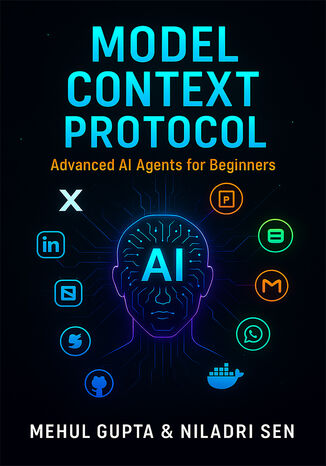
Mehul Gupta, Niladri Sen
This book offers a detailed introduction to the groundbreaking field of AI agents and Model Context Protocol (MCP). The first section delves into generative AI and large language models (LLMs), exploring how these technologies power modern AI systems. From there, the book introduces the concept of AI agents—autonomous systems capable of executing tasks with varying levels of complexity. Moving into practical applications, the book focuses on Model Context Protocol, explaining its key components and how it enables effective interaction between AI and various software tools. Each chapter offers step-by-step instructions for setting up MCP servers for popular tools like Gmail, YouTube, GitHub, and more, empowering readers to automate tasks and streamline workflows. The book concludes by addressing the future of MCP, its potential risks, and how to stay safe while using these advanced technologies. Whether you're a beginner or experienced practitioner, this guide will deepen your understanding of AI and enhance your ability to leverage cutting-edge automation in daily operations.
Moodle Gradebook - Second Edition. - Second Edition
Rebecca Barrington
This book is for teachers and administrators who have experience with Moodle. Basic knowledge of Moodle 2.x will be required, but no prior knowledge of grade functions is needed. This book will help you utilize the full functionality of Version 2.7.
Mercury Learning and Information, Roger W. Pryor
This updated edition of the book explores COMSOL 5 and MATLAB, essential modeling tools for engineers and scientists. It includes five new models and covers systems from 0D to 3D, introducing numerical analysis techniques in COMSOL 5.6 and MATLAB. Using examples from electromagnetic, electronic, optical, thermal physics, and biomedical models, the book provides fundamental concepts and step-by-step instructions for building each model. Companion files include all models and related animations.The course starts with modeling methodology and material properties, progressing through 0D electrical circuit interface, 1D, 2D, 2D axisymmetric, 2D simple and complex mixed mode, and 3D modeling. Advanced topics like Perfectly Matched Layer models and Bioheat models are also covered. Each chapter builds on the previous one, ensuring a comprehensive understanding of modeling techniques.Understanding these concepts is crucial for developing and analyzing engineering, science, and biomedical systems. This book transitions readers from basic to advanced modeling, combining theoretical knowledge with practical skills. Companion files enhance the learning experience, making this an essential resource for mastering COMSOL 5 and MATLAB.
Brian Sacash, Bhargav Srinivasa-Desikan, Reddy Anil Kumar
Modern text analysis is now very accessible using Python and open source tools, so discover how you can now perform modern text analysis in this era of textual data.This book shows you how to use natural language processing, and computational linguistics algorithms, to make inferences and gain insights about data you have. These algorithms are based on statistical machine learning and artificial intelligence techniques. The tools to work with these algorithms are available to you right now - with Python, and tools like Gensim and spaCy.You'll start by learning about data cleaning, and then how to perform computational linguistics from first concepts. You're then ready to explore the more sophisticated areas of statistical NLP and deep learning using Python, with realistic language and text samples. You'll learn to tag, parse, and model text using the best tools. You'll gain hands-on knowledge of the best frameworks to use, and you'll know when to choose a tool like Gensim for topic models, and when to work with Keras for deep learning.This book balances theory and practical hands-on examples, so you can learn about and conduct your own natural language processing projects and computational linguistics. You'll discover the rich ecosystem of Python tools you have available to conduct NLP - and enter the interesting world of modern text analysis.