
Uczenie maszynowe
Uczenie maszynowe (ang. machine learning) zajmuje się teorią i praktycznym zastosowaniem algorytmów analizujących dane — stanowi najciekawszą dziedzinę informatyki. Żyjemy w czasach przetwarzania olbrzymiej ilości informacji; za pomocą samouczących się algorytmów będących częścią uczenia maszynowego informacje te są przekształcane w rzeczywistą wiedzę. Dzięki licznym i potężnym bibliotekom o jawnym kodzie źródłowym, które powstały w ostatnich latach, prawdopodobnie teraz jest najlepszy czas, aby zainteresować się uczeniem maszynowym i nauczyć się wykorzystywać potężne algorytmy do wykrywania wzorców w przetwarzanych danych oraz prognozować przyszłe zdarzenia. Przykładami zastosowania Machine Learning są np. mechanizmy wyszukiwarek internetowych, GPS, autokorekta w edytorze tekstu czy boty w komunikatorach. Jedną z dziedzin uczenia maszynowego jest deep learning, podczas którego komputer uczy się procesów naturalnych dla ludzkiego mózgu (tworzy sieci neuronowe). Technologia ta jest wykorzystywana np. przy identyfikacji głosu i obrazów.
Nick McClure
TensorFlow is an open source software library for Machine Intelligence. The independent recipes in this book will teach you how to use TensorFlow for complex data computations and will let you dig deeper and gain more insights into your data than ever before. You’ll work through recipes on training models, model evaluation, sentiment analysis, regression analysis, clustering analysis, artificial neural networks, and deep learning – each using Google’s machine learning library TensorFlow.This guide starts with the fundamentals of the TensorFlow library which includes variables, matrices, and various data sources. Moving ahead, you will get hands-on experience with Linear Regression techniques with TensorFlow. The next chapters cover important high-level concepts such as neural networks, CNN, RNN, and NLP. Once you are familiar and comfortable with the TensorFlow ecosystem, the last chapter will show you how to take it to production.
Nick McClure
TensorFlow is an open source software library for Machine Intelligence. The independent recipes in this book will teach you how to use TensorFlow for complex data computations and allow you to dig deeper and gain more insights into your data than ever before. With the help of this book, you will work with recipes for training models, model evaluation, sentiment analysis, regression analysis, clustering analysis, artificial neural networks, and more. You will explore RNNs, CNNs, GANs, reinforcement learning, and capsule networks, each using Google's machine learning library, TensorFlow. Through real-world examples, you will get hands-on experience with linear regression techniques with TensorFlow. Once you are familiar and comfortable with the TensorFlow ecosystem, you will be shown how to take it to production.By the end of the book, you will be proficient in the field of machine intelligence using TensorFlow. You will also have good insight into deep learning and be capable of implementing machine learning algorithms in real-world scenarios.
Ankit Jain, Dr. Amita Kapoor
TensorFlow has transformed the way machine learning is perceived. TensorFlow Machine Learning Projects teaches you how to exploit the benefits—simplicity, efficiency, and flexibility—of using TensorFlow in various real-world projects. With the help of this book, you’ll not only learn how to build advanced projects using different datasets but also be able to tackle common challenges using a range of libraries from the TensorFlow ecosystem.To start with, you’ll get to grips with using TensorFlow for machine learning projects; you’ll explore a wide range of projects using TensorForest and TensorBoard for detecting exoplanets, TensorFlow.js for sentiment analysis, and TensorFlow Lite for digit classification.As you make your way through the book, you’ll build projects in various real-world domains, incorporating natural language processing (NLP), the Gaussian process, autoencoders, recommender systems, and Bayesian neural networks, along with trending areas such as Generative Adversarial Networks (GANs), capsule networks, and reinforcement learning. You’ll learn how to use the TensorFlow on Spark API and GPU-accelerated computing with TensorFlow to detect objects, followed by how to train and develop a recurrent neural network (RNN) model to generate book scripts.By the end of this book, you’ll have gained the required expertise to build full-fledged machine learning projects at work.
Md. Rezaul Karim
Predictive analytics discovers hidden patterns from structured and unstructured data for automated decision making in business intelligence. Predictive decisions are becoming a huge trend worldwide, catering to wide industry sectors by predicting which decisions are more likely to give maximum results. TensorFlow, Google’s brainchild, is immensely popular and extensively used for predictive analysis.This book is a quick learning guide on all the three types of machine learning, that is, supervised, unsupervised, and reinforcement learning with TensorFlow. This book will teach you predictive analytics for high-dimensional and sequence data. In particular, you will learn the linear regression model for regression analysis. You will also learn how to use regression for predicting continuous values. You will learn supervised learning algorithms for predictive analytics. You will explore unsupervised learning and clustering using K-meansYou will then learn how to predict neighborhoods using K-means, and then, see another example of clustering audio clips based on their audio features. This book is ideal for developers, data analysts, machine learning practitioners, and deep learning enthusiasts who want to build powerful, robust, and accurate predictive models with the power of TensorFlow. This book is embedded with useful assessments that will help you revise the concepts you have learned in this book. This book is repurposed for this specific learning experience from material from Packt's Predictive Analytics with TensorFlow by Md. Rezaul Karim.
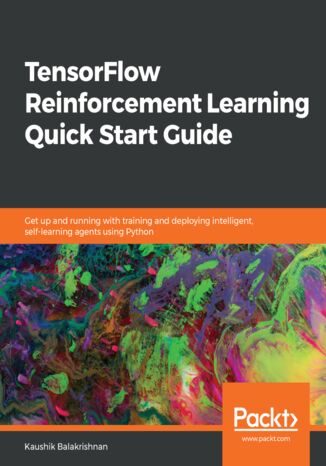
Kaushik Balakrishnan
Advances in reinforcement learning algorithms have made it possible to use them for optimal control in several different industrial applications. With this book, you will apply Reinforcement Learning to a range of problems, from computer games to autonomous driving.The book starts by introducing you to essential Reinforcement Learning concepts such as agents, environments, rewards, and advantage functions. You will also master the distinctions between on-policy and off-policy algorithms, as well as model-free and model-based algorithms. You will also learn about several Reinforcement Learning algorithms, such as SARSA, Deep Q-Networks (DQN), Deep Deterministic Policy Gradients (DDPG), Asynchronous Advantage Actor-Critic (A3C), Trust Region Policy Optimization (TRPO), and Proximal Policy Optimization (PPO). The book will also show you how to code these algorithms in TensorFlow and Python and apply them to solve computer games from OpenAI Gym. Finally, you will also learn how to train a car to drive autonomously in the Torcs racing car simulator.By the end of the book, you will be able to design, build, train, and evaluate feed-forward neural networks and convolutional neural networks. You will also have mastered coding state-of-the-art algorithms and also training agents for various control problems.
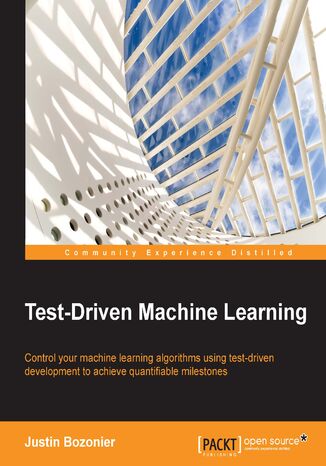
Justin Bozonier
Machine learning is the process of teaching machines to remember data patterns, using them to predict future outcomes, and offering choices that would appeal to individuals based on their past preferences.Machine learning is applicable to a lot of what you do every day. As a result, you can’t take forever to deliver your first iteration of software. Learning to build machine learning algorithms within a controlled test framework will speed up your time to deliver, quantify quality expectations with your clients, and enable rapid iteration and collaboration.This book will show you how to quantifiably test machine learning algorithms. The very different, foundational approach of this book starts every example algorithm with the simplest thing that could possibly work. With this approach, seasoned veterans will find simpler approaches to beginning a machine learning algorithm. You will learn how to iterate on these algorithms to enable rapid delivery and improve performance expectations.The book begins with an introduction to test driving machine learning and quantifying model quality. From there, you will test a neural network, predict values with regression, and build upon regression techniques with logistic regression. You will discover how to test different approaches to naïve bayes and compare them quantitatively, along with how to apply OOP (Object-Oriented Programming) and OOP patterns to test-driven code, leveraging SciKit-Learn.Finally, you will walk through the development of an algorithm which maximizes the expected value of profit for a marketing campaign by combining one of the classifiers covered with the multiple regression example in the book.
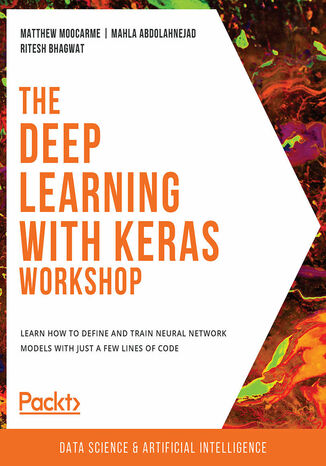
Matthew Moocarme, Mahla Abdolahnejad , Ritesh Bhagwat
New experiences can be intimidating, but not this one! This beginner’s guide to deep learning is here to help you explore deep learning from scratch with Keras, and be on your way to training your first ever neural networks.What sets Keras apart from other deep learning frameworks is its simplicity. With over two hundred thousand users, Keras has a stronger adoption in industry and the research community than any other deep learning framework.The Deep Learning with Keras Workshop starts by introducing you to the fundamental concepts of machine learning using the scikit-learn package. After learning how to perform the linear transformations that are necessary for building neural networks, you'll build your first neural network with the Keras library. As you advance, you'll learn how to build multi-layer neural networks and recognize when your model is underfitting or overfitting to the training data. With the help of practical exercises, you’ll learn to use cross-validation techniques to evaluate your models and then choose the optimal hyperparameters to fine-tune their performance. Finally, you’ll explore recurrent neural networks and learn how to train them to predict values in sequential data.By the end of this book, you'll have developed the skills you need to confidently train your own neural network models.
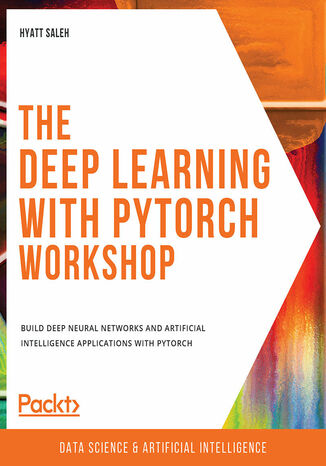
Hyatt Saleh , Tim Hoolihan, Learnkart Technology...
Want to get to grips with one of the most popular machine learning libraries for deep learning? The Deep Learning with PyTorch Workshop will help you do just that, jumpstarting your knowledge of using PyTorch for deep learning even if you’re starting from scratch.It’s no surprise that deep learning’s popularity has risen steeply in the past few years, thanks to intelligent applications such as self-driving vehicles, chatbots, and voice-activated assistants that are making our lives easier. This book will take you inside the world of deep learning, where you’ll use PyTorch to understand the complexity of neural network architectures.The Deep Learning with PyTorch Workshop starts with an introduction to deep learning and its applications. You’ll explore the syntax of PyTorch and learn how to define a network architecture and train a model. Next, you’ll learn about three main neural network architectures - convolutional, artificial, and recurrent - and even solve real-world data problems using these networks. Later chapters will show you how to create a style transfer model to develop a new image from two images, before finally taking you through how RNNs store memory to solve key data issues.By the end of this book, you’ll have mastered the essential concepts, tools, and libraries of PyTorch to develop your own deep neural networks and intelligent apps.