
Python
W kategorii Python zostały zebrane podręczniki poruszające tematykę programowania z zastosowaniem praktycznie niezależnego sprzętowo, dostępnego na licencji Open Source języka. Książki przedstawią Wam wszechstronności i elastyczności Pythona a także różne typy tworzenia kodu poprzez programowanie strukturalne, obiektowe czy funkcjonalne.
Nauczycie się tworzyć aplikacje sieciowe o dowolnym przeznaczeniu, komunikujące się z systemami operacyjnymi, lub korzystające z baz danych. Techniki analizy składni, przetwarzanie tekstu czy rozłożenie obciążenia programu na wiele wątków i procesów przestanie być problematyczne.
Luis Sobrecueva
AutoKeras is an AutoML open-source software library that provides easy access to deep learning models. If you are looking to build deep learning model architectures and perform parameter tuning automatically using AutoKeras, then this book is for you.This book teaches you how to develop and use state-of-the-art AI algorithms in your projects. It begins with a high-level introduction to automated machine learning, explaining all the concepts required to get started with this machine learning approach. You will then learn how to use AutoKeras for image and text classification and regression. As you make progress, you'll discover how to use AutoKeras to perform sentiment analysis on documents. This book will also show you how to implement a custom model for topic classification with AutoKeras. Toward the end, you will explore advanced concepts of AutoKeras such as working with multi-modal data and multi-task, customizing the model with AutoModel, and visualizing experiment results using AutoKeras Extensions.By the end of this machine learning book, you will be able to confidently use AutoKeras to design your own custom machine learning models in your company.
Luc van Vugt
Dynamics 365 Business Central is the new cloud-based SaaS ERP proposition from Microsoft. It’s not as simple as it used to be way back when it was called Navigator, Navision Financials, or Microsoft Business Solutions-Navision. Our development practices are becoming more formal, and with this, the call for test automation is pressing on us.This book will teach you to leverage testing tools available with Dynamics 365 Business Central to perform automated testing. We’ll begin with a quick introduction to automated testing, followed by an overview of test automation in Dynamics 365 Business Central. Then you’ll learn to design and build automated tests and we’ll go through some efficient methods to get from requirements to application and testing code. Lastly, you’ll learn to incorporate your own and Microsoft tests into your daily development practice.By the end of the book, you’ll be able to write your own automated tests for Dynamics 365 Business Central.
Somanath Nanda, Weslley Moura
The AWS Certified Machine Learning Specialty exam tests your competency to perform machine learning (ML) on AWS infrastructure. This book covers the entire exam syllabus using practical examples to help you with your real-world machine learning projects on AWS.Starting with an introduction to machine learning on AWS, you'll learn the fundamentals of machine learning and explore important AWS services for artificial intelligence (AI). You'll then see how to prepare data for machine learning and discover a wide variety of techniques for data manipulation and transformation for different types of variables. The book also shows you how to handle missing data and outliers and takes you through various machine learning tasks such as classification, regression, clustering, forecasting, anomaly detection, text mining, and image processing, along with the specific ML algorithms you need to know to pass the exam. Finally, you'll explore model evaluation, optimization, and deployment and get to grips with deploying models in a production environment and monitoring them.By the end of this book, you'll have gained knowledge of the key challenges in machine learning and the solutions that AWS has released for each of them, along with the tools, methods, and techniques commonly used in each domain of AWS ML.
AWS dla administratorów systemów. Tworzenie i utrzymywanie niezawodnych aplikacji chmurowych
Prashant Lakhera
Amazon Web Services (AWS) zdobywa coraz większe uznanie. Platforma AWS udostępnia znakomite rozwiązania, w tym usługi obliczeniowe, magazyn danych, obsługę sieci i usług zarządzanych. Aplikacje korporacyjne wdrożone w chmurze AWS mogą być wyjątkowo odporne, skalowalne i niezawodne. Aby takie były, administrator systemu musi jednak zrozumieć koncepcje zaawansowanego zarządzania chmurą i nauczyć się wykorzystywać je w praktyce zarówno podczas wdrażania systemu, jak i zarządzania nim. W tej książce omówiono techniki wdrażania systemów na platformie AWS i zasady zarządzania nimi. Zaprezentowano podstawy korzystania z usługi Identity and Access Management oraz narzędzia sieciowe i monitorujące chmury AWS. Poruszono tematy Virtual Private Cloud, Elastic Compute Cloud, równoważenia obciążenia, automatycznego skalowania oraz baz danych usługi Relational Database Service. Dokładnie przedstawiono zasady wdrażania aplikacji i zarządzania danymi. Pokazano też, w jaki sposób zainicjować automatyczne tworzenie kopii zapasowych oraz jak śledzić i przechowywać pliki dzienników. W książce znalazły się również informacje na temat interfejsów API platformy AWS i sposobu ich użycia oraz automatyzacji infrastruktury z wykorzystaniem usługi CloudFormation, narzędzia Terraform oraz skryptów w języku Python z biblioteką Boto3. W książce między innymi: zasady bezpieczeństwa w systemach chmurowych tworzenie usług Amazon Elastic Compute Cloud (EC2) konfiguracja centrum danych w chmurze AWS za pomocą sieci VPC automatyczne skalowanie aplikacji praca z dziennikami scentralizowanymi CloudWatch wykonywanie kopii zapasowych danych AWS, czyli dostępność, odporność i niezawodność aplikacji!
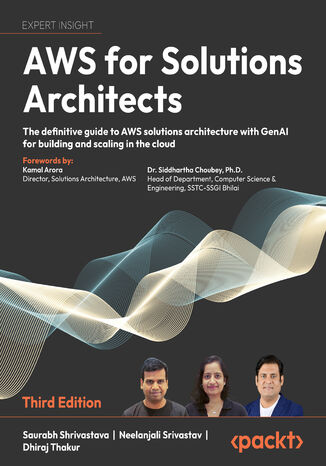
Saurabh Shrivastava, Neelanjali Srivastav, Dhiraj Thakur, Kamal...
AWS for Solutions Architects, Third Edition is your essential guide to thriving in the fast-evolving AWS ecosystem. As a solutions architect, staying on top of the latest technologies and managing complex cloud migrations can be challenging, and this book addresses those pain points head-on. Seasoned AWS experts Saurabh Shrivastava, Neelanjali Srivastav, and Dhiraj Thakur bring deep industry insight and hands-on experience to every chapter.This third edition introduces cutting-edge topics, including Generative AI and MLOps, to keep pace with the evolving cloud landscape and guide you in building AI-driven applications. The book also reflects updates from the AWS Well-Architected Framework and aligns with the latest AWS certifications, making it a future-ready guide for cloud professionals. The chapters help you stay ahead of the competition with in-depth coverage of the latest AWS certifications, including AI Practitioner Foundation and Data Engineer Associate, helping you position yourself as a leader in cloud innovation.By the end of this book, you'll transform into a solutions architecture expert, equipped with the strategies, tools, and certifications needed to handle any cloud challenge.
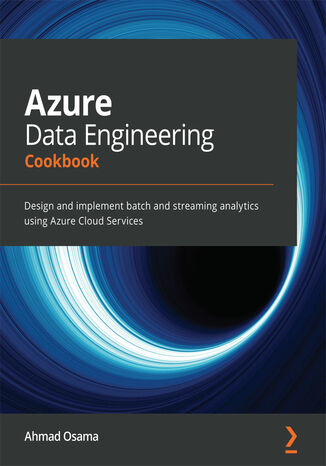
Ahmad Osama, Nagaraj Venkatesan
Data engineering is one of the faster growing job areas as Data Engineers are the ones who ensure that the data is extracted, provisioned and the data is of the highest quality for data analysis. This book uses various Azure services to implement and maintain infrastructure to extract data from multiple sources, and then transform and load it for data analysis.It takes you through different techniques for performing big data engineering using Microsoft Azure Data services. It begins by showing you how Azure Blob storage can be used for storing large amounts of unstructured data and how to use it for orchestrating a data workflow. You'll then work with different Cosmos DB APIs and Azure SQL Database. Moving on, you'll discover how to provision an Azure Synapse database and find out how to ingest and analyze data in Azure Synapse. As you advance, you'll cover the design and implementation of batch processing solutions using Azure Data Factory, and understand how to manage, maintain, and secure Azure Data Factory pipelines. You’ll also design and implement batch processing solutions using Azure Databricks and then manage and secure Azure Databricks clusters and jobs. In the concluding chapters, you'll learn how to process streaming data using Azure Stream Analytics and Data Explorer.By the end of this Azure book, you'll have gained the knowledge you need to be able to orchestrate batch and real-time ETL workflows in Microsoft Azure.
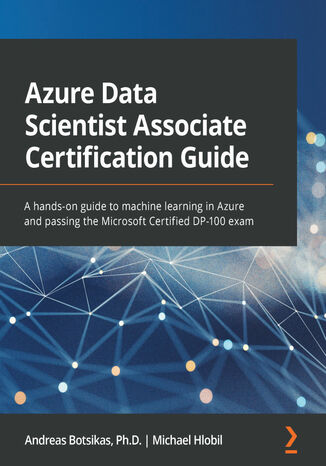
Andreas Botsikas , Michael Hlobil
The Azure Data Scientist Associate Certification Guide helps you acquire practical knowledge for machine learning experimentation on Azure. It covers everything you need to pass the DP-100 exam and become a certified Azure Data Scientist Associate.Starting with an introduction to data science, you'll learn the terminology that will be used throughout the book and then move on to the Azure Machine Learning (Azure ML) workspace. You'll discover the studio interface and manage various components, such as data stores and compute clusters.Next, the book focuses on no-code and low-code experimentation, and shows you how to use the Automated ML wizard to locate and deploy optimal models for your dataset. You'll also learn how to run end-to-end data science experiments using the designer provided in Azure ML Studio.You'll then explore the Azure ML Software Development Kit (SDK) for Python and advance to creating experiments and publishing models using code. The book also guides you in optimizing your model's hyperparameters using Hyperdrive before demonstrating how to use responsible AI tools to interpret and debug your models. Once you have a trained model, you'll learn to operationalize it for batch or real-time inferences and monitor it in production.By the end of this Azure certification study guide, you'll have gained the knowledge and the practical skills required to pass the DP-100 exam.
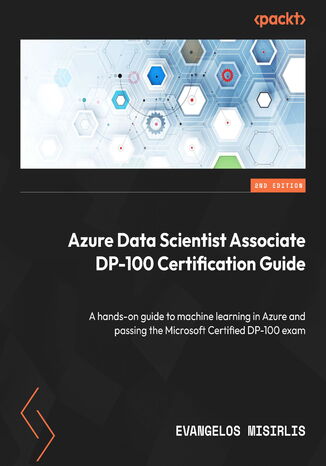
Evangelos Misirlis
The Azure Data Scientist Associate DP-100 Certification Guide teaches you how to run machine learning experiments on Azure. It includes everything you need to pass the DP-100 exam and become a certified Azure Data Scientist Associate.Starting with foundational concepts in data science, you'll learn how to configure and use the Azure Machine Learning (Azure ML) workspace via both studio and SDK interfaces. You'll progress through no-code and low-code experimentation using AutoML and the visual designer, and explore advanced Python SDK-based model training and deployment.This second edition also introduces you to the power of Generative AI with Prompt Flow, enabling you to build intelligent agents and operationalize them for production use. You’ll develop practical skills in hyperparameter tuning, model interpretation, and fairness analysis, and finally, deploy models as scalable endpoints with robust monitoring.Complete with hands-on exercises, mock exams, and expert tips, this guide offers everything you need for preparing to sit for the DP-100 exam and apply your learnings in real-world data science scenarios.
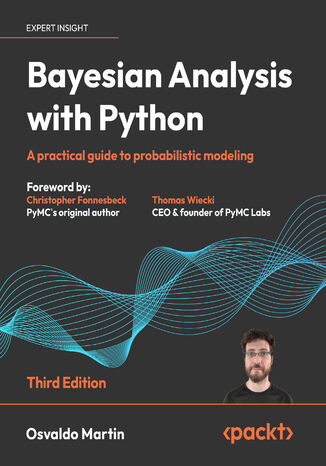
Bayesian Analysis with Python. A practical guide to probabilistic modeling - Third Edition
Osvaldo Martin, Christopher Fonnesbeck, Thomas Wiecki
The third edition of Bayesian Analysis with Python serves as an introduction to the main concepts of applied Bayesian modeling using PyMC, a state-of-the-art probabilistic programming library, and other libraries that support and facilitate modeling like ArviZ, for exploratory analysis of Bayesian models; Bambi, for flexible and easy hierarchical linear modeling; PreliZ, for prior elicitation; PyMC-BART, for flexible non-parametric regression; and Kulprit, for variable selection.In this updated edition, a brief and conceptual introduction to probability theory enhances your learning journey by introducing new topics like Bayesian additive regression trees (BART), featuring updated examples. Refined explanations, informed by feedback and experience from previous editions, underscore the book's emphasis on Bayesian statistics. You will explore various models, including hierarchical models, generalized linear models for regression and classification, mixture models, Gaussian processes, and BART, using synthetic and real datasets.By the end of this book, you’ll understand probabilistic modeling and be able to design and implement Bayesian models for data science, with a strong foundation for more advanced study.*Email sign-up and proof of purchase required
Osvaldo Martin, Eric Ma, Austin Rochford
The second edition of Bayesian Analysis with Python is an introduction to the main concepts of applied Bayesian inference and its practical implementation in Python using PyMC3, a state-of-the-art probabilistic programming library, and ArviZ, a new library for exploratory analysis of Bayesian models.The main concepts of Bayesian statistics are covered using a practical and computational approach. Synthetic and real data sets are used to introduce several types of models, such as generalized linear models for regression and classification, mixture models, hierarchical models, and Gaussian processes, among others. By the end of the book, you will have a working knowledge of probabilistic modeling and you will be able to design and implement Bayesian models for your own data science problems. After reading the book you will be better prepared to delve into more advanced material or specialized statistical modeling if you need to.
Alvaro Fuentes
Python is one of the most common and popular languages preferred by leading data analysts and statisticians for working with massive datasets and complex data visualizations.Become a Python Data Analyst introduces Python’s most essential tools and libraries necessary to work with the data analysis process, right from preparing data to performing simple statistical analyses and creating meaningful data visualizations.In this book, we will cover Python libraries such as NumPy, pandas, matplotlib, seaborn, SciPy, and scikit-learn, and apply them in practical data analysis and statistics examples. As you make your way through the chapters, you will learn to efficiently use the Jupyter Notebook to operate and manipulate data using NumPy and the pandas library. In the concluding chapters, you will gain experience in building simple predictive models and carrying out statistical computation and analysis using rich Python tools and proven data analysis techniques.By the end of this book, you will have hands-on experience performing data analysis with Python.
Michael Dinder
Django is a powerful framework but choosing the right add-ons that match the scale and scope of your enterprise projects can be tricky. This book will help you explore the multifarious options available for enterprise Django development. Countless organizations are already using Django and more migrating to it, unleashing the power of Python with many different packages and dependencies, including AI technologies.This practical guide will help you understand practices, blueprints, and design decisions to put Django to work the way you want it to. You’ll learn various ways in which data can be rendered onto a page and discover the power of Django for large-scale production applications. Starting with the basics of getting an enterprise project up and running, you'll get to grips with maintaining the project throughout its lifecycle while learning what the Django application lifecycle is.By the end of this book, you'll have learned how to build and deploy a Django project to the web and implement various components into the site.
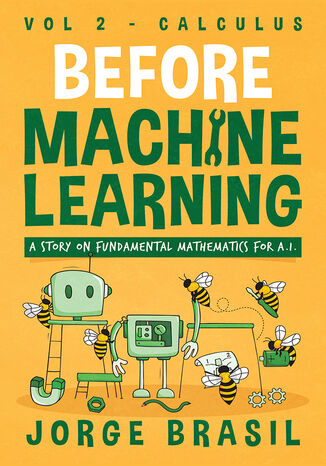
Jorge Brasil
This book takes readers on a structured journey through calculus fundamentals essential for AI. Starting with “Why Calculus?” it introduces key concepts like functions, limits, and derivatives, providing a solid foundation for understanding machine learning.As readers progress, they will encounter practical applications such as Taylor Series for curve fitting, gradient descent for optimization, and L'Hôpital’s Rule for managing undefined expressions. Each chapter builds up from core calculus to multidimensional topics, making complex ideas accessible and applicable to AI.The final chapters guide readers through multivariable calculus, including advanced concepts like the gradient, Hessian, and backpropagation, crucial for neural networks. From optimizing models to understanding cost functions, this book equips readers with the calculus skills needed to confidently tackle AI challenges, offering insights that make complex calculus both manageable and deeply relevant to machine learning.
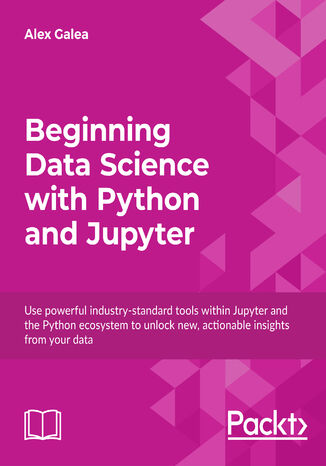
Alex Galea
Get to grips with the skills you need for entry-level data science in this hands-on Python and Jupyter course. You'll learn about some of the most commonly used libraries that are part of the Anaconda distribution, and then explore machine learning models with real datasets to give you the skills and exposure you need for the real world. We'll finish up by showing you how easy it can be to scrape and gather your own data from the open web, so that you can apply your new skills in an actionable context.
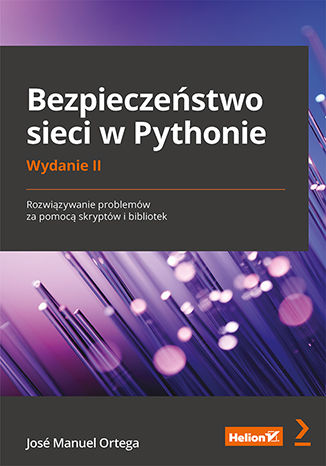
Bezpieczeństwo sieci w Pythonie. Rozwiązywanie problemów za pomocą skryptów i bibliotek. Wydanie II
José Manuel Ortega
Popularność Pythona wynika z jego wszechstronności, prostoty, a także ze zwięzłości i z łatwości pisania kodu. Rozbudowywana z każdą aktualizacją kolekcja narzędzi i bibliotek pozwala na używanie Pythona do coraz bardziej specjalistycznych zadań, takich jak zabezpieczanie sieci. O tym, że skuteczna ochrona sieci ma krytyczne znaczenie dla organizacji, świadczą powtarzające się przypadki cyberataków i utraty cennych danych. Warto więc wykorzystać możliwości Pythona do wykrywania zagrożeń i rozwiązywania różnych problemów związanych z siecią. Tę książkę docenią specjaliści do spraw bezpieczeństwa i inżynierowie sieci. Dzięki niej zapoznasz się z najnowszymi pakietami i bibliotekami Pythona i nauczysz się pisać skrypty, które pozwolą Ci zabezpieczyć sieć na wielu poziomach. Dowiesz się, w jaki sposób przesyłać dane i korzystać z sieci Tor. Nauczysz się też identyfikować podatności systemu na ataki, aby tym skuteczniej zapewnić mu bezpieczeństwo. W naturalny sposób przyswoisz wiedzę, która pozwoli Ci tworzyć w Pythonie bezpieczne aplikacje, zaczniesz również stosować techniki kryptograficzne i steganograficzne. Znajdziesz tu także wskazówki, jak rozwiązywać różne problemy sieciowe, pisać skrypty do wykrywania zagrożeń sieci i stron internetowych, zabezpieczać urządzenia końcowe, pozyskiwać metadane i pisać skrypty kryptograficzne. Najważniejsze zagadnienia: skrypty automatyzujące procedury bezpieczeństwa i testy penetracyjne narzędzia programistyczne służące do zabezpieczania sieci automatyczna analiza serwerów wykrywanie podatności na ataki i analiza bezpieczeństwa praca z siecią Tor stosowanie narzędzi do analizy śledczej Python w sieci: najlepsza ochrona!
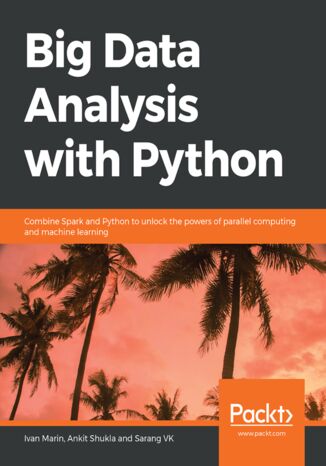
Ivan Marin, Ankit Shukla, Sarang VK
Processing big data in real time is challenging due to scalability, information inconsistency, and fault tolerance. Big Data Analysis with Python teaches you how to use tools that can control this data avalanche for you. With this book, you'll learn practical techniques to aggregate data into useful dimensions for posterior analysis, extract statistical measurements, and transform datasets into features for other systems.The book begins with an introduction to data manipulation in Python using pandas. You'll then get familiar with statistical analysis and plotting techniques. With multiple hands-on activities in store, you'll be able to analyze data that is distributed on several computers by using Dask. As you progress, you'll study how to aggregate data for plots when the entire data cannot be accommodated in memory. You'll also explore Hadoop (HDFS and YARN), which will help you tackle larger datasets. The book also covers Spark and explains how it interacts with other tools.By the end of this book, you'll be able to bootstrap your own Python environment, process large files, and manipulate data to generate statistics, metrics, and graphs.
Big Data on Kubernetes. A practical guide to building efficient and scalable data solutions
Neylson Crepalde
In today's data-driven world, organizations across different sectors need scalable and efficient solutions for processing large volumes of data. Kubernetes offers an open-source and cost-effective platform for deploying and managing big data tools and workloads, ensuring optimal resource utilization and minimizing operational overhead. If you want to master the art of building and deploying big data solutions using Kubernetes, then this book is for you.Written by an experienced data specialist, Big Data on Kubernetes takes you through the entire process of developing scalable and resilient data pipelines, with a focus on practical implementation. Starting with the basics, you’ll progress toward learning how to install Docker and run your first containerized applications. You’ll then explore Kubernetes architecture and understand its core components. This knowledge will pave the way for exploring a variety of essential tools for big data processing such as Apache Spark and Apache Airflow. You’ll also learn how to install and configure these tools on Kubernetes clusters. Throughout the book, you’ll gain hands-on experience building a complete big data stack on Kubernetes.By the end of this Kubernetes book, you’ll be equipped with the skills and knowledge you need to tackle real-world big data challenges with confidence.
Tiago Antao
Bioinformatics is an active research field that uses a range of simple-to-advanced computations to extract valuable information from biological data.This book covers next-generation sequencing, genomics, metagenomics, population genetics, phylogenetics, and proteomics. You'll learn modern programming techniques to analyze large amounts of biological data. With the help of real-world examples, you'll convert, analyze, and visualize datasets using various Python tools and libraries.This book will help you get a better understanding of working with a Galaxy server, which is the most widely used bioinformatics web-based pipeline system. This updated edition also includes advanced next-generation sequencing filtering techniques. You'll also explore topics such as SNP discovery using statistical approaches under high-performance computing frameworks such as Dask and Spark.By the end of this book, you'll be able to use and implement modern programming techniques and frameworks to deal with the ever-increasing deluge of bioinformatics data.
Tiago Antao
Bioinformatics is an active research field that uses a range of simple-to-advanced computations to extract valuable information from biological data, and this book will show you how to manage these tasks using Python.This updated third edition of the Bioinformatics with Python Cookbook begins with a quick overview of the various tools and libraries in the Python ecosystem that will help you convert, analyze, and visualize biological datasets. Next, you'll cover key techniques for next-generation sequencing, single-cell analysis, genomics, metagenomics, population genetics, phylogenetics, and proteomics with the help of real-world examples. You'll learn how to work with important pipeline systems, such as Galaxy servers and Snakemake, and understand the various modules in Python for functional and asynchronous programming. This book will also help you explore topics such as SNP discovery using statistical approaches under high-performance computing frameworks, including Dask and Spark. In addition to this, you’ll explore the application of machine learning algorithms in bioinformatics.By the end of this bioinformatics Python book, you'll be equipped with the knowledge you need to implement the latest programming techniques and frameworks, empowering you to deal with bioinformatics data on every scale.
Darko Medin
This book leverages the author’s decade-long experience in biostatistics and data science to simplify the practical use of biostatistics with Python. The chapters show you how to clean and describe your data effectively, setting a solid foundation for accurate analysis and proficiency in biostatistical inference to help you draw meaningful conclusions from your data through hypothesis testing and effect size analysis.The book walks you through predictive modeling to harness the power of Python to create robust predictive analytics that can drive your research and professional projects forward. You'll explore clinical biostatistics, learn how to design studies, conduct survival analysis, and synthesize evidence from multiple studies with meta-analysis – skills that are crucial for making informed decisions based on comprehensive data reviews. The concluding chapters will enhance your ability to analyze biological variables, enabling you to perform detailed and accurate data analysis for biological research. This book's unique blend of biostatistics and Python helps you find practical solutions that make complex concepts easy to grasp and apply.By the end of this biostatistics book, you’ll have moved from theoretical knowledge to practical experience, allowing you to perform biostatistical analysis confidently and accurately.
Oscar Baechler, Xury Greer
Blender is a powerful 3D creation package that supports every aspect of the 3D pipeline. With this book, you'll learn about modeling, rigging, animation, rendering, and much more with the help of some interesting projects.This practical guide, based on the Blender 2.83 LTS version, starts by helping you brush up on your basic Blender skills and getting you acquainted with the software toolset. You’ll use basic modeling tools to understand the simplest 3D workflow by customizing a Viking themed scene. You'll get a chance to see the 3D modeling process from start to finish by building a time machine based on provided concept art. You will design your first 2D character while exploring the capabilities of the new Grease Pencil tools. The book then guides you in creating a sleek modern kitchen scene using EEVEE, Blender’s new state-of-the-art rendering engine. As you advance, you'll explore a variety of 3D design techniques, such as sculpting, retopologizing, unwrapping, baking, painting, rigging, and animating to bring a baby dragon to life.By the end of this book, you'll have learned how to work with Blender to create impressive computer graphics, art, design, and architecture, and you'll be able to use robust Blender tools for your design projects and video games.
Martin Yanev
Unlock the power of AI in your applications with ChatGPT with this practical guide that shows you how to seamlessly integrate OpenAI APIs into your projects, enabling you to navigate complex APIs and ensure seamless functionality with ease.This new edition is updated with key topics such as OpenAI Embeddings, which’ll help you understand the semantic relationships between words and phrases. You’ll find out how to use ChatGPT, Whisper, and DALL-E APIs through 10 AI projects using the latest OpenAI models, GPT-3.5, and GPT-4, with Visual Studio Code as the IDE. Within these projects, you’ll integrate ChatGPT with frameworks and tools such as Flask, Django, Microsoft Office APIs, and PyQt. You’ll get to grips with NLP tasks, build a ChatGPT clone, and create an AI code bug-fixing SaaS app. The chapters will also take you through speech recognition, text-to-speech capabilities, language translation, generating email replies, creating PowerPoint presentations, and fine-tuning ChatGPT, along with adding payment methods by integrating the ChatGPT API with Stripe.By the end of this book, you’ll be able to develop, deploy, and monetize your own groundbreaking applications by harnessing the full potential of ChatGPT APIs.
Building AI Intensive Python Applications. Create intelligent apps with LLMs and vector databases
Rachelle Palmer, Ben Perlmutter, Ashwin Gangadhar, Nicholas...
The era of generative AI is upon us, and this book serves as a roadmap to harness its full potential. With its help, you’ll learn the core components of the AI stack: large language models (LLMs), vector databases, and Python frameworks, and see how these technologies work together to create intelligent applications.The chapters will help you discover best practices for data preparation, model selection, and fine-tuning, and teach you advanced techniques such as retrieval-augmented generation (RAG) to overcome common challenges, such as hallucinations and data leakage. You’ll get a solid understanding of vector databases, implement effective vector search strategies, refine models for accuracy, and optimize performance to achieve impactful results. You’ll also identify and address AI failures to ensure your applications deliver reliable and valuable results. By evaluating and improving the output of LLMs, you’ll be able to enhance their performance and relevance.By the end of this book, you’ll be well-equipped to build sophisticated AI applications that deliver real-world value.
Jan Lukavský
Apache Beam is an open source unified programming model for implementing and executing data processing pipelines, including Extract, Transform, and Load (ETL), batch, and stream processing.This book will help you to confidently build data processing pipelines with Apache Beam. You’ll start with an overview of Apache Beam and understand how to use it to implement basic pipelines. You’ll also learn how to test and run the pipelines efficiently. As you progress, you’ll explore how to structure your code for reusability and also use various Domain Specific Languages (DSLs). Later chapters will show you how to use schemas and query your data using (streaming) SQL. Finally, you’ll understand advanced Apache Beam concepts, such as implementing your own I/O connectors.By the end of this book, you’ll have gained a deep understanding of the Apache Beam model and be able to apply it to solve problems.