
Python
W kategorii Python zostały zebrane podręczniki poruszające tematykę programowania z zastosowaniem praktycznie niezależnego sprzętowo, dostępnego na licencji Open Source języka. Książki przedstawią Wam wszechstronności i elastyczności Pythona a także różne typy tworzenia kodu poprzez programowanie strukturalne, obiektowe czy funkcjonalne.
Nauczycie się tworzyć aplikacje sieciowe o dowolnym przeznaczeniu, komunikujące się z systemami operacyjnymi, lub korzystające z baz danych. Techniki analizy składni, przetwarzanie tekstu czy rozłożenie obciążenia programu na wiele wątków i procesów przestanie być problematyczne.
Brian Sacash, Bhargav Srinivasa-Desikan, Reddy Anil Kumar
Modern text analysis is now very accessible using Python and open source tools, so discover how you can now perform modern text analysis in this era of textual data.This book shows you how to use natural language processing, and computational linguistics algorithms, to make inferences and gain insights about data you have. These algorithms are based on statistical machine learning and artificial intelligence techniques. The tools to work with these algorithms are available to you right now - with Python, and tools like Gensim and spaCy.You'll start by learning about data cleaning, and then how to perform computational linguistics from first concepts. You're then ready to explore the more sophisticated areas of statistical NLP and deep learning using Python, with realistic language and text samples. You'll learn to tag, parse, and model text using the best tools. You'll gain hands-on knowledge of the best frameworks to use, and you'll know when to choose a tool like Gensim for topic models, and when to work with Keras for deep learning.This book balances theory and practical hands-on examples, so you can learn about and conduct your own natural language processing projects and computational linguistics. You'll discover the rich ecosystem of Python tools you have available to conduct NLP - and enter the interesting world of modern text analysis.
Sohom Ghosh , Dwight Gunning
If NLP hasn't been your forte, Natural Language Processing Fundamentals will make sure you set off to a steady start. This comprehensive guide will show you how to effectively use Python libraries and NLP concepts to solve various problems.You'll be introduced to natural language processing and its applications through examples and exercises. This will be followed by an introduction to the initial stages of solving a problem, which includes problem definition, getting text data, and preparing it for modeling. With exposure to concepts like advanced natural language processing algorithms and visualization techniques, you'll learn how to create applications that can extract information from unstructured data and present it as impactful visuals. Although you will continue to learn NLP-based techniques, the focus will gradually shift to developing useful applications. In these sections, you'll understand how to apply NLP techniques to answer questions as can be used in chatbots. By the end of this book, you'll be able to accomplish a varied range of assignments ranging from identifying the most suitable type of NLP task for solving a problem to using a tool like spacy or gensim for performing sentiment analysis. The book will easily equip you with the knowledge you need to build applications that interpret human language.
Mona M, Premkumar Rangarajan
Natural language processing (NLP) uses machine learning to extract information from unstructured data. This book will help you to move quickly from business questions to high-performance models in production.To start with, you'll understand the importance of NLP in today’s business applications and learn the features of Amazon Comprehend and Amazon Textract to build NLP models using Python and Jupyter Notebooks. The book then shows you how to integrate AI in applications for accelerating business outcomes with just a few lines of code. Throughout the book, you'll cover use cases such as smart text search, setting up compliance and controls when processing confidential documents, real-time text analytics, and much more to understand various NLP scenarios. You'll deploy and monitor scalable NLP models in production for real-time and batch requirements. As you advance, you'll explore strategies for including humans in the loop for different purposes in a document processing workflow. Moreover, you'll learn best practices for auto-scaling your NLP inference for enterprise traffic.Whether you're new to ML or an experienced practitioner, by the end of this NLP book, you'll have the confidence to use AWS AI services to build powerful NLP applications.
Tadej Magajna
Flair is an easy-to-understand natural language processing (NLP) framework designed to facilitate training and distribution of state-of-the-art NLP models for named entity recognition, part-of-speech tagging, and text classification. Flair is also a text embedding library for combining different types of embeddings, such as document embeddings, Transformer embeddings, and the proposed Flair embeddings.Natural Language Processing with Flair takes a hands-on approach to explaining and solving real-world NLP problems. You'll begin by installing Flair and learning about the basic NLP concepts and terminology. You will explore Flair's extensive features, such as sequence tagging, text classification, and word embeddings, through practical exercises. As you advance, you will train your own sequence labeling and text classification models and learn how to use hyperparameter tuning in order to choose the right training parameters. You will learn about the idea behind one-shot and few-shot learning through a novel text classification technique TARS. Finally, you will solve several real-world NLP problems through hands-on exercises, as well as learn how to deploy Flair models to production.By the end of this Flair book, you'll have developed a thorough understanding of typical NLP problems and you’ll be able to solve them with Flair.
Cuantum Technologies LLC
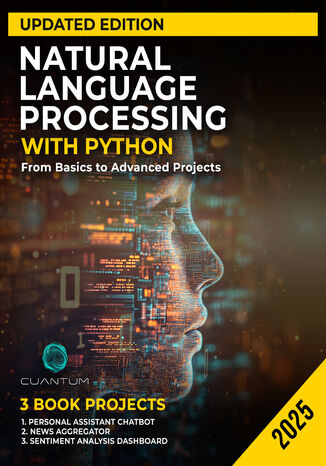
Embark on a comprehensive journey to master natural language processing (NLP) with Python. Begin with foundational concepts like text preprocessing, tokenization, and key Python libraries such as NLTK, spaCy, and TextBlob. Explore the challenges of text data and gain hands-on experience in cleaning, tokenizing, and building basic NLP pipelines. Early chapters provide practical exercises to solidify your understanding of essential techniques.Advance to sophisticated topics like feature engineering using Bag of Words, TF-IDF, and embeddings like Word2Vec and BERT. Delve into language modeling with RNNs, syntax parsing, and sentiment analysis, learning to apply these techniques in real-world scenarios. Chapters on topic modeling and text summarization equip you to extract insights from data, while transformer-based models like BERT take your skills to the next level. Each concept is paired with Python-based examples, ensuring practical mastery.The final chapters focus on real-world projects, such as developing chatbots, sentiment analysis dashboards, and news aggregators. These hands-on applications challenge you to design, train, and deploy robust NLP solutions. With its structured approach and practical focus, this book equips you to confidently tackle real-world NLP challenges and innovate in the field.
Nirant Kasliwal
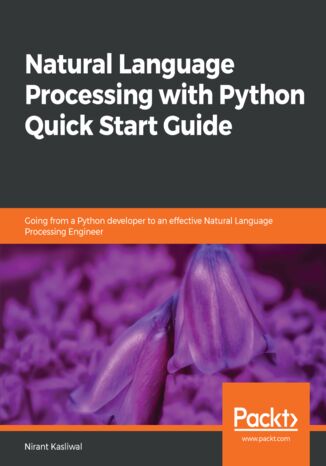
NLP in Python is among the most sought after skills among data scientists. With code and relevant case studies, this book will show how you can use industry-grade tools to implement NLP programs capable of learning from relevant data. We will explore many modern methods ranging from spaCy to word vectors that have reinvented NLP.The book takes you from the basics of NLP to building text processing applications. We start with an introduction to the basic vocabulary along with a work?ow for building NLP applications.We use industry-grade NLP tools for cleaning and pre-processing text, automatic question and answer generation using linguistics, text embedding, text classifier, and building a chatbot. With each project, you will learn a new concept of NLP. You will learn about entity recognition, part of speech tagging and dependency parsing for Q and A. We use text embedding for both clustering documents and making chatbots, and then build classifiers using scikit-learn.We conclude by deploying these models as REST APIs with Flask.By the end, you will be confident building NLP applications, and know exactly what to look for when approaching new challenges.
Thushan Ganegedara
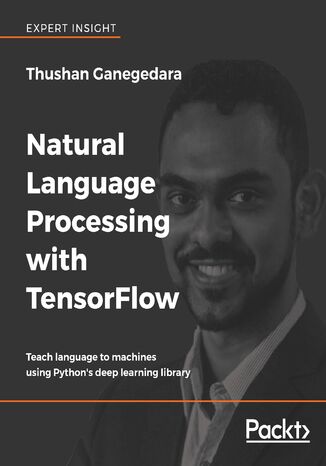
Natural language processing (NLP) supplies the majority of data available to deep learning applications, while TensorFlow is the most important deep learning framework currently available. Natural Language Processing with TensorFlow brings TensorFlow and NLP together to give you invaluable tools to work with the immense volume of unstructured data in today’s data streams, and apply these tools to specific NLP tasks.Thushan Ganegedara starts by giving you a grounding in NLP and TensorFlow basics. You'll then learn how to use Word2vec, including advanced extensions, to create word embeddings that turn sequences of words into vectors accessible to deep learning algorithms. Chapters on classical deep learning algorithms, like convolutional neural networks (CNN) and recurrent neural networks (RNN), demonstrate important NLP tasks as sentence classification and language generation. You will learn how to apply high-performance RNN models, like long short-term memory (LSTM) cells, to NLP tasks. You will also explore neural machine translation and implement a neural machine translator.After reading this book, you will gain an understanding of NLP and you'll have the skills to apply TensorFlow in deep learning NLP applications, and how to perform specific NLP tasks.
Thushan Ganegedara
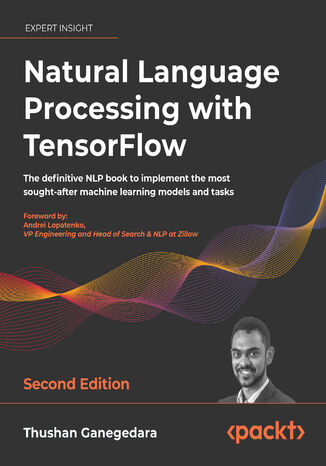
Learning how to solve natural language processing (NLP) problems is an important skill to master due to the explosive growth of data combined with the demand for machine learning solutions in production. Natural Language Processing with TensorFlow, Second Edition, will teach you how to solve common real-world NLP problems with a variety of deep learning model architectures.The book starts by getting readers familiar with NLP and the basics of TensorFlow. Then, it gradually teaches you different facets of TensorFlow 2.x. In the following chapters, you then learn how to generate powerful word vectors, classify text, generate new text, and generate image captions, among other exciting use-cases of real-world NLP.TensorFlow has evolved to be an ecosystem that supports a machine learning workflow through ingesting and transforming data, building models, monitoring, and productionization. We will then read text directly from files and perform the required transformations through a TensorFlow data pipeline. We will also see how to use a versatile visualization tool known as TensorBoard to visualize our models.By the end of this NLP book, you will be comfortable with using TensorFlow to build deep learning models with many different architectures, and efficiently ingest data using TensorFlow Additionally, you’ll be able to confidently use TensorFlow throughout your machine learning workflow.