
Python
W kategorii Python zostały zebrane podręczniki poruszające tematykę programowania z zastosowaniem praktycznie niezależnego sprzętowo, dostępnego na licencji Open Source języka. Książki przedstawią Wam wszechstronności i elastyczności Pythona a także różne typy tworzenia kodu poprzez programowanie strukturalne, obiektowe czy funkcjonalne.
Nauczycie się tworzyć aplikacje sieciowe o dowolnym przeznaczeniu, komunikujące się z systemami operacyjnymi, lub korzystające z baz danych. Techniki analizy składni, przetwarzanie tekstu czy rozłożenie obciążenia programu na wiele wątków i procesów przestanie być problematyczne.
Colleen M. Farrelly, Franck Kalala Mutombo, Michael...
We are living in the age of big data, and scalable solutions are a necessity. Network science leverages the power of graph theory and flexible data structures to analyze big data at scale.This book guides you through the basics of network science, showing you how to wrangle different types of data (such as spatial and time series data) into network structures. You’ll be introduced to core tools from network science to analyze real-world case studies in Python. As you progress, you’ll find out how to predict fake news spread, track pricing patterns in local markets, forecast stock market crashes, and stop an epidemic spread. Later, you’ll learn about advanced techniques in network science, such as creating and querying graph databases, classifying datasets with graph neural networks (GNNs), and mining educational pathways for insights into student success. Case studies in the book will provide you with end-to-end examples of implementing what you learn in each chapter.By the end of this book, you’ll be well-equipped to wrangle your own datasets into network science problems and scale solutions with Python.
Steven F. Lott
Python is the preferred choice of developers, engineers, data scientists, and hobbyists everywhere. It is a great language that can power your applications and provide great speed, safety, and scalability. It can be used for simple scripting or sophisticated web applications. By exposing Python as a series of simple recipes, this book gives you insight into specific language features in a particular context. Having a tangible context helps make the language or a given standard library feature easier to understand.This book comes with 133 recipes on the latest version of Python 3.8. The recipes will benefit everyone, from beginners just starting out with Python to experts. You'll not only learn Python programming concepts but also how to build complex applications.The recipes will touch upon all necessary Python concepts related to data structures, object oriented programming, functional programming, and statistical programming. You will get acquainted with the nuances of Python syntax and how to effectively take advantage of it.By the end of this Python book, you will be equipped with knowledge of testing, web services, configuration, and application integration tips and tricks. You will be armed with the knowledge of how to create applications with flexible logging, powerful configuration, command-line options, automated unit tests, and good documentation.
Alessandro Molina
The Python 3 Standard Library is a vast array of modules that you can use for developing various kinds of applications. It contains an exhaustive list of libraries, and this book will help you choose the best one to address specific programming problems in Python.The Modern Python Standard Library Cookbook begins with recipes on containers and data structures and guides you in performing effective text management in Python. You will find Python recipes for command-line operations, networking, filesystems and directories, and concurrent execution. You will learn about Python security essentials in Python and get to grips with various development tools for debugging, benchmarking, inspection, error reporting, and tracing. The book includes recipes to help you create graphical user interfaces for your application. You will learn to work with multimedia components and perform mathematical operations on date and time. The recipes will also show you how to deploy different searching and sorting algorithms on your data.By the end of the book, you will have acquired the skills needed to write clean code in Python and develop applications that meet your needs.
Manu Joseph, Jeffrey Tackes, Christoph Bergmeir
Predicting the future, whether it's market trends, energy demand, or website traffic, has never been more crucial. This practical, hands-on guide empowers you to build and deploy powerful time series forecasting models. Whether you’re working with traditional statistical methods or cutting-edge deep learning architectures, this book provides structured learning and best practices for both.Starting with the basics, this data science book introduces fundamental time series concepts, such as ARIMA and exponential smoothing, before gradually progressing to advanced topics, such as machine learning for time series, deep neural networks, and transformers. As part of your fundamentals training, you’ll learn preprocessing, feature engineering, and model evaluation. As you progress, you’ll also explore global forecasting models, ensemble methods, and probabilistic forecasting techniques.This new edition goes deeper into transformer architectures and probabilistic forecasting, including new content on the latest time series models, conformal prediction, and hierarchical forecasting. Whether you seek advanced deep learning insights or specialized architecture implementations, this edition provides practical strategies and new content to elevate your forecasting skills.*Email sign-up and proof of purchase required
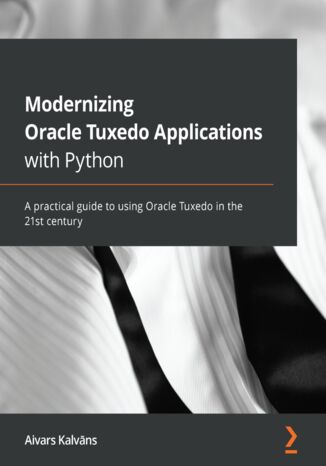
Aivars Kalvans
Despite being developed in the 1980s, Oracle Tuxedo still runs a significant part of critical infrastructure and is not going away any time soon. Modernizing Oracle Tuxedo Applications with Python will help you get to grips with the most important Tuxedo concepts by writing Python code.The book starts with an introduction to Oracle Tuxedo and guides you in installing its latest version and Python bindings for Tuxedo on Linux. You'll then learn how to build your first server and client, configure Tuxedo, and start running an application. As you advance, you'll understand load balancing and work with the BBL server, which is at the heart of a Tuxedo application. This Tuxedo book will also cover Boolean expressions and different ways to export Tuxedo buffers for storage and transmission, before showing you how to implement servers and clients and use the management information base to change the configuration dynamically. Once you've learned how to configure Tuxedo for transactions and control them in application code, you'll discover how to use the store-and-forward functionality to reach destinations and use an Oracle database from a Tuxedo application.By the end of this Oracle Tuxedo book, you'll be able to perform common Tuxedo programming tasks with Python and integrate Tuxedo applications with other parts of modern infrastructure.
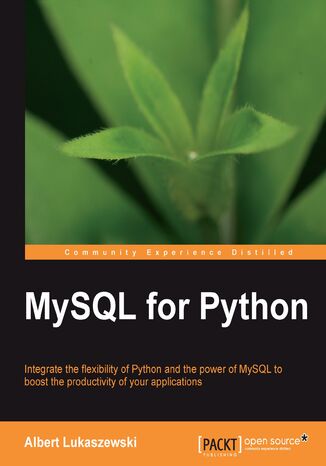
Albert Lukaszewski
Python is a dynamic programming language, which is completely enterprise ready, owing largely to the variety of support modules that are available to extend its capabilities. In order to build productive and feature-rich Python applications, we need to use MySQL for Python, a module that provides database support to our applications. Although you might be familiar with accessing data in MySQL, here you will learn how to access data through MySQL for Python efficiently and effectively.This book demonstrates how to boost the productivity of your Python applications by integrating them with the MySQL database server, the world's most powerful open source database. It will teach you to access the data on your MySQL database server easily with Python's library for MySQL using a practical, hands-on approach. Leaving theory to the classroom, this book uses real-world code to solve real-world problems with real-world solutions.The book starts by exploring the various means of installing MySQL for Python on different platforms and how to use simple database querying techniques to improve your programs. It then takes you through data insertion, data retrieval, and error-handling techniques to create robust programs. The book also covers automation of both database and user creation, and administration of access controls. As the book progresses, you will learn to use many more advanced features of Python for MySQL that facilitate effective administration of your database through Python. Every chapter is illustrated with a project that you can deploy in your own situation.By the end of this book, you will know several techniques for interfacing your Python applications with MySQL effectively so that powerful database management through Python becomes easy to achieve and easy to maintain.
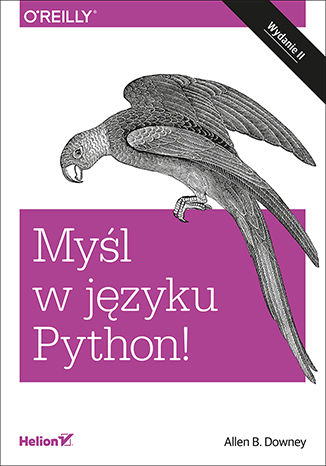
Myśl w języku Python! Nauka programowania. Wydanie II
Allen B. Downey
Aby stać się cenionym programistą, trzeba zacząć od bardzo solidnych podstaw. Python jest idealną propozycją dla osób, które chcą nauczyć się programowania. Składnia i podstawowe koncepcje programistyczne w Pythonie są dość proste do zrozumienia. Sam język ma duże możliwości zastosowania w różnych dziedzinach wiedzy. Umożliwia przy tym pisanie czytelnego i łatwego w konserwacji kodu, co jest ogromną zaletą. Trzymasz w ręku praktyczny przewodnik do nauki programowania. Znajdziesz w nim przystępnie napisane wyjaśnienia dotyczące podstawowych pojęć programistycznych. Dowiesz się, jak stosować funkcje, czym jest rekurencja, jak wyglądają struktury danych i na czym polega projektowanie obiektowe. W każdym rozdziale znalazły się praktyczne ćwiczenia, dzięki którym będziesz używać poznawanych koncepcji i utrwalisz zdobytą wiedzę. W tej książce: przedstawiono podstawy Pythona, w tym jego składnię i semantykę opisano najważniejsze koncepcje programistyczne i zdefiniowano istotne pojęcia pokazano, jak stosować wartości, zmienne, instrukcje, funkcje i struktury danych przedstawiono metody pracy z plikami i bazami danych wyjaśniono zagadnienia programowania obiektowego opisano techniki debugowania służące do usuwania błędów składniowych, uruchomieniowych i semantycznych Python: dzięki niemu zaczniesz myśleć jak informatyk!
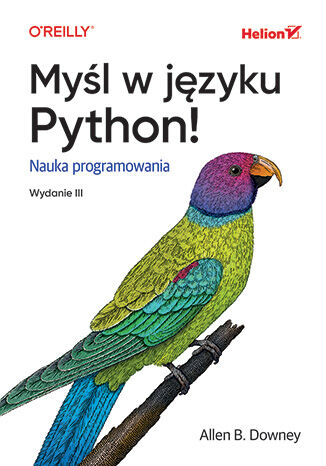
Myśl w języku Python! Nauka programowania. Wydanie III
Allen B. Downey
Python to wspaniały język programowania. Jest wszechstronny, wyrazisty i zwięzły, pozwala też korzystać z rosnącej kolekcji narzędzi i bibliotek. Cenią go zarówno profesjonalni twórcy oprogramowania, jak i amatorzy czy osoby spoza branży, które w Pythonie widzą cenne narzędzie do tworzenia własnych aplikacji, znacząco poprawiających jakość i wydajność pracy. Wyjątkowy przewodnik dla osób zainteresowanych nauką programowania od podstaw! Luciano Ramalho, autor książki Zaawansowany Python To trzecie wydanie przejrzystego przewodnika, który ułatwi Ci naukę programowania w Pythonie. Zaczniesz od przyswojenia podstawowych pojęć programistycznych, aby wkrótce płynnie posługiwać się funkcjami i strukturami danych. Zdobędziesz też umiejętność programowania zorientowanego obiektowo. W tym zaktualizowanym wydaniu znajdziesz również wskazówki, dzięki którym zastosujesz duże modele językowe, takie jak ChatGPT, do nauki programowania. Dowiesz się, jak tworzyć skuteczne zapytania dla tych modeli, a także jak testować i debugować kod Pythona. Dzięki ćwiczeniom, zamieszczonym w każdym rozdziale, będziesz stopniowo szlifować umiejętności programistyczne, a zasugerowane w książce strategie pomogą Ci w unikaniu frustrujących błędów - w ten sposób szybko nauczysz się tworzyć poprawny kod. W książce: podstawy Pythona zmienne, instrukcje, funkcje i struktury danych praca z plikami i bazami danych obiekty, metody i programowanie zorientowane obiektowo obsługa błędów składniowych, wykonawczych i semantycznych użycie dużych modeli językowych do przyspieszenia nauki programowania Dzięki tej książce nauczysz się używać dużych modeli językowych do nauki programowania! Sam Lau, współautor książki Learning Data Science O książce: Eksperyment myślowy — recenzja książki