
Python
W kategorii Python zostały zebrane podręczniki poruszające tematykę programowania z zastosowaniem praktycznie niezależnego sprzętowo, dostępnego na licencji Open Source języka. Książki przedstawią Wam wszechstronności i elastyczności Pythona a także różne typy tworzenia kodu poprzez programowanie strukturalne, obiektowe czy funkcjonalne.
Nauczycie się tworzyć aplikacje sieciowe o dowolnym przeznaczeniu, komunikujące się z systemami operacyjnymi, lub korzystające z baz danych. Techniki analizy składni, przetwarzanie tekstu czy rozłożenie obciążenia programu na wiele wątków i procesów przestanie być problematyczne.
Luis Sobrecueva
AutoKeras is an AutoML open-source software library that provides easy access to deep learning models. If you are looking to build deep learning model architectures and perform parameter tuning automatically using AutoKeras, then this book is for you.This book teaches you how to develop and use state-of-the-art AI algorithms in your projects. It begins with a high-level introduction to automated machine learning, explaining all the concepts required to get started with this machine learning approach. You will then learn how to use AutoKeras for image and text classification and regression. As you make progress, you'll discover how to use AutoKeras to perform sentiment analysis on documents. This book will also show you how to implement a custom model for topic classification with AutoKeras. Toward the end, you will explore advanced concepts of AutoKeras such as working with multi-modal data and multi-task, customizing the model with AutoModel, and visualizing experiment results using AutoKeras Extensions.By the end of this machine learning book, you will be able to confidently use AutoKeras to design your own custom machine learning models in your company.
Luc van Vugt
Dynamics 365 Business Central is the new cloud-based SaaS ERP proposition from Microsoft. It’s not as simple as it used to be way back when it was called Navigator, Navision Financials, or Microsoft Business Solutions-Navision. Our development practices are becoming more formal, and with this, the call for test automation is pressing on us.This book will teach you to leverage testing tools available with Dynamics 365 Business Central to perform automated testing. We’ll begin with a quick introduction to automated testing, followed by an overview of test automation in Dynamics 365 Business Central. Then you’ll learn to design and build automated tests and we’ll go through some efficient methods to get from requirements to application and testing code. Lastly, you’ll learn to incorporate your own and Microsoft tests into your daily development practice.By the end of the book, you’ll be able to write your own automated tests for Dynamics 365 Business Central.
Somanath Nanda, Weslley Moura
The AWS Certified Machine Learning Specialty exam tests your competency to perform machine learning (ML) on AWS infrastructure. This book covers the entire exam syllabus using practical examples to help you with your real-world machine learning projects on AWS.Starting with an introduction to machine learning on AWS, you'll learn the fundamentals of machine learning and explore important AWS services for artificial intelligence (AI). You'll then see how to prepare data for machine learning and discover a wide variety of techniques for data manipulation and transformation for different types of variables. The book also shows you how to handle missing data and outliers and takes you through various machine learning tasks such as classification, regression, clustering, forecasting, anomaly detection, text mining, and image processing, along with the specific ML algorithms you need to know to pass the exam. Finally, you'll explore model evaluation, optimization, and deployment and get to grips with deploying models in a production environment and monitoring them.By the end of this book, you'll have gained knowledge of the key challenges in machine learning and the solutions that AWS has released for each of them, along with the tools, methods, and techniques commonly used in each domain of AWS ML.
AWS dla administratorów systemów. Tworzenie i utrzymywanie niezawodnych aplikacji chmurowych
Prashant Lakhera
Amazon Web Services (AWS) zdobywa coraz większe uznanie. Platforma AWS udostępnia znakomite rozwiązania, w tym usługi obliczeniowe, magazyn danych, obsługę sieci i usług zarządzanych. Aplikacje korporacyjne wdrożone w chmurze AWS mogą być wyjątkowo odporne, skalowalne i niezawodne. Aby takie były, administrator systemu musi jednak zrozumieć koncepcje zaawansowanego zarządzania chmurą i nauczyć się wykorzystywać je w praktyce zarówno podczas wdrażania systemu, jak i zarządzania nim. W tej książce omówiono techniki wdrażania systemów na platformie AWS i zasady zarządzania nimi. Zaprezentowano podstawy korzystania z usługi Identity and Access Management oraz narzędzia sieciowe i monitorujące chmury AWS. Poruszono tematy Virtual Private Cloud, Elastic Compute Cloud, równoważenia obciążenia, automatycznego skalowania oraz baz danych usługi Relational Database Service. Dokładnie przedstawiono zasady wdrażania aplikacji i zarządzania danymi. Pokazano też, w jaki sposób zainicjować automatyczne tworzenie kopii zapasowych oraz jak śledzić i przechowywać pliki dzienników. W książce znalazły się również informacje na temat interfejsów API platformy AWS i sposobu ich użycia oraz automatyzacji infrastruktury z wykorzystaniem usługi CloudFormation, narzędzia Terraform oraz skryptów w języku Python z biblioteką Boto3. W książce między innymi: zasady bezpieczeństwa w systemach chmurowych tworzenie usług Amazon Elastic Compute Cloud (EC2) konfiguracja centrum danych w chmurze AWS za pomocą sieci VPC automatyczne skalowanie aplikacji praca z dziennikami scentralizowanymi CloudWatch wykonywanie kopii zapasowych danych AWS, czyli dostępność, odporność i niezawodność aplikacji!
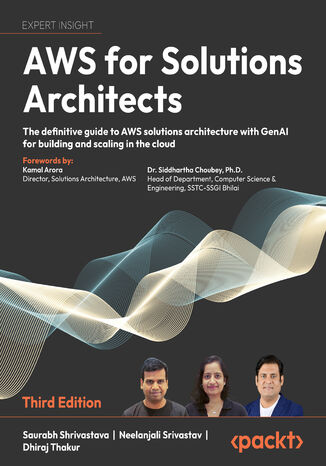
Saurabh Shrivastava, Neelanjali Srivastav, Dhiraj Thakur, Kamal...
AWS for Solutions Architects, Third Edition is your essential guide to thriving in the fast-evolving AWS ecosystem. As a solutions architect, staying on top of the latest technologies and managing complex cloud migrations can be challenging, and this book addresses those pain points head-on. Seasoned AWS experts Saurabh Shrivastava, Neelanjali Srivastav, and Dhiraj Thakur bring deep industry insight and hands-on experience to every chapter.This third edition introduces cutting-edge topics, including Generative AI and MLOps, to keep pace with the evolving cloud landscape and guide you in building AI-driven applications. The book also reflects updates from the AWS Well-Architected Framework and aligns with the latest AWS certifications, making it a future-ready guide for cloud professionals. The chapters help you stay ahead of the competition with in-depth coverage of the latest AWS certifications, including AI Practitioner Foundation and Data Engineer Associate, helping you position yourself as a leader in cloud innovation.By the end of this book, you'll transform into a solutions architecture expert, equipped with the strategies, tools, and certifications needed to handle any cloud challenge.
Ahmad Osama, Nagaraj Venkatesan
Data engineering is one of the faster growing job areas as Data Engineers are the ones who ensure that the data is extracted, provisioned and the data is of the highest quality for data analysis. This book uses various Azure services to implement and maintain infrastructure to extract data from multiple sources, and then transform and load it for data analysis.It takes you through different techniques for performing big data engineering using Microsoft Azure Data services. It begins by showing you how Azure Blob storage can be used for storing large amounts of unstructured data and how to use it for orchestrating a data workflow. You'll then work with different Cosmos DB APIs and Azure SQL Database. Moving on, you'll discover how to provision an Azure Synapse database and find out how to ingest and analyze data in Azure Synapse. As you advance, you'll cover the design and implementation of batch processing solutions using Azure Data Factory, and understand how to manage, maintain, and secure Azure Data Factory pipelines. You’ll also design and implement batch processing solutions using Azure Databricks and then manage and secure Azure Databricks clusters and jobs. In the concluding chapters, you'll learn how to process streaming data using Azure Stream Analytics and Data Explorer.By the end of this Azure book, you'll have gained the knowledge you need to be able to orchestrate batch and real-time ETL workflows in Microsoft Azure.
Andreas Botsikas , Michael Hlobil
The Azure Data Scientist Associate Certification Guide helps you acquire practical knowledge for machine learning experimentation on Azure. It covers everything you need to pass the DP-100 exam and become a certified Azure Data Scientist Associate.Starting with an introduction to data science, you'll learn the terminology that will be used throughout the book and then move on to the Azure Machine Learning (Azure ML) workspace. You'll discover the studio interface and manage various components, such as data stores and compute clusters.Next, the book focuses on no-code and low-code experimentation, and shows you how to use the Automated ML wizard to locate and deploy optimal models for your dataset. You'll also learn how to run end-to-end data science experiments using the designer provided in Azure ML Studio.You'll then explore the Azure ML Software Development Kit (SDK) for Python and advance to creating experiments and publishing models using code. The book also guides you in optimizing your model's hyperparameters using Hyperdrive before demonstrating how to use responsible AI tools to interpret and debug your models. Once you have a trained model, you'll learn to operationalize it for batch or real-time inferences and monitor it in production.By the end of this Azure certification study guide, you'll have gained the knowledge and the practical skills required to pass the DP-100 exam.
Evangelos Misirlis
The Azure Data Scientist Associate DP-100 Certification Guide teaches you how to run machine learning experiments on Azure. It includes everything you need to pass the DP-100 exam and become a certified Azure Data Scientist Associate.Starting with foundational concepts in data science, you'll learn how to configure and use the Azure Machine Learning (Azure ML) workspace via both studio and SDK interfaces. You'll progress through no-code and low-code experimentation using AutoML and the visual designer, and explore advanced Python SDK-based model training and deployment.This second edition also introduces you to the power of Generative AI with Prompt Flow, enabling you to build intelligent agents and operationalize them for production use. You’ll develop practical skills in hyperparameter tuning, model interpretation, and fairness analysis, and finally, deploy models as scalable endpoints with robust monitoring.Complete with hands-on exercises, mock exams, and expert tips, this guide offers everything you need for preparing to sit for the DP-100 exam and apply your learnings in real-world data science scenarios.