
Big data
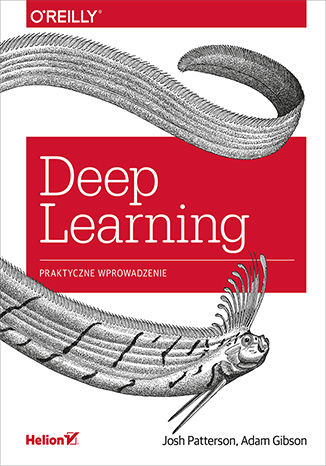
Deep Learning. Praktyczne wprowadzenie
Josh Patterson, Adam Gibson
Technologie wykorzystujące różne formy uczenia maszynowego zaczynają pojawiać się w różnych branżach. Możliwości w tym zakresie stale rosną, podobnie jak zainteresowanie i oczekiwania. Przed podjęciem decyzji o wdrożeniu w firmie tego rodzaju rozwiązań trzeba jednak zadać sobie pytanie, co można i co chciałoby się osiągnąć za pomocą sieci neuronowej. Generalnie uczenie maszynowe opiera się na algorytmach wyodrębniania informacji z surowych danych i reprezentowania ich jako modelu. Model ten następnie służy do przetwarzania kolejnych surowych danych. Co to jednak oznacza w praktyce i jak się implementuje takie algorytmy? Niniejsza książka jest przydatnym przewodnikiem po uczeniu maszynowym i sieciach neuronowych. Zawiera praktyczne informacje, które doceni każdy programista stawiający pierwsze kroki w tej dziedzinie. Przedstawiono tu podstawy deep learningu i wyjaśniono takie pojęcia, jak strojenie sieci, wielowątkowość, wektoryzowanie danych. Opisano, w jaki sposób można wykorzystać otwartą bibliotekę Deeplearning4j (DL4J) do kodowania profesjonalnych procesów uczenia głębokiego. Zaprezentowano metody i strategie trenowania sieci głębokich i uruchamiania procesów uczenia głębokiego w środowiskach Spark i Hadoop. Zagadnienia te zostały zilustrowane gotowymi do zastosowania, praktycznymi przykładami. W tej książce między innymi: ogólne koncepcje uczenia maszynowego, uczenia głębokiego i sieci neuronowych ewolucja sieci neuronowych do sieci głębokich i ich rodzaje dobieranie rodzaju sieci do analizowanego zagadnienia strojenie sieci neuronowych i sieci głębokich korzystanie z narzędzia DataVec do wektoryzowania danych różnych typów stosowanie biblioteki DL4J w środowiskach Spark i Hadoop Uczenie głębokie i sieci neuronowe: przyszłość, która dzieje się dziś!
Mike Bernico
Deep learning has become an essential necessity to enter the world of artificial intelligence. With this book deep learning techniques will become more accessible, practical, and relevant to practicing data scientists. It moves deep learning from academia to the real world through practical examples.You will learn how Tensor Board is used to monitor the training of deep neural networks and solve binary classification problems using deep learning. Readers will then learn to optimize hyperparameters in their deep learning models. The book then takes the readers through the practical implementation of training CNN's, RNN's, and LSTM's with word embeddings and seq2seq models from scratch. Later the book explores advanced topics such as Deep Q Network to solve an autonomous agent problem and how to use two adversarial networks to generate artificial images that appear real. For implementation purposes, we look at popular Python-based deep learning frameworks such as Keras and Tensorflow, Each chapter provides best practices and safe choices to help readers make the right decision while training deep neural networks.By the end of this book, you will be able to solve real-world problems quickly with deep neural networks.
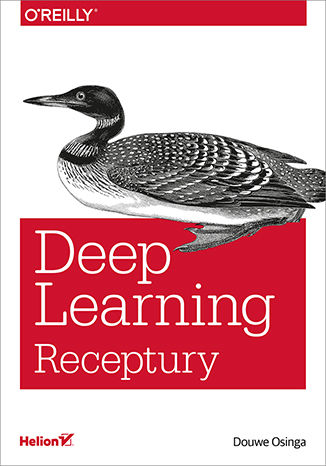
Douwe Osinga
Pomysł, by komputery wykorzystywać do generowania inteligentnych rozwiązań, narodził się w zamierzchłych dla informatyki czasach, mniej więcej w połowie XX wieku. Bardzo długo jednak idea ta - z powodu ograniczeń technologicznych - nie mogła wyjść poza rozważania teoretyczne. Dziś osoby zainteresowane uczeniem głębokim są w komfortowej sytuacji: mogą korzystać z ogólnie dostępnych frameworków uczenia głębokiego, sięgać po ogromne zbiory danych, a ponadto wyniki tego rodzaju badań znalazły się w centrum zainteresowania biznesu. Okazuje się, że nawet bez szczególnego przygotowania teoretycznego można budować i udoskonalać potężne modele sieci neuronowych oraz uczenia głębokiego i wdrażać je w konkretnych sytuacjach. Dzięki tej książce, nawet jeśli nie posiadasz zaawansowanej wiedzy o uczeniu głębokim (oryg. deep learning), zaczniesz szybko tworzyć rozwiązania z tego zakresu. Zamieszczone tu receptury pozwolą Ci sprawnie zaznajomić się z takimi zastosowaniami uczenia głębokiego jak klasyfikacja, generowanie tekstów, obrazów i muzyki. Cennym elementem książki są informacje o rozwiązywaniu problemów z sieciami neuronowymi - testowanie sieci wciąż jest trudnym zagadnieniem. Ponadto znalazły się w niej porady dotyczące pozyskiwania danych niezbędnych do trenowania sieci, a także receptury, dzięki którym łatwiej zacząć użytkować modele w środowiskach produkcyjnych. Z tej książki dowiesz się, jak: tworzyć użyteczne aplikacje, które docenią użytkownicy obliczać podobieństwo tekstów wizualizować wewnętrzny stan systemu sztucznej inteligencji napisać usługę odwrotnego wyszukiwania obrazów za pomocą wyuczonych sieci wykorzystać sieci GAN, autoenkodery i LSTM do generowania ikon wykrywać style w utworach muzycznych Uczenie głębokie - rzecz dla kreatywnych filozofów z myszą w dłoni!
Deep Learning. Uczenie głębokie z językiem Python. Sztuczna inteligencja i sieci neuronowe
Valentino Zocca, Gianmario Spacagna, Daniel Slater, Peter...
Na naszych oczach dokonuje się przełom: technologie wykorzystujące rozmaite formy sztucznej inteligencji zaczynają się pojawiać w różnych branżach. Niektórzy nawet nie zdają sobie sprawy, jak często i jak powszechnie stosuje się algorytmy uczenia głębokiego. Możliwości w tym zakresie stale rosną. Wzrasta też zapotrzebowanie na inżynierów, którzy swobodnie operują wiedzą o uczeniu głębokim i są w stanie zaimplementować potrzebne algorytmy w konkretnym oprogramowaniu. Uczenie głębokie jest jednak dość złożonym zagadnieniem, a przyswojenie sobie potrzebnych umiejętności wymaga wysiłku. Ta książka stanowi doskonałe wprowadzenie w temat uczenia głębokiego. Wyjaśniono tu najważniejsze pojęcia uczenia maszynowego. Pokazano, do czego mogą się przydać takie narzędzia jak pakiet scikit-learn, biblioteki Theano, Keras czy TensorFlow. Ten praktyczny przewodnik znakomicie ułatwi zrozumienie zagadnień rozpoznawania wzorców, dokładnego skalowania danych, pozwoli też na rzetelne zapoznanie się z algorytmami i technikami uczenia głębokiego. Autorzy zaproponowali wykorzystanie w powyższych celach języka Python - ulubionego narzędzia wielu badaczy i pasjonatów nauki. W książce między innymi: Solidne podstawy uczenia maszynowego i sieci neuronowych Trening systemów sztucznej inteligencji w grach komputerowych Rozpoznawanie obrazów Rekurencyjne sieci neuronowej w modelowaniu języka Budowa systemów wykrywania oszustw i włamań Uczenie głębokie: zajrzyj w przyszłość programowania! Dr Valentino Zokka opracował wiele algorytmów matematycznych i modeli prognostycznych dla firmy Boeing. Obecnie jest konsultantem w branży finansowej. Gianmario Spacagna pracuje w firmie Pirelli, gdzie buduje systemy maszynowego uczenia się i kompletne rozwiązania do produktów informacyjnych. Daniel Slater tworzył oprogramowanie do oceny ryzyka dla branży finansowej. Obecnie zajmuje się systemami do przetwarzania dużych ilości danych i analizy zachowań użytkowników. Peter Roelants specjalizuje się w stosowaniu technik uczenia głębokiego do badań spektralnych obrazów, rozpoznawania mowy czy ekstrakcji danych z dokumentów.
Mark Ryan
fastai is an easy-to-use deep learning framework built on top of PyTorch that lets you rapidly create complete deep learning solutions with as few as 10 lines of code. Both predominant low-level deep learning frameworks, TensorFlow and PyTorch, require a lot of code, even for straightforward applications. In contrast, fastai handles the messy details for you and lets you focus on applying deep learning to actually solve problems.The book begins by summarizing the value of fastai and showing you how to create a simple 'hello world' deep learning application with fastai. You'll then learn how to use fastai for all four application areas that the framework explicitly supports: tabular data, text data (NLP), recommender systems, and vision data. As you advance, you'll work through a series of practical examples that illustrate how to create real-world applications of each type. Next, you'll learn how to deploy fastai models, including creating a simple web application that predicts what object is depicted in an image. The book wraps up with an overview of the advanced features of fastai.By the end of this fastai book, you'll be able to create your own deep learning applications using fastai. You'll also have learned how to use fastai to prepare raw datasets, explore datasets, train deep learning models, and deploy trained models.
Deep Learning with Hadoop. Distributed Deep Learning with Large-Scale Data
Dipayan Dev
This book will teach you how to deploylarge-scale dataset in deep neural networks with Hadoop foroptimal performance.Starting with understanding what deeplearning is, and what the various modelsassociated with deep neural networks are, thisbook will then show you how to set up theHadoop environment for deep learning.In this book, you will also learn how toovercome the challenges that you facewhile implementing distributed deeplearning with large-scale unstructured datasets. The book willalso show you how you can implementand parallelize the widely used deep learning models such as Deep Belief Networks,Convolutional Neural Networks, Recurrent Neural Networks, Restricted Boltzmann machines and autoencoder using the popular deep learning library Deeplearning4j.Get in-depth mathematical explanationsand visual representations to helpyou understand the design and implementationsof Recurrent Neural network and Denoising Autoencoders withDeeplearning4j. To give you a morepractical perspective, the book will alsoteach you the implementation of large-scale video processing, image processing andnatural language processing on Hadoop.By the end of this book, you willknow how to deploy various deep neural networks indistributed systems using Hadoop.
Antonio Gulli, Sujit Pal
This book starts by introducing you to supervised learning algorithms such as simple linear regression, the classical multilayer perceptron and more sophisticated deep convolutional networks. You will also explore image processing with recognition of handwritten digit images, classification of images into different categories, and advanced objects recognition with related image annotations. An example of identification of salient points for face detection is also provided.Next you will be introduced to Recurrent Networks, which are optimized for processing sequence data such as text, audio or time series. Following that, you will learn about unsupervised learning algorithms such as Autoencoders and the very popular Generative Adversarial Networks (GANs). You will also explore non-traditional uses of neural networks as Style Transfer.Finally, you will look at reinforcement learning and its application to AI game playing, another popular direction of research and application of neural networks.
Willem Meints
Cognitive Toolkit is a very popular and recently open sourced deep learning toolkit by Microsoft. Cognitive Toolkit is used to train fast and effective deep learning models. This book will be a quick introduction to using Cognitive Toolkit and will teach you how to train and validate different types of neural networks, such as convolutional and recurrent neural networks.This book will help you understand the basics of deep learning. You will learn how to use Microsoft Cognitive Toolkit to build deep learning models and discover what makes this framework unique so that you know when to use it. This book will be a quick, no-nonsense introduction to the library and will teach you how to train different types of neural networks, such as convolutional neural networks, recurrent neural networks, autoencoders, and more, using Cognitive Toolkit. Then we will look at two scenarios in which deep learning can be used to enhance human capabilities. The book will also demonstrate how to evaluate your models' performance to ensure it trains and runs smoothly and gives you the most accurate results. Finally, you will get a short overview of how Cognitive Toolkit fits in to a DevOps environment
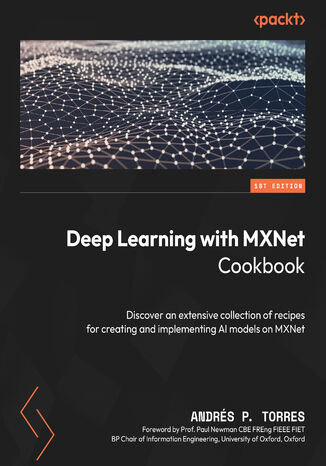
Andrés P. Torres, Paul Newman
Explore the capabilities of the open-source deep learning framework MXNet to train and deploy neural network models and implement state-of-the-art (SOTA) architectures in Computer Vision, natural language processing, and more. The Deep Learning with MXNet Cookbook is your gateway to constructing fast and scalable deep learning solutions using Apache MXNet.Starting with the different versions of MXNet, this book helps you choose the optimal version for your use and install your library. You’ll work with MXNet/Gluon libraries to solve classification and regression problems and gain insights into their inner workings. Venturing further, you’ll use MXNet to analyze toy datasets in the areas of numerical regression, data classification, picture classification, and text classification. From building and training deep-learning neural network architectures from scratch to delving into advanced concepts such as transfer learning, this book covers it all. You'll master the construction and deployment of neural network architectures, including CNN, RNN, LSTMs, and Transformers, and integrate these models into your applications.By the end of this deep learning book, you’ll wield the MXNet and Gluon libraries to expertly create and train deep learning networks using GPUs and deploy them in different environments.
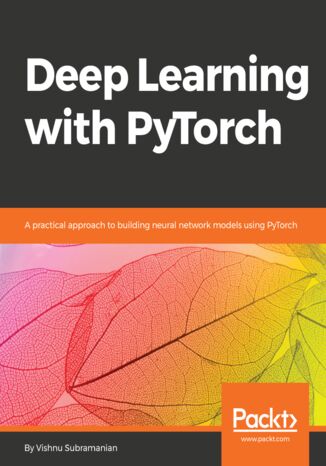
Deep Learning with PyTorch. A practical approach to building neural network models using PyTorch
Vishnu Subramanian
Deep learning powers the most intelligent systems in the world, such as Google Voice, Siri, and Alexa. Advancements in powerful hardware, such as GPUs, software frameworks such as PyTorch, Keras, TensorFlow, and CNTK along with the availability of big data have made it easier to implement solutions to problems in the areas of text, vision, and advanced analytics. This book will get you up and running with one of the most cutting-edge deep learning libraries—PyTorch. PyTorch is grabbing the attention of deep learning researchers and data science professionals due to its accessibility, efficiency and being more native to Python way of development. You'll start off by installing PyTorch, then quickly move on to learn various fundamental blocks that power modern deep learning. You will also learn how to use CNN, RNN, LSTM and other networks to solve real-world problems. This book explains the concepts of various state-of-the-art deep learning architectures, such as ResNet, DenseNet, Inception, and Seq2Seq, without diving deep into the math behind them. You will also learn about GPU computing during the course of the book. You will see how to train a model with PyTorch and dive into complex neural networks such as generative networks for producing text and images. By the end of the book, you'll be able to implement deep learning applications in PyTorch with ease.
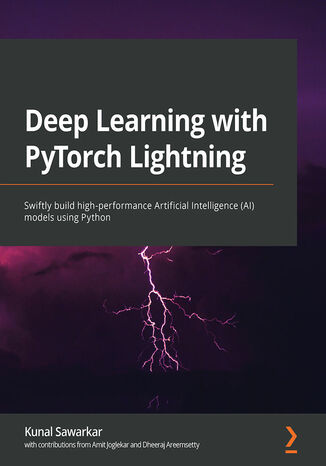
Kunal Sawarkar, Dheeraj Arremsetty
Building and implementing deep learning (DL) is becoming a key skill for those who want to be at the forefront of progress.But with so much information and complex study materials out there, getting started with DL can feel quite overwhelming.Written by an AI thought leader, Deep Learning with PyTorch Lightning helps researchers build their first DL models quickly and easily without getting stuck on the complexities. With its help, you’ll be able to maximize productivity for DL projects while ensuring full flexibility – from model formulation to implementation.Throughout this book, you’ll learn how to configure PyTorch Lightning on a cloud platform, understand the architectural components, and explore how they are configured to build various industry solutions. You’ll build a neural network architecture, deploy an application from scratch, and see how you can expand it based on your specific needs, beyond what the framework can provide.In the later chapters, you’ll also learn how to implement capabilities to build and train various models like Convolutional Neural Nets (CNN), Natural Language Processing (NLP), Time Series, Self-Supervised Learning, Semi-Supervised Learning, Generative Adversarial Network (GAN) using PyTorch Lightning.By the end of this book, you’ll be able to build and deploy DL models with confidence.
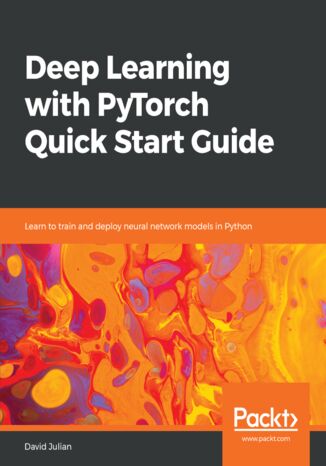
David Julian
PyTorch is extremely powerful and yet easy to learn. It provides advanced features, such as supporting multiprocessor, distributed, and parallel computation. This book is an excellent entry point for those wanting to explore deep learning with PyTorch to harness its power. This book will introduce you to the PyTorch deep learning library and teach you how to train deep learning models without any hassle. We will set up the deep learning environment using PyTorch, and then train and deploy different types of deep learning models, such as CNN, RNN, and autoencoders. You will learn how to optimize models by tuning hyperparameters and how to use PyTorch in multiprocessor and distributed environments. We will discuss long short-term memory network (LSTMs) and build a language model to predict text.By the end of this book, you will be familiar with PyTorch's capabilities and be able to utilize the library to train your neural networks with relative ease.
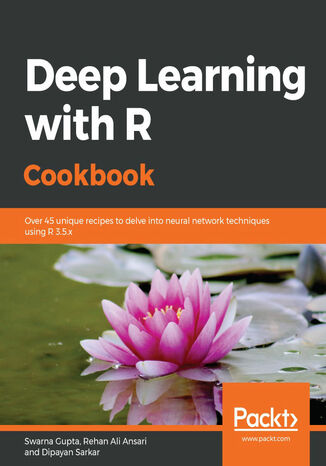
Swarna Gupta, Rehan Ali Ansari, Dipayan Sarkar
Deep learning (DL) has evolved in recent years with developments such as generative adversarial networks (GANs), variational autoencoders (VAEs), and deep reinforcement learning. This book will get you up and running with R 3.5.x to help you implement DL techniques.The book starts with the various DL techniques that you can implement in your apps. A unique set of recipes will help you solve binomial and multinomial classification problems, and perform regression and hyperparameter optimization. To help you gain hands-on experience of concepts, the book features recipes for implementing convolutional neural networks (CNNs), recurrent neural networks (RNNs), and Long short-term memory (LSTMs) networks, as well as sequence-to-sequence models and reinforcement learning. You’ll then learn about high-performance computation using GPUs, along with learning about parallel computation capabilities in R. Later, you’ll explore libraries, such as MXNet, that are designed for GPU computing and state-of-the-art DL. Finally, you’ll discover how to solve different problems in NLP, object detection, and action identification, before understanding how to use pre-trained models in DL apps.By the end of this book, you’ll have comprehensive knowledge of DL and DL packages, and be able to develop effective solutions for different DL problems.
Mark Hodnett, Joshua F. Wiley, Yuxi (Hayden)...
Deep learning has a range of practical applications in several domains, while R is the preferred language for designing and deploying deep learning models.This Learning Path introduces you to the basics of deep learning and even teaches you to build a neural network model from scratch. As you make your way through the chapters, you’ll explore deep learning libraries and understand how to create deep learning models for a variety of challenges, right from anomaly detection to recommendation systems. The Learning Path will then help you cover advanced topics, such as generative adversarial networks (GANs), transfer learning, and large-scale deep learning in the cloud, in addition to model optimization, overfitting, and data augmentation. Through real-world projects, you’ll also get up to speed with training convolutional neural networks (CNNs), recurrent neural networks (RNNs), and long short-term memory networks (LSTMs) in R.By the end of this Learning Path, you’ll be well-versed with deep learning and have the skills you need to implement a number of deep learning concepts in your research work or projects.
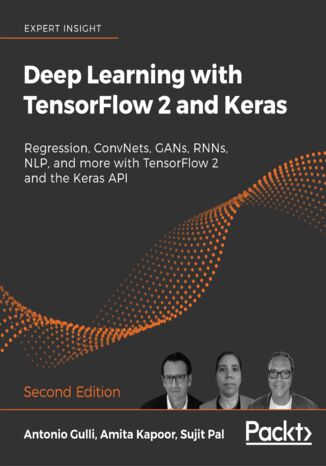
Antonio Gulli, Dr. Amita Kapoor, Sujit Pal
Deep Learning with TensorFlow 2 and Keras, Second Edition teaches neural networks and deep learning techniques alongside TensorFlow (TF) and Keras. You’ll learn how to write deep learning applications in the most powerful, popular, and scalable machine learning stack available.TensorFlow is the machine learning library of choice for professional applications, while Keras offers a simple and powerful Python API for accessing TensorFlow. TensorFlow 2 provides full Keras integration, making advanced machine learning easier and more convenient than ever before.This book also introduces neural networks with TensorFlow, runs through the main applications (regression, ConvNets (CNNs), GANs, RNNs, NLP), covers two working example apps, and then dives into TF in production, TF mobile, and using TensorFlow with AutoML.
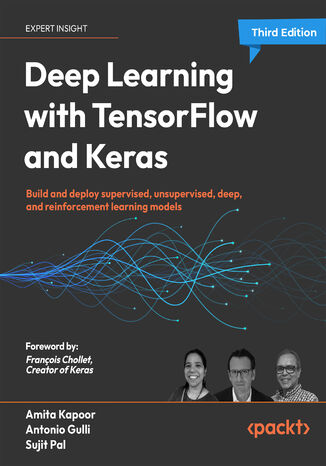
Dr. Amita Kapoor, Antonio Gulli, Sujit Pal
Deep Learning with TensorFlow and Keras teaches you neural networks and deep learning techniques using TensorFlow (TF) and Keras. You'll learn how to write deep learning applications in the most powerful, popular, and scalable machine learning stack available.TensorFlow 2.x focuses on simplicity and ease of use, with updates like eager execution, intuitive higher-level APIs based on Keras, and flexible model building on any platform. This book uses the latest TF 2.0 features and libraries to present an overview of supervised and unsupervised machine learning models and provides a comprehensive analysis of deep learning and reinforcement learning models using practical examples for the cloud, mobile, and large production environments.This book also shows you how to create neural networks with TensorFlow, runs through popular algorithms (regression, convolutional neural networks (CNNs), transformers, generative adversarial networks (GANs), recurrent neural networks (RNNs), natural language processing (NLP), and graph neural networks (GNNs)), covers working example apps, and then dives into TF in production, TF mobile, and TensorFlow with AutoML.
Giancarlo Zaccone, Vihan Jain, Md. Rezaul Karim,...
Deep learning is a branch of machine learning algorithms based on learning multiple levels of abstraction. Neural networks, which are at the core of deep learning, are being used in predictive analytics, computer vision, natural language processing, time series forecasting, and to perform a myriad of other complex tasks.This book is conceived for developers, data analysts, machine learning practitioners and deep learning enthusiasts who want to build powerful, robust, and accurate predictive models with the power of TensorFlow, combined with other open source Python libraries. Throughout the book, you’ll learn how to develop deep learning applications for machine learning systems using Feedforward Neural Networks, Convolutional Neural Networks, Recurrent Neural Networks, Autoencoders, and Factorization Machines. Discover how to attain deep learning programming on GPU in a distributed way.You'll come away with an in-depth knowledge of machine learning techniques and the skills to apply them to real-world projects.
Deep Learning with TensorFlow. Explore neural networks with Python
Giancarlo Zaccone, Fabrizio Milo, Md. Rezaul Karim
Deep learning is the step that comes after machine learning, and has more advancedimplementations. Machine learning is not just for academics anymore, but is becoming a mainstream practice through wide adoption, and deep learning has taken the front seat. As a data scientist, if you want to explore data abstraction layers, this book will be your guide. This book shows how this can be exploited in the real world with complex raw data using TensorFlow 1.x.Throughout the book, you’ll learn how to implement deep learning algorithms for machine learning systems and integrate them into your product offerings, includingsearch, image recognition, and language processing. Additionally, you’ll learn howto analyze and improve the performance of deep learning models. This can be done bycomparing algorithms against benchmarks, along with machine intelligence, to learnfrom the information and determine ideal behaviors within a specific context.After finishing the book, you will be familiar with machine learning techniques, in particular the use of TensorFlow for deep learning, and will be ready to apply your knowledge to research or commercial projects.
Deep Learning with Theano. Perform large-scale numerical and scientific computations efficiently
Christopher Bourez
This book offers a complete overview of Deep Learning with Theano, a Python-based library that makes optimizing numerical expressions and deep learning models easy on CPU or GPU.The book provides some practical code examples that help the beginner understand how easy it is to build complex neural networks, while more experimented data scientists will appreciate the reach of the book, addressing supervised and unsupervised learning, generative models, reinforcement learning in the fields of image recognition, natural language processing, or game strategy.The book also discusses image recognition tasks that range from simple digit recognition, image classification, object localization, image segmentation, to image captioning. Natural language processing examples include text generation, chatbots, machine translation, and question answering. The last example deals with generating random data that looks real and solving games such as in the Open-AI gym. At the end, this book sums up the best -performing nets for each task. While early research results were based on deep stacks of neural layers, in particular, convolutional layers, the book presents the principles that improved the efficiency of these architectures, in order to help the reader build new custom nets.
Rowel Atienza
Oto propozycja dla specjalistów zajmujących się programowaniem sztucznej inteligencji i studentów kształcących się w tej dziedzinie. Autor przybliża tajniki tworzenia sieci neuronowych stosowanych w uczeniu głębokim i pokazuje, w jaki sposób używać w tym celu bibliotek Keras i TensorFlow. Objaśnia zagadnienia dotyczące programowania AI zarówno w teorii, jak i praktyce. Liczne przykłady, czytelna oprawa graficzna i logiczne wywody sprawiają, że to skuteczne narzędzie dla każdego, kto chce się nauczyć budowania sieci neuronowych typu MLP, CNN i RNN. Książka wprowadza w teoretyczne fundamenty uczenia głębokiego - znalazły się w niej wyjaśnienia podstawowych pojęć związanych z tą dziedziną i różnice pomiędzy poszczególnymi typami sieci neuronowych. Opisano tutaj również metody programowania algorytmów używanych w uczeniu głębokim i sposoby ich wdrażania. Dzięki lekturze lepiej zrozumiesz sieci neuronowe, nauczysz się ich tworzenia i zastosowania w różnych projektach z zakresu AI. Polecamy tę książkę każdemu, kto: chce zrozumieć, jak działają sieci neuronowe i w jaki sposób się je tworzy specjalizuje się w uczeniu głębokim lub zamierza lepiej poznać tę dziedzinę posługuje się sieciami neuronowymi w programowaniu chce się nauczyć stosować biblioteki Keras i TensorFlow w uczeniu głębokim
Reinier van Altena
This practical guide on no-code development with Betty Blocks will take you through the different features, no-code functionalities, and capabilities of the Betty Blocks platform using real-world use cases. The book will equip you with the tools to develop business apps based on various data models, business processes, and more.You’ll begin with an introduction to the basic concepts of the Betty Blocks no-code platform, such as developing IT solutions on various use cases including reporting apps, data tracking apps, workflows, and business processes. After getting to grips with the basics, you’ll explore advanced concepts such as building powerful applications that impact the business straight away with no-code application development and quickly creating prototypes. The concluding chapters will help you get a solid understanding of rapid application development, building customer portals, building dynamic web apps, drag-and-drop front ends, visual modelling capabilities, and complex data models.By the end of this book, you’ll have gained a comprehensive understanding of building your own applications as a citizen developer using the Betty Blocks no-code platform.
Fanny Ip, Jeremiah Crowley
Artificial intelligence (AI) enables enterprises to optimize business processes that are probabilistic, highly variable, and require cognitive abilities with unstructured data. Many believe there is a steep learning curve with AI, however, the goal of our book is to lower the barrier to using AI. This practical guide to AI with UiPath will help RPA developers and tech-savvy business users learn how to incorporate cognitive abilities into business process optimization. With the hands-on approach of this book, you'll quickly be on your way to implementing cognitive automation to solve everyday business problems.Complete with step-by-step explanations of essential concepts, practical examples, and self-assessment questions, this book will help you understand the power of AI and give you an overview of the relevant out-of-the-box models. You’ll learn about cognitive AI in the context of RPA, the basics of machine learning, and how to apply cognitive automation within the development lifecycle. You’ll then put your skills to test by building three use cases with UiPath Document Understanding, UiPath AI Center, and Druid.By the end of this AI book, you'll be able to build UiPath automations with the cognitive capabilities of intelligent document processing, machine learning, and chatbots, while understanding the development lifecycle.
Govindakumar Madhavan
Beginning with basic concepts like central tendency, dispersion, and types of distribution, this course will help you build a robust understanding of data analysis. It progresses to more advanced topics, including hypothesis testing, outliers, and the intricacies of dependent versus independent variables, ensuring you grasp the statistical tools necessary for data-driven decision-making.Moving ahead, you'll explore the mathematical frameworks crucial for machine learning algorithms. Learn about the significance of percentiles, the distinction between population and sample, and the vital role of precision versus accuracy in data science. Chapters on linear algebra and regression will enhance your ability to implement and interpret complex models, while practical lessons on measuring algorithm accuracy and understanding key machine learning concepts will round out your expertise.The course culminates with an in-depth look at specific machine learning techniques such as decision trees, k-nearest neighbors (kNN), and gradient descent. Each chapter builds on the last, guiding you through a logical progression of knowledge and skills. By the end, you will have not only mastered the theoretical aspects but also gained practical insights into applying these techniques in real-world scenarios.
Developer, Advocate!. Conversations on turning a passion for talking about tech into a career
Geertjan Wielenga
What exactly is a developer advocate, and how do they connect developers and companies around the world? Why is the area of developer relations set to explode? Can anybody with a passion for tech become a developer advocate? What are the keys to success on a global scale? How does a developer advocate maintain authenticity when balancing the needs of their company and their tech community? What are the hot topics in areas including Java, JavaScript, tech for good, artificial intelligence, blockchain, the cloud, and open source?These are just a few of the questions addressed by developer advocate and author Geertjan Wielenga in Developer, Advocate!. 32 of the industry's most prominent developer advocates, from companies including Oracle, Microsoft, Google, and Amazon, open up about what it's like to turn a lifelong passion for knowledge sharing about tech into a rewarding career. These advocates run the gamut from working at large software vendors to small start-ups, along with independent developer advocates who work within organizations or for themselves.In Developer, Advocate!, readers will see how developer advocates are actively changing the world, not only for developers, but for individuals and companies navigating the fast-changing tech landscape. More importantly, Developer, Advocate! serves as a rallying cry to inspire and motivate tech enthusiasts and burgeoning developer advocates to get started and take their first steps within their tech community.