
Inne
W dziale Inne znajdziecie książki dotyczące projektowania hurtowni danych. Poznacie pozostałe technologie bazodanowe typu InterBase czy Visual Fox Pro oraz rozszerzenie LINQ do Microsoft .NET framwork, które umożliwia natywną komunikacje z bazami danych. Zapoznacie się z Transact SQL, odmianą języka SQL, używaną przez Microsoft. Dzięki publikacjom omawiającym języki programowania Delphi czy C++ wraz z ich zintegrowanymi środowiskami programistycznymi (IDE), nauczycie się modelować, programować, zarządzać relacyjnymi bazami danych, archiwizować i odzyskiwać dane oraz przetwarzać i raportować wyniki.
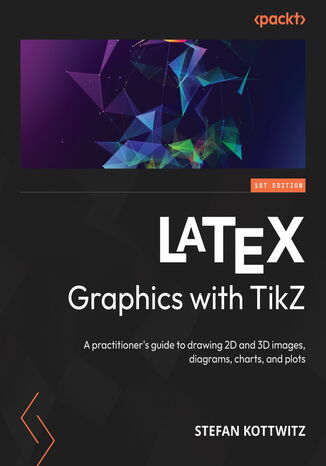
Stefan Kottwitz
In this first-of-its-kind TikZ book, you’ll embark on a journey to discover the fascinating realm of TikZ—what it’s about, the philosophy behind it, and what sets it apart from other graphics libraries. From installation procedures to the intricacies of its syntax, this comprehensive guide will help you use TikZ to create flawless graphics to captivate your audience in theses, articles, or books.You’ll learn all the details starting with drawing nodes, edges, and arrows and arranging them with perfect alignment. As you explore advanced features, you’ll gain proficiency in using colors and transparency for filling and shading, and clipping image parts. You’ll learn to define TikZ styles and work with coordinate calculations and transformations.That’s not all! You’ll work with layers, overlays, absolute positioning, and adding special decorations and take it a step further using add-on packages for drawing diagrams, charts, and plots.By the end of this TikZ book, you’ll have mastered the finer details of image creation, enabling you to achieve visually stunning graphics with great precision.
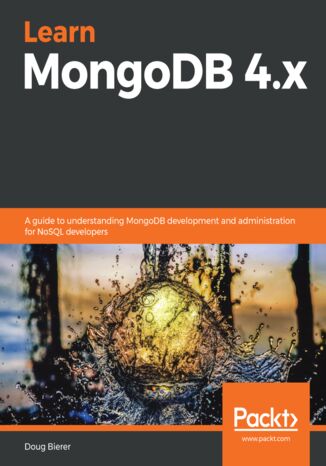
Doug Bierer
When it comes to managing a high volume of unstructured and non-relational datasets, MongoDB is the defacto database management system (DBMS) for DBAs and data architects. This updated book includes the latest release and covers every feature in MongoDB 4.x, while helping you get hands-on with building a MongoDB database app.You’ll get to grips with MongoDB 4.x concepts such as indexes, database design, data modeling, authentication, and aggregation. As you progress, you’ll cover tasks such as performing routine operations when developing a dynamic database-driven website. Using examples, you’ll learn how to work with queries and regular database operations. The book will not only guide you through design and implementation, but also help you monitor operations to achieve optimal performance and secure your MongoDB database systems. You’ll also be introduced to advanced techniques such as aggregation, map-reduce, complex queries, and generating ad hoc financial reports on the fly. Later, the book shows you how to work with multiple collections as well as embedded arrays and documents, before finally exploring key topics such as replication, sharding, and security using practical examples.By the end of this book, you’ll be well-versed with MongoDB 4.x and be able to perform development and administrative tasks associated with this NoSQL database.
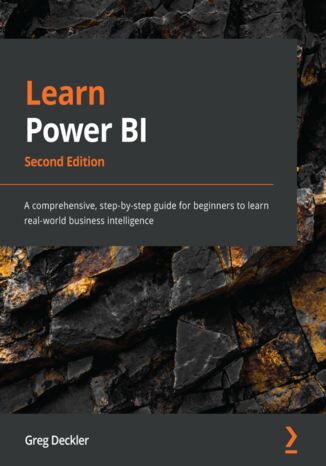
Greg Deckler
To succeed in today's transforming business world, organizations need business intelligence capabilities to make smarter decisions faster than ever before. This updated second edition of Learn Power BI takes you on a journey of data exploration and discovery, using Microsoft Power BI to ingest, cleanse, and organize data in order to unlock key business insights that can then be shared with others.This newly revised and expanded edition of Learn Power BI covers all of the latest features and interface changes and takes you through the fundamentals of business intelligence projects, how to deploy, adopt, and govern Power BI within your organization, and how to leverage your knowledge in the marketplace and broader ecosystem that is Power BI. As you progress, you will learn how to ingest, cleanse, and transform your data into stunning visualizations, reports, and dashboards that speak to business decision-makers.By the end of this Power BI book, you will be fully prepared to be the data analysis hero of your organization – or even start a new career as a business intelligence professional.
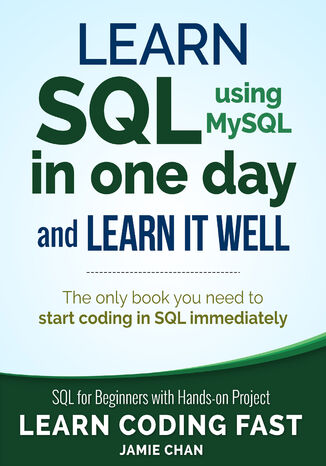
Learn SQL using MySQL in One Day and Learn It Well. SQL for beginners with Hands-on Project
Jamie Chan
Learn SQL (using MySQL) in One Day and Learn It Well is the ultimate guide for beginners aiming to grasp the complexities of SQL through hands-on learning. Starting with an introduction to the essence of databases, this book methodically advances through defining and manipulating tables, mastering data insertion, updates, deletions, and executing sophisticated data selection techniques across its comprehensive chapters. It further explores the creation and utility of views, the implementation of triggers to automate database responses, and the intricacies of variables, stored routines, control flow tools, and cursors, culminating in a capstone project that brings all concepts together.Culminating in a project , this book offers a unique opportunity to apply all the learned concepts in a practical, real-world scenario, reinforcing the skills and knowledge acquired throughout the chapters. The appendices provide additional resources including table definitions for practical exercises modeled on real-world scenarios.Embark on a learning journey that transitions you from novice to proficient in managing and querying databases with MySQL, empowering you with the skills to tackle real-world data challenges.
Learning Couchbase. Design documents and implement real world e-commerce applications with Couchbase
Henry Potsangbam
This book achieves its goal by taking up an end-to-end development structure, right from understanding NOSQL document design to implementing full fledged eCommerce application design using Couchbase as a backend. Starting with the architecture of Couchbase to get you up and running, this book quickly takes you through designing a NoSQL document and implementing highly scalable applications using Java API. You will then be introduced to document design and get to know the various ways to administer Couchbase. Followed by this, learn to store documents using bucket. Moving on, you will then learn to store, retrieve and delete documents using smart client base on Java API. You will then retrieve documents using SQL like syntax call N1QL. Next, you will learn how to write map reduce base views. Finally, you will configure XDCR for disaster recovery and implement an eCommerce application using Couchbase.
Saurabh Chhajed
The ELK stack—Elasticsearch, Logstash, and Kibana, is a powerful combination of open source tools. Elasticsearch is for deep search and data analytics. Logstash is for centralized logging, log enrichment, and parsing. Kibana is for powerful and beautiful data visualizations. In short, the Elasticsearch ELK stack makes searching and analyzing data easier than ever before.This book will introduce you to the ELK (Elasticsearch, Logstash, and Kibana) stack, starting by showing you how to set up the stack by installing the tools, and basic configuration. You’ll move on to building a basic data pipeline using the ELK stack.Next, you’ll explore the key features of Logstash and its role in the ELK stack, including creating Logstash plugins, which will enable you to use your own customized plugins. The importance of Elasticsearch and Kibana in the ELK stack is also covered, along with various types of advanced data analysis, and a variety of charts, tables ,and maps.Finally, by the end of the book you will be able to develop full-fledged data pipeline using the ELK stack and have a solid understanding of the role of each of the components.
Salahaldin Juba, Achim Vannahme, Andrey Volkov
PostgreSQL is one of the most powerful and easy to use database management systems. It supports the most advanced features included in SQL standards. The book starts with the introduction of relational databases with PostegreSQL. It then moves on to covering data definition language (DDL) with emphasis on PostgreSQL and common DDL commands supported by ANSI SQL. You will then learn the data manipulation language (DML), and advanced topics like locking and multi version concurrency control (MVCC). This will give you a very robust background to tune and troubleshoot your application. The book then covers the implementation of data models in the database such as creating tables, setting up integrity constraints, building indexes, defining views and other schema objects. Next, it will give you an overview about the NoSQL capabilities of PostgreSQL along with Hstore, XML, Json and arrays. Finally by the end of the book, you'll learn to use the JDBC driver and manipulate data objects in the Hibernate framework.
Eric Mayor
This book is packed with easy-to-follow guidelines that explain the workings of the many key data mining tools of R, which are used to discover knowledge from your data.You will learn how to perform key predictive analytics tasks using R, such as train and test predictive models for classification and regression tasks, score new data sets and so on. All chapters will guide you in acquiring the skills in a practical way. Most chapters also include a theoretical introduction that will sharpen your understanding of the subject matter and invite you to go further.The book familiarizes you with the most common data mining tools of R, such as k-means, hierarchical regression, linear regression, association rules, principal component analysis, multilevel modeling, k-NN, Naïve Bayes, decision trees, and text mining. It also provides a description of visualization techniques using the basic visualization tools of R as well as lattice for visualizing patterns in data organized in groups. This book is invaluable for anyone fascinated by the data mining opportunities offered by GNU R and its packages.