
Ochrona danych osobowych
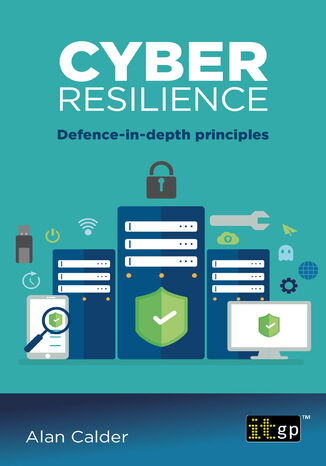
Cyber Resilience. A Comprehensive Guide to Understanding and Implementing Cybersecurity Principles
IT Governance Publishing, Alan Calder
In today’s rapidly evolving digital landscape, cybersecurity is essential for protecting organizations from cyber threats. This book provides a thorough guide to building cyber resilience, starting with an in-depth understanding of the ever-changing cyber threat landscape. It covers foundational principles such as risk management, security controls, and defense-in-depth strategies, giving readers the knowledge needed to secure digital systems effectively.The book then delves into actionable cybersecurity controls, offering insights on asset management, identity and access control, encryption, and incident response management. Each section includes practical tips for implementation, ensuring that readers can apply these strategies in real-world scenarios. The goal is to help organizations not only understand cybersecurity but also to establish robust security policies and protocols to prevent and mitigate potential risks.Finally, the book emphasizes the importance of continual improvement and monitoring to maintain a resilient cybersecurity framework. It highlights the need for regular audits, vulnerability scanning, and staff training to adapt to new threats. By the end, readers will be equipped to build and sustain a resilient cybersecurity strategy that ensures long-term protection and business continuity.
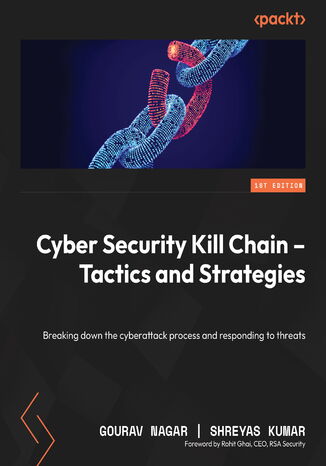
Gourav Nagar, Shreyas Kumar, Rohit Ghai
Gain a strategic edge in cybersecurity by mastering the systematic approach to identifying and responding to cyber threats through a detailed exploration of the cyber kill chain framework. This guide walks you through each stage of the attack, from reconnaissance and weaponization to exploitation, command and control (C2), and actions on objectives. Written by cybersecurity leaders Gourav Nagar, Director of Information Security at BILL Holdings, with prior experience at Uber and Apple, and Shreyas Kumar, Professor of Practice at Texas A&M, and former expert at Adobe and Oracle, this book helps enhance your cybersecurity posture. You’ll gain insight into the role of threat intelligence in boosting the cyber kill chain, explore the practical applications of the framework in real-world scenarios, and see how AI and machine learning are revolutionizing threat detection. You’ll also learn future-proofing strategies and get ready to counter sophisticated threats like supply chain attacks and living-off-the-land attacks, and the implications of quantum computing on cybersecurity.By the end of this book, you’ll have gained the strategic understanding and skills needed to protect your organization's digital infrastructure in the ever-evolving landscape of cybersecurity.*Email sign-up and proof of purchase required.
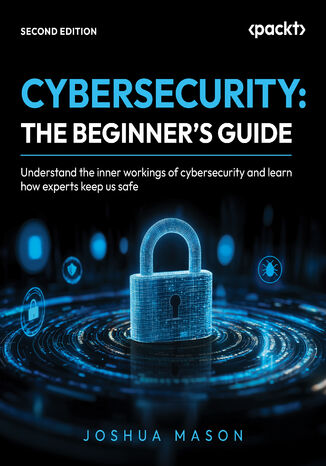
Joshua Mason
In today’s increasingly connected world, cybersecurity touches every aspect of our lives, yet it remains a mystery to most. This beginner’s guide pulls back the curtain on how cybersecurity really works, revealing what professionals do to keep us safe. Learn how cyber threats emerge, how experts counter them, and what you can do to protect yourself online.Perfect for business leaders, tech enthusiasts, and anyone curious about digital security, this book delivers insider knowledge without the jargon. This edition also explores cybersecurity careers, AI/ML in cybersecurity, and essential skills that apply in both personal and professional contexts.Air Force pilot turned cybersecurity leader Joshua Mason shares hard-won insights from his unique journey, drawing on years of training teams and advising organizations worldwide. He walks you through the tools and strategies used by professionals, showing how expert practices translate into real-world protection. With up-to-date information of the latest threats and defenses, this cybersecurity book is both an informative read and a practical guide to staying secure in the digital age.*Email sign-up and proof of purchase required.
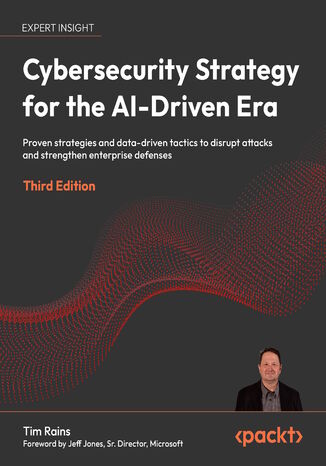
Tim Rains, Jeff Jones
Designing a cybersecurity strategy that actually works is difficult when threats evolve faster than budgets, teams, and tools. This book helps security leaders cut through noise by focusing on how organizations are compromised, which strategies succeed, and how to measure outcomes.Written by Tim Rains, a former Global Chief Security Advisor at Microsoft and senior security leader at AWS and Fortune-scale enterprises, this edition expands on the previous editions with major updates and new chapters. You will learn how threat intelligence, attack-centric security, intrusion kill chains, and MITRE ATT&CK can help defenders design stronger strategies.New and expanded content covers ransomware, API security, “living off the land” attacks, resilience as a cybersecurity strategy, and the security of AI systems alongside practical guidance on using AI to improve security outcomes. This book takes a practical, evidence-based approach to cybersecurity strategy, helping you assess trade-offs, avoid costly missteps, and communicate clearly with executives and boards.By the end of this book, you’ll be able to evaluate cybersecurity strategies more effectively, improve enterprise defenses, and communicate security priorities clearly to executives and boards.
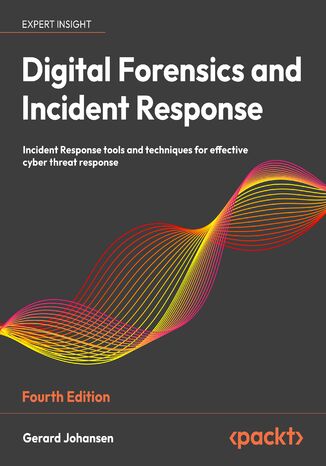
Gerard Johansen
Embark on a journey into the forefront of cyber defense with Digital Forensics and Incident Response, 4th Edition. This guide is your gateway to mastering the sophisticated techniques and methodologies essential for tackling today’s cyber threats. Authored by leading cybersecurity expert Gerard Johansen, this book provides an insider's look at the cutting-edge tools and innovative strategies needed to prevent, detect, and respond to digital vulnerabilities. With its focus on practical applications and up-to-date examples, it equips you with the skills to develop and refine robust digital forensic capabilities within your organizationThe fourth edition goes beyond traditional approaches by integrating the latest advancements in cloud technology and machine learning, offering a comprehensive look at how these technologies can enhance forensic practices. Dive into the nuances of deploying scalable incident response strategies, using open-source tools for effective threat hunting, and applying ML/AI to uncover and counteract emerging cyber threats. Each chapter is designed to build your proficiency in handling real-world challenges, making you indispensable in your fieldBy the end of the book, you will be well-versed in the various tasks and techniques associated with incident response.
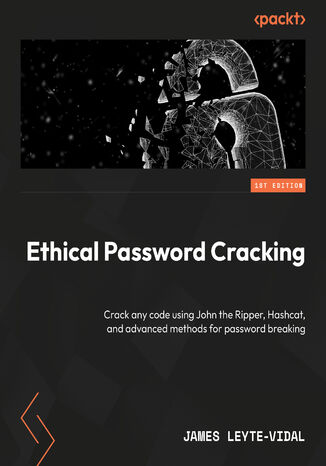
James Leyte-Vidal
Whether you’re looking to crack passwords as part of a thorough security audit or aiming to recover vital information, this book will equip you with the skills to accomplish your goals. Written by a cybersecurity expert with over fifteen years of experience in penetration testing, Ethical Password Cracking offers a thorough understanding of password protection and the correct approach to retrieving password-protected data.As you progress through the chapters, you first familiarize yourself with how credentials are stored, delving briefly into the math behind password cracking. Then, the book will take you through various tools and techniques to help you recover desired passwords before focusing on common cracking use cases, hash recovery, and cracking. Real-life examples will prompt you to explore brute-force versus dictionary-based approaches and teach you how to apply them to various types of credential storage.By the end of this book, you'll understand how passwords are protected and how to crack the most common credential types with ease.
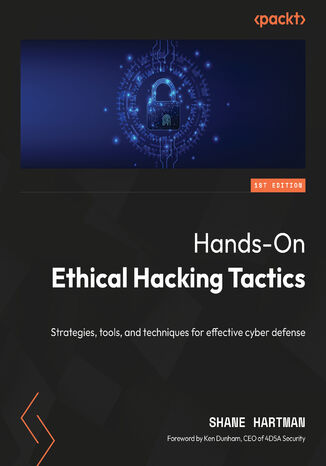
Hands-On Ethical Hacking Tactics. Strategies, tools, and techniques for effective cyber defense
Shane Hartman, Ken Dunham
If you’re an ethical hacker looking to boost your digital defenses and stay up to date with the evolving cybersecurity landscape, then this book is for you. Hands-On Ethical Hacking Tactics is a comprehensive guide that will take you from fundamental to advanced levels of ethical hacking, offering insights into both offensive and defensive techniques. Written by a seasoned professional with 20+ years of experience, this book covers attack tools, methodologies, and procedures, helping you enhance your skills in securing and defending networks.The book starts with foundational concepts such as footprinting, reconnaissance, scanning, enumeration, vulnerability assessment, and threat modeling. Next, you’ll progress to using specific tools and procedures for hacking Windows, Unix, web servers, applications, and databases. The book also gets you up to speed with malware analysis. Throughout the book, you’ll experience a smooth transition from theoretical concepts to hands-on techniques using various platforms. Finally, you’ll explore incident response, threat hunting, social engineering, IoT hacking, and cloud exploitation, which will help you address the complex aspects of ethical hacking.By the end of this book, you’ll have gained the skills you need to navigate the ever-changing world of cybersecurity.
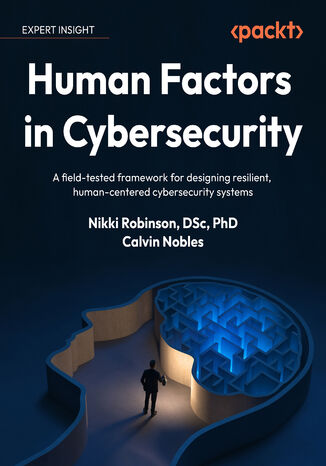
Nikki Robinson, Calvin Nobles, Chris Cochran
Cybersecurity isn’t just a technical problem; it’s a human one. Human Factors in Cybersecurity equips you to tackle today’s digital threats by designing systems that respect how cybersecurity professionals actually think, behave, and make decisions.Despite billions spent on advanced technologies, human behavior remains cybersecurity’s greatest vulnerability. This book shows how to design defenses that work with people, not against them. Blending cybersecurity operations expertise with human factors science, it reveals that security failures are not inevitable. They’re design failures. Inside, you’ll learn how to shift from user-blaming policies to human-centered security engineering. Discover how to predict and influence user behavior, design controls that support cognitive realities, and embed human factors strategies at scale. Through actionable frameworks, real-world examples, and clear guidance, you will learn to reduce errors, build trust, and design systems resilient to human limitations.Authored by experts in cybersecurity, machine learning, and human factors engineering, this book delivers the interdisciplinary insight needed to lead the shift toward systems that are not only secure but genuinely usable. It transforms human factors from cybersecurity’s biggest blind spot into its most powerful driver of resilience.