
Informatyka
Zajrzyj do kategorii Informatyka w księgarni internetowej Ebookpoint. Znajdziesz tutaj bestsellerowe książki, ebooki i kursy video z branży IT. Sięgnij po najlepszą literaturę dla specjalistów i rozwijaj doświadczenie, które już posiadasz, lub rozpocznij swoją przygodę z programowaniem, cyberbezpieczeństwem lub grafiką komputerową. Pogłębiaj swoją wiedzę tak, jak Ci wygodnie - z tradycyjną książką, wygodnym ebookiem lub nowoczesnym videokursem. Sprawdź, jakie tytuły znajdziesz w kategorii Informatyka!
Amit Malik
Windows Azure Pack is an on-premises cloud solution by Microsoft, which can be leveraged by Organizations and Services providers for building an enterprise class cloud solution. WAP provides consistent experience to Microsoft Azure, along with capabilities such as multi-tenancy, high density, self-service, automated. WAP can be leveraged to provide both IaaS & PaaS Offerings to internal and external customers. In this book, we will learn about planning and deployment of Cloud Fabric for Windows Azure Pack, Azure Pack components, VM Clouds and IaaS offerings, PaaS Offering including WebSites & Service Bus, DBaaS offerings, Automation with SMA, and extending capabilities with third party products integration and tenant experience for all services.
Tim O'Brien
Learn how to build GenAI applications using proven software engineering patterns instead of rapidly changing frameworks. This book helps engineers build secure, scalable agentic systems with familiar tools and practical, engineer-to-engineer architectural guidance.You will connect GenAI concepts such as agentic workflows, embeddings, and vector databases to enterprise patterns, including components, adapters, and microarchitectures. Established GoF and enterprise design patterns help explain agentic behavior and system design, enabling you to reason about architecture rather than memorize tools. The book also shows you how to generate multi-agent and GenAI patterns as RabbitMQ configurations for scalable orchestration and communication.Using language-agnostic examples and widely used messaging, orchestration, and data technologies, you will build production-ready systems that integrate with existing infrastructure without unnecessary complexity. You will also use our Topologos prompt to build, modify, and test deploy-ready multi-agent systems quickly while improving robustness and maintainability.By the end of this book, you will be able to design reliable GenAI systems, make informed architectural decisions, and adapt confidently as tools and frameworks evolve.*Email sign-up and proof of purchase required
David Millán Escrivá, Prateek Joshi, Vinícius G....
OpenCV is one of the best open source libraries available and can help you focus on constructing complete projects on image processing, motion detection, and image segmentation.This Learning Path is your guide to understanding OpenCV concepts and algorithms through real-world examples and activities. Through various projects, you'll also discover how to use complex computer vision and machine learning algorithms and face detection to extract the maximum amount of information from images and videos. In later chapters, you'll learn to enhance your videos and images with optical flow analysis and background subtraction. Sections in the Learning Path will help you get to grips with text segmentation and recognition, in addition to guiding you through the basics of the new and improved deep learning modules. By the end of this Learning Path, you will have mastered commonly used computer vision techniques to build OpenCV projects from scratch. This Learning Path includes content from the following Packt books:•Mastering OpenCV 4 - Third Edition by Roy Shilkrot and David Millán Escrivá•Learn OpenCV 4 By Building Projects - Second Edition by David Millán Escrivá, Vinícius G. Mendonça, and Prateek Joshi
Mark Polino
Accounting systems like Microsoft Dynamics GP 2013 hold a wealth of information. Excel 2013 provides a great tool for linking to, extracting, analysing, and presenting that rich data to help companies make better, faster, and smarter decisions.Building Dashboards with Microsoft Dynamics GP 2013 and Excel 2013 covers how to get the rich, detailed information contained in Microsoft Dynamics GP 2013 and present it in an attractive, easy-to-understand way using Excel 2013. The book shows in detail how to build great-looking dashboards that enhance a company's decision-making process.This book shows you how to get at the rich, detailed information contained in Microsoft Dynamics GP 2013 and present it in an attractive, easy-to-understand way using Excel 2013. This guide will take you from the basics of setup and deployment to creating secure, refreshable Excel reports. Using a whole host of tools available within Excel, this tutorial will show you how to visualize your data using simple conditional formatting techniques, easy-to-read charts, and allow you to make your data interactive with Slicers.Building Dashboards with Microsoft Dynamics GP 2013 and Excel 2013 provides a way for you to easily build that interactive dashboard that your CFO keeps asking for.
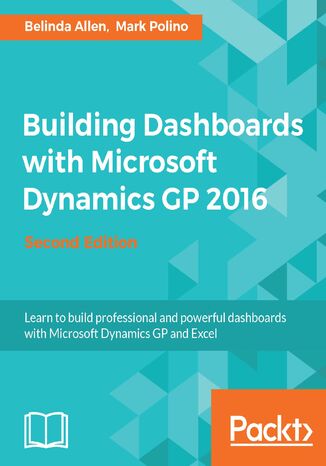
Belinda Allen, Mark Polino
Microsoft Dynamics GP is a complete ERP solution that is extremely beneficial for small to midsize organizations in helping them grow exponentially.The book shows you in detail how to build great-looking dashboards with Microsoft Dynamics GP that enhance a company’s decision-making processes. This guide will take you from the basics of setting up and deploying to creating secure, refreshable Excel reports. Using a whole host of tools available within Microsoft Dynamics GP and Excel, this tutorial will show you how to visualize your data using simple conditional formatting techniques and easy-to-read charts, and allow you to make your data interactive with slicers. We will also cover core topics such as Business Analyzer, Microsoft SQL Reporting services reports, BI360, and more. You will find out to use Power BI, share and refresh data and dashboards in Power BI, and use Power BI Query Editor.By the end of this book, you will have all the information required to build interactive dashboards using Dynamics GP.
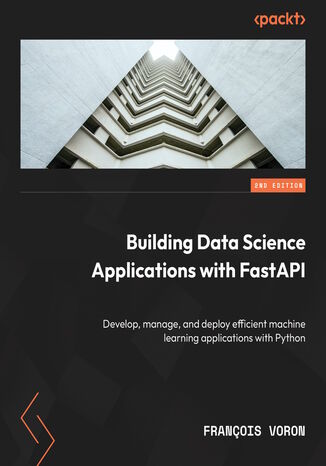
François Voron
Building Data Science Applications with FastAPI is the go-to resource for creating efficient and dependable data science API backends. This second edition incorporates the latest Python and FastAPI advancements, along with two new AI projects – a real-time object detection system and a text-to-image generation platform using Stable Diffusion. The book starts with the basics of FastAPI and modern Python programming. You'll grasp FastAPI's robust dependency injection system, which facilitates seamless database communication, authentication implementation, and ML model integration. As you progress, you'll learn testing and deployment best practices, guaranteeing high-quality, resilient applications. Throughout the book, you'll build data science applications using FastAPI with the help of projects covering common AI use cases, such as object detection and text-to-image generation. These hands-on experiences will deepen your understanding of using FastAPI in real-world scenarios. By the end of this book, you'll be well equipped to maintain, design, and monitor applications to meet the highest programming standards using FastAPI, empowering you to create fast and reliable data science API backends with ease while keeping up with the latest advancements.
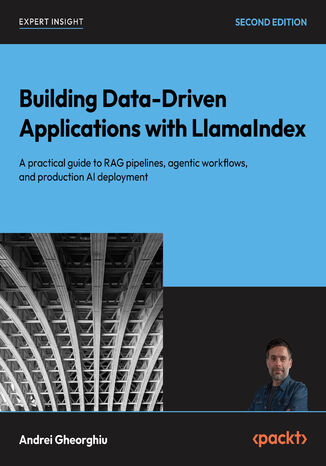
Andrei Gheorghiu
Large language models can generate impressive responses, but they often struggle with outdated knowledge, limited access to proprietary data, hallucinations, and inconsistent reasoning in real-world applications. LlamaIndex addresses these challenges through RAG, enabling developers to connect LLMs with external data sources and build more reliable AI applications.This fully updated second edition reflects the latest evolution of the LlamaIndex ecosystem. You will learn how to ingest and parse data from multiple sources, build optimized indexes, and implement advanced retrieval strategies for high-quality RAG applications.The book introduces modern agentic AI patterns using LlamaIndex Workflows, chat engines, agents, and multi-agent orchestration. You will also explore observability and RAG evaluation, prompt engineering best practices, and deployment strategies using Streamlit.Throughout the book, you will build a practical Contract Review Expert application that evolves chapter by chapter from a simple query engine into a fully deployed AI-powered web application. You will also learn how to use enterprise tooling such as LlamaParse alongside open source alternatives such as LiteParse.By the end of this book, you will be able to design, build, evaluate, and deploy scalable LlamaIndex applications grounded in your own data.*Email sign-up and proof of purchase required
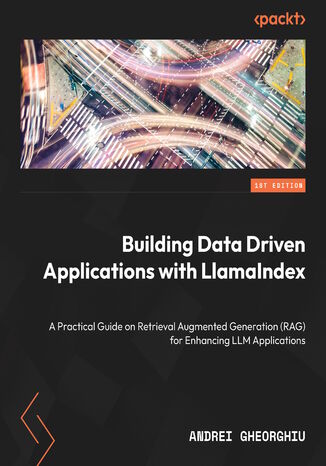
Andrei Gheorghiu
Discover the immense potential of Generative AI and Large Language Models (LLMs) with this comprehensive guide. Learn to overcome LLM limitations, such as contextual memory constraints, prompt size issues, real-time data gaps, and occasional ‘hallucinations’. Follow practical examples to personalize and launch your LlamaIndex projects, mastering skills in ingesting, indexing, querying, and connecting dynamic knowledge bases. From fundamental LLM concepts to LlamaIndex deployment and customization, this book provides a holistic grasp of LlamaIndex's capabilities and applications. By the end, you'll be able to resolve LLM challenges and build interactive AI-driven applications using best practices in prompt engineering and troubleshooting Generative AI projects.
John Horton
VirtueMart is a premier eCommerce solution powered by Joomla!In Building E-commerce Sites with VirtueMart Cookbook you will learn how to create a full-functioning and attractive eCommerce solution with VirtueMart. You will be shown how to install and configure VirtueMart, how to set-up and run your store day-to-day as well as configure and customize the look and feel of your store. With this book by your side, you will be able to overcome as problems setting up, administrating and customizing your eCommerce store! This book finishes with blueprint projects meaning that getting started with VirtueMart is even easier for the novice and aspiring site builder or developer. If you have always wanted to create a professional-looking store, but are worried about the complexity and difficulty involved, then this book is for you! With numerous recipes, practical tips and solutions Building E-commerce Sites with VirtueMart Cookbook will take you through every step required to achieve eCommerce success.
Robbert Ravensbergen
Building an online store is often considered to be a difficult, complex task. Using the combination of WordPress and the WooCommerce plugin, this is no longer the case. WooCommerce is the most popular e-commerce platform for WordPress and is being rapidly developed by WooThemes. It provides a strong e-commerce solution to set up your own online store in just a couple of hours.This easy and practical book will help you make the most of WooCommerce to be able to set up and run your online store yourself. Installing WooCommerce is an easy task, but this book will explain in detail all the possible settings. After that you'll be adding products, different payment methods, and shipping solutions to your store. You will then customize your store by adding themes to change the look and feel. Once your store is running, you'll learn how to use discount coupons, process your orders, look at reports, and even expand the functionality further with additional plugins.By the end of the book, you will learn everything you need to add a fully functional online store to you WordPress website and start running an online business.
Daniel Li
With the over-abundance of tools in the JavaScript ecosystem, it's easy to feel lost. Build tools, package managers, loaders, bundlers, linters, compilers, transpilers, typecheckers - how do you make sense of it all?In this book, we will build a simple API and React application from scratch. We begin by setting up our development environment using Git, yarn, Babel, and ESLint. Then, we will use Express, Elasticsearch and JSON Web Tokens (JWTs) to build a stateless API service. For the front-end, we will use React, Redux, and Webpack.A central theme in the book is maintaining code quality. As such, we will enforce a Test-Driven Development (TDD) process using Selenium, Cucumber, Mocha, Sinon, and Istanbul. As we progress through the book, the focus will shift towards automation and infrastructure. You will learn to work with Continuous Integration (CI) servers like Jenkins, deploying services inside Docker containers, and run them on Kubernetes.By following this book, you would gain the skills needed to build robust, production-ready applications.
Michael W. Picher
Open source telephony systems are making big waves in the communications industry. Moving your organization from a lab environment to production system can seem like a daunting and inherently risky proposition. Building Enterprise Ready Telephony Systems with sipXecs delivers proven techniques for deploying reliable and robust communications systems.Building Enterprise Ready Telephony Systems with sipXecs provides a guiding hand in planning, building and migrating a corporate communications system to the open source sipXecs SIP PBX platform. Following this step-by-step guide makes normally complex tasks, such as migrating your existing communication system to VOIP and deploying phones, easy. Imagine how good you'll feel when you have a complete, enterprise ready telephony system at work in your business.Planning a communications system for any size of network can seem an overwhelmingly complicated task. Deploying a robust and reliable communications system may seem even harder. This book will start by helping you understand the nuts and bolts of a Voice over IP Telephony system. The base knowledge gained is then built upon with system design and product selection. Soon you will be able to implement, utilize and maintain a communications system with sipXecs. Many screen-shots and diagrams help to illustrate and make simple what can otherwise be a complex undertaking. It's easy to build an enterprise ready telephony system when you follow this helpful, straightforward guide.
Building ERP Solutions with Microsoft Dynamics NAV. Solve business scenarios using NAV
Stefano Demiliani
Implementing Microsoft Dynamics NAV in the real world often requires you to integrate the ERP with external applications or solve complex architectural tasks in order to have a final successful project. This book will show you how to extend a Microsoft Dynamics NAV installation to the enterprise world in a practical way.The book starts with an introduction to Microsoft Dynamics NAV architecture and then moves on to advanced topics related to implementing real-world solutions based on NAV and external applications. You will learn how an enterprise distributed architecture with NAV at the core can be implemented. Through a series of real-world cases on every topic and every industry (sales, retail, manufacturing, distribution, healthcare, and so on), you’ll see step by step how to efficiently solve a technical problem. These common problems encountered in a NAV implementation will be solved using the entire technology stack that Microsoft offers.By the end of the book, you will have the knowledge to efficiently solve certain scenarios, you will know which is the best solution architecture to propose to a customer and how to implement it.
Brij Kishore Pandey, Emily Ro Schoof
Modern extract, transform, and load (ETL) pipelines for data engineering have favored the Python language for its broad range of uses and a large assortment of tools, applications, and open source components. With its simplicity and extensive library support, Python has emerged as the undisputed choice for data processing.In this book, you’ll walk through the end-to-end process of ETL data pipeline development, starting with an introduction to the fundamentals of data pipelines and establishing a Python development environment to create pipelines. Once you've explored the ETL pipeline design principles and ET development process, you'll be equipped to design custom ETL pipelines. Next, you'll get to grips with the steps in the ETL process, which involves extracting valuable data; performing transformations, through cleaning, manipulation, and ensuring data integrity; and ultimately loading the processed data into storage systems. You’ll also review several ETL modules in Python, comparing their pros and cons when building data pipelines and leveraging cloud tools, such as AWS, to create scalable data pipelines. Lastly, you’ll learn about the concept of test-driven development for ETL pipelines to ensure safe deployments.By the end of this book, you’ll have worked on several hands-on examples to create high-performance ETL pipelines to develop robust, scalable, and resilient environments using Python.
Samuel Zhou
Enter the world of Decentralized Finance (DeFi) with Building Full Stack DeFi Applications. Understand how this blockchain-based financial technology, designed to manage crypto assets, runs independently without centralized financial institutions like banks and brokerages, eliminating the fees that banks and other financial companies charge for using their services. This book will show you how DeFi solutions are built with smart contracts running on blockchains and how they allow users to gain and earn crypto assets based on the trust of the smart contracts.This book uncovers the inner workings of DeFi by guiding you through the mathematical foundations and teaching you how to build real-world DeFi products with Solidity and JavaScript. As you progress through the chapters, you’ll learn how to implement smart contracts of liquidity pools to trade cryptocurrencies and implement staking, including farming features that allow users to earn. You’ll also find out how to create asset pools that allow users to lend and borrow cryptocurrencies and generate interest. Additionally, you’ll discover how to use Web3 libraries to build the frontend of DeFi products.By the end of this book, you’ll will be well acquainted with popular tools, libraries, and design patterns for implementing a full-stack DeFi application with Web3 and Solidity.
Ted Hunter, Steven Porter, Legorie Rajan PS
GCP is a cloud computing platform with a wide range of products and services that enable you to build and deploy cloud-hosted applications. This Learning Path will guide you in using GCP and designing, deploying, and managing applications on Google Cloud.You will get started by learning how to use App Engine to access Google's scalable hosting and build software that runs on this framework. With the help of Google Compute Engine, you’ll be able to host your workload on virtual machine instances. The later chapters will help you to explore ways to implement authentication and security, Cloud APIs, and command-line and deployment management. As you hone your skills, you’ll understand how to integrate your new applications with various data solutions on GCP, including Cloud SQL, Bigtable, and Cloud Storage. Following this, the book will teach you how to streamline your workflow with tools, including Source Repositories, Container Builder, and Stackdriver. You'll also understand how to deploy and debug services with IntelliJ, implement continuous delivery pipelines, and configure robust monitoring and alerts for your production systems. By the end of this Learning Path, you'll be well versed with GCP’s development tools and be able to develop, deploy, and manage highly scalable and reliable applications.This Learning Path includes content from the following Packt products:• Google Cloud Platform for Developers Ted Hunter and Steven Porter• Google Cloud Platform Cookbook by Legorie Rajan PS