
Techniki programowania
Philip Klauzinski, John Moore
Single-page web applications—or SPAs, as they are commonly referred to—are quickly becoming the de facto standard for web app development. The fact that a major part of the app runs inside a single web page makes it very interesting and appealing. Also, the accelerated growth of browser capabilities is pushing us closer to the day when all apps will run entirely in the browser.This book will take your JavaScript development skills to the next level by teaching you to create a single-page application within a full-stack JavaScript environment. Using only JavaScript, you can go from being a front-end developer to a full-stack application developer with relative ease.You will learn to cross the boundary from front-end development to server-side development through the use of JavaScript on both ends. Use your existing knowledge of JavaScript by learning to manage a JSON document data store with MongoDB, writing a JavaScript powered REST API with Node.js and Express, and designing a front-end powered by AngularJS.This book will teach you to leverage the MEAN stack to do everything from document database design, routing REST web API requests, data-binding within views, and adding authentication and security to building a full-fledged, complex, single-page web application.In addition to building a full-stack JavaScript app, you will learn to test it with JavaScript-powered testing tools such as Mocha, Karma, and Jasmine. Finally, you will learn about deployment and scaling so that you can launch your own apps into the real world.
Andrew Mallett
Shell scripting is a quick method to prototype a complex application or a problem by automating tasks when working on Linux-based systems. Using both simple one-line commands and command sequences complex problems can be solved with ease, from text processing to backing up sysadmin tools.In this book, you’ll discover everything you need to know to master shell scripting and make informed choices about the elements you employ. Get to grips with the fundamentals of creating and running a script in normal mode, and in debug mode. Learn about various conditional statements' code snippets, and realize the power of repetition and loops in your shell script. Implement functions and edit files using the Stream Editor, script in Perl, program in Python – as well as complete coverage of other scripting languages to ensure you can choose the best tool for your project.
Braulio Diez, Jose Fernando Almoguera, Pablo NAVARRO...
Microsoft Silverlight is fully established as a powerful tool for creating and delivering Rich Internet Applications and media experiences on the Web. This book will help you dive straight into utilizing Silverlight 5, which now more than ever is a top choice in the Enterprise for building Business Applications. Mastering LOB Development for Silverlight 5: A Case Study in Action focuses on the development of a complete Silverlight 5 LOB application, helping you to take advantage of the powerful features available along with expert advice. Fully focused on LOB development, this expert guide takes you from the beginning of designing and implementing a Silverlight 5 LOB application, all the way through to completion. Accompanied by a gradually built upon case study, you will learn about data access via RIA and Web services, architecture with MEF and MVVM applied to LOB development, testing and error control, and much more.With Mastering LOB Development for Silverlight 5: A Case Study in Action in hand, you will be fully equipped to expertly develop your own Silverlight Line of Business application, without dwelling on the basics of Enterprise Silverlight development.
Jebin BV
The web is dead – applications now rule our online experiences. But how are you going to build them? Well, if you’ve been paying attention, you might already have tried your hand with MeteorJS, the JavaScript framework that helps you build complete full-stack web applications that are responsive and fast with ease. Mastering MeteorJS Application Development shows you how to do even more with MeteorJS – if you’re ready to try a comprehensive course through one of the most exciting frameworks in web development today, this is the book you need. Designed to take you through the entire process of building an advanced multipage application with Meteor, you’ll be able to bring your web development ideas with surprising ease. You’ll not only learn how Meteor makes web development easier, but also how you can make using Meteor easier, by automating and simplifying tasks so you can be confident you have full control of everything in your workflow – especially everything that could go wrong. From automated testing to integrating other useful frameworks such as Angular and D3, each chapter covers a crucial element in the Meteor development process.Discover how to integrate animations using Meteor’s Blaze, to give your UI designs the edge, and explore reactive programming to effectively harness RESTful systems in your projects. You will also learn how to deploy and scale your application, two crucial aspects of modern development and vital in a changing digital environment with users expecting a product and experience that delivers. With further insights on developing for mobile – and how Meteor can help you tackle the challenges of the trend – and details on incorporating SEO strategies into your application, this book isn’t just a code tutorial – it’s about creating a product that users love.
Sandro Pasquali
Node.js is a modern development stack focused on providing an easy way to build scalable network software. Backed by a growing number of large companies and a rapidly increasing developer base, Node is revolutionizing the way that software is being built today. Powered by Google's V8 engine and built out of C++ modules, this is a JavaScript environment for the enterprise.Mastering Node.js will take the reader deep into this exciting development environment. Beginning with a comprehensive breakdown of its innovative non-blocking evented design, Node's structure is explained in detail, laying out how its blazingly fast I/O performance simplifies the creation of fast servers, scalable architectures, and responsive web applications.Mastering Node.js takes you through a concise yet thorough tour of Node's innovative evented non-blocking design, showing you how to build professional applications with the help of detailed examples.Learn how to integrate your applications with Facebook and Twitter, Amazon and Google, creating social apps and programs reaching thousands of collaborators on the cloud. See how the Express and Path frameworks make the creation of professional web applications painless. Set up one, two, or an entire server cluster with just a few lines of code, ready to scale as soon as you're ready to launch. Move data seamlessly between databases and file systems, between clients, and across network protocols, using a beautifully designed, consistent, and predictable set of tools.Mastering Node.js contains all of the examples and explanations you'll need to build applications in a short amount of time and at a low cost, running on a scale and speed that would have been nearly impossible just a few years ago.
Denis Perevalov
openFrameworks is a powerful programming toolkit and library designed to assist the creative process through simplicity and intuitiveness. It's a very handy software library written in C++ to reduce the software development process, helping you to kick-start creative coding. With the help of C++ and shaders support, openFrameworks allows for the processing of all kinds of media information with your custom-developed algorithms at the lowest possible level, with the fastest speed.Mastering openFrameworks: Creative Coding Demystified will introduce you to a world of creative coding projects, including interactive installations, audio-visual, and sound art projects. You will learn how to make your own projects using openFrameworks. This book focuses on low-level data processing, which allows you to create really unique and cutting-edge installations and projects.Mastering openFrameworks: Creative Coding Demystified provides a complete introduction to openFrameworks, including installation, core capabilities, and addons. Advanced topics like shaders, computer vision, and depth cameras are also covered.We start off by discussing the basic topics such as image and video loading, rendering and processing, playing sound samples, and synthesizing new sounds. We then move on to cover 3D graphics, computer vision, and depth cameras. You will also learn a number of advanced topics such as video mapping, interactive floors and walls, video morphing, networking, and using geometry shaders.You will learn everything you need to know in order to create your own projects; create projects of all levels, ranging from simple creative-code experiments, to big interactive systems consisting of a number of computers, depth cameras, and projectors.
Gábor Farkas
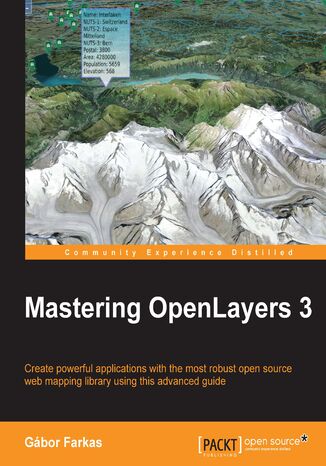
OpenLayers 3 allows you to create stunning web mapping and WebGIS applications. It uses modern, cutting edge browser technologies. It is written with Closure Library, enabling you to build browser-independent applications without painful debugging ceremonies, which even have some limited fallback options for older browsers.With this guide, you will be introduced to the world of advanced web mapping and WebGIS.First, you will be introduced to the advanced features and functionalities available in OpenLayers 3. Next, you will be taken through the key points of creating custom applications with OpenLayers 3. You will then learn how to create the web mapping application of yours (or your company's) dream with this open source, expense-free, yet very powerful library. We’ll also show you how to make amazing looking thematic maps and create great effects with canvas manipulation.By the end of this book, you will have a strong command of web mapping and will be well on your way to creating amazing applications using OpenLayers 3.
Kerri Shotts
PhoneGap is a useful and flexible tool that enables you to create complex hybrid applications for mobile platforms. In addition to the core technology, there is a large and vibrant community that creates third-party plugins that can take your app to the next level.This book will guide you through the process of creating a complex data-driven hybrid mobile application using PhoneGap, web technologies, and third-party plugins.A good foundation is critical, so you will learn how to create a useful workflow to make development easier. From there, the next version of JavaScript (ES6) and the CSS pre-processor SASS are introduced as a way to simplify creating the look of the mobile application. Responsive design techniques are also covered, including the flexbox layout module. As many apps are data-driven, you'll build an application throughout the course of the book that relies upon IndexedDB and SQLite. You'll also download additional content and address how to handle in-app purchases. Furthermore, you’ll build your own customized plugins for your particular use case. When the app is complete, the book will guide you through the steps necessary to submit your app to the Google Play and Apple iTunes stores.