
Uczenie maszynowe
Uczenie maszynowe (ang. machine learning) zajmuje się teorią i praktycznym zastosowaniem algorytmów analizujących dane — stanowi najciekawszą dziedzinę informatyki. Żyjemy w czasach przetwarzania olbrzymiej ilości informacji; za pomocą samouczących się algorytmów będących częścią uczenia maszynowego informacje te są przekształcane w rzeczywistą wiedzę. Dzięki licznym i potężnym bibliotekom o jawnym kodzie źródłowym, które powstały w ostatnich latach, prawdopodobnie teraz jest najlepszy czas, aby zainteresować się uczeniem maszynowym i nauczyć się wykorzystywać potężne algorytmy do wykrywania wzorców w przetwarzanych danych oraz prognozować przyszłe zdarzenia. Przykładami zastosowania Machine Learning są np. mechanizmy wyszukiwarek internetowych, GPS, autokorekta w edytorze tekstu czy boty w komunikatorach. Jedną z dziedzin uczenia maszynowego jest deep learning, podczas którego komputer uczy się procesów naturalnych dla ludzkiego mózgu (tworzy sieci neuronowe). Technologia ta jest wykorzystywana np. przy identyfikacji głosu i obrazów.
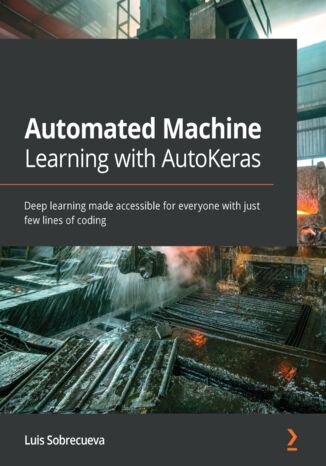
Luis Sobrecueva
AutoKeras is an AutoML open-source software library that provides easy access to deep learning models. If you are looking to build deep learning model architectures and perform parameter tuning automatically using AutoKeras, then this book is for you.This book teaches you how to develop and use state-of-the-art AI algorithms in your projects. It begins with a high-level introduction to automated machine learning, explaining all the concepts required to get started with this machine learning approach. You will then learn how to use AutoKeras for image and text classification and regression. As you make progress, you'll discover how to use AutoKeras to perform sentiment analysis on documents. This book will also show you how to implement a custom model for topic classification with AutoKeras. Toward the end, you will explore advanced concepts of AutoKeras such as working with multi-modal data and multi-task, customizing the model with AutoModel, and visualizing experiment results using AutoKeras Extensions.By the end of this machine learning book, you will be able to confidently use AutoKeras to design your own custom machine learning models in your company.
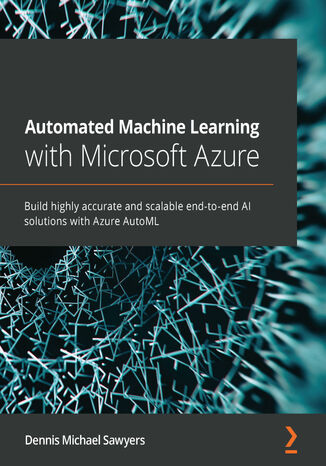
Dennis Sawyers
Automated Machine Learning with Microsoft Azure will teach you how to build high-performing, accurate machine learning models in record time. It will equip you with the knowledge and skills to easily harness the power of artificial intelligence and increase the productivity and profitability of your business. Guided user interfaces (GUIs) enable both novices and seasoned data scientists to easily train and deploy machine learning solutions to production. Using a careful, step-by-step approach, this book will teach you how to use Azure AutoML with a GUI as well as the AzureML Python software development kit (SDK).First, you'll learn how to prepare data, train models, and register them to your Azure Machine Learning workspace. You'll then discover how to take those models and use them to create both automated batch solutions using machine learning pipelines and real-time scoring solutions using Azure Kubernetes Service (AKS). Finally, you will be able to use AutoML on your own data to not only train regression, classification, and forecasting models but also use them to solve a wide variety of business problems.By the end of this Azure book, you'll be able to show your business partners exactly how your ML models are making predictions through automatically generated charts and graphs, earning their trust and respect.
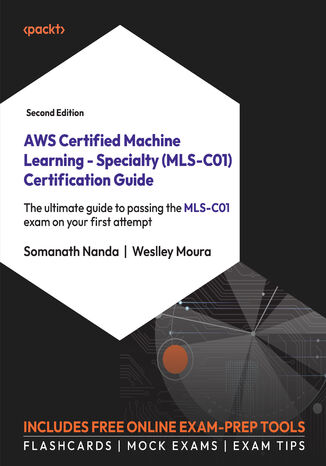
Somanath Nanda, Weslley Moura
The AWS Certified Machine Learning Specialty (MLS-C01) exam evaluates your ability to execute machine learning tasks on AWS infrastructure. This comprehensive book aligns with the latest exam syllabus, offering practical examples to support your real-world machine learning projects on AWS. Additionally, you'll get lifetime access to supplementary online resources, including mock exams with exam-like timers, detailed solutions, interactive flashcards, and invaluable exam tips, all accessible across various devices—PCs, tablets, and smartphones.Throughout the book, you’ll learn data preparation techniques for machine learning, covering diverse methods for data manipulation and transformation across different variable types. Addressing challenges such as missing data and outliers, the book guides you through an array of machine learning tasks including classification, regression, clustering, forecasting, anomaly detection, text mining, and image processing, accompanied by requisite machine learning algorithms essential for exam success. The book helps you master the deployment of models in production environments and their subsequent monitoring.Equipped with insights from this book and the accompanying mock exams, you'll be fully prepared to achieve the AWS MLS-C01 certification.
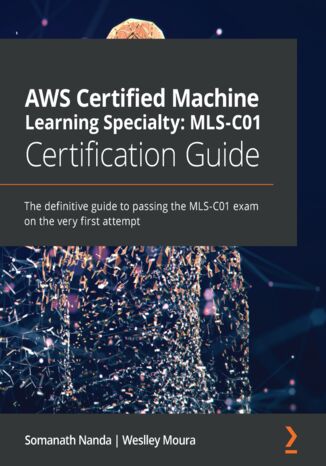
Somanath Nanda, Weslley Moura
The AWS Certified Machine Learning Specialty exam tests your competency to perform machine learning (ML) on AWS infrastructure. This book covers the entire exam syllabus using practical examples to help you with your real-world machine learning projects on AWS.Starting with an introduction to machine learning on AWS, you'll learn the fundamentals of machine learning and explore important AWS services for artificial intelligence (AI). You'll then see how to prepare data for machine learning and discover a wide variety of techniques for data manipulation and transformation for different types of variables. The book also shows you how to handle missing data and outliers and takes you through various machine learning tasks such as classification, regression, clustering, forecasting, anomaly detection, text mining, and image processing, along with the specific ML algorithms you need to know to pass the exam. Finally, you'll explore model evaluation, optimization, and deployment and get to grips with deploying models in a production environment and monitoring them.By the end of this book, you'll have gained knowledge of the key challenges in machine learning and the solutions that AWS has released for each of them, along with the tools, methods, and techniques commonly used in each domain of AWS ML.
Andreas Botsikas , Michael Hlobil
The Azure Data Scientist Associate Certification Guide helps you acquire practical knowledge for machine learning experimentation on Azure. It covers everything you need to pass the DP-100 exam and become a certified Azure Data Scientist Associate.Starting with an introduction to data science, you'll learn the terminology that will be used throughout the book and then move on to the Azure Machine Learning (Azure ML) workspace. You'll discover the studio interface and manage various components, such as data stores and compute clusters.Next, the book focuses on no-code and low-code experimentation, and shows you how to use the Automated ML wizard to locate and deploy optimal models for your dataset. You'll also learn how to run end-to-end data science experiments using the designer provided in Azure ML Studio.You'll then explore the Azure ML Software Development Kit (SDK) for Python and advance to creating experiments and publishing models using code. The book also guides you in optimizing your model's hyperparameters using Hyperdrive before demonstrating how to use responsible AI tools to interpret and debug your models. Once you have a trained model, you'll learn to operationalize it for batch or real-time inferences and monitor it in production.By the end of this Azure certification study guide, you'll have gained the knowledge and the practical skills required to pass the DP-100 exam.
Bayesian Analysis with Python. A practical guide to probabilistic modeling - Third Edition
Osvaldo Martin, Christopher Fonnesbeck, Thomas Wiecki
The third edition of Bayesian Analysis with Python serves as an introduction to the main concepts of applied Bayesian modeling using PyMC, a state-of-the-art probabilistic programming library, and other libraries that support and facilitate modeling like ArviZ, for exploratory analysis of Bayesian models; Bambi, for flexible and easy hierarchical linear modeling; PreliZ, for prior elicitation; PyMC-BART, for flexible non-parametric regression; and Kulprit, for variable selection.In this updated edition, a brief and conceptual introduction to probability theory enhances your learning journey by introducing new topics like Bayesian additive regression trees (BART), featuring updated examples. Refined explanations, informed by feedback and experience from previous editions, underscore the book's emphasis on Bayesian statistics. You will explore various models, including hierarchical models, generalized linear models for regression and classification, mixture models, Gaussian processes, and BART, using synthetic and real datasets.By the end of this book, you’ll understand probabilistic modeling and be able to design and implement Bayesian models for data science, with a strong foundation for more advanced study.*Email sign-up and proof of purchase required
Jorge Brasil
In this book, you'll embark on a comprehensive journey through the fundamentals of linear algebra, a critical component for any aspiring machine learning expert. Starting with an introductory overview, the course explains why linear algebra is indispensable for machine learning, setting the stage for deeper exploration. You'll then dive into the concepts of vectors and matrices, understanding their definitions, properties, and practical applications in the field.As you progress, the course takes a closer look at matrix decomposition, breaking down complex matrices into simpler, more manageable forms. This section emphasizes the importance of decomposition techniques in simplifying computations and enhancing data analysis. The final chapter focuses on principal component analysis, a powerful technique for dimensionality reduction that is widely used in machine learning and data science. By the end of the course, you will have a solid grasp of how PCA can be applied to streamline data and improve model performance.This course is designed to provide technical professionals with a thorough understanding of linear algebra's role in machine learning. By the end, you'll be well-equipped with the knowledge and skills needed to apply linear algebra in practical machine learning scenarios.
Jorge Brasil
This book takes readers on a structured journey through calculus fundamentals essential for AI. Starting with “Why Calculus?” it introduces key concepts like functions, limits, and derivatives, providing a solid foundation for understanding machine learning.As readers progress, they will encounter practical applications such as Taylor Series for curve fitting, gradient descent for optimization, and L'Hôpital’s Rule for managing undefined expressions. Each chapter builds up from core calculus to multidimensional topics, making complex ideas accessible and applicable to AI.The final chapters guide readers through multivariable calculus, including advanced concepts like the gradient, Hessian, and backpropagation, crucial for neural networks. From optimizing models to understanding cost functions, this book equips readers with the calculus skills needed to confidently tackle AI challenges, offering insights that make complex calculus both manageable and deeply relevant to machine learning.