
Python
W kategorii Python zostały zebrane podręczniki poruszające tematykę programowania z zastosowaniem praktycznie niezależnego sprzętowo, dostępnego na licencji Open Source języka. Książki przedstawią Wam wszechstronności i elastyczności Pythona a także różne typy tworzenia kodu poprzez programowanie strukturalne, obiektowe czy funkcjonalne.
Nauczycie się tworzyć aplikacje sieciowe o dowolnym przeznaczeniu, komunikujące się z systemami operacyjnymi, lub korzystające z baz danych. Techniki analizy składni, przetwarzanie tekstu czy rozłożenie obciążenia programu na wiele wątków i procesów przestanie być problematyczne.
Mark Ryan
fastai is an easy-to-use deep learning framework built on top of PyTorch that lets you rapidly create complete deep learning solutions with as few as 10 lines of code. Both predominant low-level deep learning frameworks, TensorFlow and PyTorch, require a lot of code, even for straightforward applications. In contrast, fastai handles the messy details for you and lets you focus on applying deep learning to actually solve problems.The book begins by summarizing the value of fastai and showing you how to create a simple 'hello world' deep learning application with fastai. You'll then learn how to use fastai for all four application areas that the framework explicitly supports: tabular data, text data (NLP), recommender systems, and vision data. As you advance, you'll work through a series of practical examples that illustrate how to create real-world applications of each type. Next, you'll learn how to deploy fastai models, including creating a simple web application that predicts what object is depicted in an image. The book wraps up with an overview of the advanced features of fastai.By the end of this fastai book, you'll be able to create your own deep learning applications using fastai. You'll also have learned how to use fastai to prepare raw datasets, explore datasets, train deep learning models, and deploy trained models.
Willem Meints
Cognitive Toolkit is a very popular and recently open sourced deep learning toolkit by Microsoft. Cognitive Toolkit is used to train fast and effective deep learning models. This book will be a quick introduction to using Cognitive Toolkit and will teach you how to train and validate different types of neural networks, such as convolutional and recurrent neural networks.This book will help you understand the basics of deep learning. You will learn how to use Microsoft Cognitive Toolkit to build deep learning models and discover what makes this framework unique so that you know when to use it. This book will be a quick, no-nonsense introduction to the library and will teach you how to train different types of neural networks, such as convolutional neural networks, recurrent neural networks, autoencoders, and more, using Cognitive Toolkit. Then we will look at two scenarios in which deep learning can be used to enhance human capabilities. The book will also demonstrate how to evaluate your models' performance to ensure it trains and runs smoothly and gives you the most accurate results. Finally, you will get a short overview of how Cognitive Toolkit fits in to a DevOps environment
Andrés P. Torres, Paul Newman
Explore the capabilities of the open-source deep learning framework MXNet to train and deploy neural network models and implement state-of-the-art (SOTA) architectures in Computer Vision, natural language processing, and more. The Deep Learning with MXNet Cookbook is your gateway to constructing fast and scalable deep learning solutions using Apache MXNet.Starting with the different versions of MXNet, this book helps you choose the optimal version for your use and install your library. You’ll work with MXNet/Gluon libraries to solve classification and regression problems and gain insights into their inner workings. Venturing further, you’ll use MXNet to analyze toy datasets in the areas of numerical regression, data classification, picture classification, and text classification. From building and training deep-learning neural network architectures from scratch to delving into advanced concepts such as transfer learning, this book covers it all. You'll master the construction and deployment of neural network architectures, including CNN, RNN, LSTMs, and Transformers, and integrate these models into your applications.By the end of this deep learning book, you’ll wield the MXNet and Gluon libraries to expertly create and train deep learning networks using GPUs and deploy them in different environments.
Kunal Sawarkar, Dheeraj Arremsetty
Building and implementing deep learning (DL) is becoming a key skill for those who want to be at the forefront of progress.But with so much information and complex study materials out there, getting started with DL can feel quite overwhelming.Written by an AI thought leader, Deep Learning with PyTorch Lightning helps researchers build their first DL models quickly and easily without getting stuck on the complexities. With its help, you’ll be able to maximize productivity for DL projects while ensuring full flexibility – from model formulation to implementation.Throughout this book, you’ll learn how to configure PyTorch Lightning on a cloud platform, understand the architectural components, and explore how they are configured to build various industry solutions. You’ll build a neural network architecture, deploy an application from scratch, and see how you can expand it based on your specific needs, beyond what the framework can provide.In the later chapters, you’ll also learn how to implement capabilities to build and train various models like Convolutional Neural Nets (CNN), Natural Language Processing (NLP), Time Series, Self-Supervised Learning, Semi-Supervised Learning, Generative Adversarial Network (GAN) using PyTorch Lightning.By the end of this book, you’ll be able to build and deploy DL models with confidence.
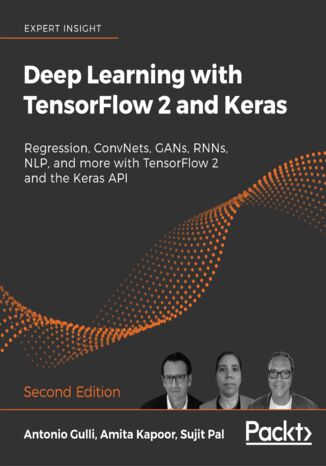
Antonio Gulli, Dr. Amita Kapoor, Sujit Pal
Deep Learning with TensorFlow 2 and Keras, Second Edition teaches neural networks and deep learning techniques alongside TensorFlow (TF) and Keras. You’ll learn how to write deep learning applications in the most powerful, popular, and scalable machine learning stack available.TensorFlow is the machine learning library of choice for professional applications, while Keras offers a simple and powerful Python API for accessing TensorFlow. TensorFlow 2 provides full Keras integration, making advanced machine learning easier and more convenient than ever before.This book also introduces neural networks with TensorFlow, runs through the main applications (regression, ConvNets (CNNs), GANs, RNNs, NLP), covers two working example apps, and then dives into TF in production, TF mobile, and using TensorFlow with AutoML.
Deep Learning with Theano. Perform large-scale numerical and scientific computations efficiently
Christopher Bourez
This book offers a complete overview of Deep Learning with Theano, a Python-based library that makes optimizing numerical expressions and deep learning models easy on CPU or GPU.The book provides some practical code examples that help the beginner understand how easy it is to build complex neural networks, while more experimented data scientists will appreciate the reach of the book, addressing supervised and unsupervised learning, generative models, reinforcement learning in the fields of image recognition, natural language processing, or game strategy.The book also discusses image recognition tasks that range from simple digit recognition, image classification, object localization, image segmentation, to image captioning. Natural language processing examples include text generation, chatbots, machine translation, and question answering. The last example deals with generating random data that looks real and solving games such as in the Open-AI gym. At the end, this book sums up the best -performing nets for each task. While early research results were based on deep stacks of neural layers, in particular, convolutional layers, the book presents the principles that improved the efficiency of these architectures, in order to help the reader build new custom nets.
Maxim Lapan
Start your journey into reinforcement learning (RL) and reward yourself with the third edition of Deep Reinforcement Learning Hands-On. This book takes you through the basics of RL to more advanced concepts with the help of various applications, including game playing, discrete optimization, stock trading, and web browser navigation. By walking you through landmark research papers in the field, this deep RL book will equip you with practical knowledge of RL and the theoretical foundation to understand and implement most modern RL papers. The book retains its approach of providing concise and easy-to-follow explanations from the previous editions. You'll work through practical and diverse examples, from grid environments and games to stock trading and RL agents in web environments, to give you a well-rounded understanding of RL, its capabilities, and its use cases. You'll learn about key topics, such as deep Q-networks (DQNs), policy gradient methods, continuous control problems, and highly scalable, non-gradient methods. If you want to learn about RL through a practical approach using OpenAI Gym and PyTorch, concise explanations, and the incremental development of topics, then Deep Reinforcement Learning Hands-On, Third Edition, is your ideal companion*Email sign-up and proof of purchase required
Maxim Lapan
Deep Reinforcement Learning Hands-On, Second Edition is an updated and expanded version of the bestselling guide to the very latest reinforcement learning (RL) tools and techniques. It provides you with an introduction to the fundamentals of RL, along with the hands-on ability to code intelligent learning agents to perform a range of practical tasks.With six new chapters devoted to a variety of up-to-the-minute developments in RL, including discrete optimization (solving the Rubik's Cube), multi-agent methods, Microsoft's TextWorld environment, advanced exploration techniques, and more, you will come away from this book with a deep understanding of the latest innovations in this emerging field.In addition, you will gain actionable insights into such topic areas as deep Q-networks, policy gradient methods, continuous control problems, and highly scalable, non-gradient methods. You will also discover how to build a real hardware robot trained with RL for less than $100 and solve the Pong environment in just 30 minutes of training using step-by-step code optimization.In short, Deep Reinforcement Learning Hands-On, Second Edition, is your companion to navigating the exciting complexities of RL as it helps you attain experience and knowledge through real-world examples.