
Sztuczna inteligencja

Leonid Kuligin, Jorge Zaldívar, Maximilian Tschochohei, Harrison...
The rapid transformation and enterprise adoption of GenAI has created an urgent demand for developers to quickly build and deploy AI applications that deliver real value. Written by three distinguished Google AI engineers and LangChain contributors who have shaped Google Cloud’s integration with LangChain and implemented AI solutions for Fortune 500 companies, this book bridges the gap between concept and implementation, exploring LangChain and Google Cloud’s enterprise-ready tools for scalable AI solutions.You'll start by exploring the fundamentals of LLMs and how LangChain simplifies the development of AI workflows by connecting LLMs with external data and services. This book guides you through using essential tools like the Gemini and PaLM 2 APIs, Vertex AI, and Vertex AI Search to create sophisticated, production-ready GenAI applications. You'll also overcome the context limitations of LLMs by mastering advanced techniques like RAG and external memory layers.Through practical patterns and real-world examples, you’ll gain everything you need to harness Google Cloud’s AI ecosystem, reducing the time to market while ensuring enterprise scalability. You’ll have the expertise to build robust GenAI applications that can be tailored to solve real-world business challenges.*Email sign-up and proof of purchase required
Shikhar Kwatra, Bunny Kaushik
The concept of generative artificial intelligence has garnered widespread interest, with industries looking to leverage it to innovate and solve business problems. Amazon Bedrock, along with LangChain, simplifies the building and scaling of generative AI applications without needing to manage the infrastructure.Generative AI with Amazon Bedrock takes a practical approach to enabling you to accelerate the development and integration of several generative AI use cases in a seamless manner. You’ll explore techniques such as prompt engineering, retrieval augmentation, fine-tuning generative models, and orchestrating tasks using agents. The chapters take you through real-world scenarios and use cases such as text generation and summarization, image and code generation, and the creation of virtual assistants. The latter part of the book shows you how to effectively monitor and ensure security and privacy in Amazon Bedrock.By the end of this book, you’ll have gained a solid understanding of building and scaling generative AI apps using Amazon Bedrock, along with various architecture patterns and security best practices that will help you solve business problems and drive innovation in your organization.
Ben Auffarth
ChatGPT and the GPT models by OpenAI have brought about a revolution not only in how we write and research but also in how we can process information. This book discusses the functioning, capabilities, and limitations of LLMs underlying chat systems, including ChatGPT and Gemini. It demonstrates, in a series of practical examples, how to use the LangChain framework to build production-ready and responsive LLM applications for tasks ranging from customer support to software development assistance and data analysis – illustrating the expansive utility of LLMs in real-world applications.Unlock the full potential of LLMs within your projects as you navigate through guidance on fine-tuning, prompt engineering, and best practices for deployment and monitoring in production environments. Whether you're building creative writing tools, developing sophisticated chatbots, or crafting cutting-edge software development aids, this book will be your roadmap to mastering the transformative power of generative AI with confidence and creativity.

Generative AI with Python. Harness the Power of Python for Building Generative AI Models
Rheinwerk Publishing, Inc, Bert Gollnick
Generative AI with Python introduces readers to the fascinating world of AI model development. It begins with essential concepts in AI and deep learning, building a solid foundation for working with generative models. You will explore how to create models that generate text, images, and more, with clear, practical examples. The book provides an in-depth look at large language models and pretrained tools like Hugging Face, demonstrating how they can be leveraged in real-world applications. Each chapter blends theoretical concepts with hands-on coding exercises to ensure you understand both the principles and practical implementation of generative AI. Starting with the basics of natural language processing and deep learning, the book guides you to more advanced applications such as text summarization, image generation, and model fine-tuning. You'll also learn about optimizing AI models and deploying them in various environments. By the end of the book, you’ll be able to confidently build AI-driven applications with Python, capable of transforming business processes and enhancing consumer products.
Behram Irani, Rahul Sonawane
Many developers face the challenge of managing repetitive tasks and maintaining productivity. This book will help you tackle both these challenges with Amazon Q Developer, a generative AI-powered assistant designed to optimize coding and streamline workflows.This book takes you through the setup and customization of Amazon Q Developer, demonstrating how to leverage its capabilities for auto-code generation, code explanation, and transformation across multiple IDEs and programming languages. You'll learn to use Amazon Q Developer to enhance coding experiences, generate accurate code references, and ensure security by scanning for vulnerabilities. The book also shows you how to use Amazon Q Developer for AWS-related tasks, including solution building, applying architecture best practices, and troubleshooting errors. Each chapter provides practical insights and step-by-step guidance to help you fully integrate this powerful tool into your development process. You’ll get to grips with effortless code implementation, explanation, transformation, and documentation, helping you create applications faster and improve your development experience.By the end of this book, you’ll have mastered Amazon Q Developer to accelerate your software development lifecycle, improve code quality, and build applications faster and more efficiently.
Chris Fregly, Antje Barth, Shelbee Eigenbrode
Podczas projektowania aplikacji opartych na generatywnej AI trzeba dokonywać wielu wyborów decydujących o jakości danych dostarczanych przez aplikację, jej opłacalności, skalowalności i niezawodności. Decyzje te są tym trudniejsze, że świat generatywnej AI zmienia się niezwykle szybko, a mity i błędne przeświadczenia dotyczące tej technologii mają się świetnie. W tej niezwykle pragmatycznej książce, przeznaczonej dla dyrektorów technicznych, praktyków uczenia maszynowego, twórców aplikacji, analityków biznesowych, inżynierów i badaczy danych, znajdziesz skuteczne techniki używania sztucznej inteligencji. Zaznajomisz się z cyklem życia projektu opartego na generatywnej AI i jej zastosowaniami, a także metodami doboru i dostrajania modeli, generowania danych wspomaganego wyszukiwaniem, uczenia przez wzmacnianie na podstawie informacji zwrotnych od człowieka, kwantyzacji, optymalizacji i wdrażania modeli. Poznasz szczegóły różnych typów modeli, między innymi dużych językowych (LLM), multimodalnych generujących obrazy (Stable Diffusion) i odpowiadających na pytania wizualne (Flamingo/IDEFICS). Dowiedz się, jak: używać generatywnej AI w biznesie dobierać modele generatywnej AI stosować inżynierię monitu i uczenie kontekstowe dostrajać modele przy użyciu własnych zbiorów danych i techniki LoRA korzystać z agentów i akcji za pomocą bibliotek LangChain i ReAct tworzyć aplikacje na bazie usługi Amazon Bedrock To fascynująca książka, rewelacyjna kompozycja niezwykle ważnych informacji, a także szczegółowych, praktycznych kodów, skryptów i instrukcji! Jeff Barr, wiceprezes i główny popularyzator AWS
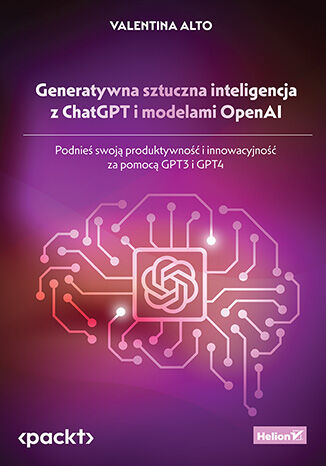
Valentina Alto
Generatywne modele językowe, takie jak ChatGPT udostępniony przez OpenAI, stały się przełomem ze względu na ich możliwości i łatwe użycie w szerokiej gamie zastosowań. Wszechstronność tych narzędzi pozwala podnieść produktywność i kreatywność na niespotykany wcześniej poziom. Wystarczy w tym celu użyć we własnych projektach ChatGPT lub któregoś z wyspecjalizowanych modeli. Dzięki tej przystępnej książce zrozumiesz metody działania wielkich modeli językowych i techniki szkolenia modeli generatywnych. Następnie zapoznasz się z przypadkami użycia, w których ChatGPT sprawdzi się najlepiej, a w efekcie zwiększy produktywność i kreatywność. Dowiesz się też, jak wchodzić w interakcje z ChatGPT, tworzyć lepsze prompty i korzystać z funkcji uczenia się. Znajdziesz tu rozdziały dla marketingowców, naukowców i programistów, ułatwiające szybkie zastosowanie nabytej wiedzy w praktyce. Przekonasz się również, jak w środowisku korporacyjnym stosować interfejsy API modeli OpenAI dostępne w infrastrukturze Azure. Dla każdego scenariusza podano kompletną implementację w Pythonie, korzystającą z bibliotek Streamlit i LangChain do integracji modeli AI z aplikacjami. W książce: koncepcja generatywnej AI i architektura GPT projektowanie optymalnych promptów prezentacja aplikacji i przypadków użycia ChatGPT używanie modeli i funkcji OpenAI za pośrednictwem wywołań API kod Pythona do budowania i wdrażania systemów generatywnej AI odpowiedzialność i etyka w systemach generatywnej AI Odkryj, jak łatwo model generatywnej AI zintegruje się z Twoją aplikacją!
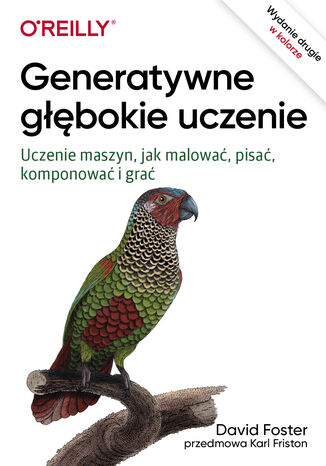
Generatywne głębokie uczenie, wyd. II. Uczenie maszyn, jak malować, pisać, komponować i grać
David Foster
Generatywna sztuczna inteligencja (AI) jest dziś gorącym tematem w dziedzinie techniki. Ta praktyczna książka pokazuje inżynierom uczenia się maszyn, jak wykorzystywać TensorFlow i Keras, aby od zera tworzyć robiące wrażenie generatywne modele głębokiego uczenia, w tym wariacyjne autokodowanie (VAE), generatywne sieci przeciwstawne (GAN), transformery, przepływy normalizacyjne, modele oparte na energii i dyfuzyjne modele odszumiające. Książka zaczyna się od podstaw głębokiego uczenia i prowadzi do nowatorskich architektur. Dzięki wskazówkom i sztuczkom zrozumiesz, jak sprawić, aby nasze modele uczyły się bardziej skutecznie i stawały się bardziej kreatywne. - Dowiedz się, jak VAE pozwala zmienić wyraz twarzy na zdjęciu. - Naucz GAN generowania obrazów na podstawie własnego zbioru danych. - Zbuduj modele dyfuzyjne do tworzenia nowych odmian kwiatów. - Wyszkol swój własny GPT, aby generował tekst. - Dowiedz się jak są szkolone duże modele językowe jak ChatGPT. - Przeanalizuj najnowocześniejsze architektury jak StyleGAN2 i ViT-VQGAN - Skomponuj muzykę polifoniczną wykorzystując transformery i MuseGAN - Zrozum jak generatywne modele świata mogą rozwiązać zadania uczenia przez wzmacnianie. - Zanurz się w multimodalnych modelach jak DALL.E 2, Imagen i Stable Diffusion Książka ta analizuje także przyszłą generacyjną sztuczną inteligencję i sposób, w jaki ludzie i firmy mogą proaktywnie zacząć wykorzystywać tę niezwykłą nową technikę, aby zyskiwać przewagę konkurencyjną. "Generatywne głębokie uczenie to dostępne wprowadzenie do narzędzi głębokiego uczenia dla celów modelowania generatywnego. Jeśli jesteście kreatywnymi praktykami, kochającymi bawić się kodem i chcecie zastosować głębokie uczenie w swojej pracy, ta książka jest dla was." -David Ha Szef strategii, Stability AT "Doskonała książka, która zagłębia się wprost w podstawowe technik stanowiące aktualną wiedzę o generacyjnym głębokim nauczaniu. Jest to ekscytująca analiza jednej z najbardziej fascynujących dziedzin w ramach sztucznej inteligencji!" -Francois Chollet Twórca Keras
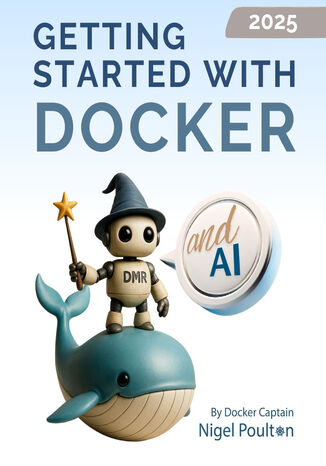
Nigel Poulton
This hands-on guide is designed to take you from zero to Docker-ready, combining clear explanations with practical examples. You’ll begin by exploring the fundamentals of containers, Docker architecture, and key concepts like images, registries, and the role of containers in microservices and AI. Early chapters lay a strong foundation, demystifying industry jargon and highlighting how containers differ from traditional virtual machines.Once the basics are in place, the book moves into real-world usage. You’ll install Docker, run your first containers, and learn how to manage them with Docker Desktop. You’ll then containerize a simple web app, push images to Docker Hub, and build multi-container microservices applications using Docker Compose. These hands-on labs build both confidence and competency through guided, project-based learning.This newly updated edition adds a dedicated chapter on AI integration using the new Docker Model Runner. You'll deploy local AI models, integrate with Open WebUI, and see how Docker now powers modern AI workflows. This book is ideal for anyone looking to master Docker while also gaining experience in deploying containerized AI solutions.
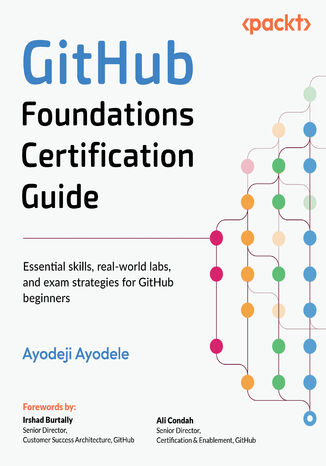
Ayodeji Ayodele, Irshad Burtally, Ali Condah
Progress from the basics of version control to excelling at collaborative development with the GitHub Foundations Certification Guide, your go-to resource for mastering Git and GitHub. You'll learn how to use Git to accurately track and manage code changes, and discover why GitHub is the leading platform for collaboration, project management, and open-source development. Written by Ayodeji Ayodele, Senior Customer Success Architect at GitHub with expertise in DevOps, Agile coaching, and software engineering, this book provides a structured path to Git/GitHub proficiency. Through hands-on tutorials, projects, and self-assessment questions, you’ll harness the potential of open source, navigate the GitHub platform with ease, employ advanced Git techniques, and gain practical code management skills. The book then explores secure collaboration, automation, and key features of the GitHub Desktop app. You’ll prepare for the certification exam with practice questions, mock exams, and invaluable study tips. By the end of this book, you’ll be ready to take the GitHub Foundations exam and advance your developer career.
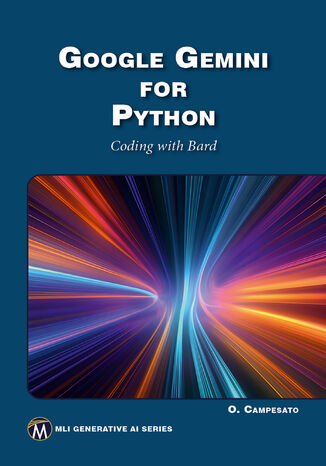
Google Gemini for Python. Coding with Bard: Mastering Python with Google's AI Tools
Mercury Learning and Information, Oswald Campesato
This book bridges Python 3 programming and Generative AI, equipping readers with the skills to navigate both domains confidently. It starts with Python basics, covering data types, number formatting, text manipulation, loops, functions, data structures, NumPy, Pandas, conditional logic, and reserved words. You'll also learn about handling user input, managing exceptions, and working with command-line arguments.The journey continues into Generative AI, distinguishing it from Conversational AI. It introduces popular platforms and models, including Bard (now called Gemini) and its competitors, providing insights into their capabilities, strengths, weaknesses, and applications. The final chapters show how to generate various Python 3 code samples using Gemini.Understanding these concepts is crucial for modern programming and AI applications. This book transitions readers from basic Python programming to advanced AI techniques, blending theoretical knowledge with practical skills. Companion files with source code and figures enhance the learning experience, making this an essential resource for mastering Python 3 and Generative AI.
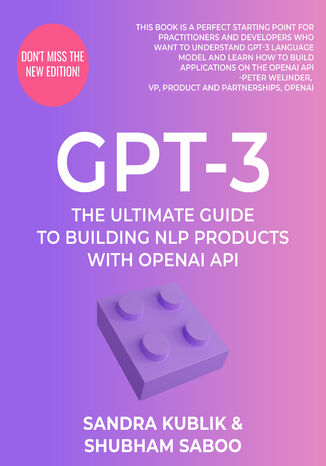
GPT-3. The Ultimate Guide To Building NLP Products With OpenAI API
Sandra Kublik, Shubham Saboo
GPT-3 has made creating AI apps simpler than ever. This book provides a comprehensive guide on how to utilize the OpenAI API with ease. It explores imaginative methods of utilizing this tool for your specific needs and showcases successful businesses that have been established through its use.The book is divided into two sections, with the first focusing on the fundamentals of the OpenAI API. The second part examines the dynamic and thriving environment that has arisen around GPT-3.Chapter 1 sets the stage with background information and defining key terms. Chapter 2 goes in-depth into the API, breaking it down into its essential components, explaining their functions and offering best practices. Chapter 3, you will build your first app with GPT-3.Chapter 4 features interviews with the founders of successful GPT-3-based products, who share challenges and insights gained. Chapter 5 examines the perspective of enterprises on GPT-3 and its potential for adoption. The problematic consequences of widespread GPT-3 adoption, such as misapplication and bias, are addressed along with efforts to resolve these issues in Chapter 6. Finally, Chapter 7 delves into the future by exploring the most exciting trends and possibilities as GPT-3 becomes increasingly integrated into the commercial ecosystem.
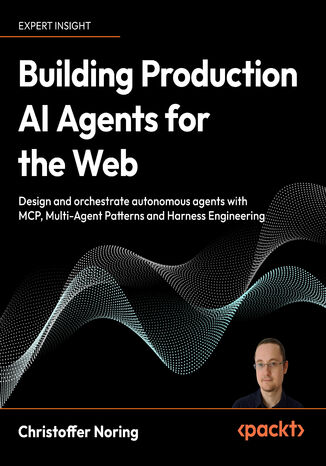
Christoffer Noring
AI is no longer just about generating text. It’s about building autonomous, goal-driven systems that can reason, act, and collaborate. Hands-On AI Agents for the Web is your practical guide to designing and deploying agentic web applications powered by Large Language Models (LLMs).Starting with the fundamentals of agentic thinking and responsible AI, this book walks you through integrating LLMs into real-world web apps. You’ll progressively enhance your systems with tool calling, Retrieval-Augmented Generation (RAG), and advanced reasoning patterns like ReAct, before moving into the design of fully autonomous agents.As you advance, you’ll explore agent architectures, planning systems, orchestration, and multi-agent collaboration, learning how modern frameworks and protocols like Model Context Protocol (MCP) enable scalable, interoperable AI systems. The book emphasizes hands-on learning, with practical examples that demonstrate how to build AI assistants, coordinate multiple agents, and apply proven design patterns, while avoiding common pitfalls.By the end, you’ll have the skills to build production-ready, intelligent web experiences powered by autonomous agents.
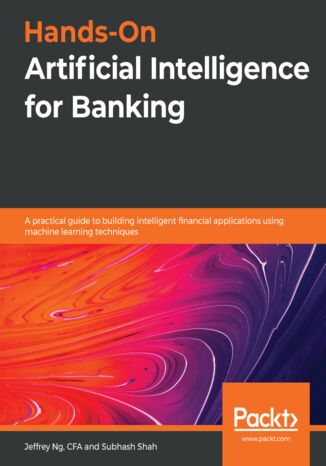
Jeffrey Ng , Subhash Shah
Remodeling your outlook on banking begins with keeping up to date with the latest and most effective approaches, such as artificial intelligence (AI). Hands-On Artificial Intelligence for Banking is a practical guide that will help you advance in your career in the banking domain. The book will demonstrate AI implementation to make your banking services smoother, more cost-efficient, and accessible to clients, focusing on both the client- and server-side uses of AI.You’ll begin by understanding the importance of artificial intelligence, while also gaining insights into the recent AI revolution in the banking industry. Next, you’ll get hands-on machine learning experience, exploring how to use time series analysis and reinforcement learning to automate client procurements and banking and finance decisions. After this, you’ll progress to learning about mechanizing capital market decisions, using automated portfolio management systems and predicting the future of investment banking. In addition to this, you’ll explore concepts such as building personal wealth advisors and mass customization of client lifetime wealth. Finally, you’ll get to grips with some real-world AI considerations in the field of banking. By the end of this book, you’ll be equipped with the skills you need to navigate the finance domain by leveraging the power of AI.
Ian Horne
Data Analysis Expressions (DAX) is known for its ability to increase efficiency by extracting new information from data that is already present in your model. With this book, you’ll learn to use DAX’s functionality and flexibility in the BI and data analytics domains.You’ll start by learning the basics of DAX, along with understanding the importance of good data models, and how to write efficient DAX formulas by using variables and formatting styles. You’ll then explore how DAX queries work with the help of examples. The book will guide you through optimizing the BI workflow by writing powerful DAX queries. Next, you’ll learn to manipulate and load data of varying complexity within Microsoft products such as Power BI, SQL Server, and Excel Power Pivot. You’ll then discover how to build and extend your data models to gain additional insights, before covering progressive DAX syntax and functions to understand complex relationships in DAX. Later, you’ll focus on important DAX functions, specifically those related to tables, date and time, filtering, and statistics. Finally, you’ll delve into advanced topics such as how the formula and storage engines work to optimize queries.By the end of this book, you’ll have gained hands-on experience in employing DAX to enhance your data models by extracting new information and gaining deeper insights.

Van Vung Pham
Computer vision is a crucial component of many modern businesses, including automobiles, robotics, and manufacturing, and its market is growing rapidly. This book helps you explore Detectron2, Facebook's next-gen library providing cutting-edge detection and segmentation algorithms. It’s used in research and practical projects at Facebook to support computer vision tasks, and its models can be exported to TorchScript or ONNX for deployment.The book provides you with step-by-step guidance on using existing models in Detectron2 for computer vision tasks (object detection, instance segmentation, key-point detection, semantic detection, and panoptic segmentation). You’ll get to grips with the theories and visualizations of Detectron2’s architecture and learn how each module in Detectron2 works. As you advance, you’ll build your practical skills by working on two real-life projects (preparing data, training models, fine-tuning models, and deployments) for object detection and instance segmentation tasks using Detectron2. Finally, you’ll deploy Detectron2 models into production and develop Detectron2 applications for mobile devices.By the end of this deep learning book, you’ll have gained sound theoretical knowledge and useful hands-on skills to help you solve advanced computer vision tasks using Detectron2.
Giuseppe Futia, Maxime Labonne
Graph Neural Networks have become essential tools for learning from relational and structured data. This second edition provides a comprehensive, hands-on guide implementing GNNs using Python and PyTorch Geometric.The book begins with graph theory fundamentals and data manipulation using NetworkX and PyTorch Geometric. You then explore shallow embedding methods—DeepWalk and Node2Vec—before progressing to core GNN architectures: Graph Convolutional Networks, Graph Attention Networks, and GraphSAGE.This edition introduces several new chapters reflecting the latest advances: Graph Transformers, integration of graph databases with GNNs, the convergence of LLMs and GNNs through GraphRAG, and the emerging paradigm of Graph Foundation Models. Existing chapters on expressiveness, link prediction, heterogeneous graphs, temporal GNNs, and explainability have been updated with current best practices.The final part puts theory into practice with end-to-end projects: traffic forecasting with A3T-GCN, anomaly detection with heterogeneous GNNs, and building a recommender system with LightGCN.By the end of this book, you will have the knowledge and practical skills to apply GNNs to your own graph-structured data problems.
Maxime Labonne
Graph neural networks are a highly effective tool for analyzing data that can be represented as a graph, such as networks, chemical compounds, or transportation networks. The past few years have seen an explosion in the use of graph neural networks, with their application ranging from natural language processing and computer vision to recommendation systems and drug discovery.Hands-On Graph Neural Networks Using Python begins with the fundamentals of graph theory and shows you how to create graph datasets from tabular data. As you advance, you’ll explore major graph neural network architectures and learn essential concepts such as graph convolution, self-attention, link prediction, and heterogeneous graphs. Finally, the book proposes applications to solve real-life problems, enabling you to build a professional portfolio. The code is readily available online and can be easily adapted to other datasets and apps.By the end of this book, you’ll have learned to create graph datasets, implement graph neural networks using Python and PyTorch Geometric, and apply them to solve real-world problems, along with building and training graph neural network models for node and graph classification, link prediction, and much more.
Alexandre DuBreuil
The importance of machine learning (ML) in art is growing at a rapid pace due to recent advancements in the field, and Magenta is at the forefront of this innovation. With this book, you’ll follow a hands-on approach to using ML models for music generation, learning how to integrate them into an existing music production workflow. Complete with practical examples and explanations of the theoretical background required to understand the underlying technologies, this book is the perfect starting point to begin exploring music generation.The book will help you learn how to use the models in Magenta for generating percussion sequences, monophonic and polyphonic melodies in MIDI, and instrument sounds in raw audio. Through practical examples and in-depth explanations, you’ll understand ML models such as RNNs, VAEs, and GANs. Using this knowledge, you’ll create and train your own models for advanced music generation use cases, along with preparing new datasets. Finally, you’ll get to grips with integrating Magenta with other technologies, such as digital audio workstations (DAWs), and using Magenta.js to distribute music generation apps in the browser.By the end of this book, you'll be well-versed with Magenta and have developed the skills you need to use ML models for music generation in your own style.
Giuseppe Ciaburro
Simulation modelling is an exploration method that aims to imitate physical systems in a virtual environment and retrieve useful statistical inferences from it. The ability to analyze the model as it runs sets simulation modelling apart from other methods used in conventional analyses. This book is your comprehensive and hands-on guide to understanding various computational statistical simulations using Python. The book begins by helping you get familiarized with the fundamental concepts of simulation modelling, that’ll enable you to understand the various methods and techniques needed to explore complex topics. Data scientists working with simulation models will be able to put their knowledge to work with this practical guide. As you advance, you’ll dive deep into numerical simulation algorithms, including an overview of relevant applications, with the help of real-world use cases and practical examples. You'll also find out how to use Python to develop simulation models and how to use several Python packages. Finally, you’ll get to grips with various numerical simulation algorithms and concepts, such as Markov Decision Processes, Monte Carlo methods, and bootstrapping techniques.By the end of this book, you'll have learned how to construct and deploy simulation models of your own to overcome real-world challenges.
Xun (Brian) Wu, Chuangfeng Zhang, Zhibin (Andrew)...
Hyperledger is an open-source project and creates private blockchain applications for a range of domains. This book will be your desk reference as you explore common and not-so-common challenges faced while building blockchain networks using Hyperledger services.We'll work through all Hyperledger platform modules to understand their services and features and build end-to-end blockchain applications using various frameworks and tools supported by Hyperledger. This book's independent, recipe-based approach (packed with real-world examples) will familiarize you with the blockchain development cycle. From modeling a business network to integrating with various tools, you will cover it all. We'll cover common and not-so-common challenges faced in the blockchain life cycle. Later, we'll delve into how we can interact with the Hyperledger Fabric blockchain, covering all the principles you need to master, such as chaincode, smart contracts, and much more. We'll also address the scalability and security issues currently faced in blockchain development.By the end of this book, you will be able to implement each recipe to plan, design, and create a full-fledged, private, decentralized application to meet organizational needs.
Louis Owen
Hyperparameters are an important element in building useful machine learning models. This book curates numerous hyperparameter tuning methods for Python, one of the most popular coding languages for machine learning. Alongside in-depth explanations of how each method works, you will use a decision map that can help you identify the best tuning method for your requirements.You’ll start with an introduction to hyperparameter tuning and understand why it's important. Next, you'll learn the best methods for hyperparameter tuning for a variety of use cases and specific algorithm types. This book will not only cover the usual grid or random search but also other powerful underdog methods. Individual chapters are also dedicated to the three main groups of hyperparameter tuning methods: exhaustive search, heuristic search, Bayesian optimization, and multi-fidelity optimization. Later, you will learn about top frameworks like Scikit, Hyperopt, Optuna, NNI, and DEAP to implement hyperparameter tuning. Finally, you will cover hyperparameters of popular algorithms and best practices that will help you efficiently tune your hyperparameter.By the end of this book, you will have the skills you need to take full control over your machine learning models and get the best models for the best results.
Mahender Pal
Microsoft Dynamics 365 for Customer Engagement (CE) is one of the leading customer relationship management (CRM) solutions that help companies to effectively communicate with their customers and allows them to transform their marketing strategies. Complete with detailed explanations of the essential concepts and practical examples, this book will guide you through the entire life cycle of implementing Dynamics 365 CE for your organization or clients, and will help you avoid common pitfalls while increasing efficiency at every stage of the project. Starting with the foundational concepts, the book will gradually introduce you to Microsoft Dynamics 365 features, plans, and products. You’ll learn various implementation strategies and requirement gathering techniques, and then design the application architecture by converting your requirements into technical and functional designs. As you advance, you’ll learn how to configure your CRM system to meet your organizational needs, customize Dynamics 365 CE, and extend its capabilities by writing client-side and server-side code. Finally, you’ll integrate Dynamics 365 CE with other applications and explore its business intelligence capabilities. By the end of this Microsoft Dynamics 365 book, you’ll have gained an in-depth understanding of all the key components necessary for successful Dynamics 365 CE implementation.
VINCENT BUMGARNER, James D. Miller
If you are a data analyst with basic knowledge of Big Data analysis but no knowledge of Splunk, then this book will help you get started with Splunk. The book assumes that you have access to a copy of Splunk, ideally not in production, and many examples also assume you have administrator rights.