
Informatyka
Zajrzyj do kategorii Informatyka w księgarni internetowej Ebookpoint. Znajdziesz tutaj bestsellerowe książki, ebooki i kursy video z branży IT. Sięgnij po najlepszą literaturę dla specjalistów i rozwijaj doświadczenie, które już posiadasz, lub rozpocznij swoją przygodę z programowaniem, cyberbezpieczeństwem lub grafiką komputerową. Pogłębiaj swoją wiedzę tak, jak Ci wygodnie - z tradycyjną książką, wygodnym ebookiem lub nowoczesnym videokursem. Sprawdź, jakie tytuły znajdziesz w kategorii Informatyka!
Vitor Cerqueira, Luís Roque
Most organizations exhibit a time-dependent structure in their processes, including fields such as finance. By leveraging time series analysis and forecasting, these organizations can make informed decisions and optimize their performance. Accurate forecasts help reduce uncertainty and enable better planning of operations. Unlike traditional approaches to forecasting, deep learning can process large amounts of data and help derive complex patterns. Despite its increasing relevance, getting the most out of deep learning requires significant technical expertise.This book guides you through applying deep learning to time series data with the help of easy-to-follow code recipes. You’ll cover time series problems, such as forecasting, anomaly detection, and classification. This deep learning book will also show you how to solve these problems using different deep neural network architectures, including convolutional neural networks (CNNs) or transformers. As you progress, you’ll use PyTorch, a popular deep learning framework based on Python to build production-ready prediction solutions.By the end of this book, you'll have learned how to solve different time series tasks with deep learning using the PyTorch ecosystem.
Deep Learning from the Basics. Python and Deep Learning: Theory and Implementation
Koki Saitoh, Shigeo Yushita
Deep learning is rapidly becoming the most preferred way of solving data problems. This is thanks, in part, to its huge variety of mathematical algorithms and their ability to find patterns that are otherwise invisible to us.Deep Learning from the Basics begins with a fast-paced introduction to deep learning with Python, its definition, characteristics, and applications. You’ll learn how to use the Python interpreter and the script files in your applications, and utilize NumPy and Matplotlib in your deep learning models. As you progress through the book, you’ll discover backpropagation—an efficient way to calculate the gradients of weight parameters—and study multilayer perceptrons and their limitations, before, finally, implementing a three-layer neural network and calculating multidimensional arrays.By the end of the book, you’ll have the knowledge to apply the relevant technologies in deep learning.
Alan M. F. Souza, Fabio M. Soares,...
Machine learning applications are everywhere, from self-driving cars, spam detection, document search, and trading strategies, to speech recognitionStarting with an introduction to basic machine learning algorithms, this course takes you further into this vital world of stunning predictive insights and remarkable machine intelligence. This course helps you solve challenging problems in image processing, speech recognition, language modeling. You will discover how to detect anomalies and fraud, and ways to perform activity recognition, image recognition, and text. You will also work with examples such as weather forecasting, disease diagnosis, customer profiling, generalization, extreme machine learning and more. By the end of this course, you will have all the knowledge you need to perform deep learning on your system with varying complexity levels, to apply them to your daily work.The course provides you with highly practical content explaining deep learning with Java, from the following Packt books:1. Java Deep Learning Essentials 2. Machine Learning in Java3. Neural Network Programming with Java, Second Edition
Mike Bernico
Deep learning has become an essential necessity to enter the world of artificial intelligence. With this book deep learning techniques will become more accessible, practical, and relevant to practicing data scientists. It moves deep learning from academia to the real world through practical examples.You will learn how Tensor Board is used to monitor the training of deep neural networks and solve binary classification problems using deep learning. Readers will then learn to optimize hyperparameters in their deep learning models. The book then takes the readers through the practical implementation of training CNN's, RNN's, and LSTM's with word embeddings and seq2seq models from scratch. Later the book explores advanced topics such as Deep Q Network to solve an autonomous agent problem and how to use two adversarial networks to generate artificial images that appear real. For implementation purposes, we look at popular Python-based deep learning frameworks such as Keras and Tensorflow, Each chapter provides best practices and safe choices to help readers make the right decision while training deep neural networks.By the end of this book, you will be able to solve real-world problems quickly with deep neural networks.
Deep Learning with C++. Design and deploy neural networks using CUDA for high-performance AI in C++
Bill Chen, Vikash Gupta
Deep learning systems often struggle to meet performance demands in real-time and production environments. This book shows you how to build high-performance deep learning systems in C++, enabling efficient and scalable artificial intelligence (AI) in resource-constrained environments where performance matters.You’ll start by setting up a complete C++ deep learning environment and implementing core neural networks from scratch. As you progress, you’ll build advanced architectures, including Convolutional Neural Networks (CNNs), Recurrent Neural Networks (RNNs), Long Short-Term Memory Networks (LSTMs), Generative Adversarial Networks (GANs), and Transformers, using C++, CUDA, and PyTorch’s C++ API. The book then focuses on model quantization and compression. It will guide you through the model deployment process in production with robust monitoring and explainability. You’ll also explore distributed training and techniques for real-time inference in performance-critical domains.By the end of this book, you’ll be able to design, optimize, and deploy deep learning systems in C++ that are production-ready, scalable, and efficient across multiple industries.*Email sign-up and proof of purchase required
Deep Learning with Hadoop. Distributed Deep Learning with Large-Scale Data
Dipayan Dev
This book will teach you how to deploylarge-scale dataset in deep neural networks with Hadoop foroptimal performance.Starting with understanding what deeplearning is, and what the various modelsassociated with deep neural networks are, thisbook will then show you how to set up theHadoop environment for deep learning.In this book, you will also learn how toovercome the challenges that you facewhile implementing distributed deeplearning with large-scale unstructured datasets. The book willalso show you how you can implementand parallelize the widely used deep learning models such as Deep Belief Networks,Convolutional Neural Networks, Recurrent Neural Networks, Restricted Boltzmann machines and autoencoder using the popular deep learning library Deeplearning4j.Get in-depth mathematical explanationsand visual representations to helpyou understand the design and implementationsof Recurrent Neural network and Denoising Autoencoders withDeeplearning4j. To give you a morepractical perspective, the book will alsoteach you the implementation of large-scale video processing, image processing andnatural language processing on Hadoop.By the end of this book, you willknow how to deploy various deep neural networks indistributed systems using Hadoop.
Antonio Gulli, Sujit Pal
This book starts by introducing you to supervised learning algorithms such as simple linear regression, the classical multilayer perceptron and more sophisticated deep convolutional networks. You will also explore image processing with recognition of handwritten digit images, classification of images into different categories, and advanced objects recognition with related image annotations. An example of identification of salient points for face detection is also provided.Next you will be introduced to Recurrent Networks, which are optimized for processing sequence data such as text, audio or time series. Following that, you will learn about unsupervised learning algorithms such as Autoencoders and the very popular Generative Adversarial Networks (GANs). You will also explore non-traditional uses of neural networks as Style Transfer.Finally, you will look at reinforcement learning and its application to AI game playing, another popular direction of research and application of neural networks.
Willem Meints
Cognitive Toolkit is a very popular and recently open sourced deep learning toolkit by Microsoft. Cognitive Toolkit is used to train fast and effective deep learning models. This book will be a quick introduction to using Cognitive Toolkit and will teach you how to train and validate different types of neural networks, such as convolutional and recurrent neural networks.This book will help you understand the basics of deep learning. You will learn how to use Microsoft Cognitive Toolkit to build deep learning models and discover what makes this framework unique so that you know when to use it. This book will be a quick, no-nonsense introduction to the library and will teach you how to train different types of neural networks, such as convolutional neural networks, recurrent neural networks, autoencoders, and more, using Cognitive Toolkit. Then we will look at two scenarios in which deep learning can be used to enhance human capabilities. The book will also demonstrate how to evaluate your models' performance to ensure it trains and runs smoothly and gives you the most accurate results. Finally, you will get a short overview of how Cognitive Toolkit fits in to a DevOps environment
Deep Learning with PyTorch. A practical approach to building neural network models using PyTorch
Vishnu Subramanian
Deep learning powers the most intelligent systems in the world, such as Google Voice, Siri, and Alexa. Advancements in powerful hardware, such as GPUs, software frameworks such as PyTorch, Keras, TensorFlow, and CNTK along with the availability of big data have made it easier to implement solutions to problems in the areas of text, vision, and advanced analytics. This book will get you up and running with one of the most cutting-edge deep learning libraries—PyTorch. PyTorch is grabbing the attention of deep learning researchers and data science professionals due to its accessibility, efficiency and being more native to Python way of development. You'll start off by installing PyTorch, then quickly move on to learn various fundamental blocks that power modern deep learning. You will also learn how to use CNN, RNN, LSTM and other networks to solve real-world problems. This book explains the concepts of various state-of-the-art deep learning architectures, such as ResNet, DenseNet, Inception, and Seq2Seq, without diving deep into the math behind them. You will also learn about GPU computing during the course of the book. You will see how to train a model with PyTorch and dive into complex neural networks such as generative networks for producing text and images. By the end of the book, you'll be able to implement deep learning applications in PyTorch with ease.
Dr. Amita Kapoor, Antonio Gulli, Sujit Pal
Deep Learning with TensorFlow and Keras teaches you neural networks and deep learning techniques using TensorFlow (TF) and Keras. You'll learn how to write deep learning applications in the most powerful, popular, and scalable machine learning stack available.TensorFlow 2.x focuses on simplicity and ease of use, with updates like eager execution, intuitive higher-level APIs based on Keras, and flexible model building on any platform. This book uses the latest TF 2.0 features and libraries to present an overview of supervised and unsupervised machine learning models and provides a comprehensive analysis of deep learning and reinforcement learning models using practical examples for the cloud, mobile, and large production environments.This book also shows you how to create neural networks with TensorFlow, runs through popular algorithms (regression, convolutional neural networks (CNNs), transformers, generative adversarial networks (GANs), recurrent neural networks (RNNs), natural language processing (NLP), and graph neural networks (GNNs)), covers working example apps, and then dives into TF in production, TF mobile, and TensorFlow with AutoML.
Deep Learning with TensorFlow. Explore neural networks with Python
Giancarlo Zaccone, Fabrizio Milo, Md. Rezaul Karim
Deep learning is the step that comes after machine learning, and has more advancedimplementations. Machine learning is not just for academics anymore, but is becoming a mainstream practice through wide adoption, and deep learning has taken the front seat. As a data scientist, if you want to explore data abstraction layers, this book will be your guide. This book shows how this can be exploited in the real world with complex raw data using TensorFlow 1.x.Throughout the book, you’ll learn how to implement deep learning algorithms for machine learning systems and integrate them into your product offerings, includingsearch, image recognition, and language processing. Additionally, you’ll learn howto analyze and improve the performance of deep learning models. This can be done bycomparing algorithms against benchmarks, along with machine intelligence, to learnfrom the information and determine ideal behaviors within a specific context.After finishing the book, you will be familiar with machine learning techniques, in particular the use of TensorFlow for deep learning, and will be ready to apply your knowledge to research or commercial projects.
Oleg Vasilev, Maxim Lapan, Martijn van Otterlo,...
Deep Reinforcement Learning Hands-On is a comprehensive guide to the very latest DL tools and their limitations. You will evaluate methods including Cross-entropy and policy gradients, before applying them to real-world environments. Take on both the Atari set of virtual games and family favorites such as Connect4.The book provides an introduction to the basics of RL, giving you the know-how to code intelligent learning agents to take on a formidable array of practical tasks. Discover how to implement Q-learning on 'grid world' environments, teach your agent to buy and trade stocks, and find out how natural language models are driving the boom in chatbots.
Andy Peng, Alex Strick van Linschoten, Duarte...
Learn how to build, fine-tune, and deploy AI systems using DeepSeek, one of the most influential open-source large language models available today. This book guides you through real-world DeepSeek applications—from understanding its core architecture and training foundations to developing reasoning agents and deploying production-ready systems.Starting with a concise synthesis of DeepSeek's research, breakthroughs, and open-source philosophy, you’ll progress to hands-on projects including prompt engineering, workflow design, and rationale distillation. Through detailed case studies—ranging from document understanding to legal clause analysis—you’ll see how to use DeepSeek in high-value GenAI scenarios.You’ll also learn to build sophisticated agent workflows and prepare data for fine-tuning. By the end of the book, you’ll have the skills to integrate DeepSeek into local deployments, cloud CI/CD pipelines, and custom LLMOps environments.Written by experts with deep knowledge of open-source LLMs and deployment ecosystems, this book is your comprehensive guide to DeepSeek’s capabilities and implementation.
Victor Wu
Virtualized systems are well established now, and their disparate components can be found bundled together in hyper-converged infrastructures, such as VxRail from Dell EMC. Dell VxRail System Design and Best Practices will take you, as a system architect or administrator, through the process of designing and protecting VxRail systems.While this book assumes a certain level of knowledge of VMware, vSphere 7.x, and vCenter Server, you’ll get a thorough overview of VxRail's components, features, and architecture, as well as a breakdown of the benefits of this hyper-converged system. This guide will give you an in-depth understanding of VxRail, as well as plenty of practical examples and self-assessment questions along the way to help you plan and design every core component of a VxRail system – from vSAN storage policies to cluster expansion. It's no good having a great system if you lose everything when it breaks, so you'll spend some time examining advanced recovery options, such as VMware Site Recovery Manager and Veeam Backup and Replication.By the end of this book, you will have got to grips with Dell’s hyper-converged VxRail offering, taking your virtualization proficiency to the next level.
Delphi 2007 dla WIN32 i bazy danych
Marian Wybrańczyk
Stwórz własne aplikacje dla systemu Windows Jak pracować ze środowiskiem programistycznym Delphi? W jaki sposób tworzyć biblioteki DLL? Jak zaprojektować wydajną bazę danych? Jak tworzyć aplikacje operujące na bazach danych? Wśród wszystkich środowisk programistycznych umożliwiających tworzenie aplikacji Delphi jest jednym z najbardziej znanych i popularnych. To narzędzie, obecne na rynku od ponad dwunastu lat, cieszy się zasłużonym uznaniem twórców oprogramowania -- dzięki sporym możliwościom, ogromnej bibliotece komponentów i czytelnej składni języka Object Pascal, będącego podstawą tego środowiska. Najnowsza wersja Delphi, oznaczona symbolem RAD Studio 2007, nie tylko umożliwia tworzenie "klasycznych" aplikacji dla Windows, opartych o Windows API, ale także udostępnia kontrolki platformy .NET. Książka "Delphi 2007 dla WIN32 i bazy danych" to podręcznik opisujący zasady tworzenia aplikacji dla systemu Windows w najnowszej wersji Delphi. Przedstawia ona techniki tworzenia aplikacji bazodanowych w oparciu o mechanizmy Windows API i kontrolki VCL. Czytając ją, poznasz komponenty, jakie Delphi oferuje programiście, i dowiesz się, jak korzystać z nich we własnych aplikacjach. Opanujesz mechanizmy komunikacji z niemal wszystkimi systemami zarządzania bazami danych dostępnymi na rynku. Przeczytasz także o tworzeniu wersji instalacyjnych napisanych przez siebie aplikacji. Interfejs użytkownika Delphi 2007 Komponenty dostępne w Delphi Przetwarzanie grafiki Korzystanie z komponentów VCL Aplikacje wielowątkowe Tworzenie bibliotek DLL Operacje na plikach Obsługa dokumentów XML Projektowanie bazy danych i struktury tabel Komunikacja z bazami danych Mechanizmy blokowania rekordów Tworzenie wersji instalacyjnych aplikacji Wykorzystaj możliwości najnowszej wersji środowiska programistycznego, które zrewolucjonizowało proces tworzenia aplikacji!
Daniele Teti
Intended to refresh the basics of Delphi as well as advance your knowledge to the next level, it is assumed you will know RAD studio and the Object Pascal language. However, if you are not an experienced RAD studio programmer this accessible guide will still develop those initial crucial skills.
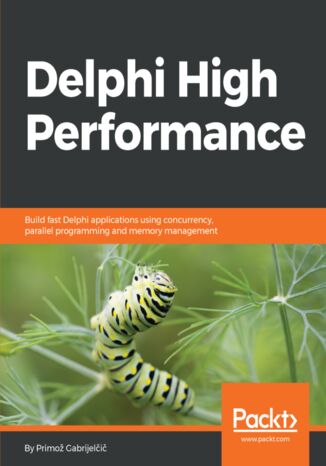
Primož Gabrijelčič
Delphi is a cross-platform Integrated Development Environment (IDE) that supports rapid application development for Microsoft Windows, Apple Mac OS X, Google Android, iOS, and now Linux with RAD Studio 10.2. This book will be your guide to build efficient high performance applications with Delphi.The book begins by explaining how to find performance bottlenecks and apply the correct algorithm to fix them. It will teach you how to improve your algorithms before taking you through parallel programming. You’ll then explore various tools to build highly concurrent applications. After that, you’ll delve into improving the performance of your code and master cross-platform RTL improvements. Finally, we’ll go through memory management with Delphi and you’ll see how to leverage several external libraries to write better performing programs. By the end of the book, you’ll have the knowledge to create high performance applications with Delphi.
Koichi Tsuji, Suvrutt Gurjar, Takuya Miyai
Many citizen developers regularly use spreadsheets in their business and day-to-day jobs. With AppSheet, you can take your spreadsheets to the next level by enhancing their ease of use. The platform allows you to run your business efficiently and manage it in the field outside of an office or indoor environment. This book enables you to create your own simple or medium to complex hybrid apps for business or personal use.As a beginner to AppSheet, this book will show you how the AppSheet Editor works and how it is used to configure, test, and deploy an app and share it with others as users or co-authors. You’ll learn about widely used features such as how to use data sources, create app views and actions, construct expressions with AppSheet functions, and make your app secure through security and UX options. Next, you’ll create email/attachment templates and develop reports/documents based on templates, store in the cloud, and send files through emails. You’ll also understand how to integrate third-party services and monitor various usage statistics of your app. As you progress, you’ll explore various features with the help of sample apps that you create using the book.By the end of this book, you’ll have learned how to make the most of AppSheet to build powerful and efficient applications.
Caio Calderari
In an era marked by a growing demand for tech solutions and a shortage of skilled developers, companies grapple with hiring expenses. No-code tools offer a faster, more affordable software development alternative. Leading this no-code revolution is Bubble, enabling newcomers to construct impressive web applications in a matter of weeks if not days.Written by Caio Calderari, a seasoned no-code expert with 17 years of experience to offers practical advice for mastering no-code application development. You'll learn to plan your app with Bubble's visual builder features and UI components and implement frontend functionalities such as customizing layouts and creating responsive user interfaces. The book covers workflow automation, database management, security best practices, and backend functionality setup and advances to span the Bubble plugin ecosystem and API integration for third-party services to improve the app's functionality. Additionally, you'll explore app testing, debugging, performance monitoring, and maintenance. From launching with a custom domain to gathering user feedback for continuous improvement and optimization of performance and scalability, you’ll learn every aspect of Bubble's app development and deployment.By the end of this book, you'll know how to bring your digital ideas to life without writing code.
Peter Krause
Whether you want to organize simple files or perform more complex consolidations between different Office programs and remote-control applications that don't allow outside access, Power Automate Desktop helps meet these challenges. This book shows you how to leverage this workflow automation platform by explaining the underlying RPA concepts in a step-by-step way.You’ll start with simple flows that can be easily recorded and further processed using the built-in recorder. Later, you’ll learn how to use the more advanced actions to automate folder and file management and enable Office programs to interact with each other. You’ll also get to grips with integrating desktop flows into other cloud environments and further enhance their value using AI. As you progress, you’ll understand how flows can run unattended and how they are managed in the Power Platform, as well as key concepts such as creating, modifying, debugging, and error-handling UI flows. Finally, the book will guide you to use Process Automation Designer (PAD) in conjunction with your frequently used desktop systems to automate routine tasks.By the end of this book, you’ll have become a Power Automate Desktop expert, automating both professional and personal tasks.
Jacek Doktór, Paweł Jarosz
It becomes important to plan, design, and deploy configurations when administrators know that Configuration Manager interacts with a number of infrastructure components such as Active Directory Domain Services, network protocols, Windows Server services, and so on.Via real-world-world deployment scenarios, this book will help you implement a single primary site or multiples sites. You will be able to efficiently plan and deploy a multiple-site hierarchy such as central administration site. Next, you will learn various methods to plan and deploy Configuration Manager clients, secure them and make the most of new features offered through ConfigMgr 1706 like compliance, deploying updates operating systems to the endpoints. Then, this book will show you how to install, configure, and run SQL reports to extract information. Lastly, you will also learn how to create and manage users access in an ConfigMgr environmentBy the end of this book, you will have learned to use the built-in mechanism to back up and restore data and also design maintenance plan.
Srdjan Grubor
Deploying Docker into production is considered to be one of the major pain points in developing large-scale infrastructures, and the documentation available online leaves a lot to be desired. With this book, you will learn everything you wanted to know to effectively scale your deployments globally and build a resilient, scalable, and containerized cloud platform for your own use.The book starts by introducing you to the containerization ecosystem with some concrete and easy-to-digest examples; after that, you will delve into examples of launching multiple instances of the same container. From there, you will cover orchestration, multi-node setups, volumes, and almost every relevant component of this new approach to deploying services. Using intertwined approaches, the book will cover battle-tested tooling, or issues likely to be encountered in real-world scenarios, in detail. You will also learn about the other supporting components required for a true PaaS deployment and discover common options to tie the whole infrastructure together.At the end of the book, you learn to build a small, but functional, PaaS (to appreciate the power of the containerized service approach) and continue to explore real-world approaches to implementing even larger global-scale services.

Laura Goodsell , Janine Friston, Heather Palfreyman
If you're constantly frustrated by how long it takes to create a design in Canva, then you've come to the right place. This book will get you up and running quickly with creating professional branded graphics in Canva.You’ll learn how to set up a Canva account, both free and pro and create a brand kit while understanding the importance of branding. Next, you’ll discover all the features and tools as well as how to put everything together to build a brand you love and graphics that work for your business. As you progress, the chapters will show you how to organize your account, create presentations, use videos and animation within your marketing materials and more.By the end of this book, you’ll have a solid understanding of what Canva is and what it does and be able to confidently and easily create a branded design from scratch.

Šimon Jůn
Figma isn’t just a design tool; it’s the modern designer’s command centerŠimon Jun, COO at Dotidot, longtime Figma lecturer, and organizer of the Czech Friends of Figma community, built this book from the trenches of real product work. After years of untangling messy files, rescuing failing handoffs, and coaching teams at scale, he distilled what actually works into a practical, recipe-driven guide.Over time, Šimon saw the same problems show up again and again: bloated files, broken handoffs, and design systems that couldn’t scale. This book is his way of sharing the patterns, tools, and habits that helped teams move past those roadblocks and build stronger, more connected design processes in Figma.Inside, you’ll learn how to structure files for real collaboration, use design tokens without chaos, build accessible, scalable libraries, and hand off to developers with confidence. You’ll see how to automate repetitive work with plugins and AI, run async reviews, and bake feedback loops into your process so projects keep moving, without losing polish.*Email sign-up and proof of purchase required