
Wydawca: Packt Publishing
David Studebaker
Microsoft Dynamics NAV is a well established Enterprise Resource Planning (ERP) application, part of the Microsoft Dynamics family. Dynamics NAV is installed worldwide, with well over one million users. Version 2009 contains many major new features and structures, requiring even experienced Dynamics NAV developers to refresh their NAV development knowledge.Renowned for its challenging learning curve, Dynamics NAV is a complex piece of software with a unique design structure. For developers learning to modify or enhance Dynamics NAV for vital business purposes, the task can sometimes be intimidating.This book is an in-depth step-by-step guide to programming NAV, designed to ease you through the complexities of NAV application development. You will learn the skills and develop the confidence to tackle your own critical NAV applications. This book will act as your experienced NAV programming mentor, helping you to become productive as a NAV developer much more quickly.NAV development is quite complex, with a steep learning curve. This book makes it easy for you. From basic NAV terminology and concept definitions, through the essential building blocks of NAV data structure and objects, you will gain an understanding of the fundamental underlying concepts of NAV. You will learn practical details about NAV object construction and the tools available, including table, page, and report design. You will learn how to use NAV's tools to effectively navigate through the various features of objects, including properties, triggers, and C/AL code, and receive practical guidance on ways to develop and test in the unique NAV C/SIDE development environment.Extensive guidance on software design for NAV is provided along with tips for efficient design of new NAV applications or enhancing existing applications. With its comprehensive collection of NAV information and distillation of years of NAV development experience, this book is not only designed to help you learn, but to act as a reference as well.
David Studebaker, Christopher D. Studebaker
Microsoft Dynamics NAV 2013 is a complete and robust ERP system that is accompanied by a comprehensive set of development tools. You will learn how to master these tools and tailor Microsoft Dynamics NAV 2013 to meet your customer's specific business needs.Programming Microsoft Dynamics® NAV 2013 will lead you from start to finish, teaching you how to use this incredible ERP software whilst simultaneously making you a more productive developer. You'll learn how to implement your solutions, as well as evaluating, managing and appraising Dynamics NAV 2013 productions and projects.You will be empowered with the skills and knowledge that you need to get the job done and exceed your client's expectations. Step by step, you will learn how to use NAV, master the C/AL programming language, as well as the construction and uses of each object type. Ultimately, you will be able to bring your NAV 2013 solution together with fantastic efficiency.Hands-on development examples and additional material teach you by example and uncover the insider knowledge that only years of experience can provide, truly unleashing your productivity and potential.
David Studebaker
This book is targeted at those who want to learn NAV's powerful and extensive built-in development capabilities. It assumes that you understand programming and are familiar with business application software.
Marije Brummel, David Studebaker, Christopher D. Studebaker
Microsoft Dynamics NAV is a full business solution suite, and a complete ERP solution that contains a robust set of development tools to support customization and enhancement. These tools provide greater control over financials and can simplify supply chain, manufacturing, and operations.This book will take you from an introduction to Dynamics NAV and its integrated development tools to being a productive developer in the Dynamics NAV Development Environment. You will find this book very useful if you want to evaluate the product's development capabilities or need to manage Dynamics NAV based projects. It will teach you about the NAV application structure, the C/SIDE development environment, the C/AL language paired with the improved editor, the construction and uses of each object type, and how it all fits together to build universal applications. With this new edition, you will be able to understand how to design and develop using Patterns and new features such as Extensions and Events.
Matthew Whiteside
Programming Puzzles is a meticulously crafted collection designed to elevate your coding skills through engaging and challenging exercises. The book begins with a helpful guide on getting started, ensuring that readers are well-prepared to tackle the puzzles ahead. As you delve deeper, you'll encounter a series of challenge puzzles that test your logical thinking and problem-solving abilities, followed by fun puzzles that offer a more relaxed yet equally rewarding experience.Hints are provided for the challenge puzzles to guide you through particularly tough spots, ensuring you stay motivated without giving away the solutions. Once you've worked through the puzzles, comprehensive solutions are provided, allowing you to understand different approaches and learn from your mistakes. Each section of the book is designed to progressively build your skills, from basic logic to advanced problem-solving techniques, making it an invaluable resource for anyone looking to improve their programming abilities.The journey through this book is not just about finding solutions; it's about developing a deeper understanding of how to approach and solve complex problems. By the end of this book, you'll have honed your coding skills, enhanced your logical thinking, and gained a new appreciation for the art of problem-solving in programming.
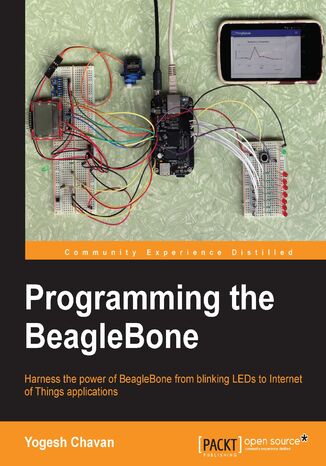
Yogesh Chavan
The whole world is moving from desktop computers to smartphones and embedded systems. We are moving towards utilizing Internet of Things (IoT). An exponential rise in the demand for embedded systems and programming in the last few years is driving programmers to use embedded development boards such as Beaglebone. BeagleBone is an ultra-small, cost-effective computer that comes with a powerful hardware. It runs a full-fledged Debian Linux OS and provides numerous electronics solutions. BeagleBone is open source and comes with an Ethernet port, which allows you to deploy IoT projects without any additions to the board. It provides plenty of GPIO, Anlaog pins, and UART, I2C, SPI pins which makes it the right choice to perform electronics projects. This gives you all the benefits of Linux kernel such as multitasking, multiusers, and extensive device driver support. This allows you to do programming in many languages including high-level languages such as JavaScript and Python.This book aims to exploit the hardware and software capabilities of BeagleBone to create real-life electronics and IoT applications quickly. It is divided into two parts. The first part covers JavaScript programs. The second part provides electronics projects and IoT applications in Python.First, you will learn to use BeagleBone as tool to write useful applications on embedded systems. Starting with the basics needed to set up BeagleBone and the Cloud9 IDE, this book covers interfacing with various electronics components via simple programs. The electronics theory related to these components is then explained in depth before you use them in a program. Finally, the book helps you create some real-life IoT applications.
Kenneth Scott Allen
Windows Workflow Foundation (WF) is a technology for defining, executing, and managing workflows. It is part of the .NET Framework 3.0 and will be available natively in the Windows Vista operating system.Windows Workflow Foundation might be the most significant piece of middleware to arrive on the Windows platform since COM+ and the Distributed Transaction Coordinator. The difference is, not every application needs a distributed transaction, but nearly every application does have a workflow encoded inside it.In this book, K Scott Allen, author of renowned .NET articles at www.odetocode.com, provides you with all the information needed to develop successful products with Windows Workflow.From the basics of how Windows Workflow can solve the difficult problems inherent in workflow solutions, through authoring workflows in code, learning about the base activity library in Windows Workflow and the different types of workflow provided, and on to building event-driven workflows using state machines, workflow communications, and finally rules and conditions in Windows Workflow, this book will give you the in-depth information you need. Throughout the book, an example bug reporting workflow system is developed, showcasing the technology and techniques used.
Eliahou Orr, Yehuda Zadik
The CodeIgniter Model-View-Controller framework provides genius simplicity, flexibility, and efficient resource usage, boosting performance and reusability.Programming with CodeIgniter MVC reviews the unique features of CodeIgniter using simple, easy-to-follow, and practical examples.Programming with CodeIgniter MVC provides a simple step-by-step guide to efficiently utilizingthe CodeIgniter MVC framework for developing web applications. This book is packed with engaging examples to understand the usage of controllers, libraries, and (Codeigniter) CI Models. This book commences with a quick discussion of the CodeIgniter Integration with external plugins such as Flickr API, Google Maps and more will be reviewed with clear usage examples. It will then cover CI naming convention rules, mandatory and optional configurations, and usage within a CI project. It will also cover user defined configurations.By the end of this book, you will not only understand user-defined libraries in a CI framework, but also their services, role, usage, and scope with the help of an example-based approach. The book also covers helpers, models, and views, as well as their usage.Using this book, youwill soonbe able to develop feature-rich web applications using the CodeIgniter MVC framework. Programming with CodeIgniter MVC is a one-stop solution to developing solutions with CodeIgniter MVC.