
Hardware
Lonneke Dikmans, RONALD VAN LUTTIKHUIZEN
SOA is an industry term which is often preached like a religion rather than taught like a technology, and over time, grasping the concept has become unnecessarily difficult. Many companies proclaim that they don't know where to begin with SOA, while others have begun their SOA effort but haven't reaped the benefits they were convinced it would bring. SOA Made Simpleù unveils the true meaning of Service Oriented Architecture and how to make it successful so that you can confidently explain SOA to anyone!SOA Made Simpleù explains exactly what SOA is in simple terminology and by using real-life examples. Once a simple definition is clear in your mind, you'll be guided through what SOA solves, when and why you should use it, and how to set up, design and categorize your SOA landscape. With this book in hand you'll learn to keep your SOA strategy successful as you expand on it.SOA Made Simpleù demystifies SOA, simply. It is not difficult to grasp, but for various reasons SOA is often made unnecessarily complex. Service-orientation is already a very natural way of thinking for business stakeholders that want to realize and sell services to potential clients, and this book helps you to realize that concept both in theory and practice.You'll begin with a clear and simple explanation of what SOA is and why we need it. You'll then be presented with plain facts about the key ingredients of a service, and along the way learn about service design, layering and categorizing, some major SOA platform offerings as well as governance and successful implementation.After reading SOA Made Simpleù you will have a clear understanding of what SOA is so you can implement and govern SOA in your own organization.
Richard Seroter
SOA is about architecture, not products and SOA enables you to create better business processes faster than ever. While BizTalk Server 2009 is a powerful tool, by itself it cannot deliver long-lasting, agile solutions unless we actively apply tried and tested service-oriented principles.The current BizTalk Server books are all for the 2006 version and none of them specifically looks at how to map service-oriented principles and patterns to the BizTalk product. That's where this book fits in. In this book, we specifically investigate how to design and build service-oriented solutions using BizTalk Server 2009 as the host platform.This book extends your existing BizTalk knowledge to apply service-oriented thinking to classic BizTalk scenarios. We look at how to build the most reusable, flexible, and loosely-coupled solutions possible in the BizTalk environment. Along the way, we dive deeply into BizTalk Server's integration with Windows Communication Foundation, and see how to take advantage of the latest updates to the Microsoft platform. Chock full of dozens of demonstrations, this book walks through design considerations, development options, and strategies for maintaining production solutions.
Mihaela Roxana Ghidersa
Large-scale web applications require you to write code efficiently following business and architectural considerations. They require web developers to understand the impact of their work on the system and how they can evolve the product.With this handbook, every developer will find something to take away. This book will help web developers looking to change projects or work on a new project in understanding the context of the application, along with how some design decisions or patterns fit better in their application’s architecture. It acts as a guide, taking you through different levels of professional growth with a focus on best practices, coding guidelines, business considerations, and soft skills that will help you gain the knowledge to craft a career in web development. Finally, you’ll work with examples and ways of applying the discussed concepts in practical situations.By the end of this book, you’ll have gained valuable insights into what it means to be a web architect, as well as the impact architecture has on a web application.
John Gilbert, Memi Lavi
Organizations undergoing digital transformation rely on IT professionals to design systems to keep up with the rate of change while maintaining stability. With this edition, enriched with more real-world examples, you’ll be perfectly equipped to architect the future for unparalleled innovation.This book guides through the architectural patterns that power enterprise-grade software systems while exploring key architectural elements (such as events-driven microservices, and micro frontends) and learning how to implement anti-fragile systems.First, you'll divide up a system and define boundaries so that your teams can work autonomously and accelerate innovation. You'll cover the low-level event and data patterns that support the entire architecture while getting up and running with the different autonomous service design patterns.This edition is tailored with several new topics on security, observability, and multi-regional deployment. It focuses on best practices for security, reliability, testability, observability, and performance. You'll be exploring the methodologies of continuous experimentation, deployment, and delivery before delving into some final thoughts on how to start making progress.By the end of this book, you'll be able to architect your own event-driven, serverless systems that are ready to adapt and change.
Charalampos S Arapidis
Sonar is an open source platform used by development teams to manage source code quality. Sonar has been developed with this main objective in mind: make code quality management accessible to everyone with minimal effort. As such, Sonar provides code analyzers, reporting tools, manual reviews, defect-hunting modules, and TimeMachine as core functionalities. It also comes with a plugin mechanism enabling the community to extend the functionality, making Sonar the one-stop-shop for source code quality by addressing not only the developer's requirements, but also the manager's needs.The Sonar Code Quality Testing Essentials book will help you understand the different factors that define code quality and how to improve your own or your team's code using Sonar.You will learn to use Sonar effectively and explore the quality of your source code in the following axes:Coding StandardsDocumentation and CommentsPotential Bugs and DefectsUnit Testing CoverageDesign and ComplexityThrough practical examples, you will customize Sonar components and widgets to identify areas where your source code is lacking. The book goes down to proposing good practices and common solutions that you can put to use to improve such code.You will start with installing and setting up a Sonar server and performing your first project analysis. Then you will go through the process of creating a custom and balanced quality profile exploring all Sonar components through practical examples. After reading the book, you will be able to analyze any project using Sonar and know how to read and evaluate quality metrics.Hunting potential bugs and eliminating complexity are the hottest topics regarding code quality. The book will guide you through the process of finding such problematic areas, leveraging and customizing the most appropriate components. Knowing the best tool for each task is essential. While you improve code and design through the book, you will notice that metrics go high and alerts turn green. You will use the Time Machine and the Timeline to examine how your changes affected the quality.Sonar Code Quality Testing Essentials will enable you to perform custom quality analysis on any Java project and quickly gain insight on even large code bases, as well as provide possible solutions to code defects and complexity matters.
Alistair McDonald
As a busy administrator, you know Spam is a major distraction in todays network. The effects range from inappropriate content arriving in the mailboxes up to contact email addresses placed on a website being deluged with unsolicited mail, causing valid enquiries and sales leads to be lost and wasting employee time. The perception of the problem of spam is as big as the reality. In response to the growing problem of spam, a number of free and commercial applications and services have been developed to help network administrators and email users combat spam. Its up to you to choose and then get the most out of an antispam solution. Free to use, flexible, and effective, SpamAssassin has become the most popular open source antispam application. Its unique combination of power and flexibility make it the right choice. This book will now help you set up and optimize SpamAssassin for your network.
Splunk Essentials. Operational Intelligence at your fingertips - Second Edition
Betsy Page Sigman, Somesh Soni, Erickson Delgado
Splunk is a search, analysis, and reporting platform for machine data, which has a high adoption on the market. More and more organizations want to adopt Splunk to use their data to make informed decisions.This book is for anyone who wants to manage data with Splunk. You’ll start with very basics of Splunk— installing Splunk—and then move on to searching machine data with Splunk. You will gather data from different sources, isolate them by indexes, classify them into source types, and tag them with the essential fields. After this, you will learn to create various reports, XML forms, and alerts. You will then continue using the Pivot Model to transform the data models into visualization. You will also explore visualization with D3 in Splunk. Finally you’ll be provided with some real-world best practices in using Splunk.
Massimiliano Dessi
Developing powerful web applications with clean, manageable code makes the maintenance process much easier. Aspect-Oriented Programming (AOP) is the easiest and quickest way to achieve such results. Spring is the only Java framework to offer AOP features. The combined power of Spring and AOP gives a powerful and flexible platform to develop and maintain feature-rich web applications quickly.This book will help you to write clean, manageable code for your Java applications quickly, utilizing the combined power of Spring and AOP. You will master the concepts of AOP by developing several real-life AOP-based applications with the Spring Framework, implementing the basic components of Spring AOP: Advice, Joinpoint, Pointcut, and Advisor.This book will teach you everything you need to know to use AOP with Spring. It starts by explaining the AOP features of Spring and then moves ahead with configuring Spring AOP and using its core classes, with lot of examples. It moves on to explain the AspectJ support in Spring. Then you will develop a three-layered example web application designed with Domain-Driven Design (DDD) and built with Test-Driven Development methodology using the full potential of AOP for security, concurrency, caching, and transactions.
Petri Kainulainen
Spring Framework has always had a good support for different data access technologies. However, developers had to use technology-specific APIs, which often led to a situation where a lot of boilerplate code had to be written in order to implement even the simplest operations. Spring Data changed all this. Spring Data makes it easier to implement Spring-powered applications that use cloud-based storage services, NoSQL databases, map-reduce frameworks or relational databases.Spring Data is a practical guide that is full of step-by-step instructions and examples which ensure that you can start using the Java Persistence API and Redis in your applications without extra hassle.This book provides a brief introduction to the underlying data storage technologies, gives step-by-step instructions that will help you utilize the discussed technologies in your applications, and provides a solid foundation for expanding your knowledge beyond the concepts described in this book.You will learn an easier way to manage your entities and to create database queries with Spring Data JPA. This book also demonstrates how you can add custom functions to your repositories. You will also learn how to use the Redis key-value store as data storage and to use its other features for enhancing your applications.Spring Data includes all the practical instructions and examples that provide you with all the information you need to create JPA repositories with Spring Data JPA and to utilize the performance of Redis in your applications by using Spring Data Redis.
Ashish Kumar Sarin
Spring Roo is an easy-to-use productivity tool for rapidly developing Java enterprise applications using well-recognized frameworks such as Spring, Hibernate, AspectJ, Spring Web Flow, Spring Security, GWT, and so on. Spring Roo takes care of creating maven-enabled projects, enterprise application architecture based on your choice of technologies, unit/integration tests based on your choice of testing framework, and so on. The bottom line is that if you're using Spring, then you must consider using Spring Roo for increased productivity.Spring Roo 1.1 Cookbook brings together a collection of recipes that demonstrate how the Spring Roo developer tool simplifies rapidly developing enterprise applications using standard technologies/frameworks such as JPA, GWT, Spring, Flex, Spring Web Flow, Spring Security, and so on. It introduces readers to developing enterprise applications for the real world using Spring Roo tool. The book starts off with basic recipes to make readers comfortable with using Spring Roo tool. As the book progresses, readers are introduced to more sophisticated features supported by Spring Roo in the context of a Flight Booking application. In a step-by-step by fashion, each recipe shows how a particular activity is performed, what Spring Roo does when a command is executed, and why it is important in the context of the application being developed.Initially, you make a quick start with using Spring Roo through some simple recipes. Then you learn how Spring Roo simplifies creating the persistence layer of an enterprise application using JPA. You are introduced to the various roo commands to create JPA entities, create relationships between JPA entities, create integration tests using Spring TestContext framework, and so on. Following this, the book shows you how Spring Roo simplifies creating the web layer of an enterprise application using Spring Web MVC, Spring Web Flow, and how to create selenium tests for controller objects.Subsequently, we focus on using Spring-BlazeDS, GWT, JSON, and so on. Spring Roo commands that are used to incorporate e-mail/messaging features into an enterprise application are demonstrated next. Finally, we wrap it up with some miscellaneous recipes that show how to extend Spring Roo via add-ons, incorporate security, create cloud-ready applications, remove Spring Roo from your enterprise application, and so on.
Kulbir Saini
Squid Proxy Server enables you to cache your web content and return it quickly on subsequent requests. System administrators often struggle with delays and too much bandwidth being used, but Squid solves these problems by handling requests locally. By deploying Squid in accelerator mode, requests are handled faster than on normal web servers making your site perform quicker than everyone else's!Squid Proxy Server 3.1 Beginner's Guide will help you to install and configure Squid so that it is optimized to enhance the performance of your network. The Squid Proxy Server reduces the amount of effort that you will have to put in, saving your time to get the most out of your network. Whether you only run one site, or are in charge of a whole network, Squid is an invaluable tool that improves performance immeasurably. Caching and performance optimization usually requires a lot of work on the developer's part, but Squid does all that for you. This book will show you how to get the most out of Squid by customizing it for your network. You will learn about the different configuration options available and the transparent and accelerated modes that enable you to focus on particular areas of your network.Applying proxy servers to large networks can be a lot of work as you have to decide where to place restrictions and who should have access, but the straightforward examples in this book will guide you through step by step so that you will have a proxy server that covers all areas of your network by the time you finish the book.
Joseph Steinberg
Virtual Private Networks (VPNs) provide remote workers with secure access to their company network via the internet by encrypting all data sent between the company network and the user?s machine (the client). Before SSL VPN this typically required the client machine to have special software installed, or at least be specially configured for the purpose.Clientless SSL VPNs avoid the need for client machines to be specially configured. Any computer with a Web browser can access SSL VPN systems. This has several benefits:Low admin costs, no remote configurationUsers can safely access the company network from any machine, be that a public workstation, a palmtop or mobile phoneBy pass ISP restrictions on custom VPNs by using standard technologies SSL VPN is usually provided by a hardware appliance that forms part of the company network. These appliances act as gateways, providing internal services such as file shares, email servers, and applications in a web based format encrypted using SSL. Existing players and new entrants, such as Nokia, Netilla, Symantec, Whale Communications, and NetScreen technologies, are rushing our SSL VPN products to meet growing demand.This book provides a detailed technical and business introduction to SSL VPN. It explains how SSL VPN devices work along with their benefits and pitfalls. As well as covering SSL VPN technologies, the book also looks at how to authenticate and educate users ? a vital element in ensuring that the security of remote locations is not compromised. The book also looks at strategies for making legacy applications accessible via the SSL VPN.
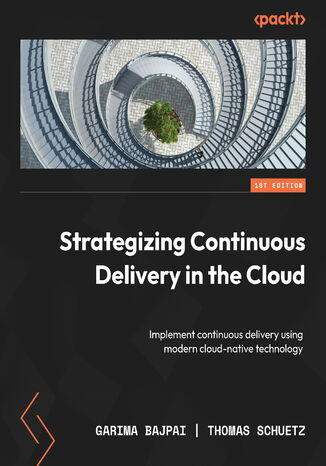
Garima Bajpai, Thomas Schuetz
Many organizations are embracing cloud technology to remain competitive, but implementing and adopting development processes while modernizing a cloud-based ecosystem can be challenging.Strategizing Continuous Delivery in Cloud helps you modernize continuous delivery and achieve infrastructure-application convergence in the cloud. You’ll learn the differences between cloud-based and traditional delivery approaches and develop a tailored strategy. You’ll discover how to secure your cloud delivery environment, ensure software security, run different test types, and test in the pre-production and production stages.You’ll also get to grips with the prerequisites for onboarding cloud-based continuous delivery for organizational and technical aspects. Then, you’ll explore key aspects of readiness to overcome core challenges in your cloud journey, including GitOps, progressive delivery controllers, feature flagging, differences between cloud-based and traditional tools, and implementing cloud chaos engineering.By the end of this book, you’ll be well-equipped to select the right cloud environment and technologies for CD and be able to explore techniques for implementing CD in the cloud.
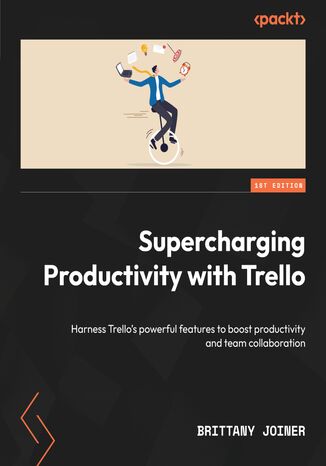
Brittany Joiner
Managing large projects and teams can be an immense challenge, but having an efficient project management system can make all the difference. Trello is one of the leading project management systems, however, it’s crucial to understand its features to leverage its full potential Supercharging Productivity with Trello is the perfect guide for you to enhance efficiency and do more in less time. You’ll start by exploring Trello's structure, including cards, boards, and lists, before diving into Trello card basics. Next, you’ll learn to use Trello views and templates to aggregate tasks and organize projects. You’ll then explore automation, including triggers and actions, to create powerful workflows that will help you prioritize tasks and organize your data effectively. Later, you’ll discover Power-Ups, an add-on that extends Trello's functionality. Throughout the book, you’ll find practical tips and real-world examples to gain practical knowledge. By the end of this book, you’ll be well-equipped to use Trello effectively for task and project management helping you stay on top of your game and deliver quick wins in no time.
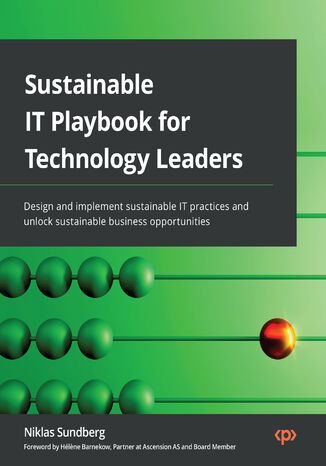
Niklas Sundberg
We are at a critical point in human history. Humanity is under threat, but all is not lost. We can take action! But how?Sustainable IT Playbook for Technology Leaders will show you how. It will walk you through the construction and implementation of a sustainable IT strategy and enable you to do your bit for the future of mankind.The book is split into three parts. Part I details the “why” and the clear and present danger that humanity faces today: the climate crisis. How did we get here, what are the immediate threats, what are the planetary boundaries that we need to peel back to safe levels, and what impact does IT have on society at large? Part II will focus on the what.” It examines the nitty-gritty details of what we can do to unlock significant returns on sustainable investments toward a more sustainable future. Part III, the final part of the book, focuses on the “how.” How do you turn your ideas into action? What do you need to do to establish your baseline and your direction of travel towards your objective? This part provides tangible case studies and explains how you can start your journey today to begin delivering global and impactful objectives.By the end of this book, you’ll be able to plan, implement, and communicate a sustainable IT strategy and set yourself apart as a progressive technology leader.
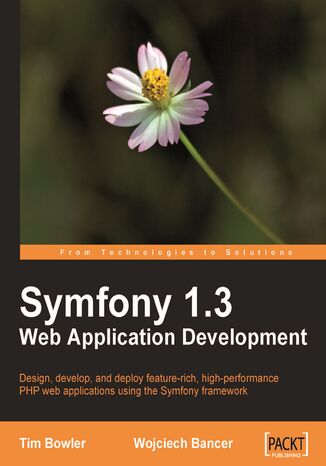
Tim Bowler, Wojciech Bancer
With its flexible architecture, the Symfony framework allows you to build modern web applications and web services easily and rapidly. The MVC components separate the logic from the user interface and therefore make developing, changing, and testing your applications much faster. Using Symfony you can minimize repetitive coding tasks, optimize performance, and easily integrate with other libraries and frameworks.Although this framework contains with many powerful features, most developers do not exploit Symfony to its full potential.This book makes it easy to get started and produce a powerful and professional-looking web site utilizing the many features of Symfony. Taking you through a real-life application, it covers all major Symfony framework features without pushing you into too much theoretical detail, as well as throwing some light on the best practices for rapid application development.This book takes you through detailed examples as well as covering the foundations that you will need to get the most out of the Symfony framework. You will learn to shorten the development time of your complex applications and maintain them with ease. You will create several useful plug-ins and add them to your application and automate common tasks. The book also covers best practices and discussions on security and optimization. You will learn to utilize all major features of this framework by implementing them in your application.By the end, you should have a good understanding of the development features of Symfony (for Propel as well as Doctrine editions), and be able to deploy a high-performance web site quite easily.