
Sztuczna inteligencja
Deep Learning with C++. Design and deploy neural networks using CUDA for high-performance AI in C++
Bill Chen, Vikash Gupta
Deep learning systems often struggle to meet performance demands in real-time and production environments. This book shows you how to build high-performance deep learning systems in C++, enabling efficient and scalable artificial intelligence (AI) in resource-constrained environments where performance matters.You’ll start by setting up a complete C++ deep learning environment and implementing core neural networks from scratch. As you progress, you’ll build advanced architectures, including Convolutional Neural Networks (CNNs), Recurrent Neural Networks (RNNs), Long Short-Term Memory Networks (LSTMs), Generative Adversarial Networks (GANs), and Transformers, using C++, CUDA, and PyTorch’s C++ API. The book then focuses on model quantization and compression. It will guide you through the model deployment process in production with robust monitoring and explainability. You’ll also explore distributed training and techniques for real-time inference in performance-critical domains.By the end of this book, you’ll be able to design, optimize, and deploy deep learning systems in C++ that are production-ready, scalable, and efficient across multiple industries.*Email sign-up and proof of purchase required
Andy Peng, Alex Strick van Linschoten, Duarte...
Learn how to build, fine-tune, and deploy AI systems using DeepSeek, one of the most influential open-source large language models available today. This book guides you through real-world DeepSeek applications—from understanding its core architecture and training foundations to developing reasoning agents and deploying production-ready systems.Starting with a concise synthesis of DeepSeek's research, breakthroughs, and open-source philosophy, you’ll progress to hands-on projects including prompt engineering, workflow design, and rationale distillation. Through detailed case studies—ranging from document understanding to legal clause analysis—you’ll see how to use DeepSeek in high-value GenAI scenarios.You’ll also learn to build sophisticated agent workflows and prepare data for fine-tuning. By the end of the book, you’ll have the skills to integrate DeepSeek into local deployments, cloud CI/CD pipelines, and custom LLMOps environments.Written by experts with deep knowledge of open-source LLMs and deployment ecosystems, this book is your comprehensive guide to DeepSeek’s capabilities and implementation.
Developing AI Applications. An Introduction
Rheinwerk Publishing, Inc, Metin Karatas
This book opens with a clear introduction to AI fundamentals, covering its history and key concepts while guiding readers through installing essential tools like KNIME and AutoKeras. It begins by building a strong foundation in artificial neural networks and decision trees, enabling readers to grasp core AI methods. The journey then advances to convolutional layers for image classification, transfer learning, and anomaly detection, offering practical, beginner-friendly examples.As the reader progresses, the book explores text classification, cluster analysis, and automated AI model creation with AutoKeras. Visual programming with KNIME is introduced to simplify complex AI workflows. Further chapters cover reinforcement learning and genetic algorithms, expanding the reader’s skill set and preparing them for more advanced challenges. Hands-on exercises throughout reinforce concepts and practical application.In its final chapters, the guide dives into cutting-edge AI tools by demonstrating how to leverage ChatGPT and DALL-E APIs, including prompt engineering and API programming. It concludes with an outlook on the future of AI, equipping readers with the knowledge and confidence to build and deploy their own AI-powered applications from start to finish.
Tim Beattie, Mike Hepburn, Noel O'Connor, Donal...
DevOps Culture and Practice with OpenShift features many different real-world practices - some people-related, some process-related, some technology-related - to facilitate successful DevOps, and in turn OpenShift, adoption within your organization. It introduces many DevOps concepts and tools to connect culture and practice through a continuous loop of discovery, pivots, and delivery underpinned by a foundation of collaboration and software engineering.Containers and container-centric application lifecycle management are now an industry standard, and OpenShift has a leading position in a flourishing market of enterprise Kubernetes-based product offerings. DevOps Culture and Practice with OpenShift provides a roadmap for building empowered product teams within your organization.This guide brings together lean, agile, design thinking, DevOps, culture, facilitation, and hands-on technical enablement all in one book. Through a combination of real-world stories, a practical case study, facilitation guides, and technical implementation details, DevOps Culture and Practice with OpenShift provides tools and techniques to build a DevOps culture within your organization on Red Hat's OpenShift Container Platform.
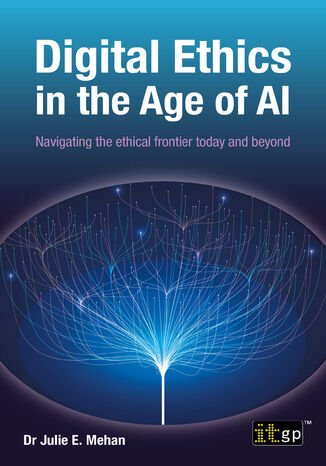
Digital Ethics in the Age of AI. Navigating the ethical frontier today and beyond
IT Governance Publishing, Dr. Julie E. Mehan
Digital Ethics in the Age of AI explores the profound ethical challenges posed by the rise of artificial intelligence and its integration into our daily lives. The book covers AI’s disruptive effects across various sectors, including misinformation, privacy, and job displacement, offering clear explanations and real-world examples. The author delves into the role of AI in spreading misinformation and disinformation, including the creation of deepfakes, and highlights the increasing risk of online disinhibition driven by AI-powered interactions. The book also addresses the cognitive biases embedded within AI systems and the growing concerns over privacy, data security, and surveillance in an age of ubiquitous AI technologies. Finally, the book explores the potential for AI-driven job displacement, particularly in the cognitive class, and the societal implications of such disruptions. It also covers intellectual property challenges in the age of AI and the complexities surrounding generative AI’s impact on privacy and digital ownership. Offering solutions for mitigating these risks, Digital Ethics in the Age of AI provides a roadmap for navigating the ethical and regulatory landscape of AI today and in the future.

Gerard Johansen
Digital Forensics and Incident Response will guide you through the entire spectrum of tasks associated with incident response, starting with preparatory activities associated with creating an incident response plan and creating a digital forensics capability within your own organization. You will then begin a detailed examination of digital forensic techniques including acquiring evidence, examining volatile memory, hard drive assessment, and network-based evidence. You will also explore the role that threat intelligence plays in the incident response process. Finally, a detailed section on preparing reports will help you prepare a written report for use either internally or in a courtroom.By the end of the book, you will have mastered forensic techniques and incident response and you will have a solid foundation on which to increase your ability to investigate such incidents in your organization.
Nelson Enriquez, Samundar Singh Rathore
Business Intelligence is a type of technology that has been proven to support business decisions in an organization. MicroStrategy 9 is a fully-integrated BI platform that makes Business Intelligence faster, easier, and more user-friendly. It enables businesses to generate their own reports and dashboards without the need for technical knowledge.This practical, hands-on guide will provide Business Intelligence for executives, as well as enable BI reports and dashboards without the dependency of IT savvy personnel. It will allow you to design, build, and share business relevant data in hours, in a secure way, including mobile devices and show you how to leverage your transactional information.This example-oriented book looks at the value proposition of cloud computing and the MicroStrategy platform, and features practical exercises for BI reports and dashboard enablement, including the design phase and best practices for when we design a BI report.The book begins with an exploration of MicroStrategy along with typical business needs. Our focus then shifts to best practices for BI reports and dashboard definitions from the functional stand point, with easy-to-do exercises that will allow you to enable the reports in the platform. You will learn about scorecards and dashboards, along with sharing the reports. Next, you will get acquainted with cloud-based services provided by the MicroStrategy platform. By the end of this book, you will able to design, enable, and share BI reports and dashboards without the need for comprehensive technical knowledge, and leverage the latest technology on the market.
Fuheng Wu
As AI models grow to billions and trillions of parameters, distributed systems are essential for training and serving them. Many resources cover fragments of this domain, but none provide a full path from distributed training to inference and production deployment. This book fills that gap with practical, production-focused examples.It starts with GPU and memory estimation, data preparation, and an overview of GPU architecture, interconnects, and core parallelism strategies. You’ll learn training techniques including data parallelism for single and multi-node setups, parameter sharding for memory-efficient scaling, and methods to reduce memory usage in large models.The next section covers distributed inference and deployment. You’ll build high-performance systems using optimized attention, caching, operator fusion, and router-based designs. You’ll deploy on schedulers and container platforms with GPU-aware orchestration and assemble production stacks emphasizing reliability, scalability, and observability.The final section covers benchmarking, performance tuning, and trends like MoE models, edge - cloud co-ordination, and advanced parallelism. Each chapter includes tested code and debugging guidance.By the end, you’ll be able to build distributed AI systems that scale from a single GPU to large clusters.
DZIENNIK(AI)RSTWO. Jak sztuczna inteligencja zmienia najciekawszą profesję na świecie
Jan Kreft
Za banałem rewolucji sztucznej inteligencji (AI) kryją się obietnice, lęki i marzenia o nirwanie końca ułomności dziennikarstwa i bogactwie możliwości. Dziennikarstwo algorytmiczne, dziennikarstwo danych, burzy fundamenty modeli biznesowych i zarządzania mediami, tożsamości i ról zawodowych oraz dziennikarskiej ideologii. Obiecuje wiele, destabilizuje wszystko. Zapowiada egalitaryzm, oferuje niespotykaną historycznie dominację. To opowieść o tym, co nauka ma do powiedzenia o maszynach "płynnych bzdur" i chatbotach nie tylko w roli "służalczych kretynów". O schyłku hegemonii dziennikarstwa, o kreatywności i wiarygodności sztucznej inteligencji w dziennikarstwie, stereotypach na temat dezinformacji i powszechnym zastępowaniu i uzupełnianiu dziennikarza w jego zadaniach. O autorytecie algorytmicznym oraz szkoleniu sztucznej inteligencji i treściach nie do odróżnienia od dzieł dziennikarzy. O inwazji "obcych" na jedną z najbardziej pasjonujących profesji, pożytkach teorii ludowych i teorii spiskowych. Także o tym, czym jest prawda sztucznej inteligencji. Wreszcie o przyszłości, oporze algorytmicznym i sensie wykonywania zawodu dziennikarza na świecie i w Polsce. Książka prof. Jana Krefta DZIENNIK(AI)RSTWO. Jak sztuczna inteligencja zmienia najciekawszą profesję na świecie jest niewątpliwie skazana na sukces, podejmując problematykę tzw. sztucznej inteligencji, która stała się obecnie tematem o pierwszoplanowym charakterze i jest rozpatrywana w różnych kontekstach: prawnym, ekonomicznym, społecznym. Entuzjazm i jednocześnie niepokój, jakie wywołuje, można porównać do podobnej gorączki, która towarzyszyła rozwojowi Internetu pod koniec lat 90. Książka, która podejmuje ten temat, wpisuje się natychmiast w gorącą atmosferę oczekiwań i lęków, co z pewnością przełoży się na jej popularność, a także [...] będzie wyznaczać przyszłe tory refleksji, definiować podstawowe pole analizy czy podsuwać główne pojęcia z tą refleksją związane. Z recenzji prof. Rafała Maciąga, Uniwersytet Jagielloński Prof. dr hab. Jan Kreft - wieloletni dziennikarz i korespondent zagraniczny, menedżer zarządzający firmami mediów i nowych technologii. Szef Zakładu Zarządzania Algorytmicznego (Politechnika Gdańska). Autor kilkunastu książek, między innymi: Władza algorytmów, Władza platform, Za fasadą społeczności, Koniec dziennikarstwa, jakie znamy oraz Władza misjonarzy. Zmierzch i świt świeckiej religii w Dolinie Krzemowej.
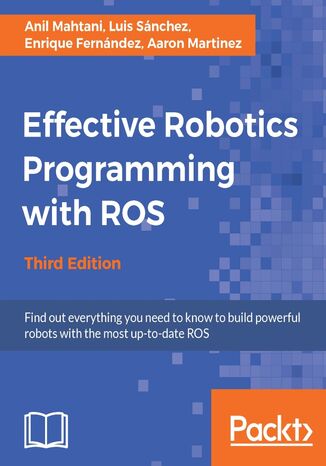
Luis Sanchez, Enrique Fernandez Perdomo, Anil Mahtani
Building and programming a robot can be cumbersome and time-consuming, but not when you have the right collection of tools, libraries, and more importantly expert collaboration. ROS enables collaborative software development and offers an unmatched simulated environment that simplifies the entire robot building process.This book is packed with hands-on examples that will help you program your robot and give you complete solutions using open source ROS libraries and tools. It also shows you how to use virtual machines and Docker containers to simplify the installation of Ubuntu and the ROS framework, so you can start working in an isolated and control environment without changing your regular computer setup.It starts with the installation and basic concepts, then continues with more complex modules available in ROS such as sensors and actuators integration (drivers), navigation and mapping (so you can create an autonomous mobile robot), manipulation, Computer Vision, perception in 3D with PCL, and more. By the end of the book, you’ll be able to leverage all the ROS Kinetic features to build a fully fledged robot for all your needs.

ElevenLabs. Zastosowanie w biznesie i twórczości
Witold Wrotek
To do mnie przemawia Wśród rozmaitych zastosowań sztucznej inteligencji znajdują się możliwości klonowania i generowania głosu. Obecnie na rynku dostępnych jest kilka narzędzi służących do tych celów ― jedno z nich to wciąż zyskująca na popularności platforma ElevenLabs. Stworzył ją zespół pod przewodnictwem dwóch polskich inżynierów: Piotra Dąbkowskiego, który wcześniej pracował dla Google, i Mateusza Staniszewskiego, byłego stratega wdrażania w Palantir Technologies. Inspiracją do powstania ich firmy ElevenLabs była chęć kreowania bardziej realistycznych dubbingów filmowych. Jeśli chcesz się nauczyć klonować głosy w taki sposób, by były nieodróżnialne od prawdziwych — odpowiednio modulowane, o oczekiwanej barwie i intonacji, przekazujące emocje — ta książka jest dla Ciebie. Obsługa narzędzi do generowania głosów AI nie jest trudna, a dzięki temu poradnikowi opanujesz ją błyskawicznie. Z książki dowiesz się między innymi: Dlaczego spośród dostępnych syntezatorów mowy warto wybrać ElevenLabs Jak szybko stworzyć swój pierwszy głosowy komentarz W jaki sposób promptować, by uzyskać naturalnie brzmiące rezultaty Co o klonowaniu i generowaniu głosów mówi prawo Jak przygotowywać nagrania wysokiej jakości ― w tym na potrzeby radia i w różnych językach Jak generować dialogi, podcasty i audiobooki W jaki sposób można zarabiać dzięki syntezie głosu opartej na AI
Suvoraj Biswas
The course begins with an insightful introduction to the burgeoning field of Generative AI, laying down a robust framework for understanding its applications within the AWS ecosystem.The course focuses on meticulously detailing the five pillars of the AWS Well-Architected Framework—Operational Excellence, Security, Compliance, Reliability, and Cost Optimization. Each module is crafted to provide you with a comprehensive understanding of these essential areas, integrating Generative AI technologies. You'll learn how to navigate the complexities of securing AI systems, ensuring they comply with legal and regulatory standards, and designing them for unparalleled reliability. Practical sessions on cost optimization strategies for AI projects will empower you to deliver value without compromising on performance or scalability. Furthermore, the course delves into System Architecture Excellence, emphasizing the importance of robust design principles in creating effective Generative AI solutions.The course wraps up by offering a forward-looking perspective on the Common Architectural Pattern for FM/LLM Integration & Adoption within the AWS framework. You'll gain hands-on experience with AWS solutions specifically tailored for Generative AI applications, including Lambda, API Gateway, and DynamoDB, among others.
Mercury Learning and Information, William Kimmerly
This book guides organizations in effectively responding to the metaverse, a rapidly converging collection of advanced technologies, methods, and models. The metaverse is poised to be as disruptive as the personal computer, Internet, and smartphone, impacting personal, social, professional, and business lives. The book covers essential metaverse technologies and concepts, helping organizational leaders plan their transformation strategies.The journey begins with an introduction and key definitions, followed by the evolution of IT governance and responses to disruptive technologies. It delves into AI, machine learning, blockchain, platforms, algorithms, edge computing, quantum computing, and immersive technologies like VR, AR, MR, and XR. Further chapters explore holographic technologies, deep tech, and other metaverse-related technologies, along with organizational structures and governance frameworks for the metaverse era.Understanding these concepts is crucial for navigating the metaverse transformation. The book concludes with a detailed hypothetical case study, illustrating how such a transformation can be achieved. This resource helps executives and professionals chart an effective course to the metaverse, blending theoretical insights with practical applications.
Ryan Doan
The rapid advancements in large language models (LLMs) bring significant challenges in deployment, maintenance, and scalability. This Essential Guide to LLMOps provides practical solutions and strategies to overcome these challenges, ensuring seamless integration and the optimization of LLMs in real-world applications.This book takes you through the historical background, core concepts, and essential tools for data analysis, model development, deployment, maintenance, and governance. You’ll learn how to streamline workflows, enhance efficiency in LLMOps processes, employ LLMOps tools for precise model fine-tuning, and address the critical aspects of model review and governance. You’ll also get to grips with the practices and performance considerations that are necessary for the responsible development and deployment of LLMs. The book equips you with insights into model inference, scalability, and continuous improvement, and shows you how to implement these in real-world applications.By the end of this book, you’ll have learned the nuances of LLMOps, including effective deployment strategies, scalability solutions, and continuous improvement techniques, equipping you to stay ahead in the dynamic world of AI.
Everyone Is a Programmer. A battle-tested guide to building real apps with AI coding
Zhang Bin, Wu Zhenyao
This book is written by practitioners shaping AI coding tools and developer ecosystems in one of the world’s most application-driven tech environments.Vibe coding is a modern, AI-driven way of building software where you focus on what you want to create, and AI helps handle how it’s built. But it is not a shortcut or a gimmick. Effective vibe coding requires understanding how products are structured, how systems fit together, and how ideas turn into real, usable applications.This book introduces you to just that, helping you find your way to your first AI-coded apps.In six chapters, you’ll learn to ideate, plan, and execute your app ideas. You’ll hit the ground running with professional-grade tools like TRAE SOLO, Cursor, Figma, Vercel, and Supabase. The book’s coverage of end-to-end AI application development includes UI/UX, backend, hosting, authentication, and payment integration.By the end, you will have built two full projects and be equipped with a new way to create. What you build next is up to you.
Bryan Lyon, Matt Tora
Applying Deepfakes will allow you to tackle a wide range of scenarios creatively.Learning from experienced authors will help you to intuitively understand what is going on inside the model. You’ll learn what deepfakes are and what makes them different from other machine learning techniques, and understand the entire process from beginning to end, from finding faces to preparing them, training the model, and performing the final swap.We’ll discuss various uses for face replacement before we begin building our own pipeline. Spending some extra time thinking about how you collect your input data can make a huge difference to the quality of the final video. We look at the importance of this data and guide you with simple concepts to understand what your data needs to really be successful.No discussion of deepfakes can avoid discussing the controversial, unethical uses for which the technology initially became known. We’ll go over some potential issues, and talk about the value that deepfakes can bring to a variety of educational and artistic use cases, from video game avatars to filmmaking.By the end of the book, you’ll understand what deepfakes are, how they work at a fundamental level, and how to apply those techniques to your own needs.
Rollan Banez
Creating conceptual art and design assets is a slow and laborious process, especially for those unfamiliar with complex design tools. With Adobe Firefly, you can say goodbye to your design challenges and start creating attractive visuals faster than ever before. Written by an Adobe expert with over two decades of experience, Extending Creativity With Adobe Firefly teaches you how to use Generative AI for art and design with easy-to-follow steps. You’ll learn how to create images, add text effects, edit photos, and explore colors faster with Adobe Firefly. You'll discover Firefly’s capabilities for tasks like generating text-to-image samples, styling text effects, and editing photos quickly. You’ll also find how to integrate Firefly with other Adobe Creative Cloud apps to streamline your workflow. If you're just starting out, this book will acquaint you with the basics of design, enabling you to create images easily. If you are a professional, you’ll learn how to improve collaboration and visual communication, and if you are a teacher, you’ll be able to enhance your teaching methods with visual thinking. By the end, you’ll master every function of Adobe Firefly and create outputs for website and desktop applications such as Photoshop, Illustrator, Express, and Adobe Stock.
Prasanna Vijayanathan
As generative AI moves into critical applications like hiring, credit decisions, education, and healthcare, the potential for real-world harm escalates. When systems perpetuate stereotypes or skew outcomes based on identity, the impact goes far beyond poor user experience. It results in lost opportunities, violated dignity, and erosion of trust. This book offers practical methods for evaluating and ensuring fairness across text, image, and multimodal GenAI systems. You'll begin with fairness principles that matter for GenAI and learn how to translate philosophical constructs into engineering artifacts. Abstract goals become measurable requirements: what constitutes harm, which groups are in scope, how fairness is defined, and which trade-offs are acceptable. Next, design a benchmarking framework that integrates with existing pipelines. Thereafter, create scenario and prompt libraries, model sensitive attributes and intersections, and run evaluations through an orchestrated pipeline. Implement quantitative metrics and qualitative rubrics, add human review with rater training and agreement checks, and publish results as scorecards and dashboards. Finally, integrate fairness checks into CI and model release gates, monitor drift, and run incident response playbooks so benchmarks stay credible as models and norms evolve.
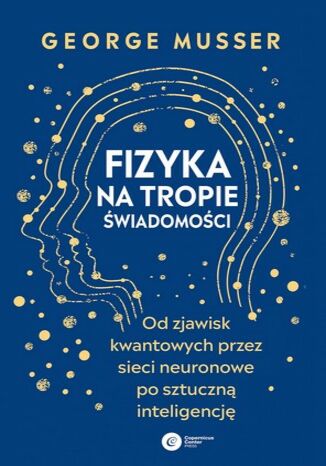
Fizyka na tropie świadomości. Od zjawisk kwantowych przez sieci neuronowe po sztuczną inteligencję
George Musser
Jak się uczy sztuczna inteligencja? Czy może popełniać błędy? Czy kiedykolwiek będzie świadoma? Czym się różni wiersz napisany przez ChatGTP od wiersza, którego autorem jest człowiek? George Musser rozmawia ze znanymi fizykami zajmującymi się najbardziej śmiałymi teoriami i prowadzącymi intrygujące badania. Porusza tematy zjawisk kwantowych, sieci neuronowych, sztucznej inteligencji i, przede wszystkim, świadomości. Szuka tak pożądanej przez naukowców "teorii wszystkiego" wspólnie z najwybitniejszymi umysłami naszej epoki. A to nie takie proste! Fizycy bywają wszak ciekawscy, wścibscy i natrętni. Gdy zasną, śnią im się kolejne pytania, gdy się budzą, zaczynają z zapałem analizować, czy śnili świadomie. Gdy zobaczą kota na kanapie, zamiast zapytać, kto sobie tak słodko śpi, pytają, czy zrozumiałby rachunek różniczkowy. Gdy poprosisz trzech fizyków o wyjaśnienie jednego problemu, otrzymasz cztery różne teorie. Na szczęście, nikt nie potrafi z nimi rozmawiać tak jak wytrawny dziennikarz naukowy George Musser. Dzięki Fizyce na tropie świadomości nauczysz się tego, czego jeszcze nie umie żadna sztuczna inteligencja: umiejętności zadawania krytycznych pytań.
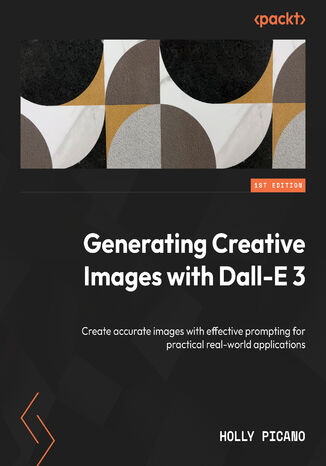
Holly Picano
Unveil the extraordinary capabilities of the groundbreaking AI model, DALL-E 3, as it transforms text prompts into accurate images. This book addresses the challenge of creating meaningful images by writing prompts, guiding you step by step through creating stunning visual art regardless of your skill level.Prepare to delve deep into the inner workings of DALL-E 3's architecture and training process. With clear explanations, practical tutorials, and real-world examples that can be easily applied, you’ll unlock secrets to creating awe-inspiring AI-generated art, from fine art prints to digital designs. This book provides comprehensive insights into various lens options, camera angles, lighting techniques, and art movements, helping you integrate AI capabilities with your artistic skills. You’ll also learn to create NFTs that can be monetized and gain invaluable insights into designing compelling covers, all within the ethical boundaries of AI-generated art. And with the invaluable prompt cheat sheet by your side, you’ll hone your skills in formulating captivating prompts for diverse purposes.By the end of this book, you’ll have learned how to produce generative AI art at a rapid pace and relatively low cost and push the boundaries of imagination with DALL-E 3.
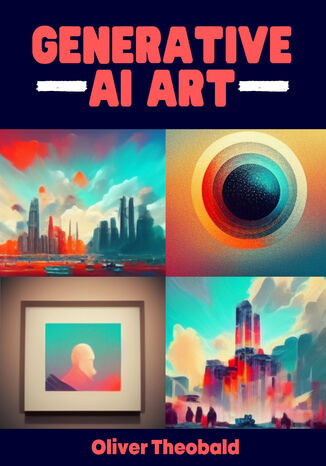
Generative AI Art. Unleash Your Creativity with Generative AI Art for Beginners
Oliver Theobald
The course introduces the basic concepts of artificial intelligence and its application in art, making it accessible even to those without a technical background. This foundation paves the way for exploring the nuances of effective prompt crafting, a critical skill for generating bespoke AI artwork.The course focuses on hands-on demonstrations with leading AI art software, including Craiyon and Midjourney, offering step-by-step guides to harness these tools effectively. Through practical examples, learners will understand how to navigate image prompts, masking techniques, framing, and lighting to enhance the visual appeal of their creations. The significance of navigating these elements is underscored, highlighting their role in achieving consistency and originality in AI-generated art.The course wraps up by delving into the remixing of popular art styles, the art of creating compelling text prompts, and the critical aspects of image rights, ethics, privacy, and originality in the digital art space. By concluding with recommended resources, learners are equipped to continue their journey in AI art, fueled by inspiration and a solid understanding of the field's possibilities and responsibilities.
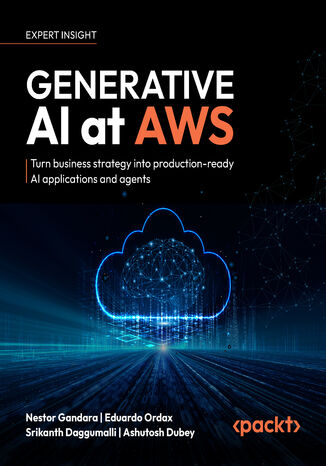
Generative AI at AWS. Turn business strategy into production-ready AI applications and agents
Nestor Gandara, Eduardo Ordax, Srikanth Daggumalli, Ashutosh...
Cut through the noise around generative AI and learn how to turn promising ideas into secure, scalable solutions on AWS. This book helps you connect business priorities with technical execution, so you can identify worthwhile use cases, select the right models and services, and move from pilot to production with confidence.You explore the fundamentals of generative AI, understand how foundation models and agents work, and see where services such as Amazon Bedrock AgentCore and Amazon SageMaker AI fit into a modern AI stack. From there, the book guides you through preparing data, building an MVP, deploying production-ready applications, and designing for scalability, governance, and responsible AI.Real-world industry examples and practical decision frameworks help you evaluate when to use generative AI, when traditional approaches are a better fit, and how to measure business value. You also examine advanced topics such as agentic AI, emerging patterns, and the future direction of enterprise AI.By the end of this book, you will be able to plan, build, and govern generative AI solutions on AWS that deliver measurable value for your organization.
Adrián González Sánchez
Gen AI has shifted from a technical breakthrough to a leadership imperative. This book is the essential guide for executives, directors, and tech leads who must navigate this transformation. Written for strategic leaders and decision-makers, it bridges the gap between AI’s technical realities and enterprise applications, equipping leaders with the fluency, frameworks, and foresight to lead effectively in the age of digital intelligence. This playbook demystifies key concepts such as Generative AI, LLMs, and emerging agentic AI systems. It guides readers through crafting AI strategies aligned with business objectives, building AI-native organizations, and implementing governance frameworks for responsible and compliant adoption. Real-world case studies illustrate how leading companies are leveraging AI for innovation, efficiency, and growth. Beyond strategy, the book focuses on assembling and scaling AI teams, evaluating technology vendors, and integrating AI across functions. You’ll also explore global policy trends, ethical implications, and future scenarios that every organization must prepare for. This playbook is your roadmap to turning AI disruption into sustainable advantage. It’s the leadership guide every executive needs to understand, implement, and scale AI responsibly.*Email sign-up and proof of purchase required
Saurabh Shrivastava, Kamal Arora, Ashutosh Dubey, Sanjeet...
Generative AI for Software Developers is your practical guide to mastering AI-powered development and staying ahead in a fast-changing industry. Through a structured, hands-on approach, this book helps you understand, implement, and optimize Generative AI in modern software engineering. From AI-assisted coding, debugging, and documentation to testing, deployment, and system design, it equips you with the skills to integrate AI seamlessly into your workflows.You’ll work with tools such as GitHub Copilot, Amazon Q Developer, and OpenAI APIs while learning strategies for prompt engineering, fine-tuning, and building scalable AI-powered applications. Featuring real-world use cases, best practices, and expert insights, this book bridges the gap between experimenting with AI and production deployment.Whether you’re an aspiring AI developer, experienced engineer, or solutions architect, this guide gives you the clarity, confidence, and tactical knowledge to thrive in the GenAI-driven future of software development. Armed with these insights, you’ll be ready to build, integrate, and scale intelligent solutions that enhance every stage of the software development lifecycle.