
Sztuczna inteligencja
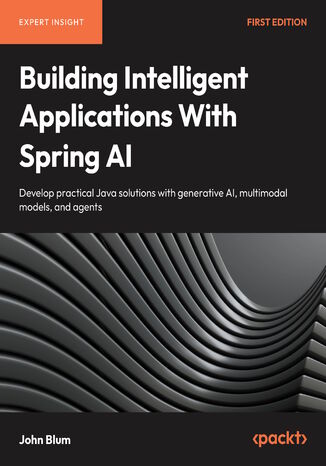
John Blum
Learn how to turn AI ideas into practical Java applications without fighting unfamiliar tools or excessive boilerplate. This book shows you how to use Spring AI to build intelligent applications with the Spring programming model, helping you work productively while applying chat, audio, image, embeddings, structured output, and automation capabilities in real projects.Written by John Blum, a staff software engineer formerly with Spring R&D at VMware and a contributor to Spring AI, Spring Boot, Spring Data, Spring Framework, and Spring Session, this book combines deep Spring expertise with hands-on AI experience. You start with the foundations of AI and Spring AI, then move into building applications that translate messages in real time, process audio, identify songs, and compare model reasoning in game-based scenarios.You also explore model options, observability, testing, extensions, and autonomous workflows so you can move beyond prototypes and build reliable applications. By the end of this book, you will be comfortable using Spring AI to design, develop, evaluate, and refine intelligent Java applications for a wide range of use cases.
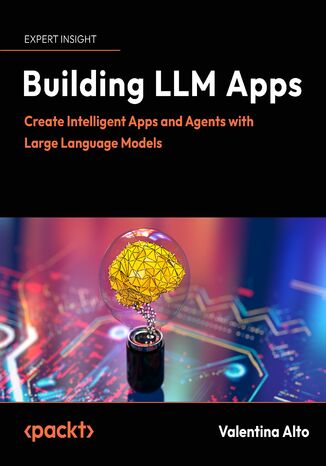
Building LLM Powered Applications. Create intelligent apps and agents with large language models
Valentina Alto
Building LLM Powered Applications delves into the fundamental concepts, cutting-edge technologies, and practical applications that LLMs offer, ultimately paving the way for the emergence of large foundation models (LFMs) that extend the boundaries of AI capabilities.The book begins with an in-depth introduction to LLMs. We then explore various mainstream architectural frameworks, including both proprietary models (GPT 3.5/4) and open-source models (Falcon LLM), and analyze their unique strengths and differences. Moving ahead, with a focus on the Python-based, lightweight framework called LangChain, we guide you through the process of creating intelligent agents capable of retrieving information from unstructured data and engaging with structured data using LLMs and powerful toolkits. Furthermore, the book ventures into the realm of LFMs, which transcend language modeling to encompass various AI tasks and modalities, such as vision and audio.Whether you are a seasoned AI expert or a newcomer to the field, this book is your roadmap to unlock the full potential of LLMs and forge a new era of intelligent machines.*Email sign-up and proof of purchase required
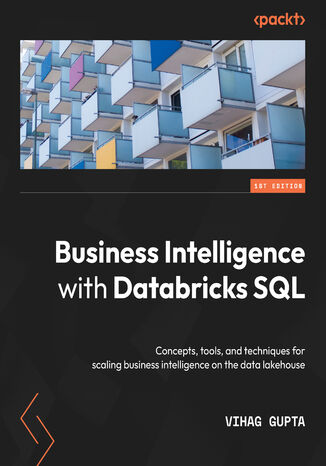
Vihag Gupta
In this new era of data platform system design, data lakes and data warehouses are giving way to the lakehouse – a new type of data platform system that aims to unify all data analytics into a single platform. Databricks, with its Databricks SQL product suite, is the hottest lakehouse platform out there, harnessing the power of Apache Spark™, Delta Lake, and other innovations to enable data warehousing capabilities on the lakehouse with data lake economics.This book is a comprehensive hands-on guide that helps you explore all the advanced features, use cases, and technology components of Databricks SQL. You’ll start with the lakehouse architecture fundamentals and understand how Databricks SQL fits into it. The book then shows you how to use the platform, from exploring data, executing queries, building reports, and using dashboards through to learning the administrative aspects of the lakehouse – data security, governance, and management of the computational power of the lakehouse. You’ll also delve into the core technology enablers of Databricks SQL – Delta Lake and Photon. Finally, you’ll get hands-on with advanced SQL commands for ingesting data and maintaining the lakehouse.By the end of this book, you’ll have mastered Databricks SQL and be able to deploy and deliver fast, scalable business intelligence on the lakehouse.
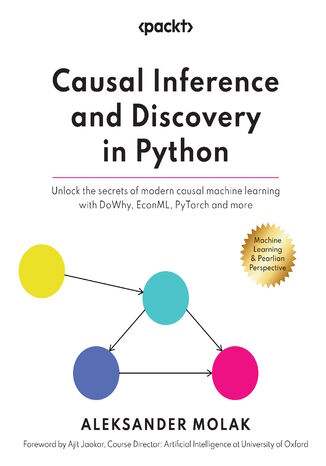
Aleksander Molak, Ajit Jaokar
Causal methods present unique challenges compared to traditional machine learning and statistics. Learning causality can be challenging, but it offers distinct advantages that elude a purely statistical mindset. Causal Inference and Discovery in Python helps you unlock the potential of causality.You’ll start with basic motivations behind causal thinking and a comprehensive introduction to Pearlian causal concepts, such as structural causal models, interventions, counterfactuals, and more. Each concept is accompanied by a theoretical explanation and a set of practical exercises with Python code. Next, you’ll dive into the world of causal effect estimation, consistently progressing towards modern machine learning methods. Step-by-step, you’ll discover Python causal ecosystem and harness the power of cutting-edge algorithms. You’ll further explore the mechanics of how “causes leave traces” and compare the main families of causal discovery algorithms. The final chapter gives you a broad outlook into the future of causal AI where we examine challenges and opportunities and provide you with a comprehensive list of resources to learn more.By the end of this book, you will be able to build your own models for causal inference and discovery using statistical and machine learning techniques as well as perform basic project assessment.
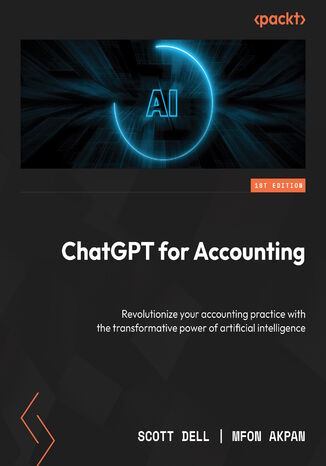
Dr. Scott Dell, Dr. Mfon Akpan
In the fast-paced AI world, accounting professionals are increasingly challenged by the complexities of AI. Many struggle to integrate these advanced tools into their workflows, leading to a sense of overwhelm. ChatGPT for Accounting bridges this gap by not only simplifying AI concepts but also offering practical insights for its application in various accounting domains.This book takes you from the foundational principles of Generative Artificial Intelligence (GAI) to its practical applications in audits, tax planning, practice management, fraud examination, financial analysis, and beyond. Each chapter equips you with essential skills, showing you how AI can revolutionize internal control systems, enhance recruitment processes, streamline marketing plans, optimize tax strategies, and boost efficiency in audits. You’ll then advance to exploring the role of AI in forensic accounting, financial analysis, managerial accounting, and corporate governance, while also addressing ethical and security implications.Concluding with a reflective outlook on the promises and challenges of AI, you’ll gain a holistic view of the future of accounting. By the end of this book, you’ll be equipped with the knowledge to harness the power of AI effectively and ethically, transforming your accounting practice and staying ahead in the ever-evolving landscape.
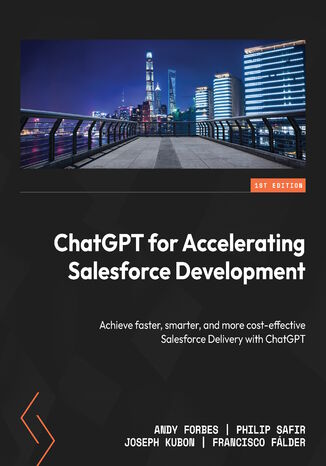
Andy Forbes, Philip Safir, Joseph Kubon, Francisco...
Authored by a team of Salesforce masters with exemplary IT background, ChatGPT for Salesforce Development helps you learn about the intricacies of Salesforce design, configuration, coding, and testing, demonstrating how ChatGPT can simplify complex setups and enhance project team efficiency.With this book, you’ll unlock the effective use of ChatGPT for crafting user stories that align seamlessly with project goals, learn how to design and implement Salesforce flows, and quickly write clear, comprehensive, and high-quality project documentation. You’ll leverage ChatGPT to write new Apex code, decipher existing code, and explore the development of web services and callouts. This book covers everything from trigger creation to the development of Lightning Web Components (LWC), highlighting how these can accelerate the development process. Applying ChatGPT's debugging capabilities, you’ll swiftly identify and resolve Salesforce issues to uphold the integrity and performance of your Salesforce applications.By the end of this book, you’ll be adept at integrating ChatGPT at every stage of Salesforce project delivery, from initial configuration to final testing.
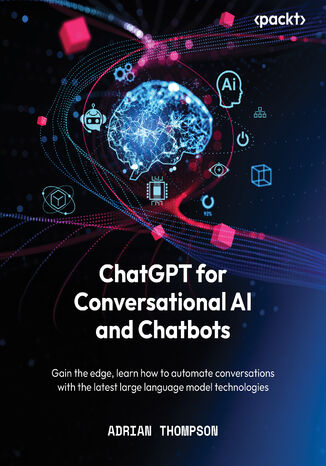
Adrian Thompson
ChatGPT for Conversational AI and Chatbots is a definitive resource for exploring conversational AI, ChatGPT, and large language models.This book introduces the fundamentals of ChatGPT and conversational AI automation. You’ll explore the application of ChatGPT in conversation design, the use of ChatGPT as a tool to create conversational experiences, and a range of other practical applications. As you progress, you’ll delve into LangChain, a dynamic framework for LLMs, covering topics such as prompt engineering, chatbot memory, using vector stores, and validating responses. Additionally, you’ll learn about creating and using LLM-enabling tools, monitoring and fine tuning, LangChain UI tools such as LangFlow, and the LangChain ecosystem. You’ll also cover popular use cases, such as using ChatGPT in conjunction with your own data. Later, the book focuses on creating a ChatGPT-powered chatbot that can comprehend and respond to queries directly from your unique data sources. The book then guides you through building chatbot UIs with ChatGPT API and some of the tools and best practices available.By the end of this book, you’ll be able to confidently leverage ChatGPT technologies to build conversational AI solutions.
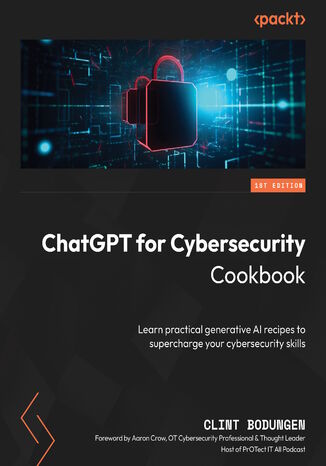
Clint Bodungen, Aaron Crow
Are you ready to unleash the potential of AI-driven cybersecurity? This cookbook takes you on a journey toward enhancing your cybersecurity skills, whether you’re a novice or a seasoned professional. By leveraging cutting-edge generative AI and large language models such as ChatGPT, you'll gain a competitive advantage in the ever-evolving cybersecurity landscape.ChatGPT for Cybersecurity Cookbook shows you how to automate and optimize various cybersecurity tasks, including penetration testing, vulnerability assessments, risk assessment, and threat detection. Each recipe demonstrates step by step how to utilize ChatGPT and the OpenAI API to generate complex commands, write code, and even create complete tools. You’ll discover how AI-powered cybersecurity can revolutionize your approach to security, providing you with new strategies and techniques for tackling challenges. As you progress, you’ll dive into detailed recipes covering attack vector automation, vulnerability scanning, GPT-assisted code analysis, and more. By learning to harness the power of generative AI, you'll not only expand your skillset but also increase your efficiency.By the end of this cybersecurity book, you’ll have the confidence and knowledge you need to stay ahead of the curve, mastering the latest generative AI tools and techniques in cybersecurity.