
Sztuczna inteligencja
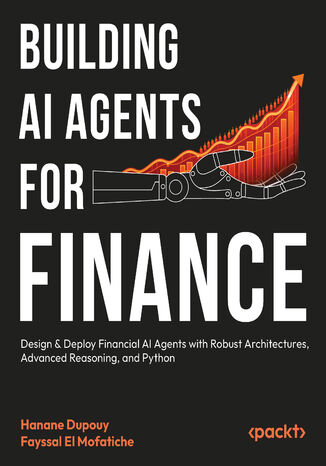
Hanane Dupouy, Fayssal El Mofatiche
AI agents are rapidly changing how financial systems analyze information, make decisions, and automate complex workflows. While many resources explain agentic AI concepts at a high level, few show how to design and deploy AI agents that work reliably in real financial environments. This book fills that gap. You will start by learning what AI agents are, how they differ from non-agentic systems, and when agentic architectures are the right choice. Next, explore core design patterns, memory management strategies, AI agents frameworks , and reasoning paradigms such as ReAct, reflection, self-consistency, LATS , and multi-agent collaboration across various architectural styles. You will apply these concepts through practical Python labs and deep-dive finance use cases, including fundamental analysis, research, trading, insurance, and compliance. Next, you will learn how to evaluate agent behavior, implement guardrails, and add tracing and observability to ensure safe and reliable operation. Finally, focus on operationalization and Responsible AI, covering cost and latency trade-offs, scaling strategies, human-in-the-loop systems, and ethical considerations required in regulated financial settings. By the end, you’ll know how to design, evaluate, and deploy finance AI agents that deliver real business value.
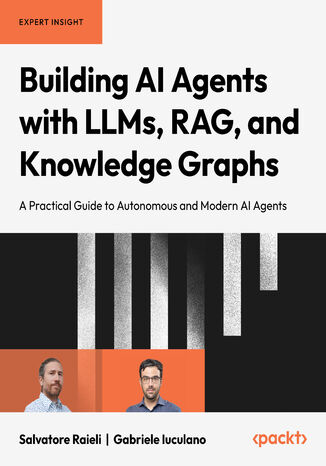
Salvatore Raieli, Gabriele Iuculano
This book addresses the challenge of building AI that not only generates text but also grounds its responses in real data and takes action. Authored by AI specialists with expertise in drug discovery and systems optimization, this guide empowers you to leverage retrieval-augmented generation (RAG), knowledge graphs, and agent-based architectures to engineer truly intelligent behavior. By combining large language models (LLMs) with up-to-date information retrieval and structured knowledge, you'll create AI agents capable of deeper reasoning and more reliable problem-solving.Inside, you'll find a practical roadmap from concept to implementation. You’ll discover how to connect language models with external data via RAG pipelines for increasing factual accuracy and incorporate knowledge graphs for context-rich reasoning. The chapters will help you build and orchestrate autonomous agents that combine planning, tool use, and knowledge retrieval to achieve complex goals. Concrete Python examples and real-world case studies reinforce each concept and show how the techniques fit together.By the end of this book, you’ll be able to build intelligent AI agents that reason, retrieve, and interact dynamically, empowering you to deploy powerful AI solutions across industries.*Email sign-up and proof of purchase required
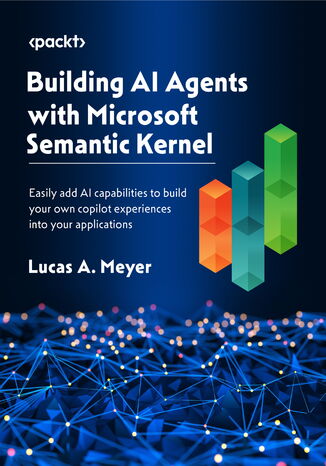
Lucas A. Meyer
In the fast-paced world of AI, developers are constantly seeking efficient ways to integrate AI capabilities into their apps. Microsoft Semantic Kernel simplifies this process by using the GenAI features from Microsoft and OpenAI.Written by Lucas A. Meyer, a Principal Research Scientist in Microsoft’s AI for Good Lab, this book helps you get hands on with Semantic Kernel. It begins by introducing you to different generative AI services such as GPT-3.5 and GPT-4, demonstrating their integration with Semantic Kernel. You’ll then learn to craft prompt templates for reuse across various AI services and variables. Next, you’ll learn how to add functionality to Semantic Kernel by creating your own plugins. The second part of the book shows you how to combine multiple plugins to execute complex actions, and how to let Semantic Kernel use its own AI to solve complex problems by calling plugins, including the ones made by you. The book concludes by teaching you how to use vector databases to expand the memory of your AI services and how to help AI remember the context of earlier requests. You’ll also be guided through several real-world examples of applications, such as RAG and custom GPT agents.By the end of this book, you'll have gained the knowledge you need to start using Semantic Kernel to add AI capabilities to your applications.
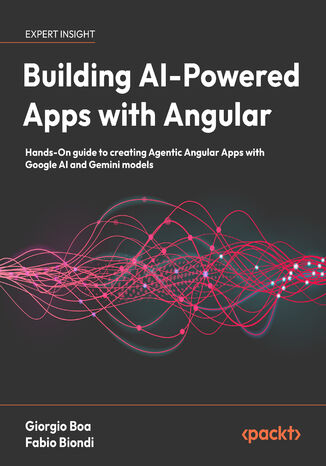
Giorgio Boa, Fabio Biondi
In Building AI-Powered Apps with Angular, you'll embark on an end-to-end journey to revolutionize web development with artificial intelligence. This hands-on guide shows you how to integrate cutting-edge AI capabilities, particularly Large Language Models (LLMs) like Google Gemini and multimodal agents, directly into your Angular applications.Starting with AI/ML fundamentals and an introduction to Google Gemini using Node.js, you’ll quickly progress to building sophisticated AI features within your Angular frontend. You’ll create dynamic content, design intelligent multi-turn chat interfaces, and harness multimodal AI to analyze and generate rich media such as images and videos.The journey extends beyond the frontend. You’ll build robust backends with Angular Server-Side Rendering and Genkit, enabling seamless communication with AI models. You’ll also implement advanced search capabilities using Retrieval Augmented Generation (RAG) and Firestore and learn how to deploy your AI-powered Angular app to the cloud.By the end of the book, you'll have the skills to design, develop, and deploy innovative and intelligent Angular applications that leverage the full potential of AI.
Tim O'Brien
Learn how to build GenAI applications using proven software engineering patterns instead of rapidly changing frameworks. This book helps engineers build secure, scalable agentic systems with familiar tools and practical, engineer-to-engineer architectural guidance.You will connect GenAI concepts such as agentic workflows, embeddings, and vector databases to enterprise patterns, including components, adapters, and microarchitectures. Established GoF and enterprise design patterns help explain agentic behavior and system design, enabling you to reason about architecture rather than memorize tools. The book also shows you how to generate multi-agent and GenAI patterns as RabbitMQ configurations for scalable orchestration and communication.Using language-agnostic examples and widely used messaging, orchestration, and data technologies, you will build production-ready systems that integrate with existing infrastructure without unnecessary complexity. You will also use our Topologos prompt to build, modify, and test deploy-ready multi-agent systems quickly while improving robustness and maintainability.By the end of this book, you will be able to design reliable GenAI systems, make informed architectural decisions, and adapt confidently as tools and frameworks evolve.*Email sign-up and proof of purchase required
François Voron
Building Data Science Applications with FastAPI is the go-to resource for creating efficient and dependable data science API backends. This second edition incorporates the latest Python and FastAPI advancements, along with two new AI projects – a real-time object detection system and a text-to-image generation platform using Stable Diffusion. The book starts with the basics of FastAPI and modern Python programming. You'll grasp FastAPI's robust dependency injection system, which facilitates seamless database communication, authentication implementation, and ML model integration. As you progress, you'll learn testing and deployment best practices, guaranteeing high-quality, resilient applications. Throughout the book, you'll build data science applications using FastAPI with the help of projects covering common AI use cases, such as object detection and text-to-image generation. These hands-on experiences will deepen your understanding of using FastAPI in real-world scenarios. By the end of this book, you'll be well equipped to maintain, design, and monitor applications to meet the highest programming standards using FastAPI, empowering you to create fast and reliable data science API backends with ease while keeping up with the latest advancements.
Andrei Gheorghiu
Large language models can generate impressive responses, but they often struggle with outdated knowledge, limited access to proprietary data, hallucinations, and inconsistent reasoning in real-world applications. LlamaIndex addresses these challenges through RAG, enabling developers to connect LLMs with external data sources and build more reliable AI applications.This fully updated second edition reflects the latest evolution of the LlamaIndex ecosystem. You will learn how to ingest and parse data from multiple sources, build optimized indexes, and implement advanced retrieval strategies for high-quality RAG applications.The book introduces modern agentic AI patterns using LlamaIndex Workflows, chat engines, agents, and multi-agent orchestration. You will also explore observability and RAG evaluation, prompt engineering best practices, and deployment strategies using Streamlit.Throughout the book, you will build a practical Contract Review Expert application that evolves chapter by chapter from a simple query engine into a fully deployed AI-powered web application. You will also learn how to use enterprise tooling such as LlamaParse alongside open source alternatives such as LiteParse.By the end of this book, you will be able to design, build, evaluate, and deploy scalable LlamaIndex applications grounded in your own data.*Email sign-up and proof of purchase required
Andrei Gheorghiu
Discover the immense potential of Generative AI and Large Language Models (LLMs) with this comprehensive guide. Learn to overcome LLM limitations, such as contextual memory constraints, prompt size issues, real-time data gaps, and occasional ‘hallucinations’. Follow practical examples to personalize and launch your LlamaIndex projects, mastering skills in ingesting, indexing, querying, and connecting dynamic knowledge bases. From fundamental LLM concepts to LlamaIndex deployment and customization, this book provides a holistic grasp of LlamaIndex's capabilities and applications. By the end, you'll be able to resolve LLM challenges and build interactive AI-driven applications using best practices in prompt engineering and troubleshooting Generative AI projects.