
Sztuczna inteligencja
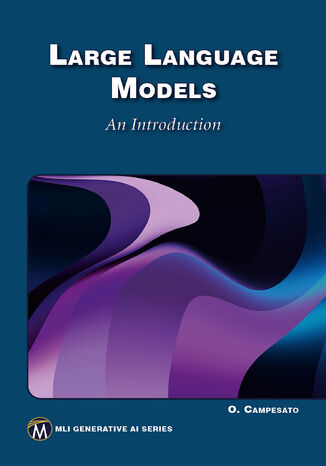
Mercury Learning and Information, Oswald Campesato
This book provides a comprehensive overview of large language models (LLMs) and generative AI, covering foundational principles, advanced concepts, and practical applications. It begins with an introduction to the generative AI landscape, examining key features, popular techniques, and its influence on industries like art, business, and technology. The book also explores prominent models like ChatGPT and GPT-4, detailing their architectures, capabilities, and applications in text generation, code assistance, and conversational AI.Additionally, the book traces the evolution of LLMs, particularly focusing on the BERT family and its wide-ranging applications in natural language processing, translation, and multilingual tasks. Readers will also gain expertise in prompt engineering, learning practical tips and examples to interact more effectively with LLMs.In later chapters, the book tackles advanced topics such as fine-tuning LLMs, working with SVG, and concepts like few-shot learning and reinforcement learning. It concludes with discussions on ethical issues, biases in generative AI, and emerging trends like AI’s integration with IoT, quantum computing, and neuromorphic computing. This guide equips professionals and enthusiasts with a thorough understanding of generative AI's present and future.
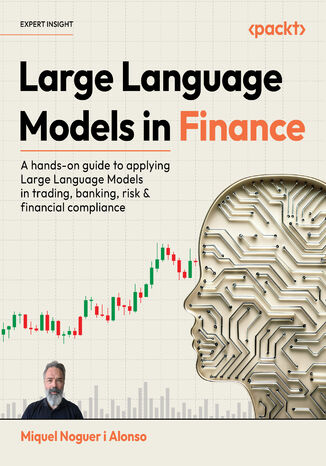
Miquel Noguer i Alonso
Large language models are revolutionizing finance from market analysis to compliance automation but applying them in practice can be challenging. LLMs in Finance is a step-by-step guide that demystifies these powerful models and shows you how to implement them in real financial projects. You'll begin with the fundamentals of how LLMs work, including the transformer architecture, prompt engineering, and fine-tuning for financial data. Next, you'll build applications: intelligent agents for trading; tools for banking tasks like credit scoring and fraud detection; and automated solutions for risk management and regulatory compliance. To deploy these solutions, you'll learn how to scale LLM implementations, from choosing the right hardware to adopting effective cloud strategies. You'll also explore advanced methods to improve model performance, including reinforcement learning for fine-tuning. Finally, learn how to address AI bias and ensure your LLM solutions comply with ethical and regulatory requirements. Real-world case studies illustrate how financial organizations are leveraging LLMs in trading systems, customer service chatbots, and more. By the end of the book, you'll have the expertise to build LLM-powered applications and pick up on trends such as multimodal AI
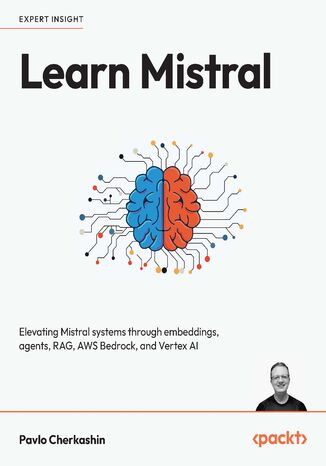
Learn Mistral. Elevating Mistral systems through embeddings, agents, RAG, AWS Bedrock, and Vertex AI
Pavlo Cherkashin
This is a practical, project-driven guide to turning open-source Mistral models into production-ready AI solutions. Through hands-on workshops and use cases, you’ll learn how to build private chat systems, semantic search engines, intelligent agents, coding assistants, and secure deployments that go beyond simple experimentation. The journey begins by exploring where Mistral excels and where human oversight is essential. You’ll then learn to set up a secure, locally hosted chat system with Ollama, customize behavior with system prompts and parameters, and dive deep into embeddings to unlock semantic search with Pinecone. As you progress, you’ll build multi-agent workflows, unpack advanced Retrieval-Augmented Generation pipelines, and integrate Mistral with Codestral to accelerate coding. You'll also learn to apply Mistral to cybersecurity, be challenged with open-ended RAG projects, and be guided through deploying scalable AI on AWS Bedrock and Google Vertex AI.By the end of this book, you will be ready to design and build AI systems that are innovative, compliant, and production-ready.*Email sign-up and proof of purchase required
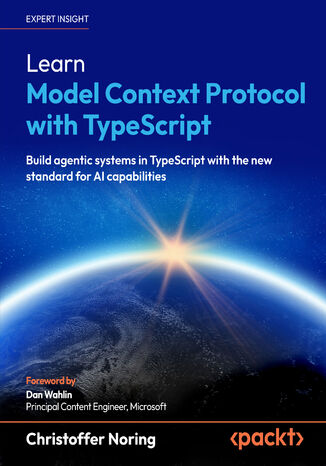
Christoffer Noring, Dan Wahlin
Learn Model Context Protocol with TypeScript introduces developers, architects, and AI practitioners to the transformative capabilities of Model Context Protocol (MCP), an emerging protocol designed to standardize, distribute, and scale AI-driven applications. Through the lens of a practical project, the book tackles the modern challenges of resource management, client-server interaction, and deployment at scale.Drawing from Christoffer's expertise as a published author and tutor at the University of Oxford, you’ll explore the components of MCP and how they streamline server and client development. After that, you’ll progress from building robust backends and integrating LLMs into intelligent clients to interacting with servers via tools such as Claude for desktop and Visual Studio Code agents. The chapters help you understand the capabilities of hosts, clients, and servers, facilitating better interoperability, easier integration, and clearer communication between different components.The book also covers security best practices and building for the cloud, ensuring that you're ready to deploy your MCP-based apps. Each chapter enables you to develop hands-on skills for building and operating MCP-based agentic apps.*Email sign-up and proof of purchase required
Josué R. Batista, Christopher Papile
As the field of generative AI evolves, so does the demand for intelligent systems that can understand human speech. Navigating the complexities of automatic speech recognition (ASR) technology is a significant challenge for many professionals. This book offers a comprehensive solution that guides you through OpenAI's advanced ASR system.You’ll begin your journey with Whisper's foundational concepts, gradually progressing to its sophisticated functionalities. Next, you’ll explore the transformer model, understand its multilingual capabilities, and grasp training techniques using weak supervision. The book helps you customize Whisper for different contexts and optimize its performance for specific needs. You’ll also focus on the vast potential of Whisper in real-world scenarios, including its transcription services, voice-based search, and the ability to enhance customer engagement. Advanced chapters delve into voice synthesis and diarization while addressing ethical considerations.By the end of this book, you'll have an understanding of ASR technology and have the skills to implement Whisper. Moreover, Python coding examples will equip you to apply ASR technologies in your projects as well as prepare you to tackle challenges and seize opportunities in the rapidly evolving world of voice recognition and processing.
Eduardo Sojo
Unlock the full potential of AI with Microsoft Foundry, Microsoft’s unified platform for building, orchestrating, and operating AI solutions at scale. This hands-on guide walks you through the full AI application lifecycle, from data preparation and model selection to deployment, monitoring, and continuous evaluation.Written by Eduardo Sojo, a former Microsoft consultant and current solutions architect at Databricks with over 15 years of experience, the book focuses on practical implementation using the latest Microsoft Foundry portal. You’ll learn to design intelligent workflows, build agents, and apply guardrails to ensure safe, reliable AI behavior in real-world scenarios.Rather than focusing only on models, the book shows how to connect workflows, agents, evaluations, and observability so solutions are not just functional, but production-ready.You’ll explore real-world use cases such as building copilots, integrating external systems like Databricks, and creating multi-agent architectures that work with enterprise data. By the end, you’ll be able to design, build, and operate secure, scalable, intelligent AI solutions using Microsoft Foundry.
David Young
If you are a game developer or a general programmer who wishes to focus on programming systems and techniques to build your game AI without creating low-level interfaces in a game engine, then this book is for you. Knowledge of C++ will come in handy to debug the entirety of the AI sandbox and expand on the features present within the book, but it is not required.
Joe Minichino, Joseph Howse
OpenCV 3 is a state-of-the-art computer vision library that allows a great variety of image and video processing operations. Some of the more spectacular and futuristic features such as face recognition or object tracking are easily achievable with OpenCV 3. Learning the basic concepts behind computer vision algorithms, models, and OpenCV's API will enable the development of all sorts of real-world applications, including security and surveillance.Starting with basic image processing operations, the book will take you through to advanced computer vision concepts. Computer vision is a rapidly evolving science whose applications in the real world are exploding, so this book will appeal to computer vision novices as well as experts of the subject wanting to learn the brand new OpenCV 3.0.0. You will build a theoretical foundation of image processing and video analysis, and progress to the concepts of classification through machine learning, acquiring the technical know-how that will allow you to create and use object detectors and classifiers, and even track objects in movies or video camera feeds. Finally, the journey will end in the world of artificial neural networks, along with the development of a hand-written digits recognition application.