
Python
W kategorii Python zostały zebrane podręczniki poruszające tematykę programowania z zastosowaniem praktycznie niezależnego sprzętowo, dostępnego na licencji Open Source języka. Książki przedstawią Wam wszechstronności i elastyczności Pythona a także różne typy tworzenia kodu poprzez programowanie strukturalne, obiektowe czy funkcjonalne.
Nauczycie się tworzyć aplikacje sieciowe o dowolnym przeznaczeniu, komunikujące się z systemami operacyjnymi, lub korzystające z baz danych. Techniki analizy składni, przetwarzanie tekstu czy rozłożenie obciążenia programu na wiele wątków i procesów przestanie być problematyczne.
Alberto Fernández Villán
OpenCV is considered to be one of the best open source computer vision and machine learning software libraries. It helps developers build complete projects in relation to image processing, motion detection, or image segmentation, among many others. OpenCV for Python enables you to run computer vision algorithms smoothly in real time, combining the best of the OpenCV C++ API and the Python language.In this book, you'll get started by setting up OpenCV and delving into the key concepts of computer vision. You'll then proceed to study more advanced concepts and discover the full potential of OpenCV. The book will also introduce you to the creation of advanced applications using Python and OpenCV, enabling you to develop applications that include facial recognition, target tracking, or augmented reality. Next, you'll learn machine learning techniques and concepts, understand how to apply them in real-world examples, and also explore their benefits, including real-time data production and faster data processing. You'll also discover how to translate the functionality provided by OpenCV into optimized application code projects using Python bindings. Toward the concluding chapters, you'll explore the application of artificial intelligence and deep learning techniques using the popular Python libraries TensorFlow, and Keras.By the end of this book, you'll be able to develop advanced computer vision applications to meet your customers' demands.
Ashish Kumar
pandas is a popular Python library used by data scientists and analysts worldwide to manipulate and analyze their data. This book presents useful data manipulation techniques in pandas to perform complex data analysis in various domains.An update to our highly successful previous edition with new features, examples, updated code, and more, this book is an in-depth guide to get the most out of pandas for data analysis. Designed for both intermediate users as well as seasoned practitioners, you will learn advanced data manipulation techniques, such as multi-indexing, modifying data structures, and sampling your data, which allow for powerful analysis and help you gain accurate insights from it. With the help of this book, you will apply pandas to different domains, such as Bayesian statistics, predictive analytics, and time series analysis using an example-based approach. And not just that; you will also learn how to prepare powerful, interactive business reports in pandas using the Jupyter notebook.By the end of this book, you will learn how to perform efficient data analysis using pandas on complex data, and become an expert data analyst or data scientist in the process.
Rui Miguel Forte
This book is intended for the budding data scientist, predictive modeler, or quantitative analyst with only a basic exposure to R and statistics. It is also designed to be a reference for experienced professionals wanting to brush up on the details of a particular type of predictive model. Mastering Predictive Analytics with R assumes familiarity with only the fundamentals of R, such as the main data types, simple functions, and how to move data around. No prior experience with machine learning or predictive modeling is assumed, however you should have a basic understanding of statistics and calculus at a high school level.
Mastering PyCharm. Use PyCharm with fluid efficiency to write idiomatic python code
Nafiul Islam
PyCharm is addictive, with powerful and configurable code completion, superb editing tools, top-notch support, diverse plugins, and a vibrant ecosystem to boot. Learning how PyCharm works and maximising the synergy of its powerful tools will help you to rapidly develop applications.From leveraging the power of the editor to understanding PyCharm's internals, this book will give you a comprehensive view of PyCharm and allow you to make your own choices about which workflow and tools are best for you.You will start by getting comfortable with PyCharm and making it look exactly like you want. You can customize the tools and taskbars to suit individual developers' coding styles. You also learn how to assign keyboard shortcuts. You will master debugging by inserting breakpoints, collecting runtime data, and debugging from the console. You will understand how PyCharm works underneath and how plugins such as Codemap, Vim, Bitbucket, Assets compressor, markdown, bash file, shortcut translator, and .gitignore leverage the power of the IntelliJ platform.You will become comfortable using the VCS interface in PyCharm and see the benefits of using it for some simple tasks as well as some more complex tasks such as partial commits using changelists.You will take an in-depth look at the various tools in PyCharm, improving your workflow drastically. Finally, you will deploy powerful PyCharm tools for Django, Flask, GAE, and Pyramid Development, becoming well acquainted with PyCharm’s toolset for web development with popular platforms.Packed with insider tricks, this book will help you boost productivity with PyCharm.
Rick Hattem
Even if you find writing Python code easy, writing code that is efficient, maintainable, and reusable is not so straightforward. Many of Python’s capabilities are underutilized even by more experienced programmers. Mastering Python, Second Edition, is an authoritative guide to understanding advanced Python programming so you can write the highest quality code. This new edition has been extensively revised and updated with exercises, four new chapters and updates up to Python 3.10.Revisit important basics, including Pythonic style and syntax and functional programming. Avoid common mistakes made by programmers of all experience levels. Make smart decisions about the best testing and debugging tools to use, optimize your code’s performance across multiple machines and Python versions, and deploy often-forgotten Python features to your advantage. Get fully up to speed with asyncio and stretch the language even further by accessing C functions with simple Python calls. Finally, turn your new-and-improved code into packages and share them with the wider Python community.If you are a Python programmer wanting to improve your code quality and readability, this Python book will make you confident in writing high-quality scripts and taking on bigger challenges
Kamon Ayeva, Sakis Kasampalis
Python is an object-oriented scripting language that is used in a wide range of categories. In software engineering, a design pattern is an elected solution for solving software design problems. Although they have been around for a while, design patterns remain one of the top topics in software engineering, and are a ready source for software developers to solve the problems they face on a regular basis. This book takes you through a variety of design patterns and explains them with real-world examples. You will get to grips with low-level details and concepts that show you how to write Python code, without focusing on common solutions as enabled in Java and C++. You'll also fnd sections on corrections, best practices, system architecture, and its designing aspects. This book will help you learn the core concepts of design patterns and the way they can be used to resolve software design problems. You'll focus on most of the Gang of Four (GoF) design patterns, which are used to solve everyday problems, and take your skills to the next level with reactive and functional patterns that help you build resilient, scalable, and robust applications. By the end of the book, you'll be able to effciently address commonly faced problems and develop applications, and also be comfortable working on scalable and maintainable projects of any size.
Kamon Ayeva, Sakis Kasampalis
As software systems become increasingly complex, maintaining code quality, scalability, and efficiency can be a daunting challenge. Mastering Python Design Patterns is an essential resource that equips you with the tools you need to overcome these hurdles and create robust, scalable applications.The book delves into design principles and patterns in Python, covering both classic and modern patterns, and apply them to solve daily challenges as a Python developer or architect.Co-authored by two Python experts with a combined experience of three decades, this new edition covers creational, structural, behavioral, and architectural patterns, including concurrency, asynchronous, and performance patterns. You'll find out how these patterns are relevant to various domains, such as event handling, concurrency, distributed systems, and testing. Whether you're working on user interfaces (UIs), web apps, APIs, data pipelines, or AI models, this book equips you with the knowledge to build robust and maintainable software. The book also presents Python anti-patterns, helping you avoid common pitfalls and ensuring your code remains clean and efficient.By the end of this book, you'll be able to confidently apply classic and modern Python design patterns to build robust, scalable applications.
Sakis Kasampalis
This book is for Python programmers with an intermediate background and an interest in design patterns implemented in idiomatic Python. Programmers of other languages who are interested in Python can also benefit from this book, but it would be better if they first read some introductory materials that explain how things are done in Python.
Samir Madhavan
Data science is a relatively new knowledge domain which is used by various organizations to make data driven decisions. Data scientists have to wear various hats to work with data and to derive value from it. The Python programming language, beyond having conquered the scientific community in the last decade, is now an indispensable tool for the data science practitioner and a must-know tool for every aspiring data scientist. Using Python will offer you a fast, reliable, cross-platform, and mature environment for data analysis, machine learning, and algorithmic problem solving.This comprehensive guide helps you move beyond the hype and transcend the theory by providing you with a hands-on, advanced study of data science.Beginning with the essentials of Python in data science, you will learn to manage data and perform linear algebra in Python. You will move on to deriving inferences from the analysis by performing inferential statistics, and mining data to reveal hidden patterns and trends. You will use the matplot library to create high-end visualizations in Python and uncover the fundamentals of machine learning. Next, you will apply the linear regression technique and also learn to apply the logistic regression technique to your applications, before creating recommendation engines with various collaborative filtering algorithms and improving your predictions by applying the ensemble methods.Finally, you will perform K-means clustering, along with an analysis of unstructured data with different text mining techniques and leveraging the power of Python in big data analytics.
James Ma Weiming
The second edition of Mastering Python for Finance will guide you through carrying out complex financial calculations practiced in the industry of finance by using next-generation methodologies. You will master the Python ecosystem by leveraging publicly available tools to successfully perform research studies and modeling, and learn to manage risks with the help of advanced examples.You will start by setting up your Jupyter notebook to implement the tasks throughout the book. You will learn to make efficient and powerful data-driven financial decisions using popular libraries such as TensorFlow, Keras, Numpy, SciPy, and scikit-learn. You will also learn how to build financial applications by mastering concepts such as stocks, options, interest rates and their derivatives, and risk analytics using computational methods. With these foundations, you will learn to apply statistical analysis to time series data, and understand how time series data is useful for implementing an event-driven backtesting system and for working with high-frequency data in building an algorithmic trading platform. Finally, you will explore machine learning and deep learning techniques that are applied in finance.By the end of this book, you will be able to apply Python to different paradigms in the financial industry and perform efficient data analysis.
James Ma Weiming
If you are an undergraduate or graduate student, a beginner to algorithmic development and research, or a software developer in the financial industry who is interested in using Python for quantitative methods in finance, this is the book for you. It would be helpful to have a bit of familiarity with basic Python usage, but no prior experience is required.
José Manuel Ortega
It’s becoming more and more apparent that security is a critical aspect of IT infrastructure. A data breach is a major security incident, usually carried out by just hacking a simple network line. Increasing your network’s security helps step up your defenses against cyber attacks. Meanwhile, Python is being used for increasingly advanced tasks, with the latest update introducing many new packages. This book focuses on leveraging these updated packages to build a secure network with the help of Python scripting. This book covers topics from building a network to the different procedures you need to follow to secure it. You’ll first be introduced to different packages and libraries, before moving on to different ways to build a network with the help of Python scripting. Later, you will learn how to check a network’s vulnerability using Python security scripting, and understand how to check vulnerabilities in your network. As you progress through the chapters, you will also learn how to achieve endpoint protection by leveraging Python packages along with writing forensic scripts. By the end of this book, you will be able to get the most out of the Python language to build secure and robust networks that are resilient to attacks.
José Manuel Ortega
It’s now more apparent than ever that security is a critical aspect of IT infrastructure, and that devastating data breaches can occur from simple network line hacks. As shown in this book, combining the latest version of Python with an increased focus on network security can help you to level up your defenses against cyber attacks and cyber threats.Python is being used for increasingly advanced tasks, with the latest update introducing new libraries and packages featured in the Python 3.7.4 recommended version. Moreover, most scripts are compatible with the latest versions of Python and can also be executed in a virtual environment.This book will guide you through using these updated packages to build a secure network with the help of Python scripting. You’ll cover a range of topics, from building a network to the procedures you need to follow to secure it. Starting by exploring different packages and libraries, you’ll learn about various ways to build a network and connect with the Tor network through Python scripting. You will also learn how to assess a network's vulnerabilities using Python security scripting. Later, you’ll learn how to achieve endpoint protection by leveraging Python packages, along with writing forensic scripts.By the end of this Python book, you’ll be able to use Python to build secure apps using cryptography and steganography techniques.
Fernando Donglio
Simply knowing how to code is not enough; on mission-critical pieces of code, every bit of memory and every CPU cycle counts, and knowing how to squish every bit of processing power out of your code is a crucial and sought-after skill. Nowadays, Python is used for many scientific projects, and sometimes the calculations done in those projects require some serious fine-tuning. Profilers are tools designed to help you measure the performance of your code and help you during the optimization process, so knowing how to use them and read their output is very handy.This book starts from the basics and progressively moves on to more advanced topics. You’ll learn everything from profiling all the way up to writing a real-life application and applying a full set of tools designed to improve it in different ways. In the middle, you’ll stop to learn about the major profilers used in Python and about some graphic tools to help you make sense of their output. You’ll then move from generic optimization techniques onto Python-specific ones, going over the main constructs of the language that will help you improve your speed without much of a change. Finally, the book covers some number-crunching-specific libraries and how to use them properly to get the best speed out of them.After reading this book, you will know how to take any Python code, profile it, find out where the bottlenecks are, and apply different techniques to remove them.
Eric Chou
This book begins with a review of the TCP/ IP protocol suite and a refresher of the core elements of the Python language. Next, you will start using Python and supported libraries to automate network tasks from the current major network vendors. We will look at automating traditional network devices based on the command-line interface, as well as newer devices with API support, with hands-on labs. We will then learn the concepts and practical use cases of the Ansible framework in order to achieve your network goals.We will then move on to using Python for DevOps, starting with using open source tools to test, secure, and analyze your network. Then, we will focus on network monitoring and visualization. We will learn how to retrieve network information using a polling mechanism, ?ow-based monitoring, and visualizing the data programmatically. Next, we will learn how to use the Python framework to build your own customized network web services.In the last module, you will use Python for SDN, where you will use a Python-based controller with OpenFlow in a hands-on lab to learn its concepts and applications. We will compare and contrast OpenFlow, OpenStack, OpenDaylight, and NFV. Finally, you will use everything you’ve learned in the book to construct a migration plan to go from a legacy to a scalable SDN-based network.
Eric Chou
Networks in your infrastructure set the foundation for how your application can be deployed, maintained, and serviced. Python is the ideal language for network engineers to explore tools that were previously available to systems engineers and application developers. In this second edition of Mastering Python Networking, you’ll embark on a Python-based journey to transition from traditional network engineers to network developers ready for the next-generation of networks. This book begins by reviewing the basics of Python and teaches you how Python can interact with both legacy and API-enabled network devices. As you make your way through the chapters, you will then learn to leverage high-level Python packages and frameworks to perform network engineering tasks for automation, monitoring, management, and enhanced security. In the concluding chapters, you will use Jenkins for continuous network integration as well as testing tools to verify your network. By the end of this book, you will be able to perform all networking tasks with ease using Python.
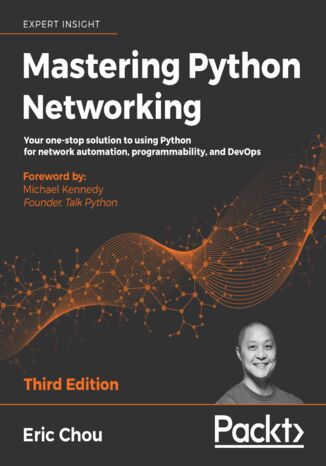
Eric Chou
Networks in your infrastructure set the foundation for how your application can be deployed, maintained, and serviced. Python is the ideal language for network engineers to explore tools that were previously available to systems engineers and application developers. In Mastering Python Networking, Third edition, you’ll embark on a Python-based journey to transition from traditional network engineers to network developers ready for the next-generation of networks.This new edition is completely revised and updated to work with Python 3. In addition to new chapters on network data analysis with ELK stack (Elasticsearch, Logstash, Kibana, and Beats) and Azure Cloud Networking, it includes updates on using newer libraries such as pyATS and Nornir, as well as Ansible 2.8. Each chapter is updated with the latest libraries with working examples to ensure compatibility and understanding of the concepts.Starting with a basic overview of Python, the book teaches you how it can interact with both legacy and API-enabled network devices. You will learn to leverage high-level Python packages and frameworks to perform network automation tasks, monitoring, management, and enhanced network security followed by Azure and AWS Cloud networking. Finally, you will use Jenkins for continuous integration as well as testing tools to verify your network.
Ganesh Sanjiv Naik
Python has evolved over time and extended its features in relation to every possible IT operation. Python is simple to learn, yet has powerful libraries that can be used to build powerful Python scripts for solving real-world problems and automating administrators' routine activities. The objective of this book is to walk through a series of projects that will teach readers Python scripting with each project.This book will initially cover Python installation and quickly revise basic to advanced programming fundamentals. The book will then focus on the development process as a whole, from setup to planning to building different tools. It will include IT administrators' routine activities (text processing, regular expressions, file archiving, and encryption), network administration (socket programming, email handling, the remote controlling of devices using telnet/ssh, and protocols such as SNMP/DHCP), building graphical user interface, working with websites (Apache log file processing, SOAP and REST APIs communication, and web scraping), and database administration (MySQL and similar database data administration, data analytics, and reporting).By the end of this book, you will be able to use the latest features of Python and be able to build powerful tools that will solve challenging, real-world tasks
Mastering PyTorch. Build powerful neural network architectures using advanced PyTorch 1.x features
Ashish Ranjan Jha
Deep learning is driving the AI revolution, and PyTorch is making it easier than ever before for anyone to build deep learning applications. This PyTorch book will help you uncover expert techniques to get the most out of your data and build complex neural network models.The book starts with a quick overview of PyTorch and explores using convolutional neural network (CNN) architectures for image classification. You'll then work with recurrent neural network (RNN) architectures and transformers for sentiment analysis. As you advance, you'll apply deep learning across different domains, such as music, text, and image generation using generative models and explore the world of generative adversarial networks (GANs). You'll not only build and train your own deep reinforcement learning models in PyTorch but also deploy PyTorch models to production using expert tips and techniques. Finally, you'll get to grips with training large models efficiently in a distributed manner, searching neural architectures effectively with AutoML, and rapidly prototyping models using PyTorch and fast.ai.By the end of this PyTorch book, you'll be able to perform complex deep learning tasks using PyTorch to build smart artificial intelligence models.
Ashish Ranjan Jha
PyTorch is making it easier than ever before for anyone to build deep learning applications. This PyTorch deep learning book will help you uncover expert techniques to get the most out of your data and build complex neural network models.You’ll build convolutional neural networks for image classification and recurrent neural networks and transformers for sentiment analysis. As you advance, you'll apply deep learning across different domains, such as music, text, and image generation, using generative models, including diffusion models. You'll not only build and train your own deep reinforcement learning models in PyTorch but also learn to optimize model training using multiple CPUs, GPUs, and mixed-precision training. You’ll deploy PyTorch models to production, including mobile devices. Finally, you’ll discover the PyTorch ecosystem and its rich set of libraries. These libraries will add another set of tools to your deep learning toolbelt, teaching you how to use fastai to prototype models and PyTorch Lightning to train models. You’ll discover libraries for AutoML and explainable AI (XAI), create recommendation systems, and build language and vision transformers with Hugging Face.By the end of this book, you'll be able to perform complex deep learning tasks using PyTorch to build smart artificial intelligence models.
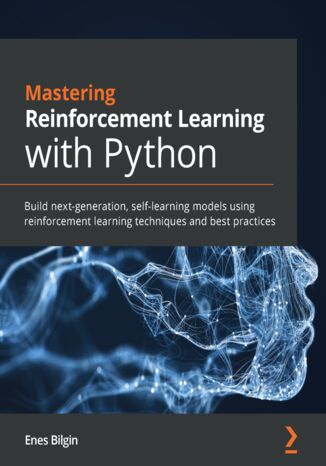
Enes Bilgin
Reinforcement learning (RL) is a field of artificial intelligence (AI) used for creating self-learning autonomous agents. Building on a strong theoretical foundation, this book takes a practical approach and uses examples inspired by real-world industry problems to teach you about state-of-the-art RL.Starting with bandit problems, Markov decision processes, and dynamic programming, the book provides an in-depth review of the classical RL techniques, such as Monte Carlo methods and temporal-difference learning. After that, you will learn about deep Q-learning, policy gradient algorithms, actor-critic methods, model-based methods, and multi-agent reinforcement learning. Then, you'll be introduced to some of the key approaches behind the most successful RL implementations, such as domain randomization and curiosity-driven learning.As you advance, you’ll explore many novel algorithms with advanced implementations using modern Python libraries such as TensorFlow and Ray’s RLlib package. You’ll also find out how to implement RL in areas such as robotics, supply chain management, marketing, finance, smart cities, and cybersecurity while assessing the trade-offs between different approaches and avoiding common pitfalls.By the end of this book, you’ll have mastered how to train and deploy your own RL agents for solving RL problems.
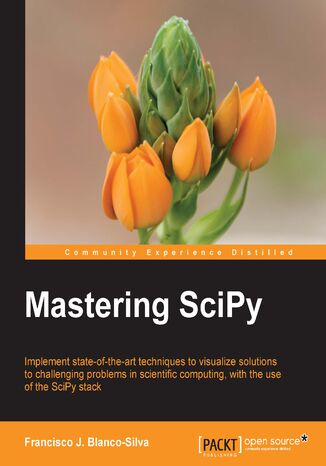
Francisco Javier Blanco-Silva, Francisco Javier B Silva
The SciPy stack is a collection of open source libraries of the powerful scripting language Python, together with its interactive shells. This environment offers a cutting-edge platform for numerical computation, programming, visualization and publishing, and is used by some of the world’s leading mathematicians, scientists, and engineers. It works on any operating system that supports Python and is very easy to install, and completely free of charge! It can effectively transform into a data-processing and system-prototyping environment, directly rivalling MATLAB and Octave.This book goes beyond a mere description of the different built-in functions coded in the libraries from the SciPy stack. It presents you with a solid mathematical and computational background to help you identify the right tools for each problem in scientific computing and visualization. You will gain an insight into the best practices with numerical methods depending on the amount or type of data, properties of the mathematical tools employed, or computer architecture, among other factors.The book kicks off with a concise exploration of the basics of numerical linear algebra and graph theory for the treatment of problems that handle large data sets or matrices. In the subsequent chapters, you will delve into the depths of algorithms in symbolic algebra and numerical analysis to address modeling/simulation of various real-world problems with functions (through interpolation, approximation, or creation of systems of differential equations), and extract their representing features (zeros, extrema, integration or differentiation).Lastly, you will move on to advanced concepts of data analysis, image/signal processing, and computational geometry.
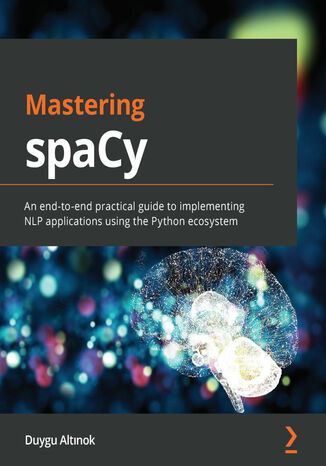
Duygu Altinok
spaCy is an industrial-grade, efficient NLP Python library. It offers various pre-trained models and ready-to-use features. Mastering spaCy provides you with end-to-end coverage of spaCy's features and real-world applications.You'll begin by installing spaCy and downloading models, before progressing to spaCy's features and prototyping real-world NLP apps. Next, you'll get familiar with visualizing with spaCy's popular visualizer displaCy. The book also equips you with practical illustrations for pattern matching and helps you advance into the world of semantics with word vectors. Statistical information extraction methods are also explained in detail. Later, you'll cover an interactive business case study that shows you how to combine all spaCy features for creating a real-world NLP pipeline. You'll implement ML models such as sentiment analysis, intent recognition, and context resolution. The book further focuses on classification with popular frameworks such as TensorFlow's Keras API together with spaCy. You'll cover popular topics, including intent classification and sentiment analysis, and use them on popular datasets and interpret the classification results.By the end of this book, you'll be able to confidently use spaCy, including its linguistic features, word vectors, and classifiers, to create your own NLP apps.
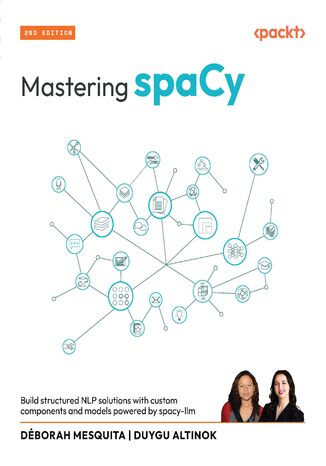
Déborah Mesquita, Duygu Altinok
Mastering spaCy, Second Edition is your comprehensive guide to building sophisticated NLP applications using the spaCy ecosystem. This revised edition builds on the expertise of Duygu Altinok, a seasoned NLP engineer and spaCy contributor, and introduces new chapters by Déborah Mesquita, a data science educator and consultant known for making complex concepts accessible.This edition embraces the latest advancements in NLP, featuring chapters on large language models with spacy-llm, transformer integration, and end-to-end workflow management with Weasel.You’ll learn how to enhance NLP tasks using LLMs, streamline workflows using Weasel, and integrate spaCy with third-party libraries like Streamlit, FastAPI, and DVC. From training custom Named Entity Recognition (NER) pipelines to categorizing emotions in Reddit posts, this book covers advanced topics such as text classification and coreference resolution. Starting with the fundamentals—tokenization, NER, and dependency parsing—you’ll explore more advanced topics like creating custom components, training domain-specific models, and building scalable NLP workflows.Through practical examples, clear explanations, tips, and tricks, this book will equip you to build robust NLP pipelines and seamlessly integrate them into web applications for end-to-end solutions.