
Python
W kategorii Python zostały zebrane podręczniki poruszające tematykę programowania z zastosowaniem praktycznie niezależnego sprzętowo, dostępnego na licencji Open Source języka. Książki przedstawią Wam wszechstronności i elastyczności Pythona a także różne typy tworzenia kodu poprzez programowanie strukturalne, obiektowe czy funkcjonalne.
Nauczycie się tworzyć aplikacje sieciowe o dowolnym przeznaczeniu, komunikujące się z systemami operacyjnymi, lub korzystające z baz danych. Techniki analizy składni, przetwarzanie tekstu czy rozłożenie obciążenia programu na wiele wątków i procesów przestanie być problematyczne.
Data Wrangling with Python. Creating actionable data from raw sources
Dr. Tirthajyoti Sarkar , Shubhadeep Roychowdhury
For data to be useful and meaningful, it must be curated and refined. Data Wrangling with Python teaches you the core ideas behind these processes and equips you with knowledge of the most popular tools and techniques in the domain.The book starts with the absolute basics of Python, focusing mainly on data structures. It then delves into the fundamental tools of data wrangling like NumPy and Pandas libraries. You'll explore useful insights into why you should stay away from traditional ways of data cleaning, as done in other languages, and take advantage of the specialized pre-built routines in Python. This combination of Python tips and tricks will also demonstrate how to use the same Python backend and extract/transform data from an array of sources including the Internet, large database vaults, and Excel financial tables. To help you prepare for more challenging scenarios, you'll cover how to handle missing or wrong data, and reformat it based on the requirements from the downstream analytics tool. The book will further help you grasp concepts through real-world examples and datasets.By the end of this book, you will be confident in using a diverse array of sources to extract, clean, transform, and format your data efficiently.
Saba Shah, Rod Waltermann
Spark has become a de facto standard for big data processing. Migrating data processing to Spark saves resources, streamlines your business focus, and modernizes workloads, creating new business opportunities through Spark’s advanced capabilities. Written by a senior solutions architect at Databricks, with experience in leading data science and data engineering teams in Fortune 500s as well as startups, this book is your exhaustive guide to achieving the Databricks Certified Associate Developer for Apache Spark certification on your first attempt.You’ll explore the core components of Apache Spark, its architecture, and its optimization, while familiarizing yourself with the Spark DataFrame API and its components needed for data manipulation. You’ll also find out what Spark streaming is and why it’s important for modern data stacks, before learning about machine learning in Spark and its different use cases. What’s more, you’ll discover sample questions at the end of each section along with two mock exams to help you prepare for the certification exam.By the end of this book, you’ll know what to expect in the exam and gain enough understanding of Spark and its tools to pass the exam. You’ll also be able to apply this knowledge in a real-world setting and take your skillset to the next level.
Cuantum Technologies LLC
Dive into the world of deep learning with this comprehensive guide that bridges theory and practice. From foundational neural networks to advanced architectures like CNNs, RNNs, and Transformers, this book equips you with the tools to build, train, and optimize AI models using TensorFlow, Keras, and PyTorch. Clear explanations of key concepts such as gradient descent, loss functions, and backpropagation are combined with hands-on exercises to ensure practical understanding.Explore cutting-edge AI frameworks, including generative adversarial networks (GANs) and autoencoders, while mastering real-world applications like image classification, text generation, and natural language processing. Detailed chapters cover transfer learning, fine-tuning pretrained models, and deployment strategies for cloud and edge computing. Practical exercises and projects further solidify your skills as you implement AI solutions for diverse challenges.Whether you're deploying AI models on cloud platforms like AWS or optimizing them for edge devices with TensorFlow Lite, this book provides step-by-step guidance. Designed for developers, AI enthusiasts, and data scientists, it balances theoretical depth with actionable insights, making it the ultimate resource for mastering modern deep learning frameworks and advancing your career in AI
Ahmed Menshawy
Deep learning is a popular subset of machine learning, and it allows you to build complex models that are faster and give more accurate predictions. This book is your companion to take your first steps into the world of deep learning, with hands-on examples to boost your understanding of the topic.This book starts with a quick overview of the essential concepts of data science and machine learning which are required to get started with deep learning. It introduces you to Tensorflow, the most widely used machine learning library for training deep learning models. You will then work on your first deep learning problem by training a deep feed-forward neural network for digit classification, and move on to tackle other real-world problems in computer vision, language processing, sentiment analysis, and more. Advanced deep learning models such as generative adversarial networks and their applications are also covered in this book.By the end of this book, you will have a solid understanding of all the essential concepts in deep learning. With the help of the examples and code provided in this book, you will be equipped to train your own deep learning models with more confidence.
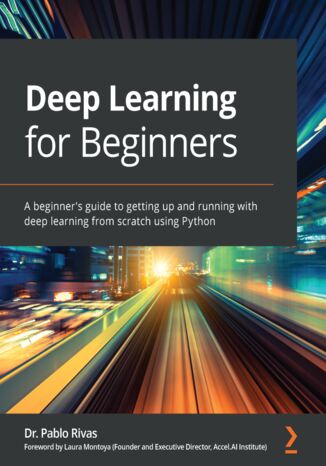
Dr. Pablo Rivas
With information on the web exponentially increasing, it has become more difficult than ever to navigate through everything to find reliable content that will help you get started with deep learning. This book is designed to help you if you're a beginner looking to work on deep learning and build deep learning models from scratch, and you already have the basic mathematical and programming knowledge required to get started.The book begins with a basic overview of machine learning, guiding you through setting up popular Python frameworks. You will also understand how to prepare data by cleaning and preprocessing it for deep learning, and gradually go on to explore neural networks. A dedicated section will give you insights into the working of neural networks by helping you get hands-on with training single and multiple layers of neurons. Later, you will cover popular neural network architectures such as CNNs, RNNs, AEs, VAEs, and GANs with the help of simple examples, and learn how to build models from scratch. At the end of each chapter, you will find a question and answer section to help you test what you've learned through the course of the book.By the end of this book, you'll be well-versed with deep learning concepts and have the knowledge you need to use specific algorithms with various tools for different tasks.
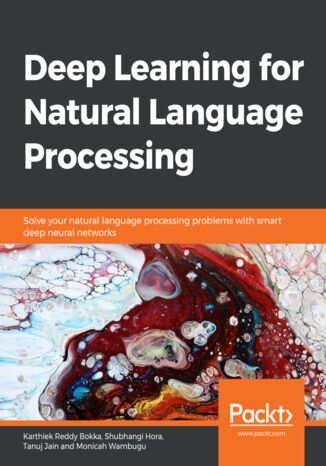
Karthiek Reddy Bokka, Shubhangi Hora , Tanuj...
Applying deep learning approaches to various NLP tasks can take your computational algorithms to a completely new level in terms of speed and accuracy. Deep Learning for Natural Language Processing starts by highlighting the basic building blocks of the natural language processing domain.The book goes on to introduce the problems that you can solve using state-of-the-art neural network models. After this, delving into the various neural network architectures and their specific areas of application will help you to understand how to select the best model to suit your needs. As you advance through this deep learning book, you’ll study convolutional, recurrent, and recursive neural networks, in addition to covering long short-term memory networks (LSTM). Understanding these networks will help you to implement their models using Keras. In later chapters, you will be able to develop a trigger word detection application using NLP techniques such as attention model and beam search.By the end of this book, you will not only have sound knowledge of natural language processing, but also be able to select the best text preprocessing and neural network models to solve a number of NLP issues.
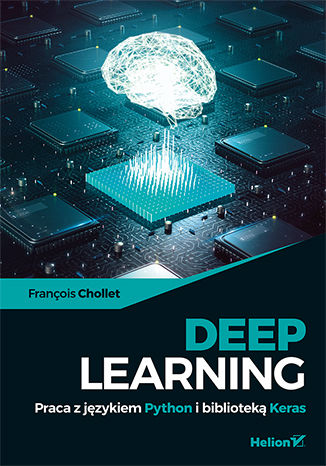
Deep Learning. Praca z językiem Python i biblioteką Keras
Francois Chollet
W skrócie uczenie maszynowe polega na wyodrębnianiu informacji z surowych danych i budowie modelu, który służy do przetwarzania kolejnych surowych danych. Technologia ta od kilku lat intensywnie się rozwija, a w miarę wzrostu jej możliwości rosną również zainteresowanie i oczekiwania architektów i użytkowników. Niektórzy widzą w głębokim uczeniu poważne zagrożenie, jednak obietnice, jakie daje ten rodzaj sztucznej inteligencji, są fascynujące. Narzędzia służące do programowania uczenia maszynowego, takie jak zaimplementowana w Pythonie biblioteka Keras, są dostępne dla każdego, kto chce wykorzystać tę technologię do własnych celów. Niniejsza książka jest praktycznym przewodnikiem po uczeniu głębokim. Znalazły się tu dokładne informacje o istocie uczenia głębokiego, o jego zastosowaniach i ograniczeniach. Wyjaśniono zasady rozwiązywania typowych problemów uczenia maszynowego. Pokazano, jak korzystać z pakietu Keras przy implementacji rozpoznawania obrazu, przetwarzania języka naturalnego, klasyfikacji obrazów, przewidywania danych szeregu czasowego, analizy sentymentu, generowania tekstu i obrazu. Nawet dość skomplikowane zagadnienia, włączając w to koncepcje i dobre praktyki, zostały wyjaśnione w sposób bardzo przystępny i zrozumiały, tak aby umożliwić samodzielne stosowanie technik uczenia głębokiego w kolejnych projektach. W tej książce między innymi: kontekst i ogólne koncepcje sztucznej inteligencji, uczenia maszynowego i uczenia głębokiego sieci neuronowe i pakiet Keras typowe sposoby pracy nad projektami uczenia głębokiego rozbudowane modele uczenia głębokiego oraz modele generatywne perspektywy i ograniczenia technologii Uczenie głębokie. Nikt nie zna granic tej technologii!
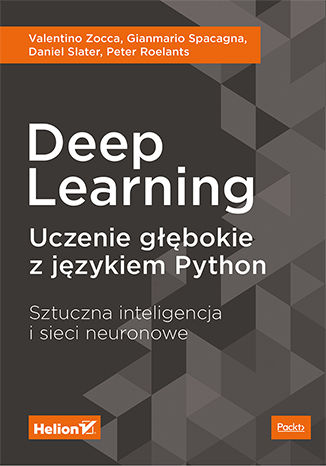
Deep Learning. Uczenie głębokie z językiem Python. Sztuczna inteligencja i sieci neuronowe
Valentino Zocca, Gianmario Spacagna, Daniel Slater, Peter...
Na naszych oczach dokonuje się przełom: technologie wykorzystujące rozmaite formy sztucznej inteligencji zaczynają się pojawiać w różnych branżach. Niektórzy nawet nie zdają sobie sprawy, jak często i jak powszechnie stosuje się algorytmy uczenia głębokiego. Możliwości w tym zakresie stale rosną. Wzrasta też zapotrzebowanie na inżynierów, którzy swobodnie operują wiedzą o uczeniu głębokim i są w stanie zaimplementować potrzebne algorytmy w konkretnym oprogramowaniu. Uczenie głębokie jest jednak dość złożonym zagadnieniem, a przyswojenie sobie potrzebnych umiejętności wymaga wysiłku. Ta książka stanowi doskonałe wprowadzenie w temat uczenia głębokiego. Wyjaśniono tu najważniejsze pojęcia uczenia maszynowego. Pokazano, do czego mogą się przydać takie narzędzia jak pakiet scikit-learn, biblioteki Theano, Keras czy TensorFlow. Ten praktyczny przewodnik znakomicie ułatwi zrozumienie zagadnień rozpoznawania wzorców, dokładnego skalowania danych, pozwoli też na rzetelne zapoznanie się z algorytmami i technikami uczenia głębokiego. Autorzy zaproponowali wykorzystanie w powyższych celach języka Python - ulubionego narzędzia wielu badaczy i pasjonatów nauki. W książce między innymi: Solidne podstawy uczenia maszynowego i sieci neuronowych Trening systemów sztucznej inteligencji w grach komputerowych Rozpoznawanie obrazów Rekurencyjne sieci neuronowej w modelowaniu języka Budowa systemów wykrywania oszustw i włamań Uczenie głębokie: zajrzyj w przyszłość programowania! Dr Valentino Zokka opracował wiele algorytmów matematycznych i modeli prognostycznych dla firmy Boeing. Obecnie jest konsultantem w branży finansowej. Gianmario Spacagna pracuje w firmie Pirelli, gdzie buduje systemy maszynowego uczenia się i kompletne rozwiązania do produktów informacyjnych. Daniel Slater tworzył oprogramowanie do oceny ryzyka dla branży finansowej. Obecnie zajmuje się systemami do przetwarzania dużych ilości danych i analizy zachowań użytkowników. Peter Roelants specjalizuje się w stosowaniu technik uczenia głębokiego do badań spektralnych obrazów, rozpoznawania mowy czy ekstrakcji danych z dokumentów.